
How to Find Leads for Managed IT Service Providers (MSPs) Without Spray-and-Pray Outreach
LinkedoJet helps MSPs spot real IT change, security, and compliance signals, build Sales Navigator target lists, and run a repeatable prospect intelligence workflow that produces better-fit MRR discovery calls.
- Sales Navigator filters + account qualification
- Buying & hiring signal detection
- Persona-based messaging angles for IT/Ops/Finance
When your calendar is full of “MSP curiosity calls” that go nowhere, the problem usually isn’t activity. It’s the silent tax of bad fit: hours lost in demos, follow-ups that never convert, and the slow reputational damage of sounding like every other provider in the inbox.
You feel it on the delivery side, too. Techs are already at capacity. Security work keeps creeping into scope. Yet outbound keeps pulling you into conversations with companies that either already have an MSP they won’t fire, have a capable internal team, or are only shopping on price.
Why MSP outbound fails: bad lists, wrong titles, and zero signal
Most MSP outbound looks “busy” because it’s built to produce motion, not conversion. Reps pull a generic list of “IT decision makers,” blast a safe pitch (“we handle IT support + security”), and hope volume makes up for relevance.
It doesn’t. LinkedIn is noisier, buyers are trained to ignore templates, and SMB/mid-market IT is being dragged into security and compliance whether they asked for it or not. Timing and context now decide who replies and who ghosts.
- Generic lists: You’re emailing and connecting with companies that don’t have the maturity gap, the Microsoft footprint, or the operational complexity that makes an MSP retainer stick.
- Wrong titles: Blasting CEOs/Founders in a 150-person manufacturing firm often gets you polite deflection. The pain lives with the IT lead (or Ops) who’s absorbing incidents, audits, onboarding, and vendor chaos.
- RFP gravity: If your first real signal is “we’re comparing three MSPs,” you’ve arrived late and you’re now competing on price and promises.
- Unqualified demos: Companies with 10+ internal IT staff (for 200–500 headcount) or a happy incumbent MSP are rarely a quick win unless you’re positioned for co-managed or a specific security motion.
The hidden failure is treating Sales Navigator like a list builder instead of a prospect intelligence system. Fit (who), pain (which persona), and live intent (why now) have to triangulate. Without that, outreach is guessing—and guessing creates unqualified demos.
Define your best-fit MSP accounts + offers (and a clear “not a fit”)
“20–500 employees” is not a market. It’s two different operating worlds. If you don’t split it, your messaging gets vague and your discovery calls get messy.
| Segment | What tends to work | Common trap |
|---|---|---|
| 20–100 employees | Ops-led buying, founder attention, “we need dependable outcomes” language. Strong fit for full managed services, M365/endpoint standardization, backup/DR, basic security hardening. | Targeting only IT titles when there isn’t a real IT leader. You miss the COO/Office Manager/Finance influencer who actually controls the decision. |
| 101–500 employees | More internal complexity: multi-site, hybrid, compliance pressure, identity/endpoint sprawl. Strong fit for co-managed, vCIO, security bundle (EDR/MDR), Intune/Defender programs, audit readiness. | Accidentally walking into procurement-heavy motions or firms with a mature in-house team where you’re “another vendor,” not a partner. |
Default best-fit starting point (editable): North America/UK/Ireland/AU/NZ. Headcount 20–500. Industry options: professional services (accounting/legal/architecture), healthcare, manufacturing, construction, logistics, financial services, nonprofit, SaaS (non-IT), and PE-backed SMB.
Offers that consistently map to LinkedIn signals: managed services retainer, co-managed IT, cybersecurity bundle (EDR/MDR + identity hardening), backup/DR, Microsoft 365/Azure/Intune projects, and vCIO.
Not a fit (exclude early): IT services/managed services providers/VARs/system integrators, staffing agencies, marketing agencies. Also be cautious with: in-house IT teams >10 for 200–500 headcount (unless co-managed or security-only), procurement-heavy enterprise motions, and obvious race-to-the-bottom RFP posts.
Who to target: IT, Ops/Exec, and Finance/Security—and the angle that lands
MSPs lose good deals by messaging the right company with the wrong persona story. Each buyer hears risk differently.
| Persona | Titles to target | Angles that get replies |
|---|---|---|
| IT leadership (primary) | IT Manager, IT Director, Director of IT, Head of IT, IT Ops Manager, Infrastructure Manager, Systems/Network Manager, Service Desk Manager, VP IT, CIO/CTO |
|
| Ops/Exec (common in 20–100) | COO, VP/Director of Operations, Operations Manager, CEO/Founder/President, Office Manager (champion) |
|
| Finance & Security/Compliance (influencers) | CFO, Finance Director; CISO (where present), Information Security Manager, Compliance/Risk Manager, HR Director (access + onboarding) |
|
Profile-reading that changes your reply rate: check tenure (new leaders are often under pressure), prior MSP experience (changes how you speak), and responsibility keywords (infrastructure, security, compliance, helpdesk). Then validate with the company page and job posts: growth announcements, security/compliance mentions, new locations, M&A, and project language (“Intune rollout,” “SOC 2,” “cyber insurance”).
Sales Navigator filter recipes + the account lists to build every week
Think in account lists, not random lead exports. You want small batches you can actually read, tag, and follow up with context.
Playbook 1: Core MSP Retainer Targets
- Account filters: Geography (US/CA/UK/IE/AU/NZ), headcount 20–200, select 2–5 industries (e.g., healthcare, manufacturing, construction, professional services, nonprofit), headcount growth positive (6–12 months), optionally revenue as a proxy.
- Exclusions: industry keywords or categories for IT services/managed services/MSPs/VARs/system integrators; staffing and agencies.
- Lead filters: seniority Manager/Director/VP/CXO/Owner; function IT; titles: IT Manager, IT Director, Head of IT, Infrastructure Manager, Service Desk Manager; Posted on LinkedIn in past 30 days.
Playbook 2: Ops-led MSP Targets (no clear IT leader)
- Account filters: headcount 20–100, fast growth or recent hiring, industries where ops pain shows up (construction, logistics, professional services), IT department headcount low/unknown if visible.
- Lead filters: COO, Director/VP Operations, Operations Manager, Office Manager, CEO/Founder; Posted in past 30 days.
- Angle focus: uptime, onboarding/offboarding, multi-site consistency, vendor accountability, and “someone owns the outcome.”
Playbook 3: Security/Compliance Trigger Targets
- Account filters: healthcare, financial services, SaaS (non-IT), PE-backed SMB; growth or new locations.
- Lead filters: IT Director/Head of IT, Information Security Manager, Compliance/Risk Manager, CISO (where present), CFO (in smaller firms).
- Trigger sourcing: job posts and company posts containing: SOC 2, HIPAA, ISO 27001, PCI, NIST, CMMC, cyber insurance, MFA, EDR, MDR, incident response.
Weekly lists worth building (at least four):
- Fast-growing SMBs: headcount growth >10% in 6–12 months.
- Compliance-driven: healthcare, financial services, SaaS pursuing SOC 2 or dealing with HIPAA/PCI/NIST pressure.
- Multi-location: construction, logistics, retail services, field service orgs with 2+ sites.
- New IT leader: IT Manager/Director hired within 90 days.
- Tech modernization: Microsoft 365/Azure/Intune/Defender project language in jobs/posts.
Get a prioritized MSP target list + signal tags for your market
Signals that mean “buying window” (and a scorecard that saves you from bad demos)
Sales Navigator gives you filters. LinkedIn gives you context. The win is combining both into a simple rule: don’t chase a lead until you can point to evidence the pain is live.
Buying intent signals (MSP-specific)
- Security signals: posts about phishing/ransomware, breach response, “suspicious emails,” MFA rollouts, cyber insurance mandates, security awareness pushes after an incident.
- Compliance signals: SOC 2 readiness, HIPAA audits, PCI attestation, ISO 27001 initiatives, NIST/CMMC language, vendor security questionnaires.
- Change signals: M&A integration, new sites, relocation, cloud migration, Windows/Server end-of-life refresh, network/Wi‑Fi overhaul.
- Workforce signals: rapid hiring, remote/hybrid expansion, onboarding spikes, new departments standing up fast.
- Leadership signals: new IT Manager/Director/CIO in the last 90 days; new COO/CFO pushing standardization or cost control.
- Vendor dissatisfaction signals: public hints of downtime, ticket backlog, slow response times, “we’re rebuilding our IT function.”
Hiring intent: read job posts like intent data
- Hiring helpdesk/desktop support: ticket volume pain → co-managed helpdesk, triage + endpoint standardization.
- Hiring Intune/Azure admin: modernization pressure → M365/Azure/Intune program, identity + endpoint hardening.
- Hiring security/compliance: risk pressure → MDR/EDR + policies + evidence for audits/insurance.
Keywords to watch: Intune, Autopilot, Defender, MFA, Conditional Access, Sentinel, SIEM, SOC 2, HIPAA, PCI, NIST, CMMC, Veeam, Datto, DR, Fortinet, Duo, Okta, CrowdStrike, Sophos, MDR, backup testing.
Quick qualification scorecard (avoid bad-fit demos)
- Fit: size/geo/industry match.
- IT maturity gap: no clear IT leader or only 1–2 IT staff; or a new leader with inherited mess.
- Trigger presence: at least one buying/hiring/change signal; better if you have two.
- Tech environment fit: Microsoft 365/Azure/Intune/Defender footprint (or clearly moving there).
- Complexity: multi-site, remote workforce, compliance exposure.
- Red flags: already an MSP/VAR, in-house IT team >10 (without co-managed angle), procurement-heavy motions, obvious RFP-only behavior, “managed services provider” language that suggests they’re the provider.
When you score accounts this way, you stop “working hard” and start working on deals that can actually become MRR.
The LinkedoJet system: a weekly prospect intelligence cadence that produces qualified discovery calls
LinkedoJet isn’t a LinkedIn automation blaster. It’s an outbound operating system built around fit, signal, and relevance—so your team spends time on conversations that can close into the right kind of retainer.
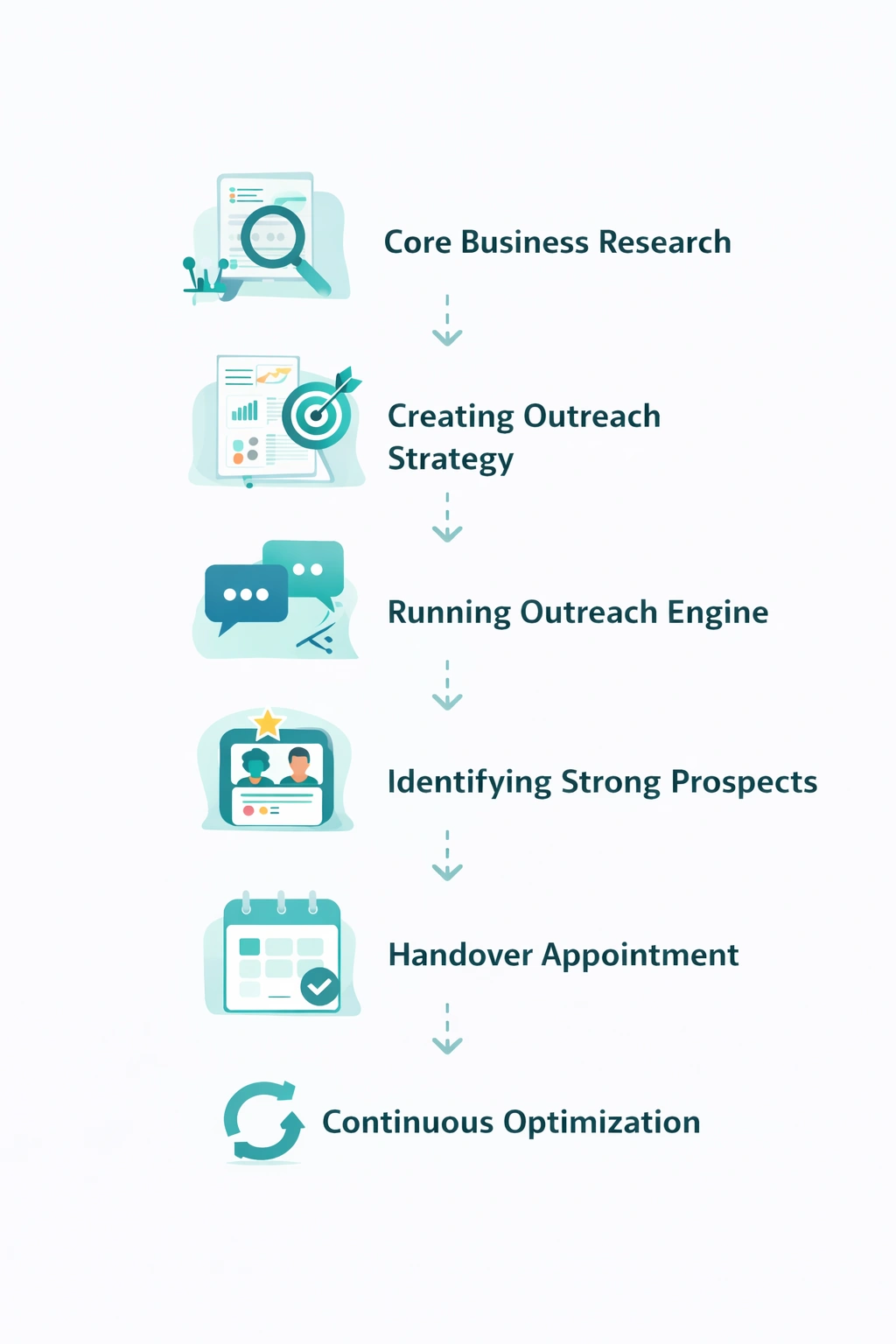
- Define ICP + exclusions (MSP-specific): your 20–100 vs 101–500 split, target geos, vertical focus, and hard “no” categories like IT services and staffing.
- Build Sales Navigator searches and account lists: repeatable list architecture (fast-growing, compliance-driven, multi-location, new IT leader, tech modernization).
- Enrich with prospect intelligence: read profiles, company posts, and job ads; tag buying/hiring/activity signals; map the right personas per account.
- AI-assisted personalization that stays grounded: we use AI to draft first-pass angles tied to the actual trigger (Intune rollout, SOC 2 pressure, cyber insurance questionnaires), then keep the message human and specific.
- Run outreach + nurturing with visibility: connection + follow-ups are executed with persona-based messaging, replies are handled and nurtured, warm leads are tracked, and appointment generation is supported with a clear view of what’s working through dashboards.
After onboarding, you receive prioritized account lists, persona maps, signal tagging (buying/hiring/activity), message angle suggestions by signal, and a weekly cadence that keeps your pipeline pointed at live demand—not stale lists.
From identifying the right decision-makers to starting meaningful conversations and turning them into qualified appointments... LinkedoJet manages the entire outbound engine for your business.
Speak to our Experts if you want this running as a managed system, not another tool your team has to babysit.
Answers MSP teams actually need before they commit to outbound
Which company sizes convert best for MSP retainers (and when should we split 20–100 vs 101–500)?
20–100 often converts faster because decisions are ops-led and the pain is immediate (onboarding, downtime, “who owns IT?”). 101–500 can be higher MRR but needs tighter qualification: internal IT structure, compliance requirements, and whether you’re positioned for co-managed or security programs. Split them because the persona mix and message angles are different.
How do you find companies that already have an MSP so we don’t waste cycles?
We screen for vendor language in profiles and posts (“our MSP,” “managed service provider”), look for job posts that reference vendor management, and check for patterns that signal a stable incumbent (long-tenure IT leader praising a provider, consistent security/tooling ownership). When we see “shopping MSP” signals that look like price bidding, we usually deprioritize unless there’s a strong trigger (incident, leadership change, compliance deadline).
What LinkedIn signals suggest a real security/compliance-driven buying window (vs noise)?
The strongest signals combine: (1) a compliance keyword (SOC 2/HIPAA/PCI/NIST/CMMC/cyber insurance) in job posts or company updates, (2) evidence of operational change (new location, hiring, M&A), and (3) an active stakeholder (posted recently, new IT/security leader, or exec discussing risk). A single generic “security awareness month” post is usually noise. A hiring post for “Security + Compliance” plus cyber insurance language is not.
Can this approach work for co-managed IT, cybersecurity-only, or Microsoft 365/Azure migrations?
Yes—often better than broad managed services messaging. Co-managed maps well to hiring and backlog signals. Cybersecurity-only maps to insurance/compliance language and security tooling keywords. M365/Azure/Intune migrations map to modernization hiring and project announcements. The list building stays the same; the signal tags and persona angles change.
How do we avoid RFP-only prospects and price shoppers on LinkedIn?
We deprioritize accounts broadcasting procurement behavior (RFP language, “seeking bids,” heavy vendor churn talk) unless there’s a compelling trigger you can own (post-incident stabilization, audit deadline, leadership change). We also shift messaging away from “we’re an MSP” and toward the trigger they can’t ignore: risk reduction, uptime accountability, standardization, and proof-driven security outcomes.
See what your MSP outbound looks like when it’s run as a system
This isn’t a vague “strategy chat.” We’ll show you how we build your target lists, tag intent signals, run persona-based outreach, and track warm conversations into qualified discovery calls.
What LinkedoJet operationally provides: we set up your ICP and exclusions, build Sales Navigator searches and account lists, add signal tagging (buying/hiring/activity), generate AI-assisted personalization tied to real triggers, execute LinkedIn outreach, handle and nurture replies, and keep warm leads and booked appointments visible in dashboards.
What happens after onboarding: you don’t get “access to a tool” and a wish. You get a managed outbound engine. Each week we refresh net-new accounts, re-check signals (new jobs, new leaders, compliance language), prioritize the best-fit targets, and run follow-up sequences that reference context instead of pestering.
What you receive: prioritized account lists for your market (segmented 20–100 and 101–500), persona maps (IT/Ops/Finance/Security), signal tags that explain why each account is worth contacting now, message angles by persona and trigger, and ongoing refinement based on reply quality and meeting-to-MRR conversion.
How targeting and prospect list building works: we build repeatable lists like fast-growing SMBs, compliance-driven accounts, multi-location operations, new IT leader hires, and Microsoft modernization signals—then we aggressively exclude MSPs/IT services/staffing/agencies and other known time-wasters.
How AI-assisted personalization is used: AI drafts are based on specific evidence (job post keywords like Intune/Defender/SOC 2, company updates about growth or locations, profile responsibilities). Nothing gets sent without a human check for accuracy and tone.
How lead nurturing and follow-up workflows operate: we run multi-touch follow-ups that add context (audit deadlines, insurance questionnaires, endpoint standardization) and route replies into a clear next step. Warm leads don’t disappear—they’re tracked and re-engaged when new signals appear.
How warm leads and appointments are tracked: you get campaign visibility through dashboards: which lists are producing replies, which personas are engaging, and which signals correlate with booked meetings—so you can stop guessing and start doubling down on what converts.
Why this is different from ordinary LinkedIn automation tools: tools send messages. LinkedoJet runs the full workflow—targeting, signal detection, relevance, execution, nurturing, and appointment generation support—so you end up with qualified MSP conversations, not just activity metrics.
From identifying the right decision-makers to starting meaningful conversations and turning them into qualified appointments... LinkedoJet manages the entire outbound engine for your business.
Next step: get a prioritized MSP target list with signal tags—and start booking better-fit calls
If your team is tired of demos that don’t convert, the fix is precision and timing: tighter account selection, clearer persona mapping, and outreach tied to real security/compliance/change signals. We’ll help you run that weekly cadence end-to-end.