
Find high-intent leads for remote hiring agencies (without generic automation blasts)
Most remote recruiting agencies don’t have a lead problem. They have a timing problem. The best accounts buy in short windows—right when hiring urgency spikes. LinkedoJet is a prospect intelligence + client acquisition system that spots those windows, maps the real buyer, and helps you reach out while the problem is still on fire.
- Sales Navigator targeting (tight account universe, not endless searches)
- Buying-signal detection (hiring + growth catalysts)
- Decision-maker mapping + outreach playbooks (so you don’t sell to the wrong node)
Why your pipeline feels random: stale lists, wrong contacts, missed windows
You can feel the month slipping away.
Delivery is busy. Candidates are moving. Recruiters are in the trenches. But new logos aren’t landing at the pace you need. So you do what most agencies do: pull a “companies hiring remote” list, spend hours in Sales Navigator, send a lot of messages… and end up with polite conversations that never turn into active searches.
The brutal part isn’t the low reply rate. It’s that the few companies who were ready to buy got contacted too late—after they already chose a vendor, leaned on internal TA, or quietly filled the role through their network. Every “we’re hiring” post you see a week late is real money left on the table.
- Stale intent: job boards and scraped “hiring” lists lag. You’re reacting, not arriving early.
- Bad routing: you message recruiters/sourcers because they’re easy to find, not because they can sign.
- Wrong timing: you pitch when there’s no urgency—or when vendor selection already happened.
- Inbox crowding: remote/global hiring triggered a flood of generic agency outreach. Same words, same cadence, same week.
Volume outreach creates activity. Signal-based targeting creates meetings.
Who actually buys remote staffing, RPO, and global sourcing (and who to avoid first)
Remote hiring changed the org chart dynamics. The person with “Talent” in their title is often not the economic buyer—especially when the pain sits with a functional leader missing a quota, a CTO blocked on headcount, or a COO trying to ship a plan tied to funding.
| Segment | Primary buyer (start here) | Co-buyer / influencer | When they buy |
|---|---|---|---|
| Startups / SMB | Founder, CEO, COO, VP Operations | Head of People, Head of Talent, Recruiting Manager | New funding, product launch, headcount plan gets real |
| Mid-market | VP People, VP HR, VP Talent Acquisition | Director TA, Workforce Planning, HR Director | Hiring goals outpace internal TA bandwidth |
| Department-driven hiring | CTO / VP Engineering, CRO / VP Sales, Director CS | TA leader + Ops/Finance sponsor | Time-to-fill is killing roadmap or revenue targets |
| RPO / vendorized buying | VP People / Head of HR Ops | Procurement Manager, Vendor Manager | They need process + coverage, not “a few candidates” |
Avoid targeting first: junior recruiters, sourcers, coordinators as your opening message. They can be helpful later, but when you start there you get “no agencies,” slow internal forwarding, or a request to be added to an ATS vendor list (translation: you’re now competing on price).
Green flags, red flags, and a simple scoring rule to rank accounts this week
Your list doesn’t need to be bigger. It needs to be ranked.
Remote hiring agencies win when they stop treating every “hiring” company the same. A remote-first SaaS adding 12 roles with a 2-person TA team is not the same as a mature org posting one evergreen requisition to keep the funnel warm.
Green flags (buying likelihood)
- Remote-first language: “distributed,” “global team,” “work across time zones,” “international hiring.”
- Multi-role hiring: 5–15+ openings, or repeated reposts for the same hard-to-fill role.
- Bandwidth mismatch: 1–3 TA people supporting a surge (visible in team size + open roles).
- Growth catalyst: recent funding, expansion announcement, new product/market entry, M&A.
- Vendor-friendly signals: mentions of “talent partner,” “RPO,” “external recruiters,” or a vendor/procurement path.
Red flags (deprioritize fast)
- Explicit “no agencies” on the job post/careers page (unless you have a warm path).
- Layoffs / hiring freeze in the last 60–90 days (unless your offer fits a specific recovery scenario).
- Low hiring volume: 0–2 open roles, unless you’re doing retained/executive search.
- Bad geo coverage: outside your service area, time zone constraints, or comp bands you can’t supply.
- Competitors: Staffing & Recruiting industry (unless you sell white-label/subcontracting).
Simple scoring rule: prioritize accounts with 2+ intent signals (hiring + growth catalysts) and 1+ activity signal (a decision-maker who posted/engaged in the last 30 days). Those are the accounts most likely to be inside a 24–72 hour buying window.
Sales Navigator plays: filters, saved searches, and a weekly review cadence
This is where most agencies burn time: searching from scratch, every day, with slightly different filters. The fix is simple—create a few segmented plays, save them, and review them weekly like a pipeline.
Play A: High-growth remote-first SaaS (core list builder)
- Account search: Geography = United States, Canada, United Kingdom, EU, ANZ (adjust to your coverage); Company headcount = 50–500 (split 51–200 and 201–500); Industry = Software, Internet, Information Technology & Services; Company type = Privately Held; Keywords = “remote” OR “distributed” OR “global team”.
- Lead search (within saved accounts): Titles contains = VP People, Head of People, Head of Talent, Head of Talent Acquisition, Director of Talent Acquisition, Director of Recruiting; Seniority = CXO/VP/Director/Manager; Function = Human Resources + Operations; Posted on LinkedIn in past 30 days = Yes.
- Optional qualifier: Years in current position = 0–2 years (new leaders often change vendors).
Play B: Engineering ramp (when time-to-fill blocks roadmap)
- Account search: Same base as above + Keywords = “distributed engineering” OR “remote-first” (or add tech stack filters if you place specific profiles: AWS, Kubernetes, React, Python, .NET).
- Lead search: CTO, VP Engineering, Director of Engineering plus Head of Talent / Director TA; Function = Engineering + Human Resources; Posted on LinkedIn in past 30 days = Yes.
- Routing note: start with the functional leader when the company is vocal about missed delivery dates, hiring bottlenecks, or team scaling.
Play C: Sales/CS ramp (when revenue targets drive urgency)
- Account search: Industry = Software / Financial Services / Professional Services; Headcount = 100–1000; Keywords = “hiring” + “AE” / “SDR” / “Customer Success” on company page content (manual check) or add “go-to-market” / “revenue” in keyword filters.
- Lead search: CRO, VP Sales, VP Revenue, VP Customer Success plus VP People / Director TA; Function = Sales + Human Resources; Posted on LinkedIn in past 30 days = Yes.
Cadence that actually holds up: save each search, review weekly, and tag accounts into three buckets—Now (signals hit this week), Watch (one signal, waiting for a trigger), Later (fit is good but no urgency).
What to watch this week—and why the 24–72 hour window matters
When buyers move fast, your message doesn’t need to be magical. It needs to be timely, specific, and aimed at the right person.
Intent triggers (company-level)
- Hiring spike: job count jumps over 7–14 days, or the same role gets reposted twice.
- “We’re hiring” leadership post: Founder/CTO/CRO announces a ramp (these are gold because urgency is public).
- TA team build: new recruiter/TA Ops hire plus an increasing open role list (signals strain, not “we’ve got it covered”).
- Funding / expansion: announced round, new market, new office hub (even for remote teams).
- Remote/global posture: explicit language about hiring across countries, time zones, or EOR/PEO partners.
Activity signals (who will reply)
- Posted on LinkedIn in the past 30 days (especially about headcount, culture, hiring, or team wins).
- Commenting/engaging on hiring content (their feed tells you what matters this week).
- Profile headline updates that include “hiring,” “building,” “scaling,” or a new role in People/Talent (0–6 months).
Timing note: aim to reach out within 24–72 hours of a hiring/funding/leadership signal. After that, they’re either buried in interviews or already taking intros from agencies that arrived first.
Message discipline: your opener should reference the trigger (“saw you’re adding X roles across Y time zones”) and then anchor to an outcome (speed-to-hire, hard-to-fill coverage, remote sourcing reach, process relief). Not “checking in.” Not “following up.”
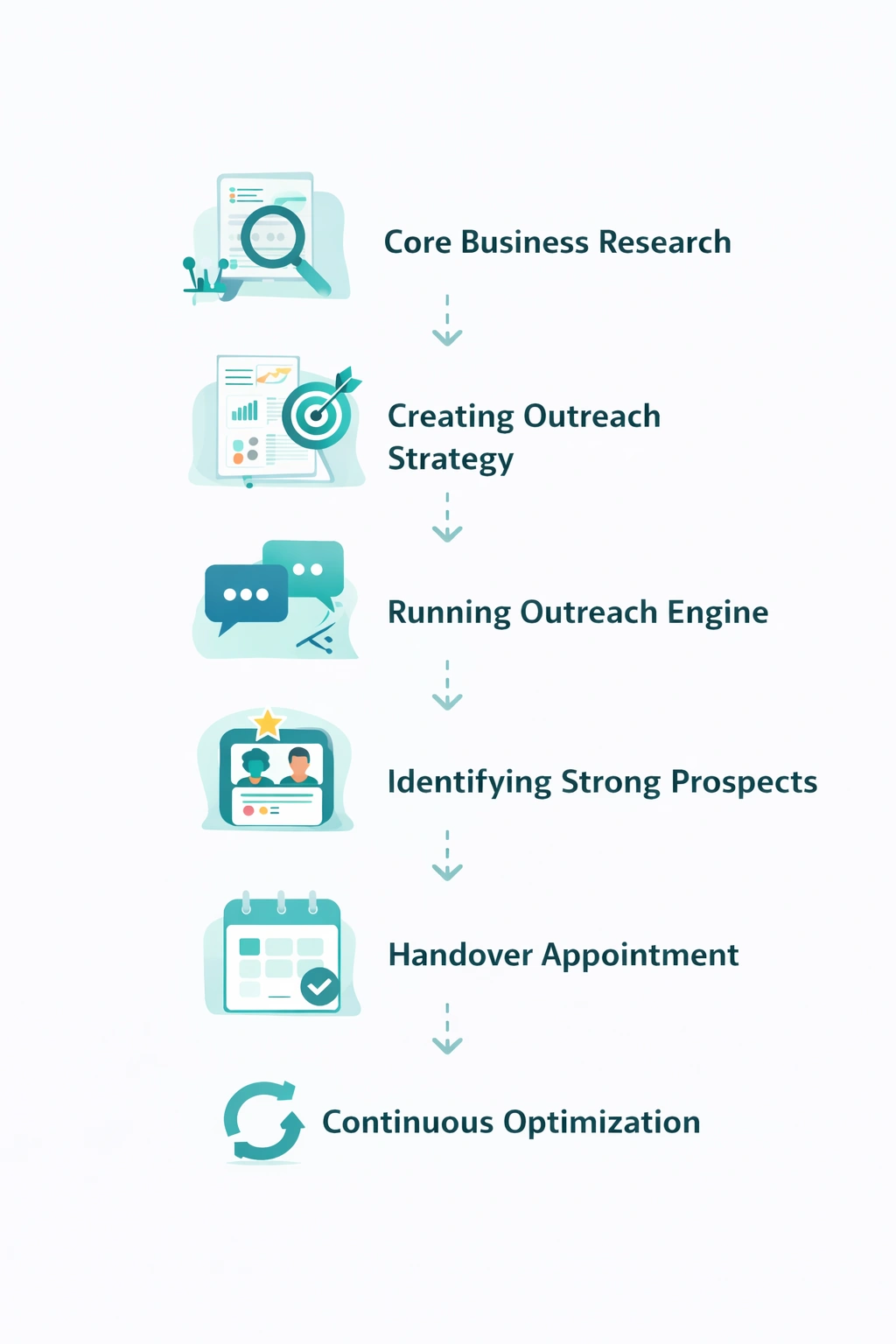
How LinkedoJet runs it end-to-end: ranked lists, reasons to reach out, and booked-call support
Most “LinkedIn automation” tools help you send more messages.
That’s not the hard part for a remote recruiting agency. The hard part is knowing who to message, when, and which angle will land with the real buyer—then having a reliable system to handle replies, nurture the warm leads, and turn momentum into booked meetings.
What LinkedoJet operationally delivers
- ICP + targeting setup: we define your buyer segments (startup vs mid-market vs department-led), your service geos (US/CA/UK/EU/ANZ or tighter), and your role categories (engineering, sales, CS, healthcare, ops). Then we build your account universe in Sales Navigator.
- Prospect list building: we create saved searches and lists that pull in the right companies, then map the right leads: TA leader + functional leader + ops/founder sponsor (and procurement paths for RPO when needed).
- Signal layering + ranking: we tag intent signals (hiring spikes, reposts, funding, leadership changes, remote/global posture) and activity signals (posted/engaged). You get a ranked pipeline, not a spreadsheet dump.
- AI-assisted personalization + outreach execution: outreach is triggered by real events, with openers tied to the exact signal. AI helps tailor the first line and angle while staying on-message for your niche (speed-to-hire, hard-to-fill roles, distributed sourcing, international reach, compliance partners if relevant).
- Lead reply handling + nurturing: when someone responds with “not now,” “send info,” or “we’re covered,” we don’t drop them. LinkedoJet runs follow-up workflows that keep you in the deal cycle without pestering.
- Warm lead tracking + appointment support: warm replies are tracked in a shared view, handoffs are clean, and booked meetings are tied back to the list and the trigger so you can see what’s working.
- Campaign visibility + ongoing refinement: you see what segments convert, which signals produce meetings, and where routing is breaking. Then we adjust targeting, messaging angles, and sequences week to week.
And yes—the system is built for remote/global hiring reality: fast cycles, noisy inboxes, and buying committees that don’t look like the org chart you wish existed.
Questions remote hiring agencies ask before they commit
Can this work if we specialize in tech, healthcare, or sales roles?
Yes. The core system is the same—tight account universe, intent signals, buyer mapping, and fast timing. What changes is your targeting layer (industries, technologies, regulated environments, geos) and which functional buyer becomes primary (CTO/VP Eng for tech, clinical ops leadership for healthcare, CRO/VP Sales for revenue roles). The point is to make your list narrower and your triggers more specific, not broader.
How do we avoid competing with dozens of other agencies in the same inbox?
You don’t “out-cadence” them. You show up earlier and you sound like you actually saw what changed. Signal timing (24–72 hours), decision-maker routing (functional owner + TA leader), and a trigger-based opener beat generic outreach every time. We also keep you out of the commodity lane by anchoring to the problem they’re facing this week (role spike, backlog, remote coverage) instead of generic candidate supply talk.
What if the company says “no agencies” on the careers page or job post?
Treat it as a strong negative signal, not a challenge to debate. We typically deprioritize those accounts unless you have a warm path (investor intro, portfolio connection, second-degree ref) or the intent signals are extreme (role reposting, public urgency, obvious bandwidth mismatch). In those cases, we route differently—often to the functional leader—because TA may be enforcing policy while the business is bleeding.
Do we need LinkedIn Sales Navigator for this to work?
It’s strongly recommended. Sales Navigator is what makes the account universe repeatable: saved searches, lead filters, and segmentation by headcount/geo/industry. Without it, you can still do parts of the approach, but you’ll spend more manual effort for a smaller, less consistent list—and the whole point is predictable weekly production.
How quickly can we build a qualified list and start booking sales calls?
Most agencies can get a first ranked batch (often 50–150 accounts with mapped decision-makers) quickly, then refresh weekly with new signals. Booking calls depends on your niche, offer clarity, and how fast you respond to warm replies. The fastest wins come from accounts already showing intent this week—and from messaging that matches the trigger, not your internal pitch deck.
See what your next 50 high-intent accounts look like—ranked by buying signals
This isn’t a vague “strategy chat.” If you run a remote staffing agency, RPO, or global sourcing firm, we’ll show you how the signal-driven engine works in your market, and what LinkedoJet actually delivers after onboarding.
On this session, we review:
- Your service lines (remote direct hire, contract, RPO), role categories, and where you win deals fastest.
- Your current targeting and where routing breaks (selling to TA-only, missing the functional buyer, or hitting accounts too late).
- The exact signals that matter for your niche (role spikes, repost patterns, new People leadership, funding/expansion, remote/global hiring language).
What you receive if we move forward: LinkedoJet sets up your ICP and targeting system, builds and maintains Sales Navigator prospect lists, and produces a ranked account pipeline with a clear reason-to-reach-out for each company (the trigger and the angle). We then run AI-assisted personalization and execute LinkedIn outreach sequences tied to those triggers—while handling replies, nurturing “not now” leads, and tracking warm conversations through to scheduled meetings.
How targeting & list building works: we segment by headcount bands (11–50, 51–200, 201–500, 501–1000), industries, geos, and remote posture, then map the buying committee (Founder/COO/VP Ops, VP People/Director TA, plus CTO/CRO/department buyers when the hire is specialized). You’re not guessing who to contact. You’re threading the org on purpose.
How AI-assisted personalization is used: AI helps us tailor openers to the real trigger (their hiring post, funding news, leadership change, role reposts) while keeping your positioning consistent. The goal is relevance at scale—without sounding like a template.
How follow-up workflows operate: we run structured follow-ups for “send info,” “later this quarter,” and “we’re covered” replies, so you stay in the buying cycle when urgency returns. Warm leads are tracked and surfaced so your team responds fast while the window is still open.
Why LinkedoJet is different from ordinary LinkedIn automation tools: automation sends. LinkedoJet decides. The engine is built around intent signals, decision-maker mapping, and timing—then backed by execution, nurturing, visibility, and refinement so it holds up week after week.
From identifying the right decision-makers to starting meaningful conversations and turning them into qualified appointments... LinkedoJet manages the entire outbound engine for your business.
Next step: build a predictable weekly pipeline from remote hiring signals
If you want fewer low-fit calls and more conversations with companies already inside a hiring decision window, you need a ranked account pipeline, mapped buyers, and trigger-based outreach that your team can run every week.