
How to find leads for procurement consulting firms—using LinkedIn signals, not guesswork
LinkedoJet builds outreach-ready account lists for procurement consulting by identifying companies with active cost, sourcing, or S2P initiatives and mapping the CPO/CFO/COO buying committee.
- Account qualification rules (size, complexity, spend indicators)
- Buying-signal detection (hiring, leadership changes, tech rollouts)
- Decision-maker mapping (CPO/VP Procurement + CFO/COO sponsors)
- Sales Navigator filter packs for key verticals
Most procurement consultants don’t lose to a “better” competitor. They lose to bad timing and vague outreach.
You can be the person who actually delivers savings realization, compliance, speed-to-award, and supplier-risk reduction—and still watch capacity sit idle because your LinkedIn messages land like generic noise.
The fix isn’t more volume. It’s better timing and clearer relevance, driven by signals you can see in Sales Navigator and LinkedIn activity.
Why procurement consulting lead gen breaks: timing, sponsorship, and initiative visibility
“Procurement consulting leads” aren’t a list problem. They’re a window problem.
The same CPO who ignores you this month will take a call two months from now when a new CFO pushes margin improvement, when an ERP program forces P2P redesign, or when a supplier consolidation initiative becomes unavoidable. Your outreach didn’t get worse. The account’s internal agenda changed.
Most outbound misses because it targets titles instead of initiatives:
- Timing: sourcing waves and operating model work often start quietly—job posts, org language, and tool roles appear before anyone says “transformation.”
- Sponsorship: cost takeout is owned by CFO/COO far more often than procurement admits publicly. If you only message the CPO, you’re betting they’ll sponsor and sell internally.
- Visibility: initiatives get packaged as working capital, resilience, compliance, or “operating model.” If your targeting only says “Procurement Director,” you’ll hit a lot of closed doors.
And inbox saturation makes it worse. Procurement leaders are seeing templated “cost reduction” notes every day. If your first message can’t point to something they recognize as happening inside their business, you look indistinguishable—no matter how good your delivery is.
Who to target (and who to ignore): the CFO/COO/CPO committee + champions
Procurement engagements get funded by a committee—even when procurement is the center of gravity.
| Role in the deal | Titles to map | What they care about (language that lands) |
|---|---|---|
| Economic buyer | CFO, VP Finance, Finance Director (cost transformation), COO, VP Operations | Margin improvement, working capital, SG&A, governance, “savings that hit the P&L,” cycle time, audit/compliance exposure |
| Functional buyer | CPO, VP Procurement, Head of Procurement, Director Strategic Sourcing, Head of Category Management | Sourcing throughput, category coverage, supplier performance, compliance, stakeholder adoption, savings pipeline vs realized savings |
| Technical / enablement | CIO, Director Enterprise Apps, Procurement Systems Manager, S2P/P2P Product Owner, Coupa/Ariba/Ivalua Admin | Tool ownership, process design, integrations, data quality, change management, adoption metrics |
Then you add champions who can validate pain and give you internal language: Procurement Transformation/Excellence, Category Managers, Strategic Sourcing Managers, Supplier Performance/SRM, Procurement Analytics.
Negative targeting (this saves months): junior “Buyer/Procurement Specialist” roles with no influence (unless you intentionally use them as champions), subsidiaries with procurement controlled by a parent, and organizations where “procurement” is mostly purchasing admin with no category strategy mandate.
The fastest path to qualified conversations is committee mapping at the account level, not title hunting across the whole market.
Ideal account criteria: spend complexity, maturity gap, and the triggers that open a buying window
You’re not looking for companies that “have procurement.” You’re looking for companies where procurement must change to hit a business goal.
- Size band (guideline): 200–10,000+ employees (adjustable by service tier and delivery model).
- Complexity: multi-site, multi-region, direct + indirect spend, multiple categories, regulated supply chains, contractor/MRO intensity.
- Maturity gap clues: “decentralized buying,” “center-led,” “CoE,” “operating model,” “spend visibility,” “tail spend,” “supplier consolidation,” “SRM,” “should-cost.”
- Budget likelihood: environments where measurable procurement ROI is culturally accepted (manufacturing, pharma/medical devices, energy/utilities, CPG/retail, logistics, aerospace/defense).
Then you layer triggers that indicate a buying window is opening:
- Org triggers: new CPO/VP Procurement, procurement team expansion, creation of Procurement Excellence/Transformation roles.
- Finance triggers: cost takeout language, working capital focus, restructuring phrasing, FP&A/controller hiring.
- Tech triggers: P2P/S2P roles, CLM mentions, Coupa/Ariba/Ivalua/Jaggaer/GEP/Zycus keywords, ERP upgrade chatter (SAP S/4HANA, Oracle, Workday).
- Event triggers: M&A integration, plant expansions/closures, supply disruption, tariffs/compliance mandates.
Sales Navigator targeting: filter packs built for procurement initiatives (not vanity lists)
Sales Navigator works when you treat it like an intelligence tool, not a directory.
Account Search playbook (company targeting)
- Geography: match your delivery footprint (regions you can actually serve well).
- Industry sets: Manufacturing, Automotive, Aerospace & Defense, Chemicals, Oil & Energy, Pharmaceuticals/Medical Devices, Food & Beverage/CPG, Retail (multi-site), Logistics, Construction (large contractors), Utilities, Tech hardware.
- Headcount segments: 200–1000, 1000–5000, 5000+ (separate lists, different messaging).
- Growth signals: hiring/on LinkedIn, headcount growth (where available).
- Company keyword set: procurement transformation, strategic sourcing, source-to-pay, procure-to-pay, P2P, CLM, spend analytics, supplier management, Coupa, SAP Ariba, Ivalua, Jaggaer, GEP, Zycus.
Lead Search playbook (committee mapping)
- Functions: Procurement, Supply Chain, Finance, Operations, IT (enterprise apps / procurement systems).
- Seniority: CXO, VP, Director, Head.
- Title targeting: CPO, VP Procurement, Head of Strategic Sourcing, Director Strategic Sourcing, Head of Category Management, Procurement Transformation/Excellence, P2P/S2P Director or Product Owner, Supplier Management/SRM.
- Co-sponsors: CFO/VP Finance/Finance Director (cost transformation), COO/VP Operations, VP Supply Chain.
- Activity priority: “Posted on LinkedIn in last 30 days” to focus on people who are currently reachable and paying attention.
LinkedoJet turns these into saved searches, account lists, and a prioritized outreach queue—and we attach context so your first message isn’t a guess.
Signals that matter: hiring, leadership, tech change, and cost/resilience language
Signals aren’t “intent data.” They’re what the company is accidentally telling the market while they mobilize internally.
1) Hiring signals (usually the earliest)
- New roles like Procurement Transformation Lead, Procurement Excellence, Category build-out, Supplier Risk, Procurement Analytics.
- Procurement systems roles: Procurement Systems Manager, S2P Product Owner, Coupa/Ariba/Ivalua Admin, P2P Analyst.
- Clusters of procurement job posts inside 60–90 days (it’s rarely random).
2) Leadership change signals
- New CPO/VP Procurement in the last 6–12 months.
- Reorg language: center-led, shared services, CoE, new governance, new operating model.
3) Tech signals (short windows, high urgency)
- ERP upgrades tied to process redesign (SAP S/4HANA, Oracle, Workday).
- Mentions of S2P/P2P/CLM tools and admin roles (Coupa, SAP Ariba, Ivalua, Jaggaer, GEP, Zycus, ServiceNow Procurement).
- Posts about adoption, data quality, or “process standardization” (often code for: the system is live but the value isn’t).
4) Cost / resilience language (often the CFO/COO door)
- Margin improvement, working capital, SG&A reduction, supplier consolidation, resilience, risk, compliance, audit findings.
- FP&A/controller hiring and restructuring phrasing—these precede governance-heavy cost programs.
Prioritization rule that works in practice: when an account shows two or more trigger categories (for example: a new CPO plus procurement systems hiring), treat it as a priority account and map the committee immediately. That’s where response quality changes.
FAQ
Which industries are most likely to fund procurement transformation and strategic sourcing projects?
Look for industries where spend is large, complex, and measurable: multi-site manufacturing, automotive supply chain, aerospace/defense, chemicals, energy/utilities (contractor/MRO spend), pharma/medical devices (regulated supply chains), and CPG/retail with large indirect + logistics spend. The common thread isn’t “industry.” It’s ROI visibility and governance pressure.
How do we identify companies with active savings targets or cost takeout programs using LinkedIn-visible signals?
You’re looking for proxy signals: CFO/COO language around margin improvement or working capital, restructuring phrasing, finance hiring (FP&A/controller), and leadership engagement with cost or operating model topics. On the procurement side, watch for transformation/excellence roles and posts that reference realized savings vs pipeline, compliance, or stakeholder adoption.
Can you map both procurement leaders and the finance/operations sponsors (CFO/COO) for the same account?
Yes. That’s the point of committee mapping. We build an account list first, then map procurement leadership plus likely sponsors in finance/ops, plus enablement stakeholders in IT when S2P/P2P is in scope. The output isn’t “more contacts.” It’s a coherent buying group you can approach with a sponsor-ready angle.
How do you detect source-to-pay / P2P tool changes (Coupa, SAP Ariba, Ivalua, Jaggaer, GEP, Zycus) without relying on private data?
We stick to Sales Navigator and LinkedIn-visible signals: job posts for admins/product owners, profile keywords, employees updating headlines (“S2P Product Owner,” “Coupa Admin”), and company/leader posts that reference rollouts, adoption, standardization, or process redesign. No scraping of private data—just disciplined reading of what’s already public.
How do you avoid low-fit accounts and junior contacts while still finding internal champions?
We separate roles: decision-makers (CFO/COO/CPO) for meetings, and champions (transformation, category, analytics, systems) for context. Negative filters remove micro companies, obvious procurement-outsourced subsidiaries, and overly junior titles unless they sit in transformation teams. The goal is fewer conversations, better conversations.
See what your outreach looks like when targeting is initiative-first
Book a demo session and we’ll show how LinkedoJet builds a qualified shortlist, maps the buying committee, and produces outreach-ready dossiers for procurement consulting engagements.
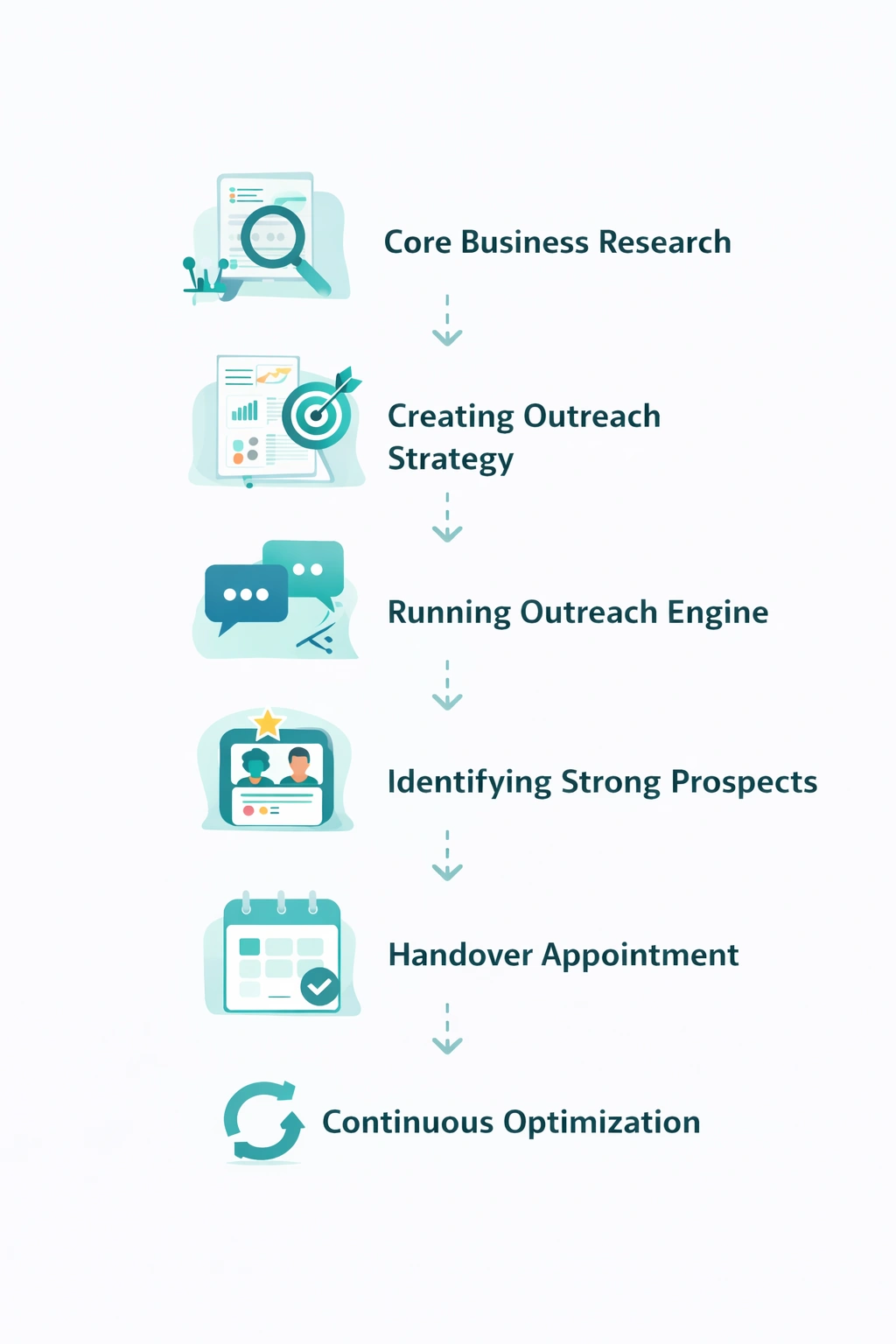
What LinkedoJet operationally provides: we run a managed outbound engine built around targeting, initiative detection, and real conversations—so you’re not stuck guessing which accounts are in a buying window.
After onboarding, here’s what happens:
- ICP + targeting setup: we translate your service lines (strategic sourcing waves, operating model redesign, supplier rationalization, S2P/P2P/CLM work, supplier risk) into clear qualification rules—size, complexity, regions, and exclusions.
- Sales Navigator prospect list building: we create filter packs and saved searches for your verticals, then build account lists that match your “complex spend + maturity gap” profile.
- Buying committee mapping: for each priority account we map procurement leadership and the CFO/COO sponsors, plus IT enablement stakeholders when tools and process redesign are involved.
- Initiative context capture: we pull LinkedIn-visible signals (hiring clusters, leadership changes, tool/admin roles, margin/working-capital language) and turn them into a simple “why now” narrative for outreach.
- AI-assisted personalization: we use AI to draft first-pass personalization tied to the account’s signals and the lead’s scope (global vs regional, direct vs indirect, category ownership, P2P ownership). A human review step keeps it grounded and specific.
- Outreach execution + follow-up: we run message workflows across connection requests, follow-ups, and nurture touches—without sounding templated. Replies are handled with playbooks that keep the thread moving toward a meeting, not endless back-and-forth.
- Warm lead tracking + appointment support: warm replies, objections, and meeting-ready leads are tracked in a shared view. You see who engaged, what triggered interest, and which angle landed (savings realization, compliance, speed-to-award, supplier risk, S2P adoption).
- Campaign visibility + refinement: dashboards show list quality, response patterns, and where drop-off happens. We refine targeting and messaging based on real conversations—weekly, not quarterly.
Why this is different from ordinary LinkedIn tools: tools send messages. LinkedoJet runs the system—targeting, list building, context, personalization, execution, nurturing, and reporting—so your pipeline isn’t hostage to referrals or random timing.
From identifying the right decision-makers to starting meaningful conversations and turning them into qualified appointments... LinkedoJet manages the entire outbound engine for your business.
Next step: get a qualified shortlist and committee map you can actually sell into
If you want predictable procurement consulting conversations, start with a tighter shortlist: complex-spend accounts showing active initiative signals, mapped to the CFO/COO/CPO committee, with outreach-ready context that makes your first message feel obvious—not generic.