
Referrals come in waves. The quiet cost is what happens between the waves.
If your diary swings between “fully booked” and “why is next month empty?”, it’s not a marketing problem. It’s a conversation supply problem.
Most IFA firms don’t feel lumpy pipeline until it bites. When reviews and servicing are heavy, business development gets postponed. When it goes quiet, someone remembers LinkedIn exists… and sends a few awkward messages that don’t sound like the firm you’d trust with a family’s planning.
And because trust is the product, the downside isn’t just “no replies”. It’s reputational. A screenshot in a WhatsApp group. An accountant quietly deciding you’re not a safe pair of hands. A HNW prospect filing you under “pushy” before you’ve even had a chance to be relevant.
The frustrating bit: you can be genuinely good at what you do—thoughtful planning, careful documentation, solid coordination with tax/legal—and still struggle to start new conversations on demand.
LinkedIn can fix the lumpiness, but only if the messaging behaves like a professional conversation: calm, specific, and patient. Not a pitch in disguise.
There are two growth paths in wealth management. Most LinkedIn outreach ignores both.
The fastest way to get ignored (or screenshotted) is to borrow SaaS-style sequences and paste them into a trust business.
Wealth management typically grows through:
- Client-led introductions (earned trust compounding over time).
- Professional referrals (accountants, solicitors, corporate finance, mortgage brokers) who protect their client relationship like it’s their pension.
Now look at what most advisers send on LinkedIn when they’re trying to “do outreach”:
- “I help busy professionals build wealth…” (broad, self-focused, instantly forgettable)
- Long paragraphs that read like a brochure
- Credential dumping (“Chartered, 20 years’ experience…”) before any relevance is established
- A calendar link in message #1 or #2
- Anything that smells like product, performance, or “returns”
- “Let’s network” messages to accountants/solicitors (they don’t have time for random coffee chats)
HNW professionals are more guarded than they were even two years ago. Many already “have an adviser” (or think they do via a bank, a platform, or a workplace scheme). Referral partners are even more cautious. Their risk isn’t wasting time—it’s introducing someone who makes them look careless.
So the bar isn’t “write better copy”. The bar is: can you lower the risk of replying?
Messages that get replies are usually short, situationally specific, and end with a one-line question that doesn’t force disclosure. You earn a small reply first. The call comes later, when a trigger moment shows up.
Who this sequence is built for: two lanes, different psychology, same trust rules.
You cannot run one generic sequence for “prospects” and expect it to work in a UK IFA context.
Lane 1: Direct prospects (HNW / emerging HNW / UHNW) — people with enough complexity that “set and forget” stops feeling safe.
- Complex compensation: equity/RSUs, bonus, partnership income. Triggers: bonus season, vesting windows, promotion to partner, changing tax residence.
- Business owners approaching an exit (or recently liquid): sitting in cash, unsure on structure/time horizon. Triggers: heads of terms, completion, earn-out, rollover equity, new spouse/second home decisions.
- “Everything is scattered” senior employees: multiple pensions/SIPPs/ISAs across providers, no joined-up plan. Triggers: fiscal year-end, job move, pension annual allowance/tapered AA headaches, new child/school fees planning.
Lane 2: Referral partners — accountants, tax advisers, solicitors, corporate finance, mortgage brokers.
- They care about client protection and clean coordination.
- They respond to narrow scenarios: “sale proceeds parked in cash”, “annual allowance surprises”, “inheritance planning after liquidity”, “multiple platforms and no plan”.
- They want to know you won’t go rogue: no cross-selling, no messy comms, and they stay in the loop.
The sequence below is designed to feel like a peer-to-peer conversation: you’re not asking them to “be a lead”. You’re inviting a low-stakes reply around something they’re already seeing.
A 7-step messaging sequence (two lanes) that earns replies first—then intro calls.
Each step has one job. The job is not “close”. The job is to learn, de-risk, and earn the next message.
| Step | Intent | Direct-to-prospect example | Referral partner example |
|---|---|---|---|
| 1) Connect | Be specific, sound normal, don’t sell. | “Hi [Name] — I work with a small number of owner-managed businesses on planning around liquidity events and keeping things tax-efficient without turning it into a product pitch. Saw your work at [Company] and thought I’d connect.” | “Hi [Name] — I’m an IFA and we often coordinate planning with accountants when clients have sale proceeds/bonus income decisions. Thought it’d be useful to connect given your focus on [area].” |
| 2) After acceptance | Open a small loop with an easy reply. | “Thanks for connecting, [Name]. Quick one—when you see people with equity/bonus/sale proceeds coming in, is the bigger headache usually tax planning, investing the cash, or just getting everything organised across providers?” | “Curious—are you seeing more clients asking about pension annual allowance / tapered AA this year, or is it mostly CGT and sale planning?” |
| 3) Soft follow-up | Assume busy. Give multiple-choice. | “Completely appreciate you’ll be buried. The reason I asked is we’re seeing a lot of ‘multiple platforms, no joined-up plan’ situations—especially when life gets busy and things drift. If it’s relevant, which camp are you in right now: (a) pretty organised, (b) a bit scattered, (c) need a proper review?” | “Totally understand if you’re head-down. When clients hit a big change (sale, bonus, inheritance), do you prefer (a) to keep everything in-house, (b) to bring in an IFA for planning coordination, or (c) case-by-case?” |
| 4) Trigger + emotion | Name the real worry without drama. | “One thing I hear a lot is: ‘I’m not worried about markets day-to-day—I’m worried I’ve missed something expensive on tax or structure.’ Does that resonate at all, or are you comfortable with how it’s set up today?” | “The pattern we see is clients who are “fine” until a trigger hits—sale proceeds, bonus, new partner income—then it becomes urgent and messy. Is that what you’re seeing this year, or is it calmer?” |
| 5) Nurture | Give value without a download or essay. | “If it helps, here are 3 prompts we use before year-end planning conversations: (1) any major income change expected in the next 12 months, (2) any large cash build-up sitting unallocated, (3) anything that would force a change—exit, inheritance, relocation. No need to share details here, but it’s a useful self-check.” | “When we work alongside accountants, the smoothest handovers happen when we agree upfront on roles (tax vs planning vs implementation) and reporting cadence. Happy to share the one-page outline we use if useful.” |
| 6) Soft meeting ask | Make it a sanity-check, not a pitch. | “If you ever want a second set of eyes, I’m happy to do a 15-minute ‘sanity check’ call—purely to see if there are any planning gaps worth looking at. If it’s not relevant, no hard feelings. Would next week be silly?” | “Open to a quick 10–15 minute call to compare notes on the types of cases you’d rather hand off vs keep in-house? I’ll keep it practical.” |
| 7) Close loop | Protect reputation. Leave the door open. | “I’ll leave it there, [Name]. If planning ever becomes messy—new role, big bonus, sale, inheritance—happy to be a sounding board. Want me to check back after year-end, or better not?” | “I’ll leave it with you, [Name]. If a case comes up where you want clean planning support without client drama, I’m happy to be a second set of hands. Want me to check back after year-end, or only if you reach out?” |
Fewer touches. Wider spacing. Clear rules on when to pause vs book.
This audience checks LinkedIn in small windows. Your cadence needs to fit their day, not your CRM.
In wealth management, “persistence” doesn’t mean daily nudges. It means calm follow-up that signals professionalism.
- Send times that get seen: early morning (before first meeting), between calls, or late afternoon when people clear messages.
- Spacing that feels respectful: 2–4 days between touches early, then 7–14 days for nurture. Around year-end, budget season, or known busy windows, widen the gaps.
- One ask per phase: earn a reply first; only then introduce the “sanity check” call.
Meeting-ready signals (don’t overthink it—look for language):
- They mention a trigger: bonus/vesting, sale, inheritance, relocation, new role, partner promotion.
- They ask “How do you work?” or “What would you look at?”
- They mention friction: scattered accounts, pension allowance confusion, concentrated share risk, “we’ve not reviewed this properly”.
- They reference a spouse/partner decision or a deadline (“need to sort this before year-end”).
Pause/stop signals (protect trust, always):
- “Not interested”, “Please remove”, or any hint of discomfort.
- No response after the close-loop message.
- They’re polite but closed (“All sorted, thanks”)—tag and revisit only around an appropriate trigger (e.g., year-end).
The goal isn’t to “win” every thread. The goal is to never create a thread you’d be embarrassed to forward to an accountant.
Trust mechanics: you’re not selling advice in messages—you’re earning permission to talk.
The sequence is built to move from one-line replies to short calls when a real trigger is present.
People don’t choose an adviser because of a clever opener. They choose an adviser when they feel understood, safe, and not rushed.
This is why the structure works specifically for IFAs and wealth managers:
- It’s situational, not generic. You’re anchoring the conversation to a moment (bonus, exit, year-end, inheritance), not a vague promise.
- It reduces perceived risk. The questions are answerable without sharing private details. You’re not fishing for AUM or trying to “qualify” them like a SaaS lead.
- It respects that many already have an adviser. The frame is second-opinion / planning coordination when something changes. That’s a believable reason to talk.
- It fits referral partners’ incentives. You’re explicit about roles, comms, and not end-running them.
When the time is right, the call isn’t “a consultation”. It’s a short compare-notes conversation: what’s changed, what’s at stake, and whether a proper review is worth doing.
Where adviser outreach goes wrong—and how we run it as a controlled conversation system.
Most firms don’t have a messaging problem. They have a targeting + follow-up + visibility problem.
I’ve seen good firms damage their own positioning with well-intentioned outreach. Common failure modes:
- Leading with credentials and compliance voice. It reads like a brochure, not a human. Save the formal tone for the right channel and the right stage.
- Asking about assets or fees early. You might be “qualifying”, but it feels invasive and transactional.
- Performance talk. Even hinting at outcomes creates an unnecessary risk signal.
- Calendar link too soon. It’s the fastest way to tell someone you’re not listening.
- Over-personalising with irrelevant trivia. “Saw you like golf” is not relevance. It’s fluff.
- Americanised language. “Wealth coach”, “crushing goals”, “financial freedom” reads wrong in a UK IFA context.
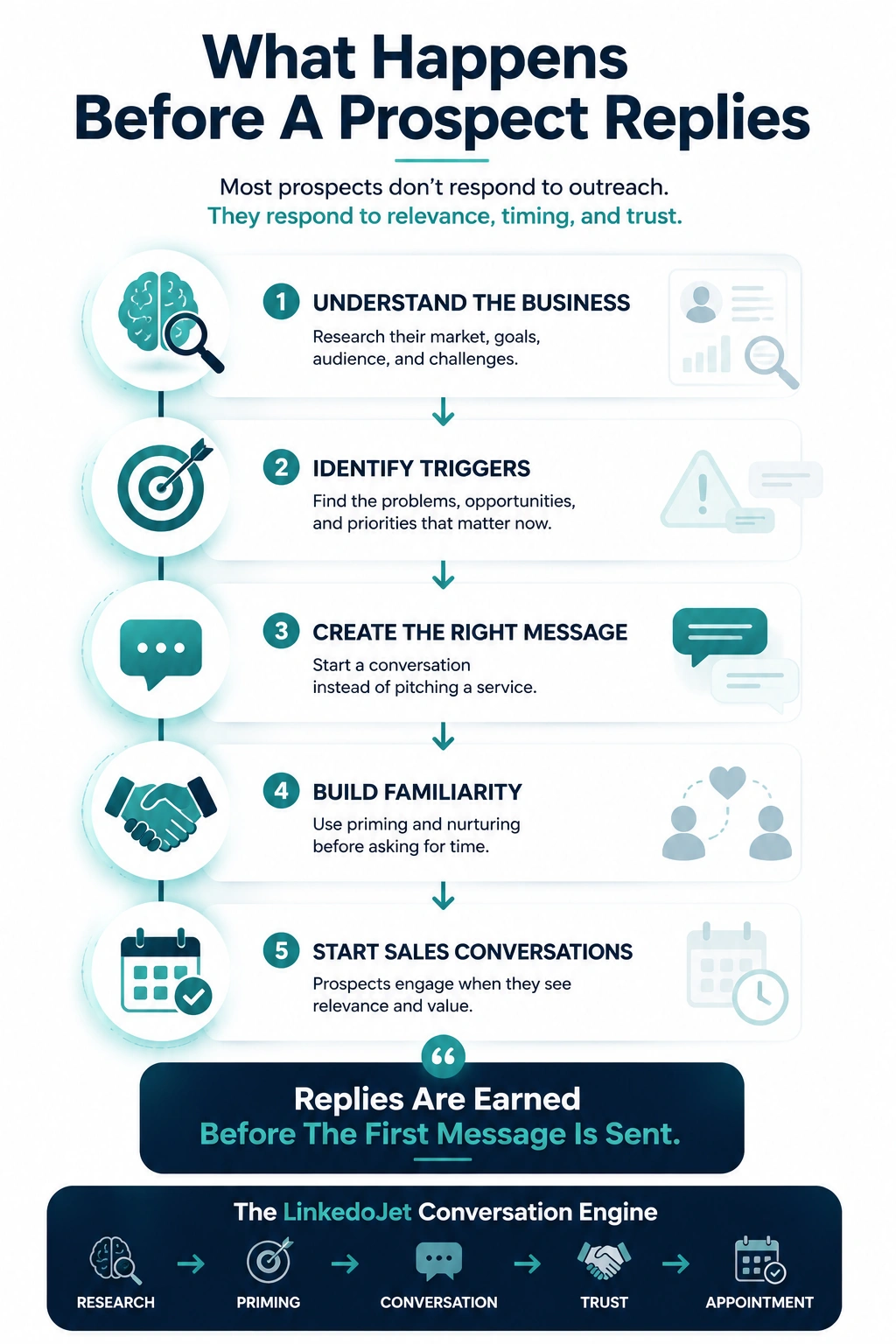
LinkedoJet fixes this by treating LinkedIn as an operational system, not a copywriting exercise:
- ICP & segmentation: separate lanes for direct prospects vs referral partners, with scenarios that match how each group thinks.
- Sales Navigator list building: tight filters (role, seniority, geography, firm type) plus trigger-aware list logic where possible.
- AI-assisted personalisation: used to add context and relevance (role, firm, situation) without creepy “I read your whole profile” energy.
- Outreach execution: connection + follow-up cadence sent in the windows your market actually checks messages.
- Reply handling & nurturing: intent-based branching (curious vs busy vs not now vs has an adviser) so good conversations aren’t lost in the inbox.
- Warm lead tracking: who engaged, what they said, what trigger they mentioned, and when to re-approach.
- Appointment generation support: we help move the thread into a short, low-stakes intro call at the right moment.
- Campaign visibility: dashboards so you can see activity, replies, and booked conversations without guessing.
- Ongoing refinement: we tighten targeting, adjust prompts, and improve branches based on real responses—not theory.
The output you want isn’t “more messages sent”. It’s a predictable flow of trust-first conversations that turn into qualified intro calls and partner introductions—without your team becoming the LinkedIn spammer everyone avoids.
FAQ
How do I message HNW prospects on LinkedIn without sounding like I’m pitching advice?
Make the first objective a reply, not a meeting. Lead with a specific scenario (bonus/vesting, exit, year-end planning, “accounts scattered across platforms”), then ask a one-line question they can answer safely.
Avoid anything that implies advice, outcomes, or product. Use language like “planning”, “options”, “trade-offs”, “structure”, and “second opinion”. If you can’t imagine an accountant reading the thread and feeling comfortable, rewrite it.
What should I say when someone replies, “I already have an adviser”?
Agree with it and reframe. Something like: “That’s usually a good sign. Most of our conversations are second-opinion or planning coordination when something changes—bonus/vesting, a sale, inheritance, relocation.”
Then ask a small, non-invasive follow-up: “Out of curiosity, is anything changing in the next 6–12 months that might warrant a review, or is it steady?” You’re not trying to displace their adviser in LinkedIn messages. You’re positioning yourself for the trigger moment.
How often should an IFA follow up on LinkedIn without damaging trust?
Less than you think. Two to three touches in the first 7–10 days is usually plenty, then move to a wider nurture cadence (every 2–4 weeks, or around an appropriate trigger like year-end).
Always include a close-loop message that gives them an easy “check back later” option. The point is to look professional and respectful, not persistent.
What’s different about messaging accountants and solicitors for referrals vs messaging end clients?
Referral partners don’t want “networking”. They want clarity: what types of cases you’re good at, how you coordinate, and how you protect their client relationship.
Use a scenario they recognise (sale proceeds sitting in cash, annual allowance surprises, inheritance complexity) and a clean co-service model (roles agreed upfront, updates provided, no end-running). If they can’t picture the handover being tidy, they won’t reply.
Can these messages be compliance-aware without turning into FCA-style boilerplate?
Yes—by focusing on behaviour and framing rather than stuffing disclaimers into message #1. Keep messages about planning prompts and coordination, avoid performance claims, avoid personal financial advice over chat, and keep meeting asks low-stakes (“sanity check” / “compare notes”).
If you do include a compliance note, keep it light and contextual (“happy to keep this high-level here—no advice over messages”). The goal is to feel safe, not stiff.
If you want this running without your advisers living in LinkedIn, here’s the clean way to do it.
This isn’t a “chat about ideas” call. It’s the start of putting a controlled conversation engine in place—built for UK wealth management and referral dynamics.
LinkedoJet is not ordinary LinkedIn automation. We build and operate the outbound system: targeting, list building, messaging, follow-up, reply handling, and visibility—so your team spends time on the right intro calls, not on fiddling with templates.
On the session, we’ll get specific: which lane you’re prioritising (direct prospects vs referral partners), which trigger moments you want to centre (bonus/vesting, exit, year-end planning, inheritance, relocation), and what “safe” language looks like for your brand.
After onboarding, this is what you receive operationally:
- ICP & targeting setup: your client segments and partner profiles turned into clear filters and rules (not vague personas).
- Sales Navigator / LinkedIn prospect list building: structured lists for each lane, refreshed as the market moves.
- AI-assisted personalisation: short, human context inserted where it matters (role, firm, scenario) while avoiding creepy overreach.
- Outreach execution: the 7-step sequence deployed with a cadence that fits how professionals actually check LinkedIn.
- Lead reply handling & nurturing: intent-based branching so “busy”, “already have an adviser”, “not now”, and “tell me more” are handled properly.
- Warm lead tracking: we track who engaged, what trigger they signalled, and when to re-approach so leads don’t vanish into inbox history.
- Appointment generation support: we help convert the right threads into short intro calls, with the right framing (“sanity check”, “compare notes”, “planning coordination”).
- Campaign visibility: dashboards showing activity, replies, warm leads, and booked conversations—without you chasing updates.
- Ongoing refinement: we adjust targeting and wording based on real-world replies, not guesswork.
You’ll know exactly what’s being sent, who it’s going to, and why it’s designed the way it is. And you’ll have a system your advisers can be proud of.
Next step: turn LinkedIn into a predictable source of trust-first intro calls.
From identifying the right decision-makers to starting meaningful conversations and turning them into qualified appointments... LinkedoJet manages the entire outbound engine for your business.