
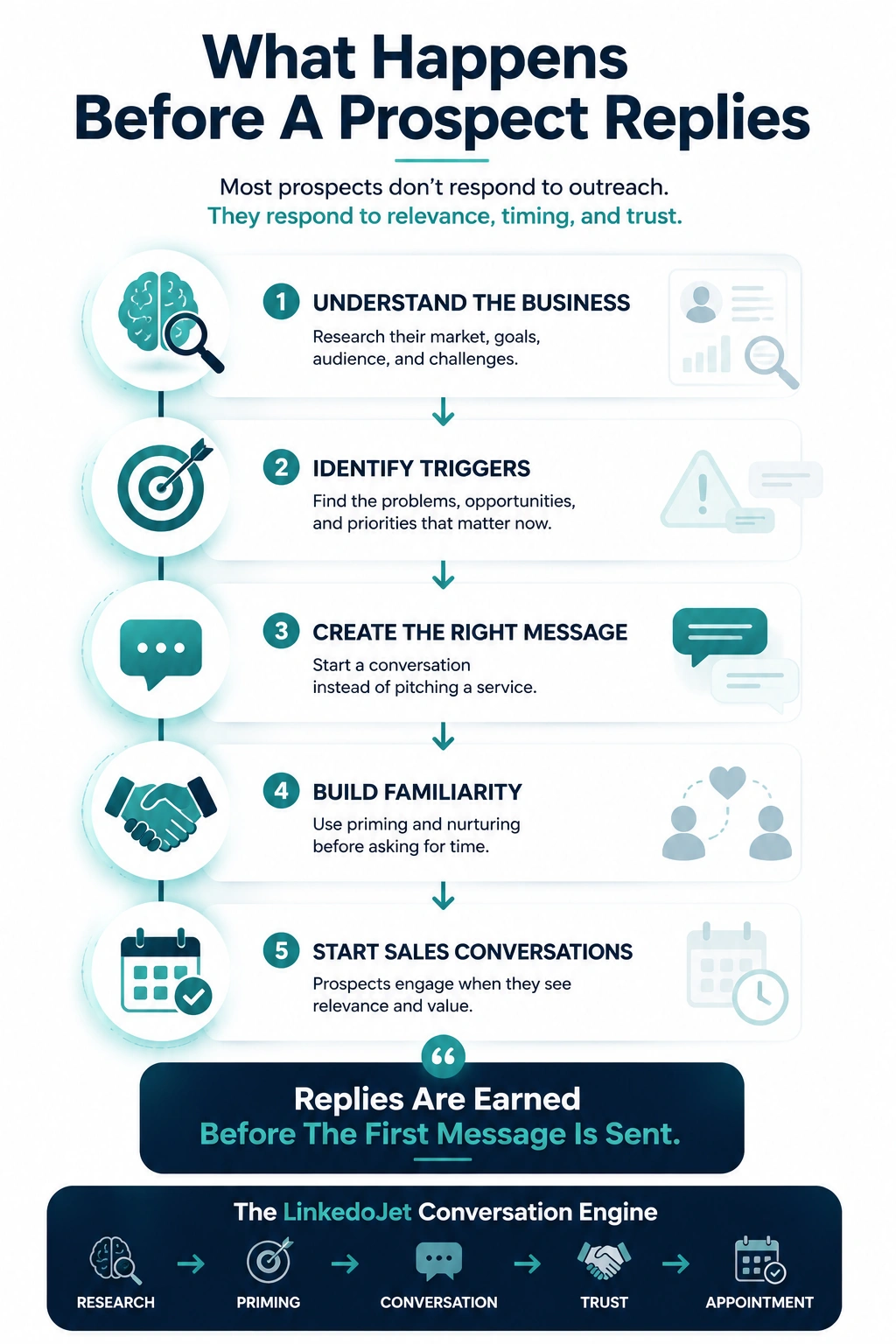
From “cold profile” to spec conversation: why most outreach dies at “send info”
If your LinkedIn outreach sounds like a vendor introduction, you’ll get vendor results: “send info,” silence, and a long, expensive gap before you ever touch a finish schedule.
You’re not losing because your product isn’t good. You’re losing because your first impression reads like risk.
Architects and senior designers don’t have time to “learn a new vendor” in a DM. Developers and owner’s reps aren’t looking for inspiration in LinkedIn messages; they’re scanning for anything that could blow up a schedule, a budget, or a handover. And GCs? They’ll ignore anything that smells like another thing they’ll have to defend on site.
So when a message leads with brand history, awards, or a line card, the brain does the fastest possible classification: vendor noise. They reply “send info” to be polite (or to clear the notification), and the conversation is effectively over.
The hidden cost isn’t one missed meeting. It’s a quiet hit to your positioning: you start to feel interchangeable. And in luxury materials, “interchangeable” is how you end up value-engineered out before you even knew the project existed.
How specification actually moves (and what your messages must earn)
LinkedIn doesn’t close the deal. It earns the next micro-commitment that matches how projects move.
Specification-driven sales is not a straight line from interest to order. It’s a sequence of risk-reduction moments.
Most brands message as if the next step is “a call.” For design-led buyers, the next step is usually smaller, more specific, and tied to the project’s reality.
| Project pathway | What the buyer is protecting | Micro-commitment your message should earn |
|---|---|---|
| Discover | Taste, time, attention | Answer one tight question (lead time / maintenance / installer pushback) |
| Shortlist | Reputation, concept integrity | Permission to send a targeted spec-fit note (not a catalog) |
| Sample / mockup | Client approval, finish accuracy | Sample request, mockup guidance, or a quick “what’s the application?” exchange |
| Submittal | Compliance, schedule, substitution risk | Spec sheet + install detail pack for the specific application |
| Install reality | Punch list, callbacks, blame | A practical note that prevents a known pitfall (shade range, grout, prep, slip rating) |
The point of the sequence is to behave like someone who understands the pathway. That means your messages need to be short enough for mobile, and specific enough to reduce uncertainty. The “appointment” you’re aiming for isn’t a demo. It’s a 10–12 minute spec-fit check or a materials shortlist chat that naturally leads to samples, mockups, and submittal support.
A sequence that earns trust: connect → context question → friction follow-up → taste + risk → insight nurture → spec-fit ask → close-loop
This is conversation engineering for a world where taste matters—and install risk has a long memory.
Every step is designed to earn one small “yes” without forcing a meeting too early.
1) Connection request (clean, non-creepy, no portfolio cosplay)
Why it works: it signals relevance without pretending intimacy.
Example:Hi [Name]—I’m with a materials brand focused on premium [stone/tile/wood/glass]. I follow a lot of [hospitality/lux res] work in [region] and liked your note on [topic]. Open to connecting?
2) First message after acceptance (context + one tight question)
Why it works: they can answer in five seconds, between meetings.
Example:Thanks for connecting, [Name]. Quick question—when you’re selecting [surface/fixture] for [project type], what tends to break the spec most often: lead time surprises, maintenance reality, or installer pushback?
3) Friction follow-up (if no reply)
Why it works: you’re not chasing; you’re showing you understand where projects get burned.
Example:Asking because we keep seeing teams get burned by “looks great in photos” materials that turn into shade-variation and replacement issues on site. Do you run into that often, or is it more a lead-time problem lately?
4) Taste + risk trigger (designed to feel understood)
Why it works: it mirrors the real tension—design intent vs install consequences.
Example:When a client pushes for something more statement—large format, strong veining, matte/honed—do you prefer to de-risk it with an early mockup, or wait until the GC is locked? Curious how you usually run that.
5) Insight nurture (one useful line, optional 1-pager)
Why it works: you sound like a peer who’s seen the movie before, not a rep with a brochure.
Example:One small thing we’ve learned: with honed/matte surfaces in high-traffic hospitality, the maintenance plan matters as much as the spec. If helpful, I can share a 1-page checklist designers use to avoid the post-install “why does it look different?” conversation.
6) Spec-fit ask (low pressure, narrow scope)
Why it works: it doesn’t assume they want you; it offers a quick filter.
Example:If you’re open to it, happy to do a quick 10-minute spec-fit check—just to understand what you typically need (lead times, finish direction, outdoor/slip rating, fabrication constraints) and tell you whether we’re even relevant. Would next week be a bad time?
7) Close-loop (polite exit that preserves brand)
Why it works: it removes pressure and leaves a credible future door open—next project cycle, not “never.”
Example:No worries if now isn’t the moment. I’ll step back—if you ever need a fast sample pack or want a second opinion on a surface option for a project, feel free to ping me here.
Message examples by persona (same product, different constraints)
If you send the same message to a principal architect, a senior interior designer, and a developer, you’re telling them you don’t understand who carries which risk.
Principal architect / project architect
They’re protecting: performance, compliance, detail clarity, submittal friction.
Example:Quick one—on recent [multifamily/hospitality] work, what’s been the bigger spec headache: lead time volatility, slip rating/outdoor compliance, or installers pushing substitutions late? I’m trying to understand what’s actually slowing approvals right now.
Senior interior designer / design director
They’re protecting: taste, concept integrity, client approval, “don’t make me regret this.”
Example:When you’re selecting a statement surface (veining direction / monolithic look / matte feel), what’s the thing that tends to disappoint after install—shade range, reflectivity under lighting, or maintenance reality? I’m curious what you’ve been seeing.
Developer / owner’s rep
They’re protecting: schedule, budget exposure, procurement risk, substitutions.
Example:On finish packages lately, what’s been more painful: materials that slip on lead time, specs that get value-engineered, or install rework? If you tell me the constraint, I can say whether we fit—or whether we’re a distraction.
GC owner / luxury residential contractor
They’re protecting: installability, callbacks, site logistics, warranty fights.
Example:Curious—what’s the most common “nice material, bad day” issue you’re seeing: inconsistent shade lots, substrate prep sensitivity, grout/edge detailing, or lead time changes mid-job? I’m asking because we’d rather be honest about where our material behaves well vs where it becomes a headache.
Same brand. Different buyer brain. When you match the message to the risk they carry, replies go up without getting louder.
What gets ignored (and quietly damages brand perception)
In luxury, bad outreach doesn’t just fail. It trains the market to file you under “vendor.”
- Vendor-tone intros: “We’d love to introduce our products…” reads like procurement outreach. Designers hear: “I’m going to take your time and give you homework.”
- Long paragraphs: nobody is reading your origin story on a phone between a client call and a site walk.
- Vague personalization: “saw your profile” is a tell. It signals you’re running a template.
- Immediate meeting asks: “Can we hop on a call?” before you’ve reduced any uncertainty feels like you’re skipping the pathway.
- PDF dumping after “send info”: you just gave them a reason to ignore you. If you can’t narrow the context, you’re not relevant.
- “Demo” language: a specifier isn’t shopping software. The next step is spec-fit, samples, mockups, or install detail clarity.
- Fast, frequent follow-ups: it reads as anxiety. Worse, it creates a reputation risk: “that brand is spammy.”
The irony: the brands who most need restraint (premium products, high taste) often sound the most desperate in outbound. Not because they are—because their sequence has no micro-commitments built in.
Priming before the ask: two light touches + pacing rules
The goal is to feel peer-level: specific, helpful, and honest about tradeoffs.
When you don’t get a reply, you don’t “check in.” You prime. Two touches is usually enough to signal credibility without becoming a nuisance.
Light touch #1: lead-time reality (region + category)
Example:Quick note—hearing a lot of teams in [region] are building more buffer into [stone/tile/glass] decisions because “promised” lead times are moving mid-stream. Are you seeing that too, or is it more stable on your side?
Light touch #2: performance tradeoff / install pitfall (honest, not promotional)
Example:One thing we’ve been flagging early: some matte/honed looks photograph beautifully but show wear patterns faster in certain hospitality corridors. If you’re ever in that situation, I’m happy to share what we’ve seen work (and what we’d avoid).
Pacing rules that protect your brand
- Assume mobile reading: 2–4 lines beats 12.
- Space touches: 3–5 business days between nudges is typically safer than “following up tomorrow.”
- Branch on intent: if they answer, go deeper. If they don’t, keep it light and specific—then close-loop.
- Know when to pause: “We don’t take vendor meetings,” procurement-only instructions, or repeated silence after a clear close-loop means stop. Preserve brand equity.
This is where most teams either over-chase (and look spammy) or disappear entirely (and miss the next project cycle). The right sequence sits in the middle: calm, relevant, and persistent without pressure.
Answers to the questions your team will run into
What should a LinkedIn connection request say to an architect or interior designer without sounding creepy or salesy?
Keep it short, grounded, and non-performative. Reference something public (a post topic, a project type, a region, a firm focus) and make the ask small.
Hi [Name]—I’m with a premium [category] materials brand. I follow a lot of [hospitality/lux res] work in [region] and liked your note on [topic]. Open to connecting?
Avoid implying you studied their whole portfolio. That’s where “creepy” comes from.
How do you respond to “Send info” without dumping PDFs and getting ignored?
Reply with one narrowing question that forces context, then offer a small targeted pack.
Happy to. Quick so I don’t spam you—what’s the application? (bath, lobby, exterior, kitchen, pool deck) And are you typically prioritizing matte/honed vs polished?
When they answer, send a tight bundle: 1-page spec sheet + 3 relevant install notes + sample options. Not a 40-page catalog.
How many follow-ups are appropriate in a vendor-saturated design market—and when should you pause?
Think in purposeful touches, not “attempts.” A common pattern is: initial question → one friction follow-up → one insight touch → close-loop. Spaced 3–5 business days apart.
Pause if they (1) explicitly say no vendor outreach, (2) direct you to procurement only, or (3) ignore the close-loop. In luxury, restraint is part of the brand.
What are the best conversation triggers for specification-driven materials (lead time, shade variation, slip rating, maintenance, installer pushback)?
The best triggers are the ones people get blamed for later:
- lead time volatility and mid-project changes
- shade range / dye lot consistency (and replacement matching)
- slip resistance and outdoor rating (especially pool decks, entries)
- maintenance reality for matte/honed and textured finishes
- installer/fabricator pushback (prep sensitivity, edge details, grout tolerances)
Ask it as a tradeoff question so they can answer quickly.
What’s the right “meeting” to ask for if you sell premium surfaces or architectural systems (spec-fit check vs demo)?
Ask for a narrow spec-fit check, not a demo. Frame it as a filter: you’ll learn their constraints and tell them whether you’re even relevant.
Open to a quick 10-minute spec-fit check? I’ll ask a couple constraint questions (lead time window, application, finish direction, slip/outdoor, fabrication) and I’ll tell you if we fit—or if you should ignore us.
That feels respectful in a design-led process.
If you want this running consistently, we’ll build and operate the system with you
Not “more messages.” A paced sequence that earns spec conversations, sample requests, and shortlist meetings—without line-card pitching.
LinkedoJet is an outbound engine built for teams that sell on trust and spec risk. We don’t hand you a tool and wish you luck. We set up the targeting, write the sequence in your voice, run the outreach, handle replies, and keep the pipeline clean so your team only spends time where there’s real intent.
What we operationally provide:
- ICP and targeting setup for spec-driven roles (principal vs senior designer vs project architect vs developer vs GC) and the segments that matter (project type, region, firm size, design focus).
- Sales Navigator + LinkedIn prospect list building so you’re not guessing who influences shortlist vs submittal vs install decisions.
- AI-assisted personalization that stays tasteful: light relevance signals (region, project type, public post topic) without creepy overfitting.
- Outreach execution with pacing that protects brand perception—short mobile-first messages, spaced intentionally.
- Lead reply handling and nurturing so “send info” becomes a doorway: we ask the narrowing question, send the right small pack, and keep the thread alive.
- Intent-based branching: if they answer about lead times, we go there; if they care about slip rating or maintenance, we follow that path.
- Warm lead tracking so your team knows who asked for samples, who signaled an active project, and who’s a “next cycle” contact.
- Appointment generation support focused on the right meeting: spec-fit checks, shortlist chats, sample/mockup coordination—not generic demos.
- Campaign visibility through dashboards so you can see what’s being sent, what’s landing, and where conversations stall.
- Ongoing refinement as market conditions shift (lead times, substitution pressure, new install issues showing up).
What happens after onboarding: we confirm your segments, build your initial prospect lists, write and QA the messaging sequence (including persona variants), launch outreach, then run daily operations—reply handling, follow-ups, and booking support—while you get clear reporting on activity and outcomes.
What you receive: a working spec-conversation sequence, segmented prospect lists, a reply-handling playbook for your team (or managed by us), and a predictable flow of booked spec-fit conversations tied to real constraints (lead time windows, application, maintenance expectations, installer concerns).
Why this is different from ordinary LinkedIn automation tools: tools send messages. LinkedoJet manages the full system—targeting, conversation design, execution, nurturing, tracking, and appointment support—so your brand stays premium and your outreach actually turns into spec conversations.
Next step: turn LinkedIn from vendor noise into spec meetings your team can win
We’ll set up the targeting, run a restrained sequence, handle replies, and help convert warm conversations into booked spec-fit appointments—without turning your brand into a template.
From identifying the right decision-makers to starting meaningful conversations and turning them into qualified appointments... LinkedoJet manages the entire outbound engine for your business.