
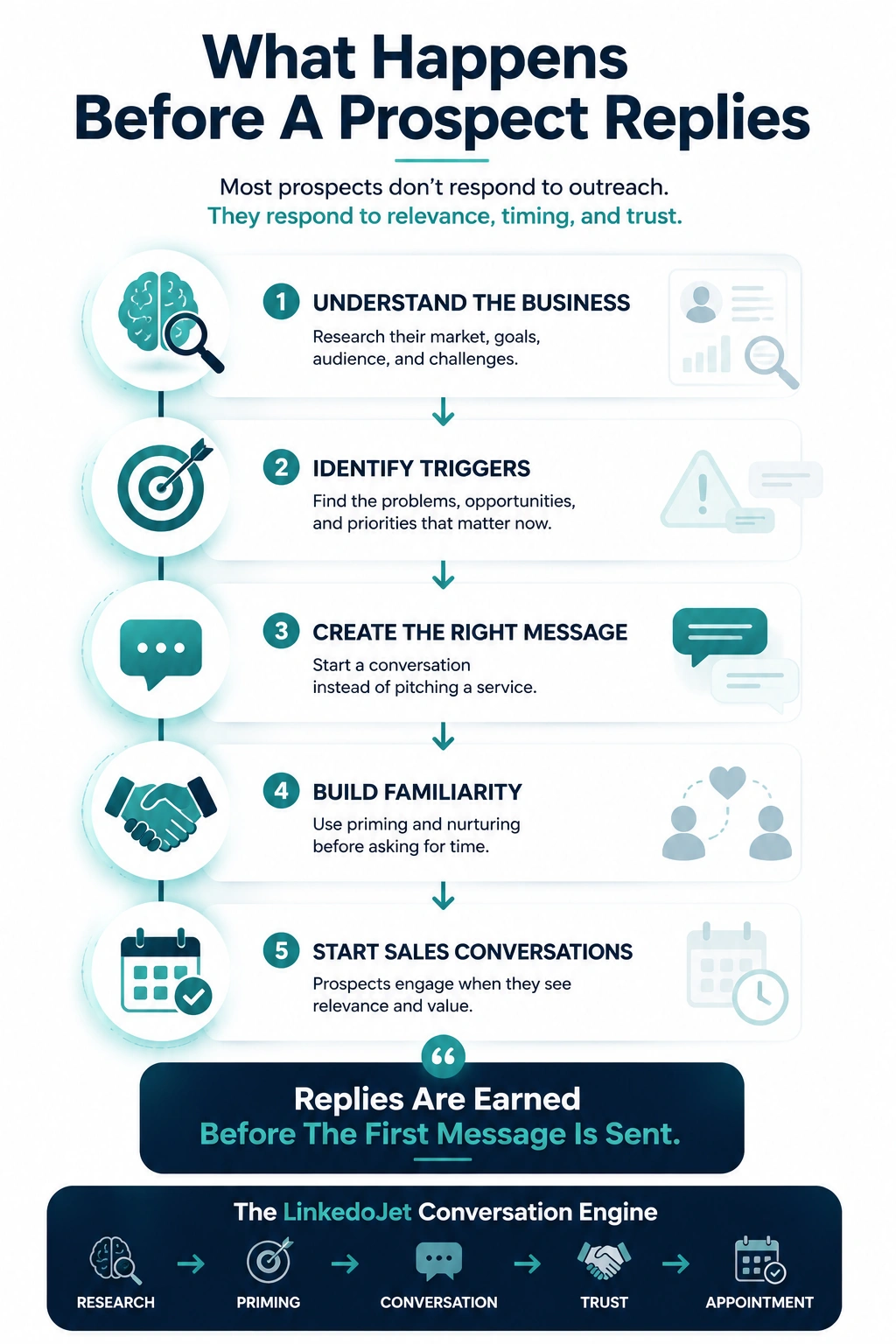
Your enablement offer isn’t the problem—your inbox is
If revenue leaders aren’t replying, you don’t have a positioning issue. You have a conversation design issue. And it shows up as pipeline, not copy.
You can feel it when you open your sent folder.
The team is doing the work—connection requests, follow-ups, “personalization,” the right titles. And the result is still the same: silence from CROs, short deflections from VPs of Sales, and a slow drip of “not a priority” from RevOps.
Then you’re in the internal meeting explaining the gap: lots of activity, not many real conversations.
It’s uniquely frustrating when you sell enablement. You’re supposed to be the company that fixes talk tracks, drives behavior change, and improves messaging discipline—yet your outbound reads like the exact enablement spam your buyers complain about.
The hidden cost isn’t just missed meetings. It’s what happens downstream:
- Weeks burned chasing low-yield threads while better-fit accounts never even see a relevant message
- Deals stalling before discovery because you never earned enough context to ask for time
- CAC creeping up because partners/referrals become the only reliable channel
- Pressure building internally as quotas still assume outbound “should work”
Most teams respond by sending more messages.
That’s how you get more ignored—faster.
What your buyers do all day (and why your message must be answerable in 10 seconds)
Revenue leaders don’t read LinkedIn like a newsletter. They triage it between forecast calls and internal fires.
CROs and VP Sales live inside dashboards, pipeline inspection, and deal reviews. Their day is a cycle of: “What moved? What didn’t? Who needs coaching? What’s the forecast risk?”
Enablement is in a different kind of chaos: onboarding throughput, certification rollouts, content requests, stakeholder alignment, and the constant question of adoption—did anyone actually change behavior?
RevOps is protecting the operating system: process friction, data hygiene, tool sprawl, and the politics of reporting when leadership changes the definition of “good.”
So when they glance at LinkedIn, they’re not looking for category talk. They’re looking for anything that’s immediately answerable—or immediately ignorable.
| What they’re thinking | What most enablement vendors send | What actually earns a reply |
|---|---|---|
| “Where is execution breaking?” | “We improve win rates with our platform/coaching.” | One concrete symptom + a choice-based question |
| “Do we have inspection discipline?” | “AI-personalized enablement at scale.” | Plain language about coaching cadence, adoption, measurement |
| “Is this urgent this quarter?” | “Can I show you a quick demo?” | Nurture first, then a low-pressure next step |
Timing matters more than most teams admit. These leaders check LinkedIn in small windows: early morning before standups, between internal meetings, or late afternoon when they’re catching up.
- Best windows: 7:00–9:00am local, 4:00–6:30pm local
- Usually weak: Monday morning fire drills, Friday late afternoon “cleanup,” and end-of-quarter chaos
- Exception: quarter-end pressure can work if your opener is explicitly about inspection, forecast risk, ramp, or coaching rigor
A sequence that earns the meeting (without asking for it in message one)
Connection → symptom question → follow-up angle → insight nurture → low-pressure meeting ask → close the loop. Short, role-aware, and designed for real replies.
1) Connection request (short, role-aware, no performance)
To CRO / VP Sales:
“I work with enablement teams on onboarding + manager coaching adoption. Thought it’d be good to connect.”
To Head of Enablement:
“I spend most of my time on adoption—getting talk tracks and content used in the field. Happy to connect.”
To RevOps:
“I work around enablement measurement/inspection (what’s actually changing vs just trained). Thought I’d connect.”
2) First message after acceptance (one pattern + a choice-based question)
“Quick question—when teams say ‘enablement isn’t landing’, is it usually onboarding completion, manager coaching consistency, or content usage that’s the real bottleneck for you?”
Why it works: it doesn’t force them into your category. It lets them pick the lane they actually care about.
3) Follow-up angle (not a bump—name an internal conversation)
“Reason I ask: I keep hearing ‘we trained them, but behavior didn’t change’. Are you seeing more of a coaching cadence issue, or measurement/inspection?”
Notice what’s missing: no pitch, no outcome claim, no “open to a quick chat?”
4) Emotional trigger question (practical, not dramatic)
“Do you have a clean way to tell whether managers are actually coaching to the talk track—or is it mostly anecdotal until numbers move?”
5) Insight nurture (2–4 lines, useful even if they never buy)
“One thing that’s been working: tying onboarding milestones to a manager-led certification moment (not just LMS completion). Adoption jumps when it’s inspected in the same rhythm as pipeline.”
6) Low-pressure meeting ask (give a choice)
“If it’s helpful, I can share the 3-question ‘adoption gap’ check we use to spot whether the issue is coaching, content findability, or measurement. Worth a quick 15 minutes next week, or should I just send it here?”
7) Polite close-loop (protect goodwill)
“I’ll close the loop for now. If enablement becomes a priority again—new rollout, new leader, or ramp time starts getting attention—happy to compare notes.”
Why sales enablement outreach gets ignored (and what to fix this week)
Ignored messages usually aren’t “bad.” They’re just written for a vendor’s narrative, not a revenue leader’s reality.
Here are the failure patterns I see constantly from enablement companies—platforms, coaching shops, training providers, conversation intelligence-adjacent services. Different logos, same thread.
- Category language instead of symptom language. “Enablement platform” means nothing to a CRO compared to “ramp slipped again” or “managers aren’t coaching.”
- Buzzword stacks. “AI-driven enablement + revenue acceleration + playbooks” reads like you’re hiding the actual mechanism.
- Outcome claims with no lever. “Increase win rates” is ignored unless it’s anchored to something real: coaching cadence, onboarding milestones, talk track consistency, inspection rhythm.
- Fake personalization. Copying their headline, company description, or recent post and pretending it’s relevance.
- Premature demo asks. If you ask for time before you earn shared problem clarity, you train them to say “send info.”
- Same sequence to CRO, Enablement, and RevOps. They do not experience the problem the same way, and they don’t use the same words internally.
The fix isn’t “be more clever.” It’s to be easier to respond to.
One symptom. One question. One follow-up that adds a second angle. One insight. Then a small next step that feels like help, not a trap.
Persona pivots: same offer, different buyer language
If you sell enablement, you’re selling into an internal system. Your message should match the part of the system each persona owns.
CRO
What they care about: forecast risk, pipeline coverage, time-to-productivity, and whether managers are running the business with rigor.
Symptom-led opener: “When ramp slips, is it usually onboarding throughput or manager inspection that breaks first for you?”
VP Sales
What they care about: coaching consistency, deal execution, rep consistency, and whether the field is actually using the playbook.
Symptom-led opener: “Curious—are you seeing more ‘we trained it but it didn’t stick,’ or more ‘managers coach differently team to team’?”
Head of Sales Enablement
What they care about: adoption, content usage, capacity, and stakeholder alignment. They’re measured on outcomes but blocked by dependencies.
Symptom-led opener: “Where is adoption breaking most right now—content findability, manager enforcement, or measurement that doesn’t reflect reality?”
RevOps
What they care about: measurement, process friction, tool sprawl, and data that leadership trusts during inspection.
Symptom-led opener: “Do you have a clean signal for ‘coaching happened’ and ‘talk track was used,’ or is it mostly assumptions until pipeline moves?”
When you pivot language like this, two things happen: you stop getting generic deflections, and you start getting context.
Context is what turns a thread into a meeting.
Reply handling logic: deflections are doors (if you know what to ask next)
Most teams lose the meeting in the reply handling—not the first message.
Deflection: “Send info.”
Bad response: a deck link and a “let me know.”
Better response: “Happy to. Quick check so I send the right thing—are you more focused on onboarding/ramp, manager coaching cadence, or content adoption right now?”
If they answer, you’ve earned a lane. Then you can send a tight, relevant artifact and keep the thread alive.
Deflection: “We already have enablement.”
Interpretation: they’re not saying “no.” They’re saying “don’t pitch me the category.”
Follow-up: “Makes sense. When you look at the last 60 days, what’s the one place it’s not landing—manager coaching consistency, content usage, or inspection/measurement?”
Objection: “Nice-to-have.”
Follow-up: “Totally fair. What would have to break for it to become urgent—ramp slipping, pipeline coverage pressure, or a new rollout that needs adoption fast?”
Timing: “Not this quarter.”
Follow-up: “Understood. Should I circle back after quarter-close, or if a rollout/adoption issue spikes? If you tell me which symptom matters most, I’ll keep anything I share tight.”
When to slow down (nurture) vs. push for time
- Slow down when they’re polite but vague, or when they ask for info without naming a problem. Keep it insight-first.
- Offer time when they mention a rollout, a new leader, a KPI miss, a deadline, or they ask “how do you handle adoption/coaching/measurement?”
Clear stop signals
- “Please remove me / stop messaging.”
- They’re locked into a multi-year contract and explicitly happy.
- Annoyance or sarcasm—don’t “win them back,” protect the brand.
FAQ
What should a sales enablement company say in a LinkedIn connection request to a CRO or VP Sales?
Keep it short, role-aware, and free of big claims. You’re asking for a connection, not permission to pitch.
Example: “I work with enablement teams on onboarding + manager coaching adoption. Thought it’d be good to connect.”
If you want to add relevance, add a symptom, not a category: “Been seeing ramp slip when coaching cadence breaks—curious how you’re handling it.”
How long should a LinkedIn messaging sequence be before you ask for a meeting?
Plan on 4–6 touches after acceptance for revenue leadership, with the meeting ask showing up only after you’ve earned a real signal (they answer your question, they share context, they ask how you handle something).
A good pattern is: symptom question → second angle → practical frustration question → short insight → low-pressure ask with a choice → close-loop.
How do you pitch sales enablement on LinkedIn without sounding spammy or like a generic enablement vendor?
Don’t pitch enablement. Start with one operational failure mode they recognize: ramp, manager coaching cadence, talk track stickiness, content usage, or inspection/measurement.
Then ask a question that’s easy to answer in 10 seconds. If your message needs a paragraph of context, it won’t survive their day.
What are good LinkedIn follow-up messages when a revenue leader says “send info” or “we already have enablement”?
“Send info” follow-up: “Happy to—quick check so I send the right thing: are you more focused on onboarding/ramp, manager coaching cadence, or content adoption right now?”
“We already have enablement” follow-up: “Makes sense. Where is it not landing lately—manager consistency, content usage, or inspection/measurement?”
The goal is to turn the deflection into a lane. Once you have a lane, you can share something tight and relevant and earn a meeting naturally.
When should you message CROs and RevOps on LinkedIn (timing windows and when to avoid outreach)?
Best windows are early morning (7–9am local) and late afternoon (4–6:30pm local). That’s when they’re most likely to triage messages.
Avoid Monday mornings and the worst of end-of-quarter unless your message directly relates to quarter-end pressure (forecast risk, inspection, ramp, coaching rigor). Random “thought leadership” doesn’t land during fire drills.
If you want meetings, don’t buy a tool—install the outbound engine
LinkedoJet builds and runs conversation-first LinkedIn sequences for sales enablement companies, then tracks warm replies through to booked appointments.
This isn’t a “let’s talk about your goals” call. It’s a working session to see if we can install a sequence that your buyers will actually answer.
What LinkedoJet operationally provides:
- ICP + targeting setup for enablement buyers (CRO, VP Sales, Enablement, RevOps) including persona mix and exclusion rules
- Sales Navigator / LinkedIn prospect list building so your team isn’t guessing who matters at each account
- AI-assisted personalization that stays grounded (role triggers, initiative signals, and symptom relevance), not headline copy/paste
- LinkedIn outreach execution with timing windows that match how revenue leaders actually check LinkedIn
- Lead reply handling and nurturing (deflections, objections, intent signals) so good threads don’t die in the inbox
- Warm lead tracking and handoff so you can see who’s engaged, what they said, and what to do next
- Appointment generation support to convert “send info” into a real meeting without forcing a demo ask
- Campaign visibility through dashboards so you can manage reality: replies, lanes, conversion, and where drop-off happens
- Ongoing campaign refinement as you learn which symptoms and persona angles produce meetings
How it works after onboarding: we build your initial targeting + lists, write role-specific sequences with symptom-led openers, set up follow-up logic and nurture messages, then run the outreach day-to-day while tracking warm replies and meeting outcomes. You get visibility into what’s being sent, what’s landing, and what’s converting—without your team living in LinkedIn all day.
Why this is different from ordinary LinkedIn automation tools: tools send messages. LinkedoJet runs the system—targeting, conversation design, personalization, follow-up logic, reply handling, and appointment conversion—so you’re not stuck with “activity” and no conversations.
Next step: get a sequence that earns replies from revenue leadership
You’ll leave with clear targeting, symptom-led messaging, follow-up logic, and a practical path from LinkedIn thread → warm lead → qualified appointment.
From identifying the right decision-makers to starting meaningful conversations and turning them into qualified appointments... LinkedoJet manages the entire outbound engine for your business.