
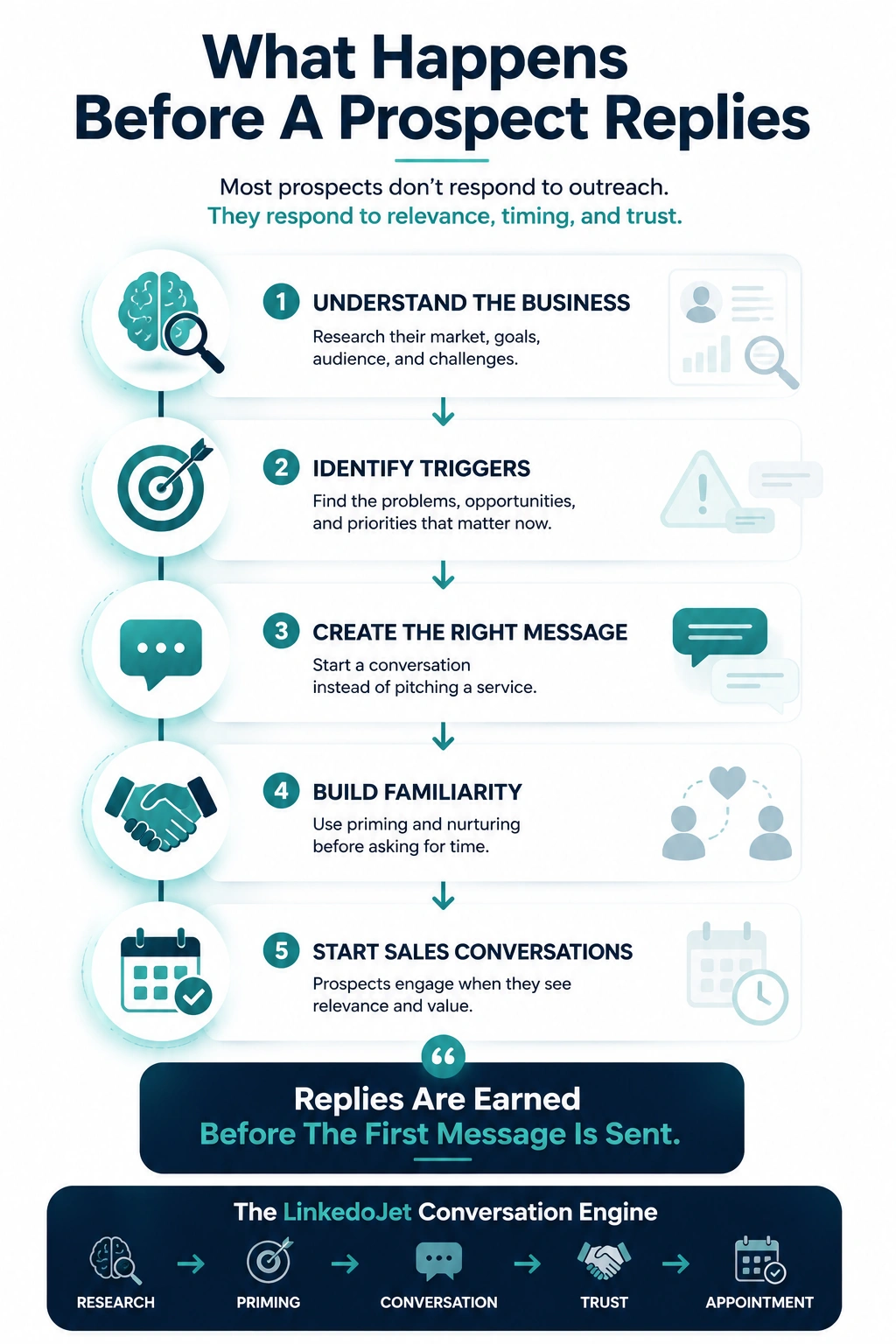
If your LinkedIn message reads like a Golden Visa pitch, you don’t get a “no”—you get silence
In residency-by-investment, the penalty for “almost okay” messaging is brutal: you don’t just lose a lead, you quietly lose trust with someone who values discretion more than speed.
Most advisors think they have a reply-rate problem. They don’t. They have a conversation safety problem.
HNWI applicants and reputation-sensitive partners are scanning for three signals in the first few lines: legitimate, confidential, not a waste of time. If your opener even slightly smells like “passport for sale” or a mass template, they won’t argue with you. They’ll just stop engaging.
And the worst part is you can’t see the damage. You only feel it later when you’re back to living off referrals you can’t control, or your team is spending hours chasing threads that go nowhere.
This playbook is built for the reality of RBI business development: you earn calls by stacking micro-commitments—permission to talk, a safe qualifier, then a suitability screen invite—without asking for sensitive details in chat, without program-dumping, and without making promises you can’t (and shouldn’t) make.
Two lanes. Two jobs-to-be-done. Two different sequences.
You’re not running one LinkedIn funnel. You’re running two, and when they share the same messaging, both underperform.
Lane A: Applicant acquisition
Founders, remote executives, internationally mobile families. They’re not “shopping a country.” They’re trying to reduce uncertainty across tax residency, travel flexibility, schooling, safety, and business continuity—while avoiding scams and public exposure. They answer when the message feels like a discreet sanity-check, not an offer.
Lane B: Referral partner growth
Wealth managers, private bankers, family office staff, cross-border tax advisors, international accountants, relocation specialists, premium real estate agents. Their first thought isn’t “is this useful?” It’s “does this create risk for my client relationship?” They respond to boundaries, process, and clean collaboration—never to a pitch for introductions.
The trust ladder: a 7-touch sequence that earns permission before it asks for a call
These aren’t standalone templates. They’re engineered as a sequence: context → safe question → friction acknowledgment → compact insight → suitability invite → close-loop.
Timing logic (simple, works in real inboxes): Touch 1 (connection) → wait 1–3 days → Touch 2 → wait 2–4 days → Touch 3 → wait 4–7 days → Touch 4 → wait 5–10 days → Touch 5 → wait 3–6 days → Touch 6 → wait 5–10 days → Touch 7. If they respond at any point, you stop the sequence and move to intent-based replies.
1) Connection request (short, contextual, non-needy)
Applicant:
“Hi <
Referral partner:
“Hi <
2) First message after acceptance (aim for a safe reply, not a pitch)
Applicant:
“Thanks for connecting. Quick question—are you looking at residency/mobility options as a 12-month thing, or more ‘someday’? Totally fine either way.”
Referral partner:
“Appreciate the connect. Are you seeing more clients ask about second residency / mobility planning lately, or has it stayed steady for you?”
3) Soft problem-based follow-up (name the real friction without probing)
Applicant:
“One reason people stall: they start with ‘which country’ before they’ve pressure-tested timelines + document readiness + source-of-funds expectations. Are you already trying to move inside a specific window, or just reducing uncertainty for the next 12–24 months?”
Referral partner:
“Where cases go sideways is usually expectations: processing timelines change, and clients underestimate documentation + compliance friction. Do you already have a go-to resource you trust when a client asks, or does it get handled ad hoc?”
4) Query-based emotional trigger (tasteful: risk, stability, reputation)
Applicant:
“When this becomes urgent, it’s rarely excitement—it’s risk management. Is the bigger driver for you travel flexibility, tax residency planning, or family stability (schooling/safety)?”
Referral partner:
“Be honest—when a client brings up residency planning, is the bigger risk for you making a weak introduction that reflects back on you?”
5) Insight-based nurture (one compact insight + a discreet artifact)
Applicant:
“A small thing that saves months: a suitability screen that starts with constraints (presence days, family members, timeline) before anyone talks ‘programs.’ I can send a one-page checklist we use—meant to be skimmed in 2 minutes. Want it?”
Referral partner:
“We keep partner collaborations clean by using a simple suitability criteria sheet + referral workflow (what we ask, what we don’t, when the advisor stays in the loop). If it’s helpful, I can send the one-pager—no forms, no gating. Should I?”
6) Soft meeting request (frame as a suitability screen and time-saver)
Applicant:
“If you’re open to it, we can do a 10–15 min suitability screen—high-level only. No documents, no sensitive details on the call unless you choose to proceed. The goal is simply to rule in/out whether this is worth your time. Want me to send a couple slots?”
Referral partner:
“If you ever refer these, a quick 12-min alignment call usually saves everyone headaches: suitability criteria, process boundaries, and how we keep you informed without stepping on the relationship. Worth doing, or better if I just send the one-pager?”
7) Final close-loop (professional, respectful, easy “no”)
Applicant:
“I’ll close the loop on my side. Want me to send the one-page checklist, or should I circle back in a few months? If it’s not relevant, feel free to say ‘not a priority.’”
Referral partner:
“No need to force timing—happy to leave it here. Would you prefer the suitability/process one-pager, or should I disappear and reconnect later in the year?”
What Golden Visa prospects ignore on LinkedIn (and why it’s not personal)
They’re not ignoring you because your offer is weak. They’re ignoring you because your message increases perceived risk.
- Country lists in the first touch. It signals you’re about to dump options and push them into a lane before you understand constraints.
- Pricing, ROI, “investment amounts” upfront. It attracts the wrong intent (price-shopping + guarantee seekers) and repels serious planners.
- “Guaranteed approval” language (or anything that hints at it). Serious buyers and serious partners both treat this as a red flag.
- “Let’s move to WhatsApp” immediately. Even if you mean well, it reads like a low-trust pattern in a scam-heavy category.
- Faux personalization. “Saw your profile” + a generic pitch is worse than being direct. It tells them you’re running volume.
- Program-dumping. Long paragraphs about timelines, benefits, and “best options” before you’ve earned the right to discuss specifics.
The mistake underneath all of it: trying to sell the program instead of running a suitability conversation.
How to screen for fit without interrogating (and when to pause)
You can qualify on LinkedIn without turning the chat into an intake form. The trick is to ask questions that feel like responsible triage, not data collection.
Qualifiers that work in-message
- Timing window: “Are you aiming for something within 6–12 months, or planning further out?”
- Presence flexibility: “Do you need low physical presence, or are you fine spending meaningful time in-country?”
- Family complexity: “Just you, or family members as well? (No details—just scope.)”
- Stability vs speed: “Are you optimizing for predictability, or are you comfortable with more moving pieces?”
- Representation: “Are you already working with counsel/advisors on this, or still exploring?”
What you don’t do in LinkedIn chat: ask for documents, sensitive financial detail, or anything that forces them to expose intent in writing.
Clear “pause/stop” signals (protect your brand)
- They push for guarantees or “100% approval.”
- They request sensitive data in chat or want you to advise around compliance boundaries.
- They show discomfort with confidentiality, or ask you to move to a channel that feels wrong for the stage.
- They’re represented and want you to go around their advisor. (Offer to coordinate with the advisor instead.)
When you pause, do it professionally: “Happy to keep it high-level here. If you want specifics, we can do a short suitability screen, or I can speak with your advisor directly.” That line alone saves reputations.
Follow-up and nurturing that earns trust in a skepticism-heavy category
Most ghosting is self-inflicted. The follow-up repeats the pitch, adds pressure, and increases risk. Your job is the opposite: make it easier to reply safely.
Micro-commitments that move threads forward
- Permission: “Want the one-pager?” beats “Can we hop on a call?”
- One constraint: “Is physical presence flexibility a factor for you?” (single answer, low exposure)
- One choice: “Better to circle back in 90 days, or is this live now?”
Discreet artifacts that don’t feel like marketing
- A one-page suitability checklist (constraints-first, not program-first)
- A short decision tree: “If timeline is X and presence is Y, here’s the type of path that tends to fit”
- A partner process one-pager: boundaries, communication cadence, and what qualifies as a good referral
And when they ask the classic questions—“Which country is best?” or “How much does it cost?”—don’t dodge, but don’t dump.
Answer pattern: acknowledge → explain why it depends (constraints) → offer a narrow next step.
“I can give ranges, but ‘best’ depends on timeline + presence flexibility + family scope. If you’re open, we do a 10–15 min suitability screen first, then I’ll point you to the right lane (even if it’s not with us).”
How LinkedoJet turns this playbook into repeatable suitability calls
Most teams fail here for a boring reason: they can write one good message, but they can’t run a consistent, segmented sequence across applicants and partners—while staying discreet, compliant, and on-brand.
LinkedoJet isn’t “automation.” It’s the outbound engine behind your advisory.
- ICP + targeting setup: we define your two lanes (applicants vs partners) with clear filters and exclusions so you don’t spray sensitive messaging into the wrong rooms.
- Sales Navigator / LinkedIn list building: we build and maintain prospect lists that match real intent signals (mobility context, cross-border roles, partner client bases), not vanity titles.
- AI-assisted personalization: not gimmicks—short, human context that reads like you wrote it and stays within compliance-safe language.
- Outreach execution: the trust-ladder sequence runs with timing logic and role-specific framing so the first ask is permission, not a meeting.
- Reply handling + nurturing: we categorize replies by intent (curious, skeptical, price-shopping, represented, not-now) and route the right follow-up so threads don’t die in your inbox.
- Warm lead tracking + appointment support: we track who’s warm, who needs a nudge, and we support suitability-call booking without you chasing for weeks.
- Dashboards + refinement: you see what’s happening (connect rates, reply rates, call conversions) and we tune messaging based on what the market is actually doing.
The outcome is simple: fewer awkward threads, fewer ghosts, and more conversations that naturally earn a suitability call—without acting like a promoter.
FAQ
What’s the safest first LinkedIn message to a Golden Visa / RBI prospect without sounding like an ad?
Keep it neutral and scenario-based. Reference “residency planning” or “mobility decisions,” not a specific program, country list, or outcomes. Then ask a question that lets them answer without exposing sensitive intent: timeframe (this year vs later) or presence flexibility. Add an easy out: “If not relevant, feel free to ignore.”
How do you ask referral partners (wealth managers, private bankers, family offices) without signaling you want direct access to their clients?
Lead with boundaries and process. Make it clear you’re not asking for introductions. Ask whether they’re seeing questions come up, and offer a simple suitability criteria / workflow one-pager. Partners engage when they feel protected: clear handoffs, advisor stays informed, and no behind-the-scenes client chasing.
When should you ask for a suitability call—and what should you promise (and not promise) on that call?
Ask after two micro-commitments: they acknowledge the scenario and answer one qualifier (timing, presence, family scope, or stability preference). Promise a short, high-level screen (10–15 minutes) designed to rule in/out fit and save time. Do not promise approval, timelines, or “best country” decisions before you understand constraints.
How do you handle “Which country is best?” and “How much does it cost?” without turning the chat into a program dump?
Answer with a frame, not a brochure. “Best” depends on constraints—timeline, presence flexibility, family members, risk tolerance, and whether they prioritize stability vs speed. Offer ranges only after you know the lane. Then propose the narrow next step: a short suitability screen, or sending a one-page checklist to align on assumptions first.
What are the red flags that mean you should stop the LinkedIn thread (guarantee seekers, sensitive data requests, discomfort)?
Stop or pause when someone pushes for guarantees, asks to share sensitive data in chat, wants you to skirt compliance boundaries, or shows discomfort with confidentiality. Also pause if they’re represented and want you to go around their advisor. The professional move is to keep it high-level and offer a suitability call or advisor-to-advisor coordination.
See the exact sequences running in your market—and get the outbound engine built for you
This isn’t a generic “strategy chat.” We’ll show you what LinkedoJet operationally builds and runs so your team gets more suitability calls and more partner conversations without sounding promotional.
On the session, we’ll review: your current positioning and inbox failure points (where replies die), the two-lane segmentation (applicants vs partners), and what a discreet trust-ladder sequence looks like for your exact ICP.
If we’re a fit and you onboard, LinkedoJet delivers the full system:
- Targeting + ICP setup: define who you should contact (and who you should never contact) to protect brand and compliance posture.
- Prospect list building: Sales Navigator and LinkedIn list creation for applicant profiles (mobility context, cross-border roles) and partner profiles (advisor types + client base fit).
- AI-assisted personalization: brief, human context lines that sound like a professional advisor—not “Hey <
> saw your profile.” - Outreach execution: connection + follow-up sequencing with timing logic that respects how HNWIs and partners actually use LinkedIn.
- Lead nurturing + follow-up workflows: intent-based replies, micro-commitments, and discreet artifacts (checklists/process one-pagers) that move threads forward without pressure.
- Warm lead + appointment tracking: visibility on who’s engaged, who’s stalled, and which conversations are ready for a suitability call—plus support to get calls booked.
- Campaign dashboards + ongoing refinement: you can see performance, and we tune messaging and targeting as programs shift and buyer skepticism changes.
Why this is different from ordinary LinkedIn automation tools: tools send messages. LinkedoJet runs a managed outbound process—segmentation, conversation design, reply handling, nurturing, tracking, and appointment support—built for a confidentiality-sensitive category.
From identifying the right decision-makers to starting meaningful conversations and turning them into qualified appointments... LinkedoJet manages the entire outbound engine for your business.
Next step: turn discreet messaging into predictable suitability calls
If you want more qualified applicant conversations and cleaner partner relationships, you need more than templates—you need a system that runs daily, tracks intent, and follows up like a professional advisory firm.