
Your outreach isn’t “bad.” It’s being filed as vendor noise—and it’s costing you job flow.
When hiring leaders open LinkedIn in 90-second bursts, they don’t read carefully. They pattern-match. Most recruiter messages hit the same pattern, so you get the same outcome: seen, ignored, or the dreaded “send info.”
You know the stand-up: BD updates are basically no replies, a couple of “we’ll keep you in mind,” and one person clinging to a lukewarm lead from three weeks ago.
Meanwhile delivery is on fire, so you tell yourself you’ll “fix BD next week.” Then the month turns, job flow dips, and suddenly you’re arguing about fee discounts or taking vendor-heavy contingent scraps just to keep people busy.
The painful part isn’t that hiring managers “don’t use agencies.” It’s that your message reads like every other recruiter who wants something from them.
Most agencies accidentally train prospects to treat them like a low-trust supplier by doing one (or more) of these:
- jumping straight from connection to “quick call?”
- teasing candidates before you even know the scorecard or comp band
- spraying “are you hiring?” to anyone with a people-manager title
- writing “personalization” that’s really just fluff before the pitch
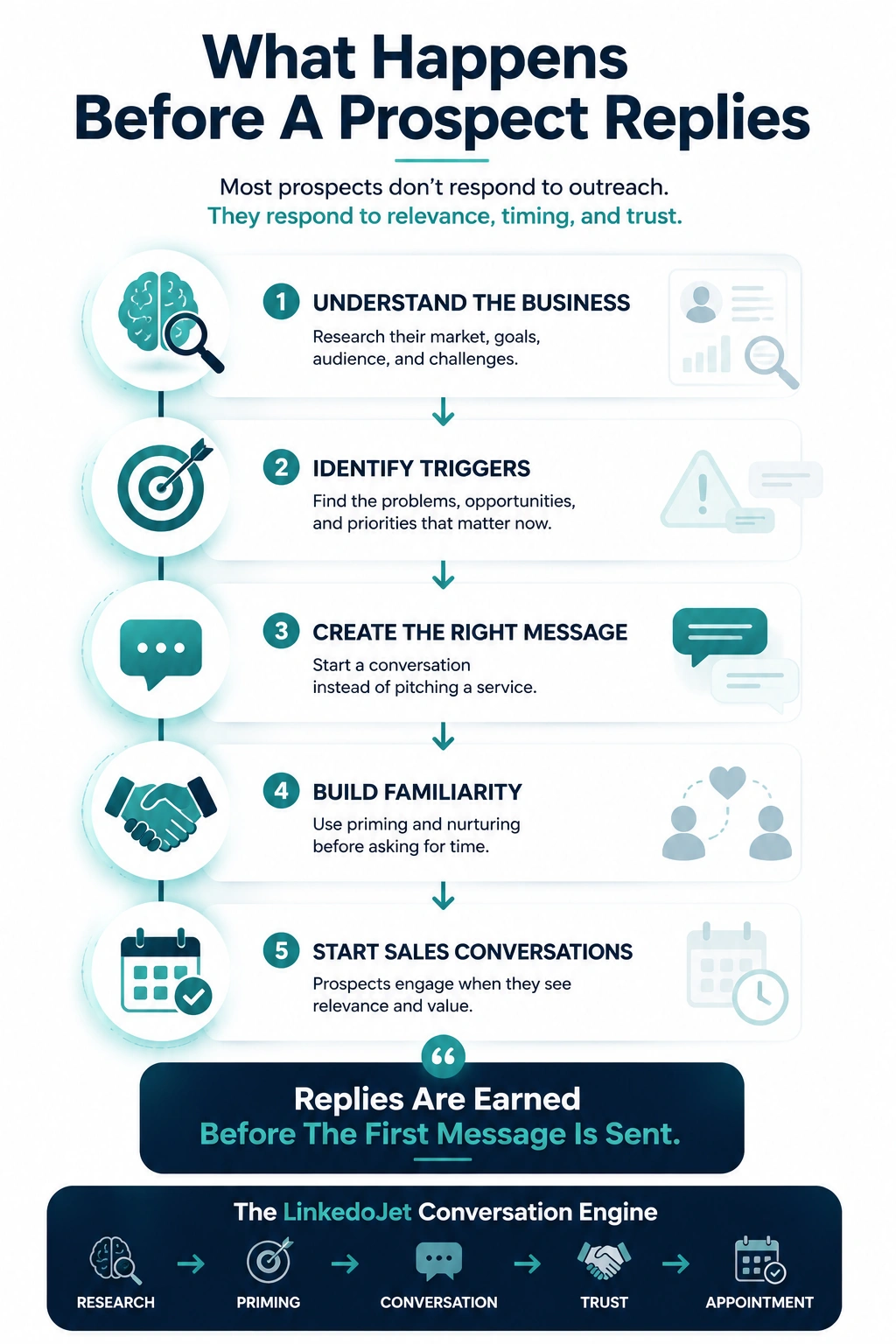
If you want consistent calibration calls, your LinkedIn outreach has to stop acting like meeting-booking and start acting like conversation engineering: earning micro-yeses that prove you understand hiring-side risk.
What makes a Head of Talent reply (and what they ignore)
Hiring leaders reply when a message reduces their workload or their risk—fast. Not “nice intro,” not “we’re specialists,” not “we have candidates.”
They’re measured on outcomes: time-to-hire, quality of hire, offer acceptance, keeping hiring managers aligned, and not letting a process drag until candidates disappear.
And their week is full of context switching: intake, debriefs, approvals, headcount drama, and the business asking why the role is still open.
So what gets a reply? Signals like:
- You understand where hiring breaks. Slow feedback loops, misaligned scorecards, comp bands that don’t clear the market, hybrid constraints that shrink the shortlist.
- You’re not trying to trap them in a meeting. You ask a simple, answerable question first.
- You sound like someone who’s been in the messy middle. “We’re seeing interview drop-off when…” lands better than “We’re a top recruitment firm.”
What they ignore (because it’s what their inbox is full of):
- “I came across your profile…”
- “Loved your post about culture…” then an immediate pitch
- “Are you hiring at the moment?” blasts
- logo name-dropping with no context (“We work with Google, Amazon…”)
- “I have 3 candidates ready to go” (aka CV dumping in disguise)
- asking for 15 minutes before you’ve earned relevance
The shift is simple: stop trying to sell recruiting. Start trying to diagnose the hiring constraint.
LinkedoJet is a conversation-first BD system for agencies (not another automation tool)
Most “LinkedIn tools” help you send more messages.
That’s not the problem. The problem is sending the wrong message to the wrong person at the wrong moment—then calling it “activity.”
LinkedoJet runs the outbound engine end-to-end so your team can stay focused on delivery and high-value BD, not inbox grinding.
Operationally, that means:
- ICP + targeting setup: We define who you should actually be speaking to (hiring manager vs Head of Talent vs HRD vs business leader) by role type, hiring motion, and your model (perm/contract/retained/RPO).
- Sales Navigator prospect list building: We build and maintain lists that match your lane, including the right seniority, functions, and geo/hybrid constraints.
- AI-assisted personalization: Not gimmicky “nice profile” lines—tight relevance cues based on hiring reality and the angle you’re running.
- Outreach execution: Connection + sequenced messaging that earns micro-yeses instead of forcing a meeting.
- Reply handling + nurturing: We manage follow-ups and keep conversations warm without pushing you into unpaid spec work.
- Warm lead tracking + appointment support: Clear visibility into who engaged, what was said, and which conversations are ready for a calibration call.
- Dashboards + refinement: You see what’s working, and we adjust angles, lists, and sequences as the market shifts.
The outcome you’re buying isn’t “more outreach.” It’s more hiring-side conversations that can naturally convert into calibration calls and real job flow.
The sequence: recruiter-native messages that earn micro-yeses (and lead to calibration calls)
Below is a practical sequence built for hiring managers and Heads of Talent who are tired of recruiter noise.
It’s designed to earn small commitments in order: connect → reply → short exchange → calibration call. Not connect → pitch → beg.
1) Connection request (goal: clean connection, no pitch)
When to use: First touch. You’re signaling relevance without pretending you know their internal plans.
Message:Hi [Name] — quick one. I work with [function/team type] leaders when roles get stuck (usually comp/hybrid constraints or slow feedback loops). Not pitching here — would be good to connect.
2) First message after acceptance (goal: one easy answer)
When to use: Same day or next business day. Keep it calm. One question.
Message:Thanks for connecting, [Name]. Curious — this quarter, where do roles tend to stall for you: getting qualified people to apply, getting hiring manager alignment on the scorecard, or losing candidates late because the process drags?
3) Soft follow-up if no reply (goal: a binary “micro-yes”)
When to use: 2–4 business days later. No guilt. No “bumping this.”
Message:[Name], quick sanity check — are you seeing more candidate drop-off lately from slower interview scheduling / feedback loops, or is your main issue simply shortlist quality?
4) Query-based emotional trigger (goal: name the pressure without being dramatic)
When to use: After another 3–5 business days. This is the “I understand the weight you’re carrying” message.
Message:One I’m hearing a lot from hiring leaders: when headcount unfreezes and multiple reqs open at once, TA gets swamped and the business still expects speed. Is that happening on your side, or are you relatively steady right now?
5) Insight-based nurture (goal: give value without CV dumping)
When to use: Only if you can share a real field note. Keep it short. End with a question.
Message:Small pattern we’ve seen recently: tightening “must-haves” to 3 and defining the real deal-breaker (comp, location, specific tooling) early cuts interview churn fast. When a role’s been open 45+ days, it’s usually not sourcing — it’s definition + process friction. Do you have one role type that consistently turns into a grind?
6) Soft calibration call ask (goal: make the meeting feel like the obvious next step)
When to use: After any engagement (even a short reply), or a strong signal (they name a constraint).
Message:That helps. If you’re open, we can do a short calibration call (15–20 mins) to align on scorecard, comp band reality, timeline, and what a “good shortlist” actually means — no pressure to brief anything. I’m free Tue 11:30 or Wed 15:00. If it’s not a priority right now, no stress — tell me when hiring picks up and I’ll circle back.
7) Close-loop message (goal: protect brand + future timing)
When to use: If they’ve seen messages but stayed silent. This is where most recruiters damage trust. Keep it clean.
Message:I’ll leave it there, [Name] — aware LinkedIn gets noisy. Should I (a) circle back next quarter, or (b) is there someone else who owns hiring for [function] that I should speak with?
Common recruiter LinkedIn mistakes that kill replies (and what the buyer hears instead)
The intent is usually fine. The execution is what gets you lumped in with every other recruiter spamming their inbox.
| Mistake in the wild | What the buyer hears | Do this instead |
|---|---|---|
| Pitching retained / “exclusive search” in message one | “This is about their sales motion, not my problem.” | Lead with a hiring constraint question. Earn relevance before you talk model. |
| “We work across multiple industries…” laundry list | “Generic vendor. Not worth time.” | Pick one role family + one market reality you’re seeing. Be narrow on purpose. |
| Teasing candidates early (“I have someone perfect…”) | “They’re going to push CVs and waste my time.” | Ask about scorecard + deal-breakers first. Make it about fit, not inventory. |
| Immediate meeting ask (“15 minutes this week?”) | “They’re trying to book quota, not help.” | Earn a micro-yes: one question, one insight, then invite a calibration call. |
| Fluff personalization (“Loved your mission…”) then pitch | “Manipulative. Same script with my name swapped.” | Use relevance cues tied to hiring: growth, backfills, hybrid constraints, req load. |
| “Send job specs / send reqs” fishing | “They want unpaid work and procurement friction.” | Offer a low-risk calibration: align on scorecard, comp, process, timeline. |
If your outreach routinely triggers “send info,” it’s not a request for a brochure. It’s a polite brush-off because you haven’t proven you understand their hiring reality yet.
Objection handling: micro-responses that avoid unpaid spec work
You’ll get brush-offs. The goal isn’t to “overcome” them; it’s to convert them into clarity on timing, urgency, and ownership—without doing free work or turning into a pest.
“We have internal TA.”
Totally fair — most teams do. When internal TA gets stretched, it’s usually on one role type (or one hiring manager) that becomes a time sink. Is there a function where speed or shortlist quality is still a headache?
“We already have suppliers / PSL.”
Understood. I’m not trying to replace your PSL. Quick question: when a role is business-critical and you can’t afford a slow process, do you have a specialist you trust for that niche — or does it become “whoever sends CVs first”?
“Not using agencies.”
Got it. If that changes, it’s usually because time-to-hire starts hurting delivery. What would have to be true for external support to make sense — a hiring spike, a hard-to-fill niche, or late-stage drop-off?
“Send info.”
Happy to — quick one so I don’t send generic fluff. Is your main challenge right now (a) attracting the right people, (b) narrowing the scorecard / deal-breakers, or (c) process speed and candidate drop-off? I’ll send the relevant 3 bullets.
Notice what’s happening: you’re not arguing. You’re qualifying. And you’re guiding them toward the only meeting worth having—a calibration call where you can actually align on the role context.
FAQs
What’s the best LinkedIn connection request message for recruiters without sounding like a pitch?
Short, specific, and not transactional. One sentence of relevance (tied to hiring reality), one sentence that makes it clear you’re not asking for time yet. If your connection request contains a call ask, a candidate tease, or a paragraph about your firm, you’ve already lost.
How many follow-ups should a recruitment agency send before it starts hurting reply rates and brand?
For most agency BD, 3–5 total touches after the connection (spread across 2–3 weeks) is the sweet spot if each touch adds a new angle: a binary question, a pressure-point observation, then a clean close-loop. Past that, you’re training them to ignore you—and you’re risking brand damage inside a tight industry network.
What should a recruiter say after a prospect replies with “Send info” on LinkedIn?
Treat “send info” as a request for relevance, not a brochure. Ask one quick clarifier (where the hiring friction is: shortlist quality, process speed, comp/hybrid constraints), then send 3 bullets that match that friction. End with a low-pressure question, not a meeting link.
How do you book calibration calls on LinkedIn without asking for a meeting in message one?
You earn a micro-yes first: a one-sentence reply about where roles stall, what’s hardest to hire, or whether candidate drop-off is happening. Once they’ve engaged, the calibration call becomes a practical next step: align on scorecard, deal-breakers, comp bands, timeline, and what “good” looks like. The meeting ask is then about reducing chaos, not taking their time.
Does this sequence work for contract staffing, perm, retained search, and RPO—what changes by model?
The structure holds. What changes is the “risk language.” Contract staffing tends to focus on speed, clearance/availability, and onboarding friction. Perm and retained lean into scorecard clarity, acceptance risk, and process discipline. RPO messaging works best when framed around req load, hiring manager alignment, and cycle-time reduction. Same sequence; different proof points and questions.
If you want calibration calls, don’t buy “automation.” Buy an outbound engine.
This is a working session to see if LinkedoJet fits your agency’s market and model—and if it does, exactly what we’ll build and run on your behalf.
On the session, we’ll look at your current LinkedIn outreach (or lack of it) and identify why it’s getting filtered as recruiter noise: targeting, angle, sequencing, or follow-up behavior.
If it’s a fit, here’s what LinkedoJet operationally provides after onboarding:
- ICP + targeting setup: We set your targeting rules around hiring-side decision makers (hiring managers, Heads of Talent, HRDs, business leaders) and the specific role families you win.
- Sales Navigator prospect list building: We build clean, repeatable prospect lists and keep them fresh—so you’re not recycling the same tired contacts.
- AI-assisted personalization: We generate relevance cues that match the angle (time-to-hire pressure, comp/hybrid constraints, process friction) without fake flattery.
- Outreach execution: We run the connection + message sequence, paced to protect your brand and account health.
- Reply handling + lead nurturing: We manage the back-and-forth so “send info” turns into a useful thread, not unpaid spec work.
- Warm lead tracking + appointment support: We track who engaged, what they care about, and when it’s time to propose a calibration call—then support you in getting it booked.
- Campaign visibility: Dashboards show volume, reply quality, warm leads, and booked conversations so you can steer BD without living in LinkedIn.
- Ongoing refinement: We adjust lists and messages as hiring demand shifts, so you’re not stuck running last quarter’s script.
You’re not getting a template pack. You’re getting a managed system that protects your agency’s reputation while creating real hiring-side conversations.
From identifying the right decision-makers to starting meaningful conversations and turning them into qualified appointments... LinkedoJet manages the entire outbound engine for your business.
Next step: turn LinkedIn into steady hiring-side conversations (without CV dumping)
If you’re done with “no replies” stand-ups, we’ll build the targeting, run the sequence, handle the follow-up, and track warm leads until you have consistent calibration calls on the calendar.