
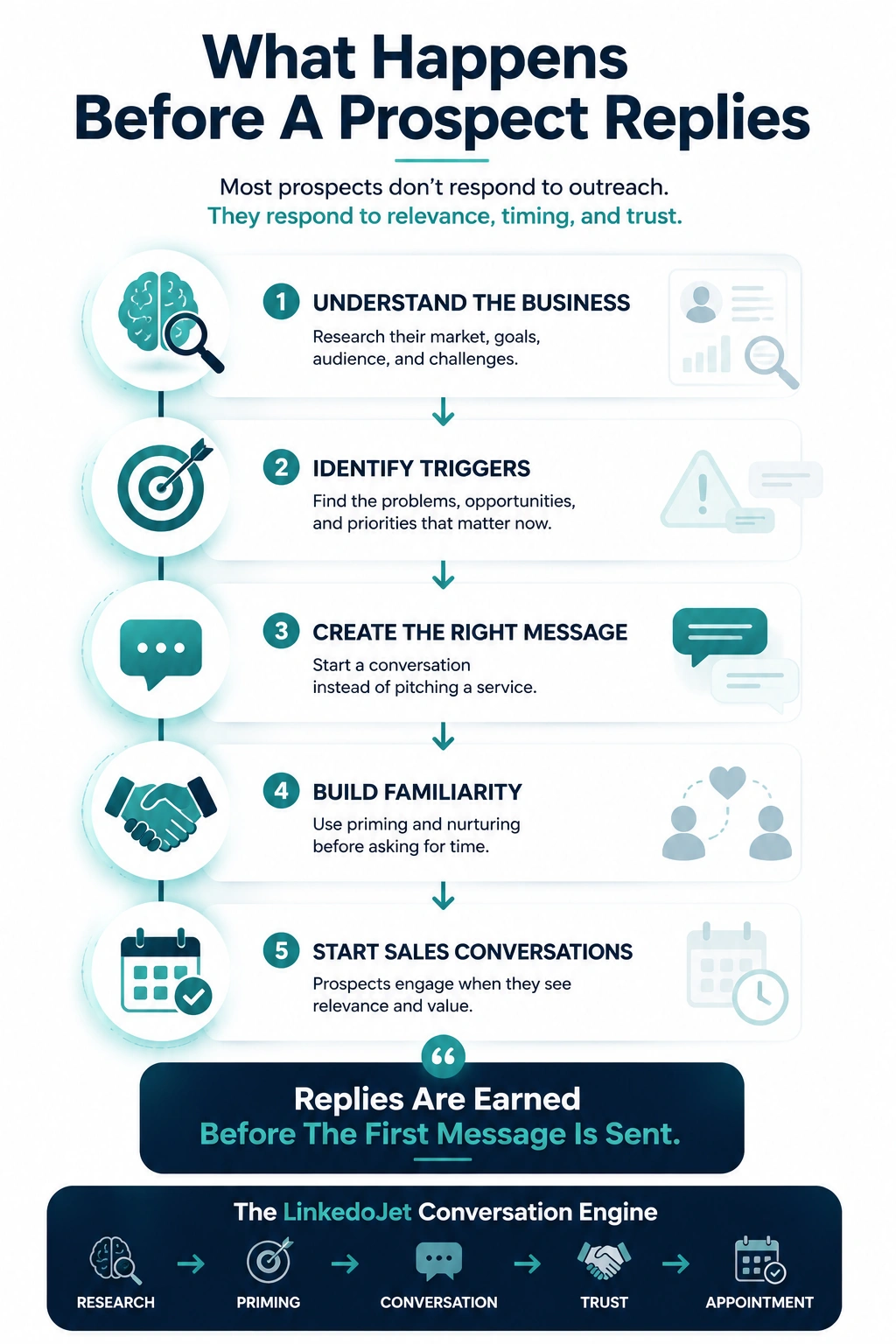
Why CPOs ignore 95% of LinkedIn outreach (and what it’s costing your pipeline)
You’re not being ignored because procurement doesn’t need help. You’re being filtered because your first two lines look like everyone else’s.
You can feel it when it happens.
You send something that’s “reasonable” — a polite opener, a credible credential, maybe a soft savings angle — and it lands like spam. No reply. Or worse: “Send info.” A brush-off dressed up as professionalism.
For a procurement consultancy, this is more than an annoyance. It turns growth into a lottery. You end up planning utilization around referrals and whatever happens to show up this quarter. Partners do awkward follow-ups that don’t match the firm’s positioning. The bench risk creeps in, quietly, and suddenly your team is reacting instead of choosing.
Procurement leaders aren’t anti-consultant. They’re anti-vendor. Their inbox is an endless parade of:
- “We can save you 10–20%” claims with no baseline, no validation path, no nuance.
- Generic “optimize spend” pitches that ignore cycle time, compliance, and stakeholder politics.
- Meeting requests that show up before any context — which triggers the exact reflex procurement trains into its org: filter first.
The hidden cost is the one you don’t see on a dashboard: you start writing outbound off as “not working,” even though you have real expertise procurement teams respect — once they actually get to the conversation.
Who you’re actually messaging: the procurement scorecard, the politics, and the filter reflex
The people you want are not hanging out on LinkedIn looking for a “procurement transformation partner.” They’re trying to survive their week.
Your typical targets — CPO, VP/Head of Procurement, Category Director, Procurement Excellence lead — are judged on a scorecard that’s both quantitative and political:
- Validated savings (with finance sign-off, not slide-deck math)
- Compliance and leakage control (contract coverage, PO discipline, stakeholder bypass)
- Cycle time (speed without breaking policy)
- Supplier risk and due diligence workload (security, ESG, third-party risk)
- Stakeholder satisfaction (because the business will route around procurement if procurement slows them down)
Now add the reality: most procurement orgs have more workstreams than capacity. Sourcing waves, renewals, escalations, policy exceptions, supplier performance reviews, and “quick asks” from the CFO that aren’t quick.
So when a LinkedIn message shows up that smells like a supplier — even if you’re a consultancy — the brain does what it’s trained to do: delete, archive, ignore.
This is why “personalization” fails so often. A line about their profile doesn’t change the fact that your message still sounds like it’s about you, not the initiative that’s currently eating their calendar.
The LinkedoJet method: value hypothesis + diagnostic question + calm progression (not a pitch)
The sequence that earns replies isn’t clever copy. It’s relevance with restraint.
We build procurement-native outreach around three parts:
- A value hypothesis tied to a live initiative (one workstream, not “transformation”).
- A low-friction diagnostic question they can answer in one word.
- A calm progression from “are we even talking about the same problem?” to “worth a quick working session?”
Good wedges for procurement consulting firms aren’t “cost reduction.” They’re the things procurement leaders are already being held accountable for, right now:
- Tail spend control without launching a massive program
- Contract compliance and leakage (coverage, buying channels, simple controls)
- Sourcing wave execution support (getting more events through without burning out the team)
- Category strategy refresh when the playbook is stale or the market moved
- Supplier performance cadence (quarterly business reviews that actually change behavior)
- Third-party risk / due diligence workload spikes (security, ESG, financial health)
- Savings validation with finance (baselines, tracking, realization vs “plan”)
Notice what’s missing: broad claims, credential dumps, and early meeting asks.
When LinkedoJet runs this, the objective of the first touches is simple: earn a two-line reply that tells you which initiative is live. That’s the doorway to a scoped intro call that doesn’t feel like a vendor pitch.
Messaging sequences that procurement leaders reply to (procurement-native examples for each step)
These are written the way a senior consultant would actually speak: calm, specific, and not trying to corner them into a meeting.
1) Connection request (one sentence, procurement context, no pretending)
Example: “Hi [Name] — I work with procurement teams on sourcing wave execution and contract compliance; figured it made sense to connect given the amount of renewal and workload pressure most teams are under right now.”
2) First message after acceptance (frame + diagnostic question)
Example: “Thanks for connecting, [Name]. Not trying to sell you anything in a LinkedIn message — quick question: is your focus this half more on sourcing wave capacity / tail spend / contract compliance, or is the bigger push supplier risk and performance?”
They can reply with one phrase. That’s the point.
3) Soft problem-based follow-up (specific pattern, no accusation)
Example: “One pattern we’re seeing: savings plans look solid on paper, but finance won’t validate without clean baselines and compliance tracking — so ‘realization’ lags and procurement gets squeezed. Is that a live conversation on your side, or not really?”
4) Query-based emotional trigger (their lived frustration, asked as judgment)
Example: “When a business unit runs ahead and brings procurement in after shortlisting suppliers, do you try to enforce policy, or do you optimize for speed and pick your battles?”
This gets replies because it’s about how the job actually works.
5) Insight-based nurturing (2–4 sentences, no link dump)
Example: “The strongest teams I’ve seen run a simple sourcing wave calendar tied to stakeholder demand, then protect capacity with a few non-negotiables (intake discipline, baseline rules, and a lightweight compliance check). It’s not ‘more governance’ — it’s fewer surprises mid-quarter. Are you running anything like that today, or is it more reactive?”
6) Soft meeting request (only after relevance shows up)
Example: “If it’s useful, happy to do a 15-minute working session to compare notes on how you’re approaching [workstream/category] and share what we’ve seen work without adding bureaucracy. Worth it, or should I stay in my lane?”
7) Final close-loop message (clean, respectful, gives them control)
Example: “I don’t want to keep tapping you on the shoulder. If now isn’t the right time, no worries — should I circle back after your next sourcing wave / after budget season, or close this out?”
Procurement people appreciate closure. It signals you understand their time and their boundaries.
Timing, cadence, and stop signals: how procurement actually checks LinkedIn
Procurement doesn’t “browse.” They skim between meetings.
In practice, your messages get seen in short windows:
- Early morning before the internal calendar takes over
- Just after lunch when they’re clearing notifications
- Late afternoon when they’re decompressing and triaging
Cadence that tends to work without feeling needy:
- Day 0: connect
- Day 1–2: first message
- Day 4–6: soft follow-up (pattern question)
- Day 9–12: judgment question (politics/cycle time)
- Day 16–21: insight nurture
- Day 28–35: close-loop
Also: be aware of internal reporting chaos. If you’re targeting procurement in sales-led orgs with heavy quarter-end pressure, end-of-quarter is often the worst time to ask for attention. Your message might be fine; the timing is wrong.
Stop signals you should treat as real:
- No engagement after the close-loop message
- Explicit “not a priority” or “company policy”
- They redirect you to a vendor portal (that’s not a conversation)
The win isn’t “more touches.” The win is a measured sequence that respects procurement’s reality while still creating enough surface area for a reply.
What to never send to procurement leaders (and why it fails on contact)
If you want to sound like a supplier, do any of the following.
- Generic savings claims (“we reduce costs 10–20%”). Procurement hears “unvalidated math” and assumes you’ll waste time.
- “We help companies optimize spend” openers. Too broad. Reads like you don’t know the difference between a category plan and a sourcing event.
- Fake personalization (“saw your profile”). Procurement has read that line a thousand times.
- Attachments or long case studies in the first touch. You’re asking them to do work before you’ve earned relevance.
- Meeting request in message one. That triggers the filter reflex. Their job is literally to protect the calendar from vendors.
- Credential dumping. Procurement respects expertise, but only after you prove you understand their current initiative and constraints.
The fastest way to lose a CPO is to sound like you’re here to “sell a program.” The fastest way to earn a reply is to sound like you understand the tradeoffs they’re managing this week.
How LinkedoJet operationalizes appointment generation for procurement consultancies
You don’t need another tool to send more messages. You need an outbound engine that consistently turns procurement expertise into real conversations — then turns those conversations into scoped intro calls.
LinkedoJet runs the full system end-to-end:
- ICP and targeting setup: we define the decision-maker map (CPO, Head/VP Procurement, Category Director, Procurement Excellence, and when it makes sense: CFO/COO for validation and mandate).
- Sales Navigator + LinkedIn prospect list building: we build and maintain lists by industry, geo, org size, procurement maturity signals, and initiative proxies (renewal-heavy categories, transformation mandates, risk-heavy sectors).
- AI-assisted personalization: not “nice profile” fluff — we generate initiative-specific openers and question paths that sound procurement-native and still read human.
- LinkedIn outreach execution: connection + sequenced messaging with measured timing and stop signals.
- Lead reply handling and nurturing: we manage the thread logic, respond to common brush-offs (including “send info”), and keep the conversation moving without pressure.
- Warm lead tracking: we track who engaged, what initiative they signaled, and where they are in the progression so follow-up is coherent, not random.
- Appointment generation support: when the thread shows readiness, we guide the transition to a short, scoped working session framed around one workstream.
- Campaign visibility: dashboards show targeting, outreach volume, reply rates, positive intent, and appointment outcomes — so you can manage it like a channel, not hope.
- Ongoing campaign refinement: we adjust wedges, questions, and sequencing based on what procurement is actually replying to in your market.
The practical outcome is partners spending less time “checking in” and more time showing up to calls where the buyer already self-identified an initiative. That’s the difference between noise and a forecastable motion.
FAQ
What should a procurement consulting firm say in the first LinkedIn message to a CPO?
Lead with a narrow procurement initiative and ask a diagnostic question they can answer quickly. Keep it calm: “Not trying to sell you anything in a LinkedIn message — quick question: is your focus this half more on sourcing wave capacity / tail spend / contract compliance, or more on supplier risk and performance?” The goal is a two-line reply, not a meeting.
How do we handle “send info” without killing the conversation?
Treat “send info” as a stall, not a win. Reply with something short and useful (no deck), then ask one question that makes it easy to re-engage: “Happy to. Before I send anything generic, which is closer to what you’re dealing with right now: compliance leakage, wave capacity, or finance validation?” If they answer, you have a thread again.
What procurement initiatives make the best outreach wedges (without sounding like a savings pitch)?
Pick wedges that signal capacity and certainty: sourcing wave execution support, contract compliance/leakage control, tail spend containment, supplier performance cadence, third-party risk workload, and savings validation with finance. These are “already on your plate” initiatives, not broad promises.
How many follow-ups is reasonable before we stop messaging procurement leaders?
Most of the time: 4–6 touches over 4–6 weeks, with respectful spacing. Procurement is meeting-heavy and skims quickly; daily pings are a fast way to get muted. If there’s no engagement after a clean close-loop message, stop and set a timed re-approach around a believable window (post-budget, post-wave, renewal season).
How do we book meetings when procurement already has an incumbent consulting partner?
Acknowledge it and narrow the scope. You’re not asking them to “replace” anyone — you’re offering a quick sanity check on a specific workstream where capacity or validation is tight. “Totally fair — most teams have someone. If you’re open, I’m happy to compare notes on just [finance validation / wave execution / leakage control] for 15 minutes. If it’s not additive, we’ll drop it.” Incumbents don’t block targeted help; generic pitches do.
If you want CPO replies, you need a system that sounds like procurement — and runs without partner babysitting
This isn’t a generic “strategy call.” It’s a working session to see if we can build a procurement-native outbound engine that consistently creates scoped intro calls.
On the session, we’ll look at your current outbound reality (who you’re targeting, what you’re sending, and where the thread dies), then pressure-test 2–3 initiative wedges that can credibly earn replies in your market — tail spend, compliance leakage, sourcing wave capacity, supplier risk workload, or finance validation.
If there’s a fit, here’s what LinkedoJet actually provides after onboarding:
- ICP + targeting setup specific to procurement decision-makers (and the CFO/COO stakeholders that influence validation and mandate).
- Sales Navigator prospect list building so you’re not guessing who to message or relying on a static list that goes stale.
- Procurement-native sequences written for your firm — value hypothesis + diagnostic questions + follow-ups that handle vendor fatigue without sounding needy.
- AI-assisted personalization that stays grounded in procurement reality (workstreams, constraints, timing), not surface-level profile compliments.
- Outreach execution on LinkedIn with controlled cadence and clear stop signals, so it’s steady and professional.
- Lead reply handling and nurturing to manage “send info,” “we have a partner,” and “not now” without dropping the thread or pushing too hard.
- Warm lead tracking + dashboards so you can see replies, intent, and where each conversation sits — and forecast outreach like a channel.
- Appointment generation support to move the right conversations into short, scoped intro calls tied to one initiative (not a broad pitch).
Ordinary LinkedIn automation tools send messages. LinkedoJet runs the conversation system: targeting, messaging, follow-up logic, reply handling, and the handoff into booked calls — with visibility and ongoing refinement as we learn what procurement is actually responding to.
Next step: turn procurement expertise into booked intro calls
If your pipeline is still riding on referrals, you don’t need louder messaging. You need procurement-native sequencing, tight targeting, and someone running the follow-up like it matters.
From identifying the right decision-makers to starting meaningful conversations and turning them into qualified appointments... LinkedoJet manages the entire outbound engine for your business.