
Why pharma TA ignores recruiter outreach (and the hidden cost of being treated like “another supplier”)
They’re not ignoring you because they don’t have hiring pain. They’re ignoring you because your message looks like the first step in a CV dump.
If your team can deliver hires once you’re on a req but you can’t reliably get in the room, you’re living the worst version of agency life: capacity on the bench, payroll ticking, and a pipeline that moves in lurches.
The brutal part is the reputational tax. Every “send details” brush-off, every no-response, every “we already have suppliers” trains your BD team to sound a little more desperate next time. And desperation reads like volume. Pharma buyers have been conditioned to protect themselves from volume.
TA leaders are drowning in process. Audit-ready steps. Vendor management pressure. Hiring managers who don’t want to see another irrelevant slate. When your first message smells like a deck, a rate card, or “we have candidates,” you trip the exact defense mechanism they’ve built to survive.
And it’s not a copywriting problem.
It’s a conversation-design problem: you’re trying to jump straight to “book a meeting” before you’ve earned a one-line reply that proves you understand what makes their hires fail in reality—GMP depth, deviations/CAPA exposure, cleanroom constraints, site/shift realities, interview washout, and submission noise.
Who you’re messaging: TA, hiring managers, and procurement read the same LinkedIn message three different ways
If you write one generic sequence for “pharma,” you’ll offend two audiences and confuse the third.
TA Directors / Heads of Talent read for process impact. They’re thinking: “Will this supplier create more work? Will they respect intake? Will they spam my hiring managers? Will they send CVs without alignment?” If your message sounds like you want them to open the floodgates, they’ll shut it down.
Hiring leaders (Manufacturing, Quality, Clinical Ops) read for throughput and risk. They care about shift coverage, site rules, readiness to work in a GMP environment, and whether the person can actually talk through investigations, deviations, CAPA, batch records, or protocol deviations without falling apart. They’ll ignore “industry experience” claims and focus on job-readiness.
Procurement / Vendor Management reads for compliance and containment. They’re listening for supplier sprawl, rate discipline, audit trail, and whether you’re trying to bypass the PSL. If you pretend they don’t exist, you’ll get bounced back to “send a capability deck” purgatory.
| Persona | What they’re protecting | What makes them reply |
|---|---|---|
| TA leadership | Hiring manager time + clean process | A narrow lane + a low-effort question about submission noise / interview churn |
| Hiring manager | Output, timelines, site realities | Specific constraints (shift/on-site/cleanroom) + proof you screen for GMP depth |
| Procurement / VM | Supplier list control + compliance | Respect for the PSL + a simple ask for the correct routing and criteria |
Same offer. Different framing. That’s why “personalization” that’s just a name and a company never lands. You need lane-specific relevance that signals you’re here to reduce noise, not add to it.
The sequence you can run this week: connection request + first question (built to earn a one-line reply)
The goal of message one isn’t the meeting. It’s the smallest credible “yes” that opens a thread.
Timing that tends to work: early morning before the standups, mid-day between blocks, and late afternoon when the fire drills ease. Don’t overthink it—just avoid sending your first touch at 9:01 on Monday and expecting warmth.
1) Connection request (no pitch, no bait)
Keep it plain. Signal the lane. Give them a safe reason to accept. Explicitly remove the fear of a deck.
Template (TA leader):
“Hi <
Template (Hiring leader):
“Hi <
2) First message after acceptance (one question, easy to answer)
One sentence of context, one binary question. No meeting ask. No “we’re specialist.” Prove it by the question you choose.
- TA-focused: “Quick one — for <
>, is the bigger pain right now (a) too many irrelevant submissions, or (b) CVs look fine but candidates fall apart in interview when you probe GMP?” - Manufacturing/Quality leader: “Are you still seeing candidates say ‘GMP’ but struggle to talk through deviations/CAPA and documentation expectations when you push?”
- Validation/CSV leader: “For CSV hires, are you mostly constrained by on-site expectations, or by candidates who haven’t actually owned validation deliverables end-to-end?”
If they answer, you’ve earned a thread. If they don’t, you haven’t earned the right to “circle back” with a pitch.
Follow-ups that don’t trigger vendor fatigue: problem-based, emotion-safe, and insight-based nudges
Your follow-up isn’t a reminder. It’s a second chance to be relevant without asking for anything.
Pharma TA teams aren’t offended by follow-ups. They’re offended by follow-ups that pretend they owe you time.
Use nudges that let them respond without committing, and that signal you respect their process.
Follow-up #1 (problem-based, low friction)
“<
Follow-up #2 (emotion-safe, vendor fatigue acknowledgment)
“Also—totally get the vendor fatigue. Are you mainly trying to cut down the volume of CVs, or is the bigger issue that the CVs look fine but don’t hold up once hiring managers probe the real work?”
Follow-up #3 (insight-based nurturing, no pitch)
Share one useful observation that proves you’re in the lane. Keep it practical and specific.
“Market note from the last few weeks: for <
Follow-up #4 (close-loop, reputation-protecting)
“I’ll park this after this message. If you ever want a short calibration on what ‘usable’ looks like for <
This is how you stay professional in a small world. No pressure. No weird persistence. Just clean positioning and a graceful exit.
Role-lane message examples (QA/QC Manufacturing + Validation/CSV)
Short templates that respect GMP reality and the buyer’s time.
Lane A: QA/QC (Manufacturing / Batch Release)
Connection request:
“Hi <
After accept (one-line reply target):
“Quick question: when QA candidates miss in interview, is it more often (a) shallow deviation/CAPA experience, or (b) they can’t handle the documentation rigor / batch record expectations on-site?”
If they answer “CAPA”:
“Got it. When you say CAPA depth—are you looking for people who’ve authored/owned CAPAs, or is participation + strong investigations enough for the level you’re hiring?”
Procurement-aware pivot (if they say ‘we have suppliers’):
“Makes sense. If you ever add a niche supplier, what has to be true—one site, one role family, one screening standard? I’d rather stay inside your process than create noise.”
Lane B: Validation / CSV (Tech Ops / Quality Systems)
Connection request:
“Hi <
After accept:
“For your CSV hires, are you getting more misses on (a) real hands-on with validation deliverables, or (b) stakeholder management/documentation discipline once they’re in a regulated environment?”
Insight nurture (if no reply):
“One thing I’m seeing: candidates who’ve only supported pieces of validation often struggle when asked to walk through the deliverable trail. If helpful, I can share the 5 screening prompts we use to catch that early.”
Turning replies into calibration calls: timing, intent signals, and the 12–15 minute alignment ask
You earn meetings by diagnosing intent, not by repeating the ask.
A calibration call is not a sales call. It’s a controlled intake that makes your future submissions usable. That framing matters in pharma because the buyer’s core fear is wasted time and process risk.
Intent signals to watch for
- High intent: they answer with specifics (site, shift, “we keep losing people in interview,” “procurement is tightening PSL”).
- Medium intent: they answer but stay general (“depends,” “we’re busy,” “always hard to find”).
- Low intent / deflection: “send details,” “send a deck,” “we already have suppliers.”
When to ask for the call
Ask after engagement—usually after they’ve answered one operational question and you’ve asked a clarifier. The call request should feel like a service to them, not a win for you.
Calibration call ask (TA leader):
“Helpful. If you’re open to it, I’d like to do a 12–15 min calibration so we don’t add to submission noise. We’d confirm must-haves, screening questions (deviations/CAPA depth, cleanroom/on-site, documentation), and what a ‘usable shortlist’ looks like for <
Calibration call ask (hiring leader):
“If you’re dealing with timeline risk on this lane, I can do a quick 12–15 min alignment to lock the non-negotiables (shift/on-site, real GMP stories, documentation expectations). That way anything I send is either a fit or it doesn’t get sent. Want to pick a slot?”
If you get “send a deck”
Don’t argue. Redirect to process and control.
“I can send a one-pager, but it won’t solve the usual problem—which is mismatch on must-haves. If you give me 12 minutes, I’ll leave with a screening checklist aligned to your process and you’ll get fewer false positives. If procurement needs to be involved first, tell me the routing and I’ll follow it.”
This is how you stop being treated like a vendor begging for attention and start being treated like a controlled, process-respecting supplier.
FAQ
How do I write LinkedIn messages that don’t sound like CV dumping to pharma TA?
Stop leading with “we have candidates” and stop attaching anything. Lead with a narrow lane (role family + site/geo) and an operational question that only someone in the lane would ask (shift/on-site, deviations/CAPA depth, cleanroom exposure, documentation rigor). The message should feel like it reduces noise, not like it creates another thread they’ll have to manage.
What should I ask in the first message after they accept—if I’m not asking for a meeting?
Ask a binary question that exposes the real friction: “Is the bigger issue irrelevant submissions, or candidates washing out in interview?” Or “Is the miss usually GMP depth or shift/on-site constraints?” If they can answer in one line, you’ll get more replies—and those replies tell you whether a calibration call is even worth proposing.
How many follow-ups is acceptable before I damage reputation with pharma hiring teams?
In most pharma lanes, 3–4 touches after acceptance is plenty if each one adds relevance (problem, clarifier, small insight) and you include a clean close-loop. What damages reputation is not the count—it’s the tone: guilt, pressure, or pretending they owe you a reply.
How do I message procurement or vendor management without getting stuck at “send a capability deck”?
Respect the gate and ask for routing criteria instead of trying to bypass it. Example: “If you add niche suppliers, what has to be true (site, lane, volume, compliance items)? Who owns the process so I don’t create noise for TA?” Procurement is paid to control sprawl. Make it easy for them to contain you to a narrow, auditable lane.
What’s a calibration call in pharma recruitment, and how is it different from a sales call?
A calibration call is a short intake alignment (12–15 minutes) designed to protect their time: non-negotiables, screening questions, site/shift constraints, documentation expectations, and what “usable shortlist” means. A sales call is about you. A calibration call is about reducing submission waste and interview churn—so if you ever do send candidates, you don’t contaminate their process.
Want this running as a system, not a one-off push?
If your team is good at delivery but tired of feast-or-famine req flow, LinkedoJet builds and runs the outbound engine that turns role-lane relevance into booked calibration calls.
LinkedoJet isn’t another LinkedIn automation tool you “set and forget.” It’s an operationally managed outbound program built for firms that sell into high-friction buying environments—like pharma TA teams dealing with vendor fatigue, procurement gates, and overloaded hiring managers.
What we set up and manage for you:
- ICP and targeting setup: we define the role lanes you’ll win in (e.g., QA/QC for a specific site cluster; Validation/CSV for a specific region) and the decision-makers who actually influence supplier engagement.
- Sales Navigator / LinkedIn prospect list building: we build and maintain clean lists by function, seniority, geography, site type, and hiring-side responsibility—so you’re not blasting “pharma” and hoping.
- AI-assisted personalization: we generate personalization that’s operational (constraints, lane signals, relevant phrasing) instead of fake flattery—then we QA it so it reads human and process-aware.
- LinkedIn outreach execution: we run the sequences, pacing, and timing windows that fit how TA teams actually work (early morning, between blocks, late afternoon).
- Lead reply handling and nurturing: we triage replies by intent, route warm conversations, and keep medium-intent contacts warm with insight nudges that don’t trigger vendor fatigue.
- Warm lead tracking + appointment generation support: you get visibility into who engaged, what they said, what lane they’re in, and when the right moment is to ask for a calibration call—plus support converting replies into booked slots.
- Campaign visibility through dashboards: you can see connection acceptance, reply rate, intent breakdown, and booked conversations without chasing screenshots.
- Ongoing campaign refinement: we adjust lanes, prompts, and follow-ups based on what buyers actually respond to (not what sounds good in a workshop).
After onboarding, you’re not left holding a template doc. You have a live outbound program running: updated lists, lane-specific sequences, AI-assisted message variations, follow-up logic, and a clear view of warm leads and scheduled calibration calls.
What you receive is practical: the exact sequences, the targeting architecture, the conversation prompts that earn one-line replies, and a managed workflow that turns those replies into short calibration calls without sounding like a supplier begging to be let in.
Why this is different from ordinary LinkedIn automation: automation sends. LinkedoJet engineers conversations, handles follow-up logic, and tracks intent so your team isn’t guessing who’s warm and when to ask. The goal isn’t activity—it’s controlled, reputation-safe appointment creation inside a procurement-heavy environment.
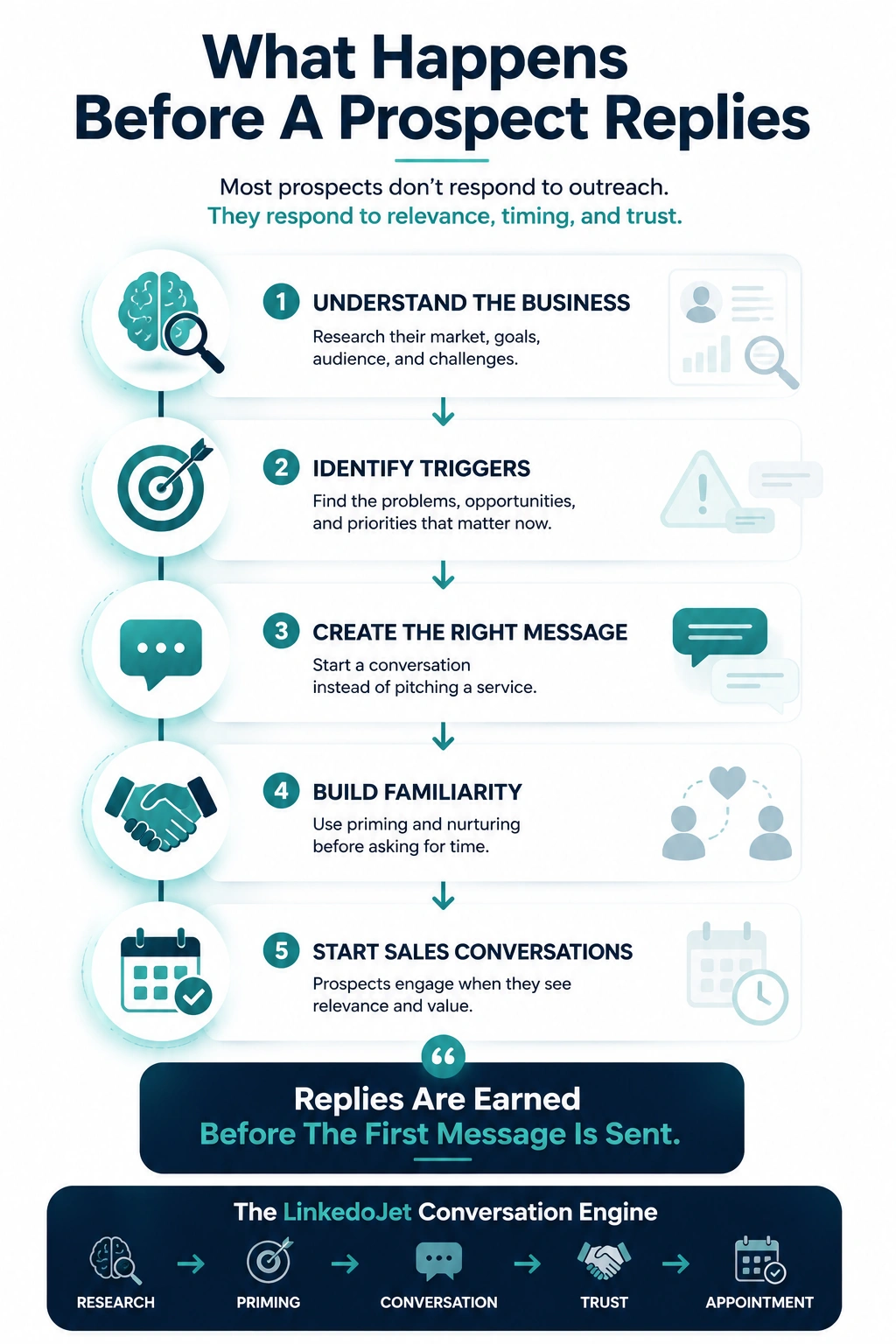
From identifying the right decision-makers to starting meaningful conversations and turning them into qualified appointments... LinkedoJet manages the entire outbound engine for your business.
Next step: get a role-lane sequence running that earns replies—and turns them into calibration calls
If your outreach currently gets silence or “send details,” the fix isn’t more volume. It’s tighter targeting, better first questions, and follow-up that respects pharma process. LinkedoJet will build the lists, run the sequences, handle nurturing, track warm intent, and support appointment conversion so your BD isn’t living on hope.