
Fewer messages. Better conversations. Why your pipeline is lumpy (and why founders ignore most branding outreach)
If you sell executive voice, credibility, and narrative—your outreach can’t read like a deliverables menu.
You know the feeling: you’re paid to make other people sound inevitable—clear POV, sharp positioning, credible proof. Then you look at your own pipeline and it’s… vibes.
A couple referrals land. A few “let’s revisit next quarter” threads. Then a quiet week where the team is half-busy, you start doing math in your head, and suddenly a misfit client doesn’t look so misfit.
This category is brutal because you’re not selling “content.” You’re selling identity work with business consequences.
- Voice integrity: “Will this sound like me, or like a marketing intern?”
- Reputation risk: “Will this make me look self-promotional, or worse, inauthentic?”
- Time scarcity: “Is this going to turn into a weekly interview I dread?”
When your outbound ignores those tensions, founders don’t just decline. They silently categorize you as another thought leadership shop—and that label is sticky.
The cost isn’t only missed calls. It’s the slow erosion of control: you stop planning hiring, you stop saying no, and your delivery team ends up carrying the emotional weight of clients you never should’ve signed.
What gets you categorized as “generic thought leadership shop” in 10 seconds
Executives scan. They don’t read. Your first two lines decide your fate.
I’ve watched enough founder inboxes to know the sorting rules are simple. They don’t ask “is this agency talented?” They ask “is this going to waste my time or mess with my voice?”
Here’s what triggers an instant mental archive:
- “Loved your profile / content.” (translation: you’re about to pitch me)
- “We help founders build their personal brand.” (translation: generic, unprovable)
- Long paragraphs. (translation: high effort to decode, low reward)
- Portfolio links before context. (translation: you didn’t earn relevance)
- “15 minutes this week?” in message one. (translation: you’re using me to hit a quota)
- Engagement promises. (translation: you measure the wrong thing)
The mismatch is subtle but fatal: your prospect is thinking about credibility, time, and risk. Most outreach is thinking about deliverables.
And founders have scar tissue here. Many have tried ghostwriting or a “content studio” already. They remember: generic voice, endless approvals, posts that get compliments but don’t move anything meaningful (recruiting, partnerships, deal quality, investor confidence).
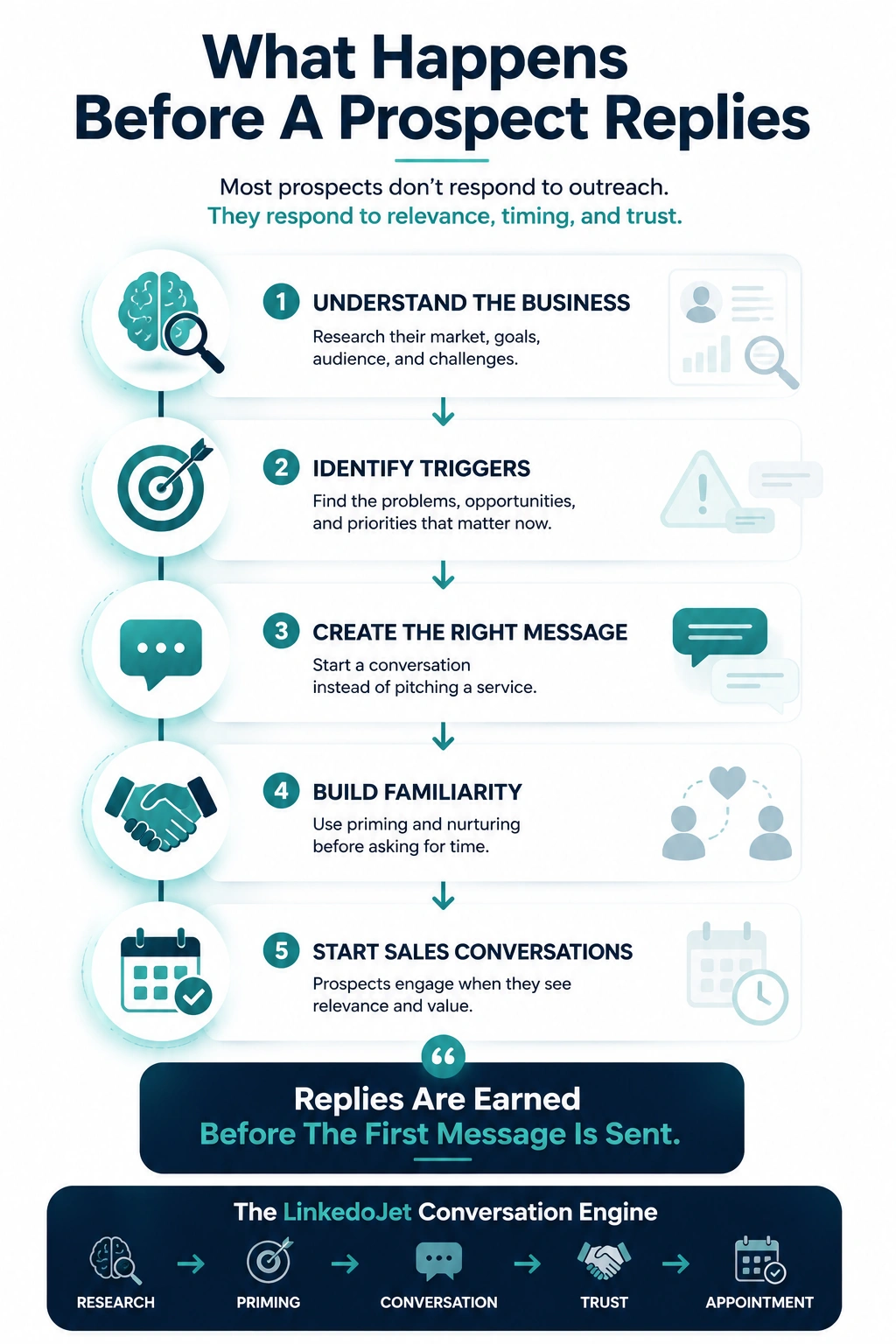
The LinkedoJet sequence: relevance → permission → diagnosis → insight → invitation
This is how you earn a call without pitching “thought leadership.”
Good personal branding work doesn’t start with “here are our packages.” It starts with a read on the person: their business moment, their constraints, and the gap between what they believe and what they’re willing to say publicly.
Your messages should work the same way.
| Stage | What you’re signaling | What the prospect feels |
|---|---|---|
| Relevance | “I’m not random. I noticed something real.” | “Okay, this might be worth 8 seconds.” |
| Permission | “You’re in control. Easy to ignore.” | “This isn’t a trap.” |
| Diagnosis | “I understand the frictions beneath the surface.” | “They get it.” |
| Insight | “Here’s a small piece of craft you can steal.” | “Useful. Credible.” |
| Invitation | “Short working session, only if it’s timely.” | “This feels like help, not a pitch.” |
Where LinkedoJet comes in is making this repeatable without turning it into spam. We build the targeting system, write sequences that match your voice, add AI-assisted personalization that’s grounded in real signals, then run the outreach and follow-up so it doesn’t die in your Slack backlog.
The goal isn’t to “send more.” It’s to consistently create the right conversations with founders and execs who actually have a business moment.
Message examples you can run this week (connection request + 5-touch sequence + dignity close-loop)
Short. Human. Built for fast replies and founder psychology.
1) Connection request (specific, not creepy; no pitch)
Option A (post theme):
“Saw your post on hiring leaders who can write. I work adjacent to founder-led POV content and I’m tracking how different execs handle ‘voice’ without sounding polished-generic. Open to connecting?”Option B (podcast / keynote):
“Listened to the clip where you talked about deciding faster with less data. I’m collecting examples of exec POV that feels real (not performative). Would love to connect.”Option C (business moment):
“Congrats on the new product push. I’m paying attention to how founders communicate during launch windows without turning into marketing voice. Want to connect?”
2) After they accept (permission-based opener + easy out)
“Appreciate the connect. Quick question—and feel free to ignore if it’s not relevant: do you write your LinkedIn posts yourself, delegate to a team, or have someone ghostwriting? And what part is the most annoying—starting, consistency, or approvals?”
3) Follow-up (no reply) that introduces a real friction
“One I see a lot with execs: posts come out ‘polished’ but somehow not them. Then they stop posting for weeks because it feels off-brand personally. Familiar at all, or do you have a system you actually like?”
4) Query-based tension (identity + reputation, without drama)
“Honest question: do you ever hold back from posting because you don’t want it to read like self-promotion? A lot of strong operators have a POV, they just don’t want to perform online.”
5) Insight-based nurture (small craft, no ask)
“Something that reduces time + ‘marketing voice’ fast: separate authority proof posts (one specific belief + one proof point) from audience building posts (story + lesson). Most exec feeds mix them, so it feels inconsistent. If you ever want it, I can send a one-page outline of 4 content lanes that keep voice intact without posting constantly.”
6) Soft invitation (only after engagement)
“If this is timely, I can do a 20-minute working session with you. Not a pitch—just map your current voice capture + review workflow, pick 2–3 lanes that match your business moment (hiring, partnerships, fundraising), and point out where the system is creating friction. Want me to send two times?”
7) Dignity close-loop (protects your brand)
“I’ll stop bothering you after this. If it would help, I can send either (a) a quick voice-capture checklist that cuts approvals, or (b) a POV-to-post structure that keeps you out of ‘marketing voice.’ If neither is useful, no worries—I’ll close the loop.”
When to move to scheduling: intent signals, what they mean, and the exact “working session” ask
Don’t ask for time until they’ve shown you there’s a problem worth solving.
Founders will give you signals. They’re rarely direct, but they’re consistent. Your job is to recognize them and switch from “conversation” to “calendar” without getting weird.
| Signal you hear | What it usually means | Your next move |
|---|---|---|
| “I’m inconsistent.” | No repeatable capture + publishing loop. | Offer a short workflow diagnosis. |
| “I hate approvals / it takes forever.” | Too many stakeholders, unclear voice guardrails. | Ask how decisions get made and who edits. |
| “I don’t want to sound salesy.” | Fear of reputation damage with peers/customers. | Ask what they refuse to be seen as. |
| “We’re hiring / fundraising / launching.” | Business moment = urgency + audience scrutiny. | Anchor lanes to that moment. |
| “We tried someone before.” | Burned by generic voice or time burden. | Ask what failed: voice, process, or impact. |
| They ask, “How do you capture voice?” | They’re evaluating fit, not price. | Move to a working session invite. |
Here’s a meeting ask that doesn’t trigger defenses:
Working session invite:
“We can keep this light. If you’re open, I’ll run a 20-minute working session: (1) how you capture voice right now, (2) what your approval path looks like, (3) what LinkedIn needs to support this quarter (recruiting, deals, partnerships, investor visibility). You’ll leave with a simple lane map and a cleaner workflow. Want to do Tue 11:00 or Thu 3:30?”
If they hesitate, don’t push. Offer an asset, then go quiet. Executives respect clean exits.
Operationalizing outreach without degrading delivery: targeting, timing windows, nurture triggers, and keeping your agency’s voice credible
Outbound fails in this niche when it feels automated—even when it isn’t.
Your best work lives in nuance: tone, context, what not to say. The risk with outbound is obvious—one sloppy message and you become the thing your clients fear becoming.
So the system has to protect your standards while creating consistency.
Targeting that doesn’t waste your team’s attention
Personal branding agencies win when they stop targeting “founders” and start targeting founders with a forcing function. LinkedoJet builds this into the ICP and list logic:
- Roles: founder/CEO, co-founder, execs with external visibility (VP/Head roles with public narrative)
- Triggers: funding, hiring waves, product launches, keynote/podcast runs, press cycles, market repositioning
- Constraints: low posting frequency but high stakes, history of trying help, strong opinions but low time
Timing windows that match how executives actually use LinkedIn
Most execs check LinkedIn in bursts: early morning scan, mid-day between calls, late afternoon when notifications pile up. LinkedoJet staggers touches to show up in those windows without hammering the same day.
Nurture triggers that feel like attention, not surveillance
If someone engages with a post (likes, comments, or shows up repeatedly in your views), that’s permission to re-open the thread with something small and relevant. Not “saw you viewed my profile.” More like: “Your post about decision-making under uncertainty—quick question…”
Keeping your voice credible while you scale outbound
LinkedoJet isn’t a set-and-forget blaster. After onboarding:
- We set up ICP + targeting rules and build Sales Navigator lists your team would actually approve of.
- We create sequences that match your agency’s tone (and avoid the thought-leadership-shop smell).
- We use AI-assisted personalization to draft first lines tied to real signals (post themes, role changes, business moments), then apply guardrails so it stays human.
- We execute outreach and follow-up, handle reply routing, and run nurture workflows so warm threads don’t die.
- We track warm leads and booked appointments in a clear dashboard, and refine weekly based on what’s getting real replies (not vanity accept rates).
The output you want is boring in the best way: steady, qualified calls with founders who can pay, will collaborate, and are in a moment where executive presence actually matters.
FAQ
What’s a good LinkedIn messaging sequence for selling founder/executive personal branding without sounding salesy?
Use a conversation sequence, not a pitch: relevance (why them), permission (easy out), diagnosis (surface voice/system friction), a small insight (prove craft), then an invitation only after intent. If you ask for a call before they admit a problem, you’ll get ignored—or worse, labeled as a generic vendor.
How do I write a connection request that feels specific (not creepy) and doesn’t pitch my agency?
Reference a public signal they chose to share (a post theme, a hiring announcement, a podcast point, a launch). Then state a neutral reason to connect (you’re tracking founder POV patterns in their space) and keep it to 1–2 lines. No compliments about “inspiring content,” no portfolio, no meeting link.
What should I send after they accept—if I want a reply, not a polite “thanks”?
Ask a permission-based diagnostic question that’s easy to answer in one line: “Do you write yourself, delegate, or ghostwrite? What’s the most annoying part—starting, consistency, or approvals?” You’re inviting truth, not forcing a sales conversation.
When is it too early to ask for a call, and what are the meeting-ready signals for founders/CEOs?
It’s too early when they haven’t acknowledged a friction. Meeting-ready signals include: “I’m inconsistent,” “approvals take forever,” “I don’t want to sound salesy,” “we’re hiring/fundraising/launching,” “we tried someone before,” or they ask how you capture voice. That’s when a short “working session” invite lands as helpful instead of pushy.
How do you handle “I already have a ghostwriter/agency” without sounding defensive?
Don’t argue and don’t pitch. Ask about quality and time: “Is it capturing your voice? Is it taking more time than it should? What part feels heavy?” Many execs aren’t opposed to help—they’re opposed to systems that produce generic voice and create more meetings.
If you want booked calls without the thought-leadership pitch, we’ll build and run the conversation system
This isn’t “try our tool.” It’s a managed outbound engine designed for founder/executive psychology: relevance, permission, diagnosis, and follow-up that protects your brand.
When you book a demo session, we’ll show you exactly how LinkedoJet runs outreach for personal branding agencies without turning your name into another inbox annoyance.
On the session, we’ll walk through:
- Your ICP and the business-moment triggers that create real urgency (fundraising, hiring, launch, press, conference season).
- How we build Sales Navigator prospect lists (founders/CEOs/execs) with filters that avoid tire-kickers and “curious but broke” profiles.
- The exact message sequence we’d run for your offer (relevance → permission → diagnosis → insight → invitation), including the guardrails that prevent portfolio-dumping and early calendar pushes.
- How AI-assisted personalization is used: first-line context tied to real signals, controlled by your tone rules so it doesn’t read like synthetic flattery.
- How lead nurturing and follow-up workflows work after the first touch (and what we send when they don’t reply).
- How warm leads and appointments are tracked in a dashboard: who engaged, what they said, which objections show up, and what’s converting into meetings.
After onboarding, LinkedoJet operationally provides: ICP + targeting setup, prospect list building, outreach execution, reply handling and nurture, warm lead tracking, appointment generation support, and ongoing campaign refinement based on real replies.
Ordinary automation tools help you send messages. LinkedoJet manages the system that makes the right people reply—without sacrificing the credibility your agency sells for a living.
Next step: make outbound feel like your best client work—deliberate, specific, and respectful
You’ll stop guessing, stop chasing, and start running a steady conversation pipeline with founders who have a real moment and real budget.
From identifying the right decision-makers to starting meaningful conversations and turning them into qualified appointments... LinkedoJet manages the entire outbound engine for your business.