
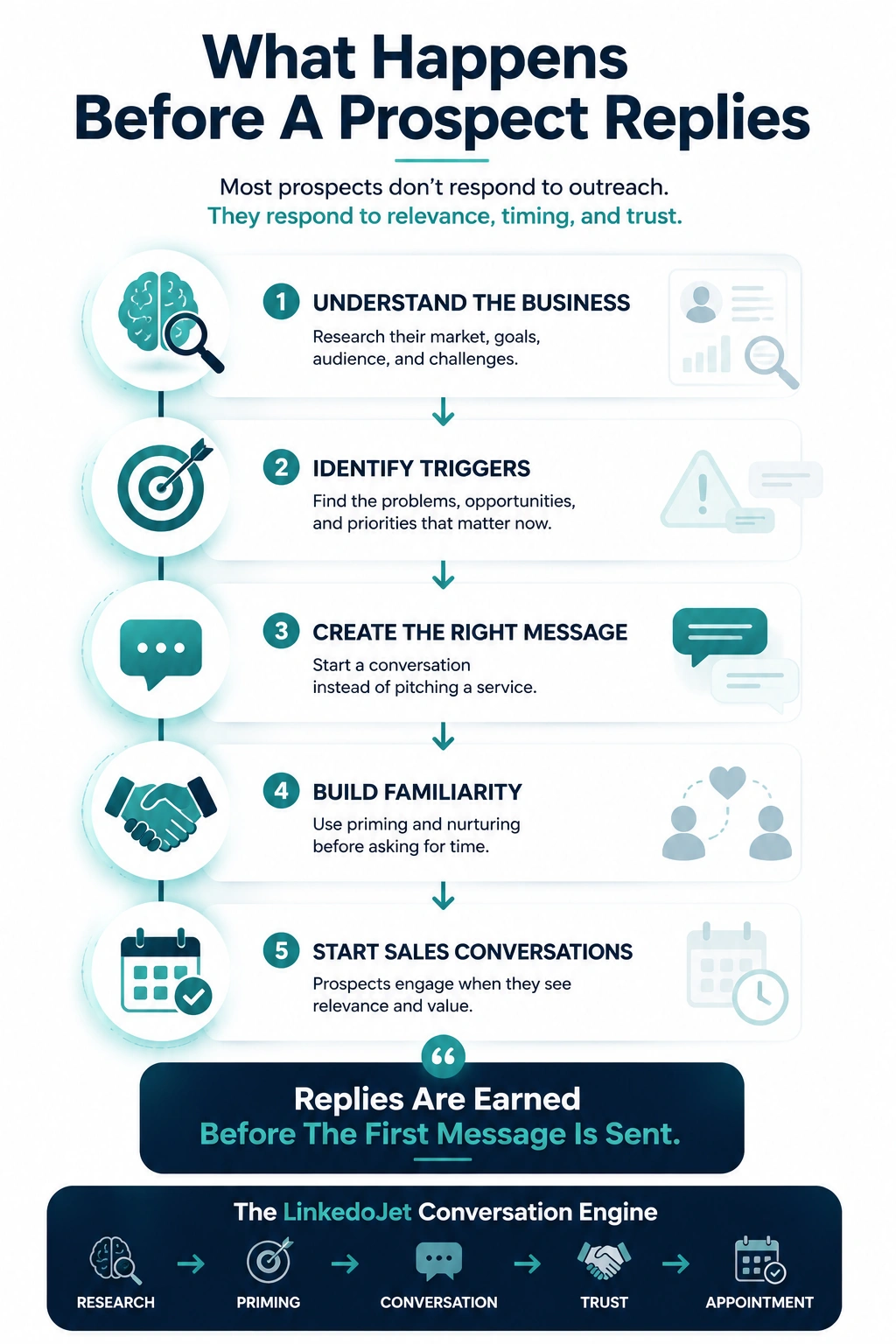
Why packaging buyers ignore LinkedIn outreach (and what silence is costing your pipeline)
If your messages read like a capability sheet, you’re training the market to keep you off the shortlist.
You already know the pattern. Your team sends connection requests, follows up politely, drops a PDF, asks for “15 minutes,” and gets… nothing.
That silence isn’t neutral. In packaging, silence is how you end up only seeing work when an incumbent fails, an RFQ lands, or a plant is already behind schedule. Then you’re scrambling for specs, chasing a quote window, and discounting to win a trial you didn’t help shape.
Buyers have been conditioned by years of commodity messaging: “high-quality packaging solutions,” “sustainable options,” “end-to-end,” “competitive pricing.” It’s all the same. And it’s disconnected from what their day actually looks like: production meetings, line changeovers, damage/returns, late trucks, and a packaging engineer getting blamed when a seal fails or print drifts on a re-order.
What gets ignored fastest in this category:
- Capability-first intros before you’ve earned relevance (no one is shopping “a supplier,” they’re managing a constraint).
- Fake personalization (“saw your profile”) with no packaging-native anchor like MOQs, ECT/burst, barrier performance, or dock schedule realities.
- Premature meeting asks when they don’t have specs ready and don’t want to start an RFQ thread.
- PDF dumping that forces them to do work to understand what you actually do.
- Over-follow-up that feels like chasing and burns the account for when timing is real.
The uncomfortable truth: if you’re not creating buyer-safe conversations now, you’re not “warming the market.” You’re becoming background noise. And when the next SKU launch slips, a supplier misses OTIF, or procurement gets told to find second-source coverage fast, you’re not the name that comes up.
Who this is for (and why messaging changes by persona)
Corrugated, folding carton, flexible, labels, protective packaging—same sales motion, different filters in the buyer’s head.
This playbook is for packaging manufacturers selling into brands, co-packers, contract manufacturers, and industrial distributors—where the buying motion is spec to quote, quote to trial, trial to repeat.
It’s also for sales leaders who are tired of lumpy pipeline: a good month because two re-bids hit, then a quiet month because no one is actively quoting.
Messaging works when it respects the persona’s risk:
- Packaging Engineering / R&D: protecting technical fit. They care about line compatibility, barrier and seal integrity, scuffing, adhesive performance, color drift, and whether your “yes” turns into rework later.
- Procurement / Sourcing: protecting cost and supplier risk. They care about pricing structure, MOQ breaks, coverage, compliance, and whether you can support them when resin/paper moves or when they’re forced to dual-source.
- Ops / Supply Chain / Plant: protecting throughput. They care about lead time stability, OTIF, damage rates, palletization, dock scheduling, and the kind of “small” packaging issue that creates a big downtime headache.
If you send the same pitch to all three, you get the same result. Silence.
The constraint-based conversation model: spec → quote → trial → repeat
The first win isn’t a meeting. It’s a small reply that tells you where the account really is.
Most LinkedIn outreach fails because it tries to skip the part that matters: surfacing the constraint that would justify a conversation.
Packaging decisions move in a predictable rhythm:
- Spec: “Will this work on our line and meet performance/compliance?”
- Quote: “Can you price it with clear assumptions and hit the timeline?”
- Trial: “Can you run it without surprises—print, damage, seal, changeover?”
- Repeat: “Can you stay consistent when volumes swing and inputs change?”
When you ask for a call too early, you’re asking the buyer to start a process they don’t have time (or specs) for. That’s why the first goal is a buyer-safe micro-commitment—a reply that can be typed in one line:
- “We’re covered.”
- “Maybe later.”
- “Send options.”
- “We only quote with specs.”
Those responses are gold. They tell you timing, appetite, and who owns the problem. Now you can nurture intelligently instead of guessing.
| What you send | What you’re really trying to learn | What a good reply looks like |
|---|---|---|
| Constraint-based opener (lead time / MOQ / damage / print / second-source) | Is there active pain or upcoming change? | “Lead time has been rough” / “We’re doing a cost-down” |
| Process question (how projects start internally) | Who drives spec and when? | “Engineering locks it early” / “Procurement gets it late” |
| Neutral insight (how teams reduce risk) | Are they open to second-source readiness? | “We’re qualifying backups” / “Not this quarter” |
| Scoping call ask (12 minutes, easy out) | Is there enough signal to talk live? | “Sure—next week works” |
A packaging-specific LinkedIn sequence (copy/paste) that earns replies
Each step has a job: learn the constraint, learn the timing, then earn the right to propose a short scoping call.
Before you send anything: pick one constraint angle per persona and stick with it. Don’t rotate randomly—buyers can feel when you’re fishing.
1) Connection request (Packaging Engineer)
“<First name> — I work with packaging teams on spec-to-quote where lead times + line fit matter (barrier/seal, print consistency, changeover risk). Not pitching anything here—would like to connect.”
2) Connection request (Procurement / Sourcing)
“<First name> — quick connect. I’m in packaging manufacturing and spend a lot of time on second-source readiness + MOQ/price-break realities when timelines get tight. Happy to connect.”
3) Message #1 after acceptance (either/or, easy answer)
“Thanks for connecting, <First name>. Quick question—are you more focused right now on lead time stability or cost-down/MOQ pressure for packaging? Either answer helps me not send irrelevant notes.”
4) Message #2 (soft process question, no neediness)
“When a new SKU or redesign comes up, do you usually lock packaging early with engineering, or does it come in late through procurement once timelines are tight?”
5) Message #3 (respectful emotional trigger: disruption, not hype)
“One I keep hearing: a supplier misses a window, then everyone is forced into a last-minute material/print change or expedited freight. Have you had anything like that hit your team recently—or has it been calm?”
6) Message #4 (neutral insight-based nurture)
“If it helps: the fastest quotes I see usually come when the team has a dieline/spec, material structure, print coverage, run size, packing configuration, and the real lead-time target. No need to send anything—just sharing what removes friction when timing suddenly matters.”
7) Message #5 (soft scoping call, packaging-native framing)
“If it’s useful, I’m happy to do a 12-minute scoping call to understand your specs/constraints and tell you if we’re a fit for second-source coverage. If it’s not a match, I’ll say so. Would Tue morning or Thu afternoon work?”
8) Message #6 (close-loop that protects the account)
“I’m going to close the loop for now so I’m not noise. If a new SKU, cost-down initiative, or lead-time issue pops up later, want me to reach back out—or would you prefer I don’t?”
Conversation starters that actually work with packaging buyers
These are designed to be answered in one line. That’s the point.
Packaging Engineer prompts
- “Are you dealing more with seal failures or scuffing/abrasion on the last few runs?”
- “When you change film structure, what tends to break first—barrier performance, seal integrity, or runability?”
- “Do you have a consistent issue with color drift/registration across re-orders, or is print stable?”
- “On corrugate: are you seeing more pressure on ECT/burst targets because of damage claims, or mostly freight/DIM?”
- “For labels: is performance risk more about adhesive (cold/wet) or application speed on the line?”
Procurement / Sourcing prompts
- “Are you being asked to find second-source coverage this quarter, or is it more of a ‘nice to have’ right now?”
- “Where is the real tension today: MOQ shifts on short runs, or price volatility on paper/resin?”
- “When you add a backup supplier, is the blocker usually qualification time or internal alignment?”
- “Do you prefer quotes with firm assumptions (lead time, freight, pack-out) or do you want the vendor to propose options?”
Ops / Supply Chain prompts
- “If packaging misses, what hurts most—dock schedule chaos, changeover rework, or damage-in-transit?”
- “Are you seeing more OTIF misses lately, or is it stable but with longer lead times?”
- “Any active work around right-sizing to reduce DIM weight, or is freight not the big fire right now?”
- “When a packaging issue hits the floor, is it usually material variability or palletization/pack-out?”
Notice what’s missing: “Can I show you what we do?” These questions sound like they belong in their world, so a reply feels safe.
Timing and pacing that matches plant life (when to send, when to pause, when to close-loop)
Packaging buyers don’t “live” on LinkedIn. They check it in small windows.
If you message like someone who has all day to follow up, you’ll get treated like someone who doesn’t understand operations.
What tends to work:
- Send windows: early morning local time (before the floor is loud), lunch, or late afternoon when they’re catching up.
- Spacing: 2–4 business days between touches. Fast enough to be coherent, slow enough to not feel like chasing.
- One question per message: if they have to think hard, they’ll save it for later—which usually means never.
- Pause on “covered”: don’t argue. Tag the account for a light nurture and come back when a trigger is likely (new SKUs, peak season, cost-down cycles, supplier performance blips).
How to read signals like an operator:
- They view your profile but don’t reply: send one more message that’s easier to answer than the last one, then close-loop.
- They reply with partial info (“send info,” “not now”): ask a single clarifying question and offer a low-effort next step (two options, one idea, or a short scoping call).
- Repeated silence after close-loop: stop. Protect the account for the moment when timing is real.
Restraint is a strategy in packaging. You’re trying to be remembered as the supplier who didn’t waste their time.
FAQ
What should I say in a LinkedIn connection request to a Packaging Engineer without sounding like a vendor blast?
Keep it role-aware and low pressure. Reference the engineer’s world (spec-to-quote, line fit, barrier/seal, print consistency) and explicitly remove the “pitch” expectation. A simple version: “I work with packaging teams on spec/lead time reliability and line compatibility. Not pitching—happy to connect.” If you can’t say it in two sentences, it’s too much.
How do I message procurement when they already have an incumbent packaging supplier?
Don’t try to displace the incumbent in the first conversation. Position around coverage and risk: “When you have a primary supplier, are you still asked to qualify a backup for lead time/MOQ swings or performance issues?” Procurement can say yes/no without starting an RFQ. If they engage, then you can ask what “second source” means to them (trial volume, lead-time target, pricing structure, compliance docs).
What if the prospect replies “send info” or “we only quote with specs” — how do I keep the conversation alive?
Answer the intent, then ask one clarifying question. For “send info,” send a short note with 2–3 relevant bullets tied to their constraint (not a brochure), then ask: “When this comes up on your side, is it usually driven by a new SKU, a cost-down push, or supplier performance?” For “we only quote with specs,” agree and de-risk it: “Makes sense. If you want, I can share what typically speeds up spec-to-quote so you’re not back-and-forth when timing gets tight—should I send that?”
How long should a LinkedIn messaging sequence be for packaging sales before I close the loop?
Six to eight touches is plenty when each one has a job. Connection request + 4–5 messages + a close-loop. If you’ve asked clear, easy-to-answer questions and still get nothing, continuing usually harms you. Close-loop, tag the account, and re-approach when a trigger is likely (seasonal volume shift, new SKU wave, cost-down cycle, lead-time disruptions).
Which constraints get the highest reply rates in packaging outreach (lead time, MOQ, damage, print, sustainability, second-source)?
Highest reply rates usually come from constraints that are both common and immediately felt: lead time stability, MOQ shifts (especially short runs), damage-in-transit, print consistency on re-orders, and second-source readiness when OTIF or inputs get volatile. Sustainability can work, but only when tied to documentation scrutiny (certs, food contact, claims) rather than vague “eco-friendly” language.
If you want this running as a managed outbound system, here’s what we’ll build
Not a “strategy chat.” A working LinkedIn outbound engine that creates constraint-based conversations with engineers, procurement, and ops—then carries the follow-up until the timing turns into a real scoping call.
LinkedoJet is not a generic automation tool. We run the full outbound motion for packaging manufacturers who want more spec-to-quote opportunities without burning accounts with spam.
On the session, we’ll pressure-test your current outbound reality (what’s being sent, who it’s going to, and where conversations die). Then we’ll show you exactly how we’d run it for your segments—corrugated, cartons, flexible, labels, or protective—based on the constraints your buyers actually respond to.
What you get after onboarding (operationally):
- ICP and targeting setup so you’re not guessing: which account types, plants, and buyer roles to go after (Packaging Engineering, Procurement/Sourcing, Ops/Supply Chain, Plant leadership, and brand/category stakeholders where relevant).
- Sales Navigator + LinkedIn prospect list building: we build and maintain persona-specific lists, not one messy list that mixes job functions and buying intent.
- AI-assisted personalization that sounds like a packaging operator, not a bot—tight references to likely constraints (lead time volatility, MOQ pressure, print drift, damage, barrier/seal risk, ECT/burst targets, right-sizing/DIM weight, compliance docs).
- Outreach execution: connection requests and message sequencing sent with restraint and pacing that fits plant life.
- Lead reply handling and nurturing: we categorize replies (“covered,” “send info,” “specs only,” “timing later,” active pain) and run the follow-up workflows so your team isn’t chasing or dropping threads.
- Warm lead tracking and appointment support: we track warm accounts, surface buying signals, and help convert the right moments into short scoping calls that feel practical (fit + constraints + second-source readiness), not a pitch.
- Campaign visibility through dashboards: what’s being sent, which constraints are getting replies, and where the sequence needs adjusting.
- Ongoing refinement: we keep improving targeting, prompts, and sequencing as you learn what your market responds to.
Most tools help you send more messages. LinkedoJet helps you start the right conversations, keep them alive without being annoying, and turn the right signals into booked meetings your sales team actually wants to run.
Next step: stop asking for RFQs on LinkedIn—start earning scoping calls
We’ll put a persona-specific sequence in market, track intent from replies, and nurture accounts until the timing turns into spec-to-quote work.
From identifying the right decision-makers to starting meaningful conversations and turning them into qualified appointments... LinkedoJet manages the entire outbound engine for your business.