
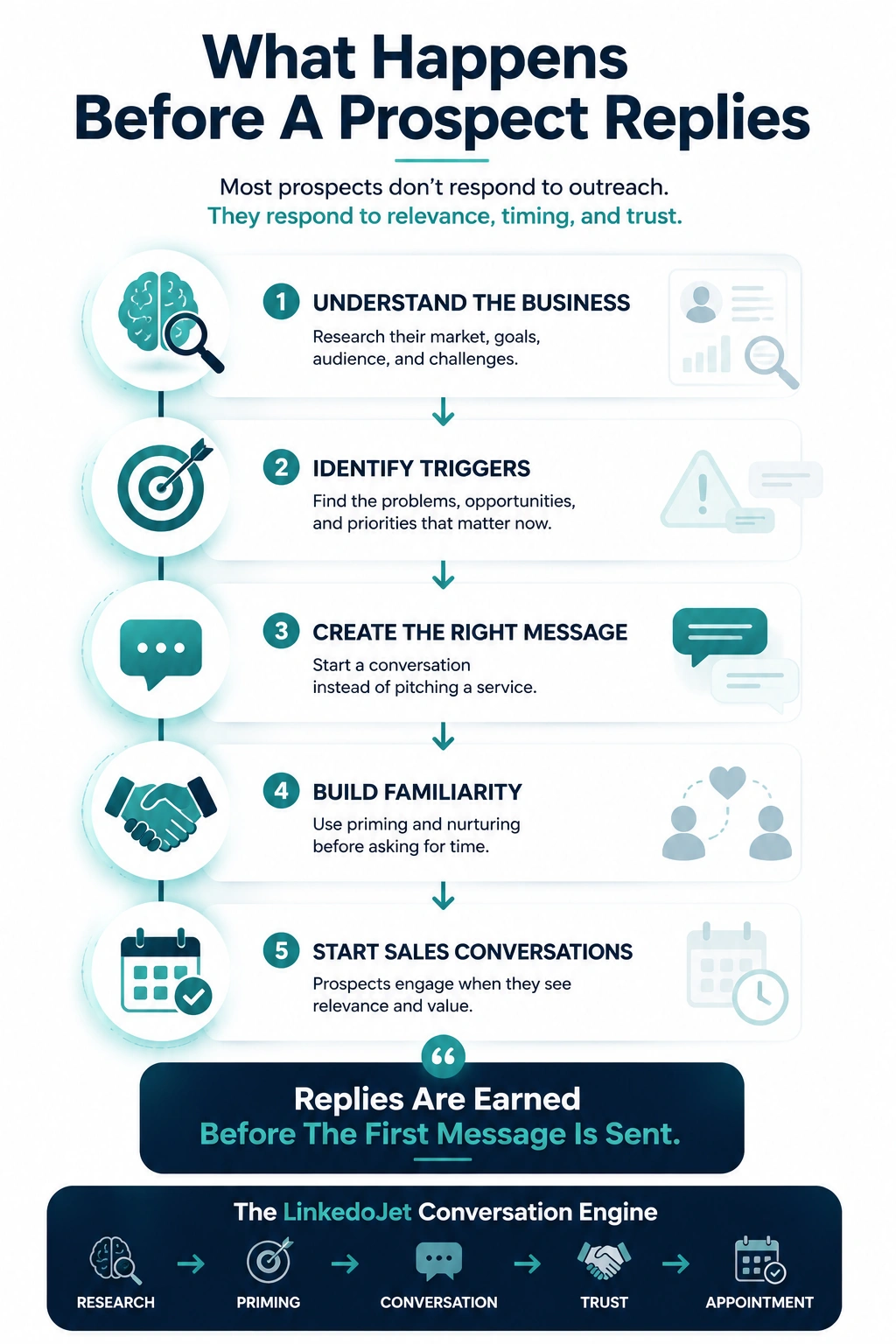
Most M&A LinkedIn outreach fails the moment it sounds like a broker email
If your DM reads like you’re trying to “source a mandate,” the prospect’s brain goes straight to risk: confidentiality, time, and reputation.
You’ve seen it: a partner forwards a screenshot to the team with a one-line caption—“Don’t ever send this.”
That’s the real tax in lower-middle-market advisor outreach. It’s not just low reply rates. It’s the quiet damage when a founder in a tight community decides you’re “one of those guys” and you lose a sector for a year.
Meanwhile your pipeline meeting still comes down to five warm names and a lot of “we’ll follow up.” The inbox looks busy. The relationship inventory isn’t.
The underlying failure isn’t copy. It’s conversation engineering:
- Wrong segmentation: owner, CFO, PE BD, and corp dev are not reading for the same thing.
- Wrong ask: a meeting request before you’ve earned permission triggers “not for sale” reflex.
- Wrong pacing: cadence timing that reads like a machine, especially when they’re mobile-only and answering at night.
- No nurturing system: you miss the moment they are ready because nobody recognized the cue and shifted the thread.
LinkedIn can work for M&A advisors, but only if the goal is smaller and more precise: earn a one-sentence reply, protect discretion, keep the relationship warm, and convert readiness signals into a short sanity-check call.
A four-lane audience map: what each reader is screening for in your first message
If you send one sequence to everyone, you’ll sound “broker-ish” to all of them.
Your prospects skim LinkedIn in short windows—early morning, between calls, or after-hours travel time. Founders and CFOs are sporadic and often mobile-only. That means short messages, one clear question, and patient follow-up that feels human.
| Lane | What they’re quietly asking themselves | What gets you ignored | What earns a reply |
|---|---|---|---|
| Founder / CEO | “Is this safe? Are they implying I’m selling? Will this waste my time?” | Buyer-name dropping, valuation talk, “we have buyers,” process language | Discretion + optionality + a pressure-off question about readiness/timing |
| CFO / Finance lead | “Do they understand diligence pain and reporting reality?” | Generic exit talk, fluff about ‘strategic options,’ no mention of QoE/WC/data | Data hygiene, QoE prep, working capital mechanics, timeline stress—practical framing |
| Private Equity (platform/BD) | “Is this relevant to our thesis? Are they going to spam me deals?” | “Can I send you deals?”, broad sector lists, pseudo-personalization | Specific thesis fit + a disqualifier question + tight ‘where can I be useful’ ask |
| Corporate Development | “Do they get integration risk, not just ‘strategic fit’ buzzwords?” | Pitchy threads, vague partnership talk, ignoring their bandwidth | Clear boundary: market color + tuck-in criteria + integration-aware questions |
Founder/CEO sequence (full examples): discreet, question-led, and paced like a human
Each message is designed to be answered in one sentence without admitting anything sensitive.
1) Connection request (light, non-threatening, community/industry tie)
Connect note: “Saw you’re in [industry] and based in [region]—I spend a lot of time around owner-led companies in that pocket. Prefer keeping a small circle here. Open to connecting?”
2) First message after acceptance (relevance hook + easy question)
DM: “Thanks for connecting. Quick question—do you get much unsolicited buyer outreach in your inbox these days, or has it cooled off in [industry]?”
3) Pressure-off follow-up (common friction owners recognize)
DM: “Makes sense. One thing I keep seeing with founder-led firms: the surprise isn’t the price conversation—it’s diligence friction (add-backs, customer concentration narrative, key employee retention). Have you ever done a ‘readiness pass’ on those, just to know where you’d get pushed?”
4) Query-based emotional trigger (optional, calm, respectful)
DM: “Totally fine if this is a ‘not right now.’ When owners do start thinking about it privately, it’s usually optionality + legacy + not wanting to spook the team. Is that kind of horizon even on your radar in the next couple years, or not really?”
5) Insight-based nurture (pattern recognition + offer a one-pager only if they want it)
DM: “Sharing one quick pattern from the last few processes I’ve watched closely: buyers push hardest in the first 30 days on (1) quality of revenue / churn story, (2) working capital ‘normalization,’ and (3) whether the org runs without the founder day-to-day. If it’s helpful, I can send a one-page checklist owners use to sanity-check those areas—no pitch attached.”
6) Soft meeting request (15-min sanity-check, no prep, easy decline)
DM: “If you’d rather talk than text, I’m happy to do a 15-min sanity-check call—no prep—just compare notes on readiness and what timing tends to look like in [industry]. Would [Tue 8–10a] or [Thu 4–6p] be better? And if it’s not relevant, just say the word.”
7) Close-loop (protect reputation, leave a clean re-entry)
DM: “All good either way. I’ll stay in your corner here and keep it discreet. If it ever becomes relevant later, just message me ‘readiness’ and I’ll send the checklist + a couple things buyers usually fixate on in [industry].”
Notice what’s missing: no “we have buyers,” no implied sale, no valuation bait, no forced urgency. You’re creating a safe channel that can stay open for 6–18 months.
CFO sequence (abbreviated): lead with diligence reality, not “exit planning” language
CFOs don’t respond to vibes. They respond to specifics: QoE prep, reporting hygiene, working capital mechanics, and timeline pressure.
- Connect note: “I work with a lot of finance leads in [industry] around reporting / diligence readiness. Keeping this discreet—open to connecting?”
- First DM: “Quick one—when you see companies go through a process (sell-side or recap), what’s usually the first ‘data pain’ that shows up internally: revenue detail, margin bridge, or customer concentration story?”
- Nurture DM: “The QoE firms I respect all say the same thing: the work isn’t the analysis, it’s the reconciling—policy consistency, add-back support, and explaining working capital swings. Do you have a clean narrative for WC seasonality today, or is it still in heads/spreadsheets?”
- Low-pressure ask: “If it helps, I can do a 15-min ‘pressure-test the data room story’ call—what a QoE team will ask first, where the timeline usually slips, and what’s easiest to clean up before it matters. No prep.”
The CFO version works because it doesn’t ask them to disclose intent. It offers a way to reduce future chaos.
PE + Corporate Development sequences (abbreviated): thesis fit, disqualifiers, and integration-aware nurturing
These buyers are drowning in “thought I’d reach out” messages. Your edge is specificity and restraint.
Private Equity (platform/BD)
- Connect note: “I follow add-on activity in [subsector] and spend time around founder-led targets in that band. Keeping it tight—open to connecting?”
- First DM: “Quick check: for [platform]-style add-ons, what disqualifies a target fastest right now—customer concentration, integration complexity, or weak second-layer management?”
- Nurture DM: “Seeing a shift: sellers are more sensitive to earn-out mechanics and post-close role clarity than they were 18 months ago. Are you finding founder rollover expectations are changing in [subsector]?”
- Soft ask: “If it’s useful, I can share a short view of where founder-led companies in [subsector] are getting stuck in diligence—no deal push. Worth a 10–15 min compare-notes?”
Corporate Development
- Connect note: “I work around tuck-in acquisition conversations in [industry]. I’m careful about confidentiality on here. Open to connecting?”
- First DM: “When you look at tuck-ins this year, what’s the ‘must-have’ for it to be worth attention—product adjacency, recurring revenue mix, or geographic density?”
- Nurture DM: “Integration risk seems to be the silent killer lately—systems + commercial overlap + who owns retention. Do you screen for integration complexity early, or only after initial interest?”
- Soft ask: “If you’re open, I’d value 15 minutes to understand what you’re actually prioritizing in [industry]. I can share market color from the founder side without turning it into a pitch thread.”
Both sequences keep a clear boundary: you’re not “shopping deals” in DMs. You’re building a reciprocal channel that pays off when something real surfaces.
What gets ignored in M&A inboxes (and how to rewrite it to sound discreet and human)
Founders ignore anything that threatens confidentiality or feels like it went to 200 people.
| Gets ignored | Why it fails | Rewrite that earns a reply |
|---|---|---|
| “We have buyers for companies like yours. Are you open to a conversation?” | Sounds like a broker blast; implies sale; triggers “not for sale.” | “Curious—are you seeing more unsolicited buyer outreach lately, or has it slowed in [industry]?” |
| “I noticed you’re a leader with an impressive track record…” | Fake personalization; no relevance; feels automated. | “I’m around owner-led [industry] companies in [region]. Keeping this discreet—open to connecting?” |
| “What’s your EBITDA? We can discuss valuation multiples.” | Premature; invasive; creates reputational risk. | “Have you ever done a quick readiness pass on the areas diligence pushes hardest (WC, concentration, add-backs), just to know where you’d get questioned?” |
| “We specialize in sell-side processes and can run a competitive auction.” | Process-first; agenda is obvious; no permission earned. | “If timing ever matters, the first win is usually reducing diligence friction before a process is even discussed. Is that a topic you’ve ever wanted to pressure-test?” |
| “Can I send you deals?” (to PE/corp dev) | Creates work for them; signals spam to come. | “What disqualifies add-ons fastest for you in [subsector]? I’d rather not send anything misaligned.” |
If your team is getting polite silence, it’s usually because the message forces the prospect to protect themselves—confidentiality, time, or both.
Meeting-ready signals (and how to move from light exchange to an intro call without breaking trust)
You don’t “create” timing. You recognize it, then handle it cleanly.
In real threads, readiness rarely shows up as “Yes, we’re selling.” It shows up as sideways comments and practical questions.
- “We’ve been getting more inbound from buyers lately.”
- “Board/partner brought it up… not sure when.”
- “Our reporting isn’t where it should be.”
- “How painful is diligence really?”
- “What do buyers care about in our sector right now?”
- “We’ve talked recap as an option.”
- “Customer concentration is the thing that comes up every time.”
The mistake is treating those cues like objections or trying to “close” them with a pitch. The right move is a controlled shift:
- Acknowledge without escalating: “That makes sense.”
- Ask one clarifying question: “Is it mostly inbound noise, or are you seeing credible parties?”
- Offer a bounded next step: “Want a 15-min sanity-check? No prep—just timing and readiness.”
This is where firms get inconsistent. Partners mean to follow up, then deals and live mandates take over. Two months pass. The moment is gone.
LinkedoJet is built to keep those threads alive without sounding mechanical—segmented sequences by persona, pacing that matches how founders/CFOs actually reply, and a disciplined way to tag “curious” vs “not now” vs “introduce me to the CFO” so the next message fits the moment.
FAQ
How do you message a founder about exit planning without implying they’re for sale?
Talk about readiness and optionality, not a process. Ask questions they can answer safely: unsolicited inbound trends, whether they’ve ever pressure-tested diligence friction (working capital, concentration, add-backs), or whether succession is a “someday” topic. Avoid buyer language, valuation ranges, and anything that reads like you’re fishing for EBITDA.
What’s a safe first question to ask a CFO about diligence readiness or QoE prep?
Start with a practical pain point: “When a QoE team shows up, what’s usually the first place things get messy—revenue detail, margin bridge, or working capital story?” It signals you understand the real work (reconciling, documentation, narrative) without forcing them to disclose intent.
How should M&A advisors message private equity teams without the “we have deals” vibe?
Lead with thesis fit and disqualifiers. A good first DM is a tight question: “What disqualifies add-ons fastest for you in [subsector]?” Then nurture with one market observation. If you ask for a call, frame it as “compare notes” and keep it short. Do not open with “Can I send you deals?”
What’s a respectful way to engage corporate development without turning it into a pitch thread?
Keep a clear boundary: you’re sharing market color and learning their criteria, not pushing an asset. Ask what makes a tuck-in worth attention this year, then show you understand integration risk (systems, retention, overlap). If you propose a call, position it as learning priorities and sharing founder-side pattern recognition—tight and useful.
How many touches is appropriate before it starts to feel automated or pushy in tight founder communities?
Fewer, better touches—spaced like a real person. Typically 4–7 messages over several weeks works if each one has a single clear question or a small piece of pattern recognition. The moment you stack follow-ups every 48 hours, you create the exact “cadence engine” smell founders screenshot.
If you want more intro calls without broker-blast risk, we’ll build the system and run it with you
This isn’t a generic “strategy chat.” It’s a working session to see exactly how LinkedoJet would run segmented outreach and nurturing for your firm—then, if it’s a fit, we implement and operate it end-to-end.
On the session, we’ll look at your current outreach (or lack of it) and identify where trust is breaking: segmentation, first-message framing, pacing, and follow-up discipline. We’ll also pressure-test your target lanes—founder/CEO vs CFO vs PE vs corporate development—so your team stops sending one-size-fits-all sequences.
If you move forward, LinkedoJet operationally provides:
- ICP and targeting setup tailored to your mandate profile (industry pockets, revenue band, ownership profile, geography, likely trigger events).
- Sales Navigator / LinkedIn list building for founders, CFOs, PE platform/BD, independent sponsors, and corp dev—built as clean, segmented prospect lists (not a messy saved search).
- AI-assisted personalization that stays discreet: relevance hooks, sector pattern recognition, and pressure-off questions—without the fake “I loved your post” tone.
- Outreach execution with pacing that matches how your prospects actually respond (asynchronous, mobile, evenings/weekends for owners).
- Lead reply handling and nurturing so “not now” becomes an organized long-game thread, not a dead end.
- Warm lead tracking so your partners can see who is curious, who is deflecting, and who is showing meeting-ready cues.
- Appointment generation support to convert the right signals into a short sanity-check call—clean framing, low pressure, easy to decline.
- Campaign visibility through dashboards so you’re not guessing what’s working or which lane is producing real conversations.
- Ongoing refinement as you learn which messages get replies in your subsectors and which trigger silence.
Most LinkedIn automation tools push volume. LinkedoJet is built to protect reputation while consistently creating high-trust conversations that mature into intro calls and, over time, mandates and introductions.
Next step: put discreet, segmented sequences into production—and keep the right conversations warm
You’ll walk away with a system your deal team can trust: the right lists, the right messages for each persona, and follow-up that turns real cues into booked intro calls.
From identifying the right decision-makers to starting meaningful conversations and turning them into qualified appointments... LinkedoJet manages the entire outbound engine for your business.