
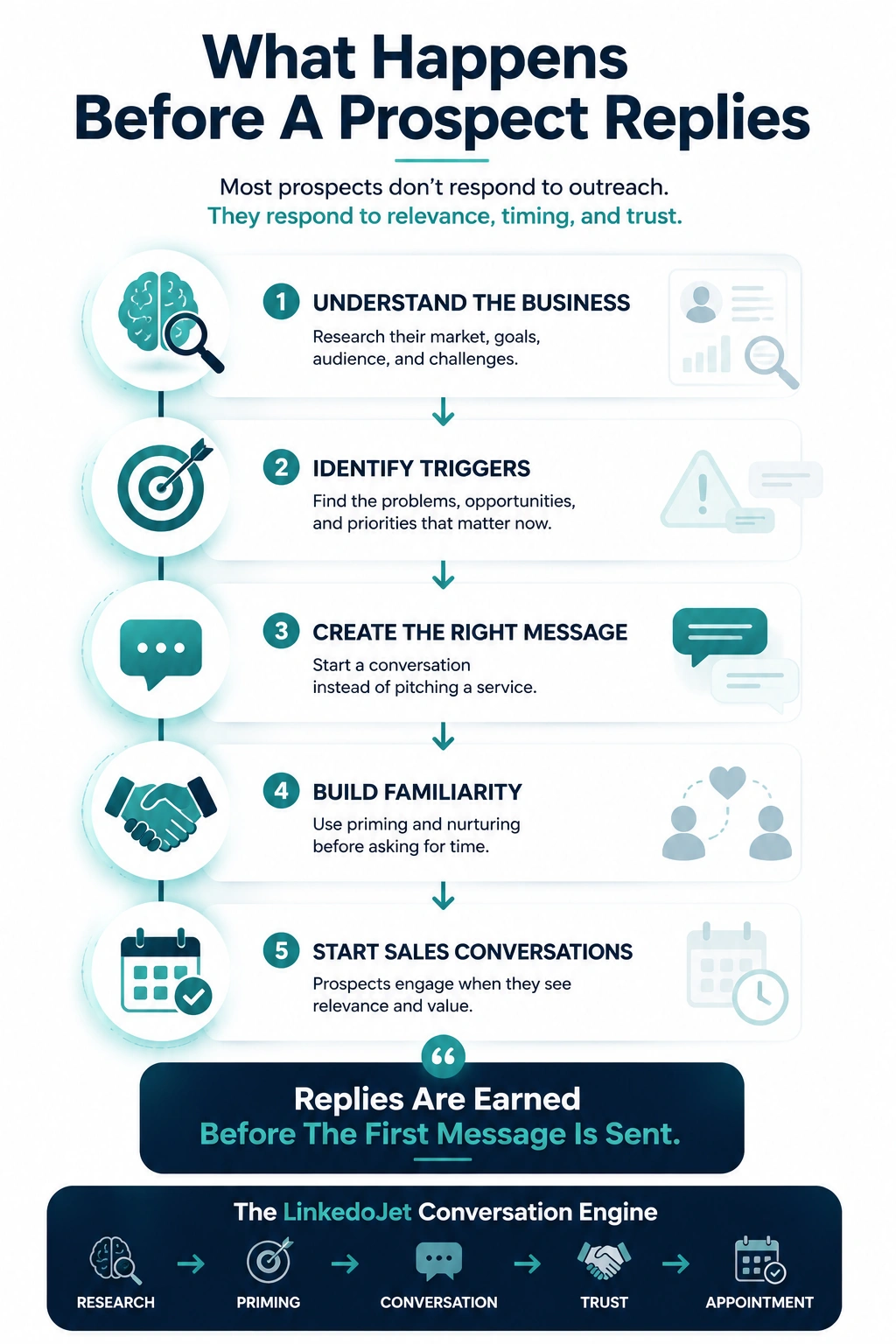
Why your outreach feels busy… but hospitals still don’t move
MedTech deals don’t stall because your product isn’t good—they stall because your first LinkedIn message lands in the wrong lane.
You can see it in the weekly pipeline call: lots of “activity,” a few polite replies, and almost no conversations that survive long enough to reach a real discovery step.
The thread usually dies in one of three places: you hit the wrong stakeholder (so you get “not my area”), you get stuck with a professional non-buyer (“send info”), or you trigger vendor fatigue by sounding like every other MedTech message they ignored that morning.
Hospitals and IDNs don’t buy through one person. They buy through clinical, ops, IT/security, and value analysis/procurement—often with finance sitting behind the curtain. If your outreach doesn’t help the recipient quickly route you (or safely say, “not me—talk to…”) you get ignored. Not because they’re mean. Because they’re protecting time, risk, and governance.
The hidden cost isn’t just reply rate. It’s credibility. Every generic sequence your team runs makes the next message from your company easier to dismiss—especially when the language smells like claims, shortcuts around value analysis, or an attempt to skip the portal.
Stakeholder mapping: the “first question” changes by role
The job of early LinkedIn isn’t booking a demo. It’s helping the reader place you in their world—and point you to the committee path.
Provider-side leaders skim LinkedIn in tiny windows: early morning before clinic, between meetings, or after-hours. Procurement and ops may check mid-day between email blocks. Long messages don’t get “read later.” They get mentally filed as vendor noise.
So your opener has to do one thing well: make it easy to answer in one line.
Clinical champion (nursing/clinical informatics/physician leader)
Angle: workflow friction, adoption across shifts, patient impact without sweeping claims. Your first question should sort whether they own the workflow change or if clinical informatics/ops owns it.
Operations leader (director of operations, throughput, service line ops)
Angle: throughput constraints, staffing strain, standard work across sites, handoffs that break at shift change. Your first question should ask whether they’re actively working on standardization this quarter or it’s parked until next budget cycle.
IT / security / integration (CIO org, security, interoperability, biomed)
Angle: integration bandwidth, PHI, support burden, vendor risk. Your first question should invite a “not me” route to the right technical owner and signal you respect governance (no attachments, no “just a quick demo”).
Value analysis / procurement
Angle: evidence threshold, total cost, contracting posture, vendor risk management. Your first question should acknowledge process reality (“Do you want this to start with value analysis, or does a clinical/ops owner sponsor first?”) so you don’t get pushed to a portal with no champion.
Finance
Angle: budget cycles, utilization logic, reimbursement where relevant, cost-to-serve. Your first question should be about how initiatives get funded (capital vs operating, shared savings rules, service line budget owner)—not a price request.
A MedTech-safe sequence that earns the right to ask for 12 minutes
Connect → route → validate → nurture → fit-check call → close loop. Short messages. Clear lane. No claims.
1) Connection request (permission + lane)
Example (ops): “Hi <
Example (IT/security): “Hi <
2) First message after acceptance (context + routing)
Example: “Thanks for connecting. Quick routing question—when teams look at reducing documentation time in <>, does that sit with you, or is it more clinical informatics / ops?”
3) Validate relevance (one sentence + low-pressure check)
Example: “Got it. The reason I asked: we’re seeing adoption break when a ‘helpful’ tool adds steps at the bedside. Is standardization across sites something you’re actively working on this quarter, or more of a next-year initiative?”
4) Query-based tension (surface the real buying friction)
Example: “When new tools come in, what usually slows decisions down most on your side—evidence for value analysis, IT integration bandwidth, or getting clinical adoption across shifts?”
5) Insight-based nurture (small practitioner note)
Example: “One quick pattern we’ve seen with pilots that actually finish well:
• one accountable owner (not a committee),
• success metrics written down before kickoff,
• minimal workflow disruption (no extra clicks).
Does that match how your org tends to evaluate workflow tools?”
6) Soft meeting request (fit-check + easy out)
Example: “If it’s useful, happy to compare notes for 12 minutes on how teams are getting value analysis comfortable without creating a massive implementation lift. If it’s not on your radar, just tell me and I’ll stop reaching out.”
7) Final close-loop (respect + future timing)
Example: “I’m going to pause outreach so I’m not adding to vendor noise. If <
This sequence works because it treats LinkedIn like stakeholder mapping, not persuasion. You’re giving them a safe way to route you—and you’re learning the real friction before you ever ask for time.
Reply handling that matches provider reality (without pushing)
Your team doesn’t lose meetings because they don’t follow up. They lose meetings because the follow-up ignores what the reply actually means inside a hospital system.
“Not my area.”
Don’t apologize and disappear. Route cleanly.
Reply you send: “Appreciate it. Who’s the right owner for <
“Send info.”
This is often a polite boundary. Earn one more turn with a role-specific, one-paragraph summary—no deck attachment.
Reply you send: “Happy to. To make it relevant: are you looking at this through a workflow/adoption lens, or an integration/security lens? I’ll send a short summary tailored to that (no pitch deck).”
“We already have a vendor.”
Good. That means the category is real. Ask about gaps and timing, not replacement.
Reply you send: “Makes sense. When systems keep the current vendor, what typically triggers a review—workflow gaps, adoption issues, support burden, or contract renewal timing?”
“Portal only / we don’t take vendor calls.”
Stop trying to outsmart governance. Go permission-based and keep the relationship intact.
Reply you send: “Understood. I won’t push for a call here. Is it okay if I share a public one-pager (no claims) and reconnect in <
Silence after a connection
Silence isn’t always rejection; it’s often triage. Two clean touches beat six “just bumping this.”
- Touch 1 (3–5 business days): one routing question.
- Touch 2 (7–10 business days): one insight + one question tied to a decision event (EHR migration, multi-site standardization, upcoming RFP, pilot fatigue).
- Then close-loop: pause and offer a timed reconnect.
Meeting-ready signals in MedTech are rarely “sounds great.” They’re questions about integration, evidence thresholds, pilot structure, pricing model, references, or “who else has done this.” When you see those, you’re no longer selling a meeting—you’re guiding next steps.
What to avoid in MedTech LinkedIn outreach (and what to say instead)
If you do one thing differently next week, make it this: stop sending the same message to a CNO, a director of ops, and a value analysis manager. It reads like you don’t understand how decisions are made—and that’s an immediate credibility hit.
- Opening with a product pitch (features, screenshots, “quick demo”).
- Leading with outcomes claims (“reduce readmissions,” “guaranteed ROI,” anything that invites compliance anxiety).
- Fast meeting ask before they’ve categorized relevance to their lane.
- Vague personalization (“saw your profile,” “love what you’re doing at <
>”). - Ignoring value analysis reality (acting surprised by portals, RFPs, or governance).
- Attachment spam in early messages (decks, PDFs, case studies) — it’s a trust-killer.
| Bad message (what gets ignored or reported) | MedTech-safe rewrite (what earns a reply) |
|---|---|
|
“Hi < |
“Hi < |
|
“I noticed you’re a leader at < |
“I’m reaching out because we’re seeing multi-site systems struggle with < |
The goal isn’t to sound clever. It’s to sound safe, specific, and committee-aware. That’s what cuts through vendor fatigue.
How LinkedoJet turns this into an appointment system (not “automation”)
Most teams don’t fail because they don’t have templates. They fail because nobody owns the system: targeting drifts, sequences get copied across roles, replies sit in inboxes, and the handoff to AE feels like a cold restart.
LinkedoJet runs the operational engine so your team can focus on real conversations and closing—not chasing ghosts.
What we set up (so messages land in the right lane)
- ICP + targeting setup: define provider org types (IDN vs community, academic, multi-site) and the stakeholder map you actually need to win.
- Sales Navigator / LinkedIn list building: role-based prospect lists (clinical, ops, IT/security, value analysis/procurement, finance) with clean segmentation so you’re not mixing lanes.
- Role-specific openers: short routing-first messages that make it easy to reply “me” or “not me—talk to…”
How execution stays human (even at volume)
- AI-assisted personalization: not fake flattery—context cues like service line, site footprint, workflow themes, and governance reality. The output is edited to stay MedTech-safe and claims-free.
- Timing that respects provider schedules: shorter notes, spaced touches, and built-in close-loop so you don’t become the problem.
- Nurture logic by reply intent: routing, curiosity, mild interest, “send info,” portal/RFP, objections, and silence each trigger different next steps.
What your team gets (so appointments aren’t random)
- Reply handling + warm lead tracking: we track stakeholder, lane, stated friction (integration bandwidth, pilot fatigue, evidence threshold), and next action.
- Appointment generation support: we help move threads to short fit-check calls only after relevance is confirmed—and we preserve relationships when the answer is “not now.”
- Campaign visibility: dashboards that show what’s being sent, what’s working by persona, and where conversations stall.
- Ongoing refinement: we adjust targeting, copy, and follow-ups as we learn which lanes and themes produce real committee-path conversations.
This is the difference between “we sent 1,000 messages” and “we created 15 committee-ready threads that led to calls.”
FAQ
How is a LinkedIn messaging strategy for MedTech different from standard B2B SDR sequences?
Two big differences: lane discipline and governance respect. In MedTech, the first responder is often a router, not a buyer. And your language is judged for risk—claims, implied outcomes, and “shortcut” vibes get filtered fast. Good sequences are routing-first, committee-aware, and built to earn small replies that reveal the real buying path.
What should a MedTech SDR ask in the first message after a connection is accepted?
Ask a routing question that makes it easy to answer in one line. Example: “Quick routing question—when teams work on <
How do you message hospital executives on LinkedIn without pitching or making outcomes claims?
Keep it short and framed as a relevance check, not a product intro. Mention a recognizable constraint (standardization across sites, staffing strain, integration bandwidth) and ask whether it’s a live initiative. If they engage, you can share a brief practitioner insight. Save any “results” language for later, and only if it’s properly supported and appropriate.
What do you say when procurement/value analysis is the first stakeholder who responds?
Thank them, acknowledge process, and ask how they prefer initiatives to enter the system. Example: “Appreciate the response. Do you prefer these start with a clinical/ops sponsor before value analysis, or should we begin with your evidence checklist first?” The goal is to avoid being forced into a portal with no internal owner.
How many touches should a LinkedIn messaging sequence for selling into hospitals include—and over what timing?
Typically 5–7 touches over ~21–35 days, depending on role and responsiveness. Clinical leaders often respond best to fewer, shorter touches; ops/procurement can tolerate a bit more structure. The key is spacing and intent: route → validate → nurture → fit-check. If there’s no signal after two thoughtful follow-ups, close-loop and offer a timed reconnect.
Get your MedTech sequence reviewed—and leave with role-based threads you can run next week
This isn’t a generic “strategy call.” We’ll pressure-test your messages against provider reality and show you exactly how we run the system end-to-end.
On the session, we’ll review your current LinkedIn messaging (or build it from scratch) through the lens that actually matters in hospitals: stakeholder lanes, committee path, governance language, and the friction that stalls decisions (integration bandwidth, pilot fatigue, evidence thresholds, implementation lift).
If there’s a fit, here’s what LinkedoJet operationally provides after onboarding:
- ICP and targeting setup built around provider org types and a real stakeholder map (clinical, ops, IT/security, value analysis/procurement, finance).
- Sales Navigator + LinkedIn prospect list building so each sequence is lane-specific—not a blended blast.
- AI-assisted personalization that stays MedTech-safe: context cues and relevance, not fluffy compliments or risky claims.
- Outreach execution with timing that respects provider schedules and avoids “vendor fatigue” behavior.
- Lead nurturing + follow-up workflows that adapt to reply intent (routing, “send info,” portal/RFP, objections, silence) instead of sending the next template anyway.
- Warm lead tracking and campaign visibility via dashboards—so you can see which roles and themes create committee-ready conversations.
- Appointment generation support to move the right threads into short fit-check calls, with a clean handoff including notes on stakeholder lane, pains mentioned, and the likely next step.
Ordinary LinkedIn automation tools send messages. LinkedoJet runs the conversation system—targeting, sequencing, reply handling, and handoff—so your team isn’t paying for activity while hospitals stay cold.
Next step: turn vendor-fatigued silence into routed, committee-aware conversations
You don’t need more touches. You need the right lane, the right question, and a system that handles the follow-through without burning credibility.
From identifying the right decision-makers to starting meaningful conversations and turning them into qualified appointments... LinkedoJet manages the entire outbound engine for your business.