
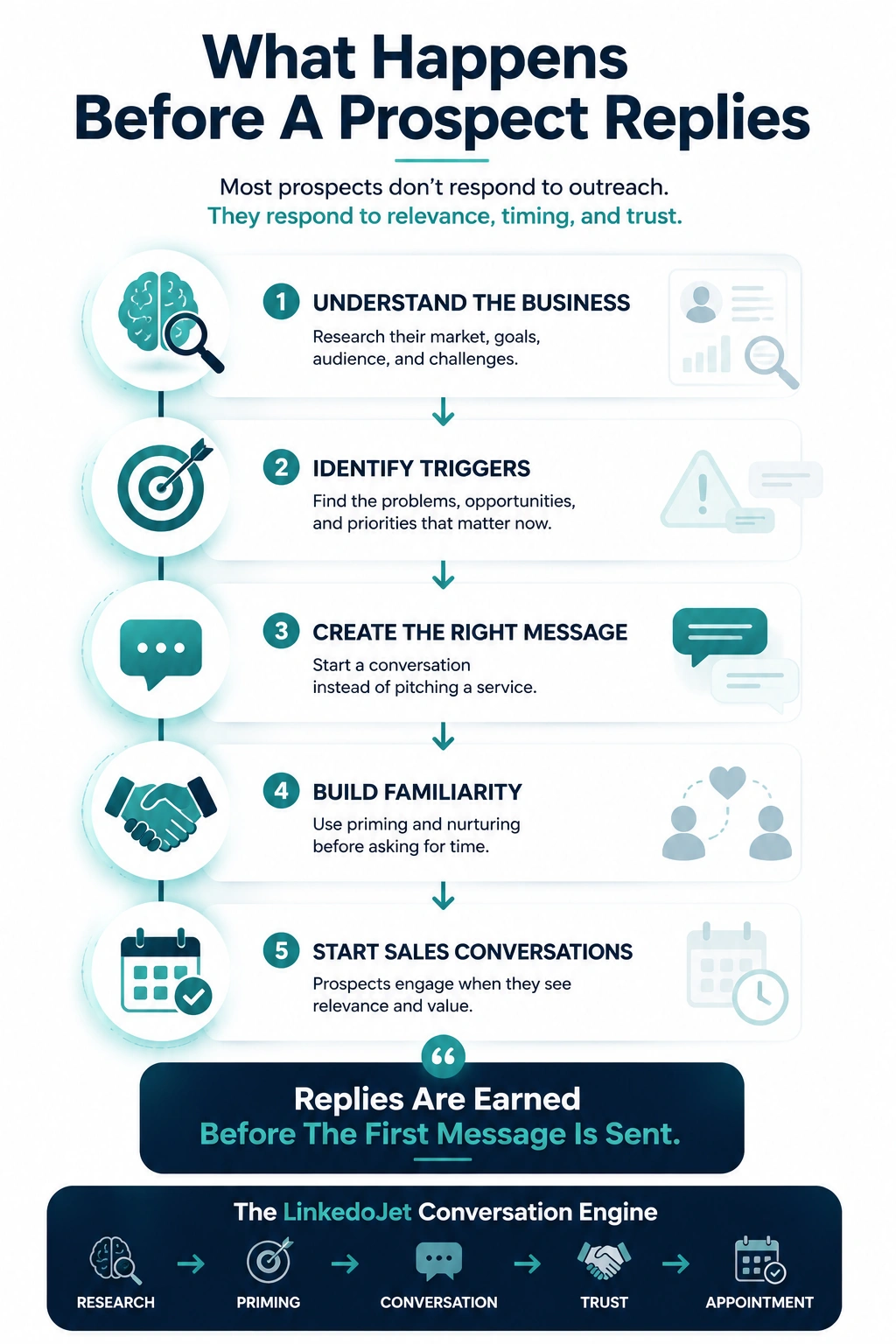
Why most agency outreach dies on contact (and what it quietly does to margin)
If your LinkedIn DMs sound like an agency, your buyer’s brain files you under “vendor noise” before they finish the first line.
It usually shows up in the Monday pipeline meeting, not in your inbox.
You’ve got a few proposals floating. Maybe one “warm” intro that’s been warm for three weeks. Delivery is busy, so outbound gets pushed to “later.” Then a client pauses, a retainer shrinks, or utilization drops two points—and suddenly everyone’s panic prospecting from scratch.
Most agencies respond by sending more messages. That’s the trap. More volume with the same positioning just makes you the agency your buyers mute.
Here’s what prospects ignore on autopilot because they see it all day:
- “Free audit” pitches (they read as bait-and-switch or a low-trust wedge).
- Generic personalization (“Love what you’re doing at…”—no operator would write that).
- Case study dumps without context (results divorced from budget, offer, creative, and tracking).
- Calendar links before the prospect has even agreed there’s a problem.
The cost isn’t just lower reply rates. It’s commercial.
When outreach doesn’t create real sales conversations, you end up backfilling with referrals (unpredictable), marketplaces (price pressure), or discounting to keep seats full. That’s how margin gets chewed up—slowly, then all at once.
Buyer headspace + timing windows: when founders and CMOs actually reply
Your message competes with attribution arguments, internal pressure, and a dozen other agencies saying the same thing.
Founders and growth leaders don’t ignore you because they “don’t care about growth.” They ignore you because responding creates work: decisions, evaluation, politics, and the risk of buying another month of agency management overhead.
Founder headspace is usually cash efficiency disguised as marketing talk. CAC payback, contribution margin, and the fear that performance is flattening while costs creep up. They’re scanning for anything that looks like a time sink or a pitch.
CMO / Head of Growth headspace is accountability under uncertainty. Post-iOS measurement fog, higher CPMs, creative fatigue cycles getting shorter, and stakeholders who want certainty on a dashboard that can’t offer it. Their inbox isn’t “lead gen.” It’s risk management.
Timing matters more than most agencies admit. People reply in short windows:
- Early morning before the day fills up.
- Between meetings when they’re clearing notifications.
- Late afternoon when they’re triaging loose threads.
And they’re more receptive after specific triggers—because the pain is top-of-mind:
- Right after a reporting cycle where CAC drift or ROAS volatility is hard to explain.
- After a campaign underperforms and nobody agrees what to change first (offer vs creative vs landing page vs tracking).
- During a hiring push (performance marketer, lifecycle, creative) when throughput becomes the bottleneck.
- When they’re rethinking channel mix or pushing into a new geo/product line.
If you show up with “Can I get 15 minutes to tell you about our agency,” you’re asking them to spend political capital before you’ve earned a one-line reply.
The 3-stage framework: earn a reply → prove constraints → propose a small next step
Booked fit-check calls don’t come from clever openers. They come from measured conversation design.
This is the sequence logic that keeps you out of the “spammy agency” bucket while still moving toward a calendar.
1) Earn the first reply (micro-commitment)
Your goal is not “sell.” It’s a one-line answer. Ask something easy to answer, tied to a real constraint.
- Stabilizing CAC vs driving more volume on the same spend
- Creative testing throughput vs targeting tweaks
- Lead quality complaints vs lead volume
- Measurement confidence vs “we think it’s working” reporting
2) Prove you understand the operational reality (without pretending you audited them)
One useful pattern you’re seeing across accounts. No diagnosis. No big claims. Just an observation that sounds like you’ve been in the weeds: creative fatigue, MER pressure, landing page friction, lead form quality, offline conversion gaps, sales follow-up breakdowns.
3) Offer a small next step that feels like a working session
Call it what it is: a fit-check. Tight boundary (15 minutes). One topic. Easy “no.”
When you do it right, the prospect feels you’re trying to help them think, not corner them into a sales process.
A hand-offable sequence: cadence, intent signals, and when to stop
The goal is consistency without turning your founder profile into a billboard.
Most agencies bounce between two extremes: manual one-off DMs that die the moment delivery gets busy, or automation blasts that burn reputation. The fix is a paced sequence with clear intent rules.
| Day | Touch | Purpose | What you’re looking for |
|---|---|---|---|
| 0 | Connection request | Permission + relevance signal | Acceptance (no reply needed) |
| 0–1 after accept | First message (1 question) | Earn a one-line reply | Any direct answer, even short |
| 2–4 | Soft problem follow-up | Introduce a market pattern | “Yes/no/kind of” replies |
| 6–9 | Pressure question (respectful) | Name the real internal friction | Longer replies, nuance, emotion |
| 10–14 | Insight nurture | Give value without a deck | “Send that” / asks a question |
| 14–18 | Fit-check ask (15 min) | Convert intent to a slot | “Next week works” / timing talk |
| 20–24 | Close-loop | Protect reputation + future timing | No reply needed |
Intent signals to treat as “warm”:
- Short, direct answers (“mostly CAC,” “lead quality is the issue,” “attribution’s messy”).
- Requests for anything specific (“send the 2–3 bullets,” “what would you look at first?”).
- Timing language (“after board meeting,” “Q3 focus,” “we’re hiring first”).
- Deflections that are actually interest (“send info” from a real operator is often “make this easy”).
When to stop: no response after a clean close-loop, explicit “not interested,” or repeated deflections with no substance. Continuing past that is how you become the thread they screen-shot.
Message examples that don’t sound like every other agency
Use these as patterns. Swap the wedge based on your offer (paid, SEO, CRO, lifecycle) and their trigger (hiring, expansion, channel focus).
Connection request (permission + trigger)
Context note: Keep it short. Reference something real (hiring, growth role, channel push). No pitch.
“Saw you’re hiring for growth + investing more in paid. I trade notes with operators on what’s working when CAC gets weird and creative fatigue hits. Open to connecting?”
First message after acceptance (one question, no trap)
Context note: One line of context, one easy question tied to a real constraint.
“Quick one—this quarter are you more focused on stabilizing CAC/payback, or getting more volume out of the same spend? No wrong answer.”
Soft problem-based follow-up (2–4 business days later)
Context note: Introduce a pattern you’re seeing, without claiming it’s their situation. End with a binary question.
“Something we keep seeing: teams hit ROAS swings from creative fatigue faster than they expect, then they over-correct in targeting and the account gets choppy. Are you running into that, or is your testing cadence pretty dialed?”
Pressure question (respectful, reality-based)
Context note: Name the real pressure without being dramatic. This is where founders/CMOs often respond because it mirrors their week.
“When numbers dip, is the harder part the performance itself—or getting everyone aligned on what to change first (offer, creative, landing page, tracking)?”
Insight-based nurture (give a useful nugget, not a monologue)
Context note: Deliver something actionable that doesn’t require their ad account. Offer 2–3 bullets, not a deck.
“One small thing that’s helped a few teams improve lead quality without killing volume: tighten the lead magnet promise and add one qualification step (question or micro-friction) before the handoff to sales. If you want, I can send the 3-bullet version of how they structured it—worth it?”
Soft fit-check ask (15 minutes, one topic, easy out)
Context note: This should feel like a working session. Clear boundary. Clear “no worries.”
“If it’s useful, happy to do a 15-min fit-check on your testing cadence and where bottlenecks usually show up (brief → creative volume → learning loop). If it’s not a priority, no worries—just reply ‘not now’ and I’ll close the loop.”
Final close-loop (reputation-safe)
Context note: Protect the relationship and your profile. Give them a clean exit and a future re-entry point.
“I’m going to step back so I’m not another unread thread. If later you’re comparing agencies or want a second opinion on performance/measurement/creative throughput, reply here and I’ll re-engage.”
What to say when they say… (without getting defensive or salesy)
Objections are usually a request for safety: “Don’t waste my time, don’t create work, don’t make me manage you.”
“We already have an agency.”
“Makes sense. Not trying to replace anyone. When teams already have an agency, the gaps I usually see are (1) creative testing velocity, (2) measurement confidence, or (3) lead quality handoff to sales. Are you 100% confident in one of those right now—or is one a bit shaky?”
“Send info.”
“Sure. Two lines so it’s actually readable:
- We help teams tighten the learning loop (creative/testing/LP/measurement) so spend turns into predictable pipeline, not noisy dashboards.
- Best fit is when there’s real spend + stakeholder pressure and performance is ‘fine’ but unstable.
Quick question so I don’t spam you with the wrong thing—are you more concerned about CAC drifting up, or lead quality/sales conversion?”
“What’s your pricing?”
“It depends on scope (channels, creative involvement, reporting depth, and whether we’re fixing measurement/LP issues alongside media). To give a real number: what’s your monthly spend range and primary channel mix right now?”
“Not looking.”
“All good. Timing is most of the battle. If it ever flips—usually after a rough reporting cycle or a hiring change—reply ‘revisit’ and I’ll send one question to see if it’s worth a fit-check.”
“We’re good / results are fine.”
“That’s a win. The only reason I ask: ‘fine’ accounts can still be fragile—one creative fatigue cycle, one tracking change, one offer shift and the learning loop slows. Are you confident you’d spot the issue in a week, or does it usually take a month to show up?”
LinkedoJet is the conversation-engineering operating system behind booked fit-check calls
Not “automation.” A managed outbound engine that protects your positioning while creating real conversations.
Most agency teams don’t fail because they can’t write a decent DM. They fail because the system breaks the moment delivery gets busy. Messaging becomes random, targeting gets fuzzy, follow-up becomes awkward, and the founder’s profile takes the reputational hit.
LinkedoJet fixes the underlying mechanics:
- ICP + targeting setup: we help you define the segments that can actually pay (and that have the right pain), then build Sales Navigator / LinkedIn lists based on real signals (hiring, channel focus, org size, seniority, geo, tech clues when available).
- Prospect list building: clean, tagged lists by persona (founder vs CMO vs Head of Growth) so the angle matches their world.
- AI-assisted personalization: not fake flattery—light context that makes the opener feel specific (trigger + wedge), while keeping your voice consistent.
- Outreach execution: paced sequences that earn micro-commitments first, then prime with a useful observation, then ask for a fit-check.
- Reply handling + nurture: intent-sensing rules so “send info” doesn’t become a deck blast, and “we have an agency” routes into a second-opinion conversation instead of a fight.
- Warm lead tracking + appointment support: clear stages (new → engaged → warm → fit-check proposed → booked) so nothing gets lost in someone’s inbox.
- Campaign visibility: dashboards that show what’s actually happening—accept rates, reply rates, intent signals, booked calls—so you’re not guessing.
- Ongoing refinement: we adjust targeting, angles, and follow-ups based on what the market is responding to, not what “should” work.
The outcome you’re buying is consistency: a predictable flow of fit-check calls with the right prospects—without calendar-link spam, without “free audit” positioning, and without turning your team into full-time DM typists.
FAQ
What’s a good LinkedIn messaging sequence for marketing agencies that doesn’t pitch too early?
Run it in three stages: earn a one-line reply (simple, credible question), prove you understand real constraints (one market pattern, not a diagnosis), then offer a 15-minute fit-check on one topic. If your first message contains a service pitch, a case study dump, or a calendar link, you’re skipping the trust steps buyers require now.
How many follow-ups should an agency send before it starts hurting reply rates and reputation?
A clean sequence is usually 4–6 total touches after connection (spread over ~2–3 weeks), with a respectful close-loop at the end. The bigger risk isn’t the number—it’s repeating the same ask. Each follow-up should change the “reason to reply” (question → pattern → pressure question → insight → fit-check → close-loop).
What should I say when a prospect replies, “We already have an agency”?
Don’t argue. Shift to second-opinion framing: “Not trying to replace anyone—when teams already have an agency, the gaps tend to be creative testing velocity, measurement confidence, or lead quality handoff. Are you 100% confident in one of those?” It keeps the conversation adult and gives them a safe way to admit friction without “firing” anyone.
Do LinkedIn outreach templates work for digital marketing agencies, or do they all feel like copy-pasta?
Templates work as structure, not as scripts. The moment the message reads like it could be sent to any brand, you lose. What makes it land is the wedge (a real operational constraint) + a trigger (hiring, channel push, reporting pain) + a question that’s easy to answer in one line.
How do you ask for a meeting on LinkedIn without dropping a calendar link too early?
Ask for a fit-check with boundaries: 15 minutes, one topic, and an easy “no.” Do it after they’ve replied at least once or signaled intent (“send that,” “we’re seeing that too,” “timing is Q3”). If you need to share scheduling, offer two time windows first; only send a link once they’ve agreed a quick fit-check is useful.
Book a fit-check: we’ll build your sequence, targeting, and follow-up system—then help you run it
This isn’t a vague “strategy chat.” You’ll leave with a concrete outbound plan tied to your offer and the buyers who can actually say yes.
On the session, we’ll pressure-test your current outreach against the realities your buyers care about (CAC drift, creative fatigue, measurement confidence, lead quality, stakeholder scrutiny). Then we’ll map a reputation-safe sequence that earns micro-commitments before asking for a fit-check call.
What LinkedoJet operationally provides (after onboarding):
- ICP and targeting setup so you’re not messaging “marketing people,” you’re messaging the right decision-makers in the right segment.
- Sales Navigator / LinkedIn prospect list building with tagging by persona and trigger (hiring, expansion, channel focus) so timing and angle match.
- AI-assisted personalization that adds context without sounding like fake flattery or a template farm.
- Outreach execution with paced sequences (connection → question → pattern → nurture → fit-check ask → close-loop).
- Lead reply handling and nurturing using intent signals (short answers, “send info,” timing language) so warm leads don’t die in the inbox.
- Warm lead tracking so you can see who’s engaged, who’s warming, who’s ready for a fit-check, and who should be paused.
- Appointment generation support to turn “interesting” threads into booked calls without pushing calendar links too early.
- Campaign visibility through dashboards so you’re managing a system, not guessing off vibes.
- Ongoing campaign refinement based on what’s actually getting replies and bookings in your market.
Ordinary automation tools help you send more messages. LinkedoJet helps you run a conversation engine: targeting + timing + priming + nurture + tracking, with human pacing and clear stop rules so you don’t burn your profile.
Next step: get a fit-check sequence that books calls without cheapening your agency
You’ll know exactly who you’re targeting, what you’re saying, how follow-up works, and how warm conversations get turned into qualified appointments—without founder whiplash or spammy tactics.
From identifying the right decision-makers to starting meaningful conversations and turning them into qualified appointments... LinkedoJet manages the entire outbound engine for your business.