
Why ISO outreach dies on LinkedIn the moment it sounds like a shortcut
Quality and GRC leaders aren’t ignoring you because they don’t need help. They’re ignoring you because the message doesn’t feel safe to reply to.
You can be excellent at ISO work and still feel one quarter away from a revenue wobble.
Not because the market is quiet. Because your pipeline depends on referrals and timing. Long stretches of nothing, then a last-minute rush when someone’s customer questionnaire lands or a surveillance date suddenly becomes “next month.”
LinkedIn should smooth that out. Instead it often makes it worse: you spend time in threads with people who want a certificate shortcut, who are actually talking to a registrar, or who aren’t under any real trigger. You do free consulting in DMs and it never turns into a scoped project.
The brutal part is the positioning damage. If your first two lines smell like “cert fast,” you get filed with the spam. Quality, QHSE, and GRC people live in evidence. They can smell template outreach in a heartbeat.
They’re scanning LinkedIn between a plant walk and a corrective action meeting. Or late afternoon when they’re trying to catch up on doc control. They don’t have patience for:
- a standards list (9001/14001/45001/27001) with no context
- vague “compliance benefits” language that could mean anything
- fake personalization (“saw your profile”)
- anything that blurs consultant vs certification body
What they will respond to is specificity that matches their week: audit month, scope changes, evidence packs, control owners who won’t play ball, and customer requirements that landed with a deadline.
Who to target (and how the message changes by persona)
Same service. Different anxieties. If you send one generic sequence, you’ll get generic replies—or none at all.
ISO work isn’t bought because someone “wants ISO.” It’s triggered. The person replying to you is deciding whether you understand the friction inside their business.
Target by role first, then tune the hook to the trigger they actually feel.
| Persona cluster | What they’re protecting | Hooks that earn replies | Language to avoid |
|---|---|---|---|
| Quality Manager / QMS Owner (ISO 9001, IMS) | Audit outcomes, CAPAs, internal audits, doc control that doesn’t collapse | Surveillance vs recert clean-up, customer requirements, evidence ownership, “system usable between audits” | “We get you certified,” “fast track,” generic “improve quality” claims |
| Ops Director / Plant Manager | Production continuity, shift consistency, not turning ISO into paperwork theatre | Multi-site consistency, process proof on the floor, internal ownership without disruption | Long policy talk, abstract governance language |
| QHSE / EHS (ISO 14001/45001) | Incident prevention, contractor control, training records, legal compliance reality | Contractor onboarding controls, site reality vs documentation, incident-driven “suddenly urgent” work | “One-size-fits-all templates,” generic “safety culture” pitches |
| IT/Security + GRC (ISO 27001) | Risk treatment that holds up, SoA that maps to evidence, questionnaire fatigue | Controls-to-evidence mapping, audit artifacts, “policies exist but aren’t lived,” vendor due diligence | Vague “cyber compliance,” tool-first talk, anything that sounds like a certification broker |
| Managing Director (SME / mid-market) | Customer retention, tenders, time, and not being embarrassed in front of a key account | Tender/customer requirement deadlines, “what does ‘ready’ cost in time and disruption,” fast clarity on scope | Long technical explanations, heavy standard references upfront |
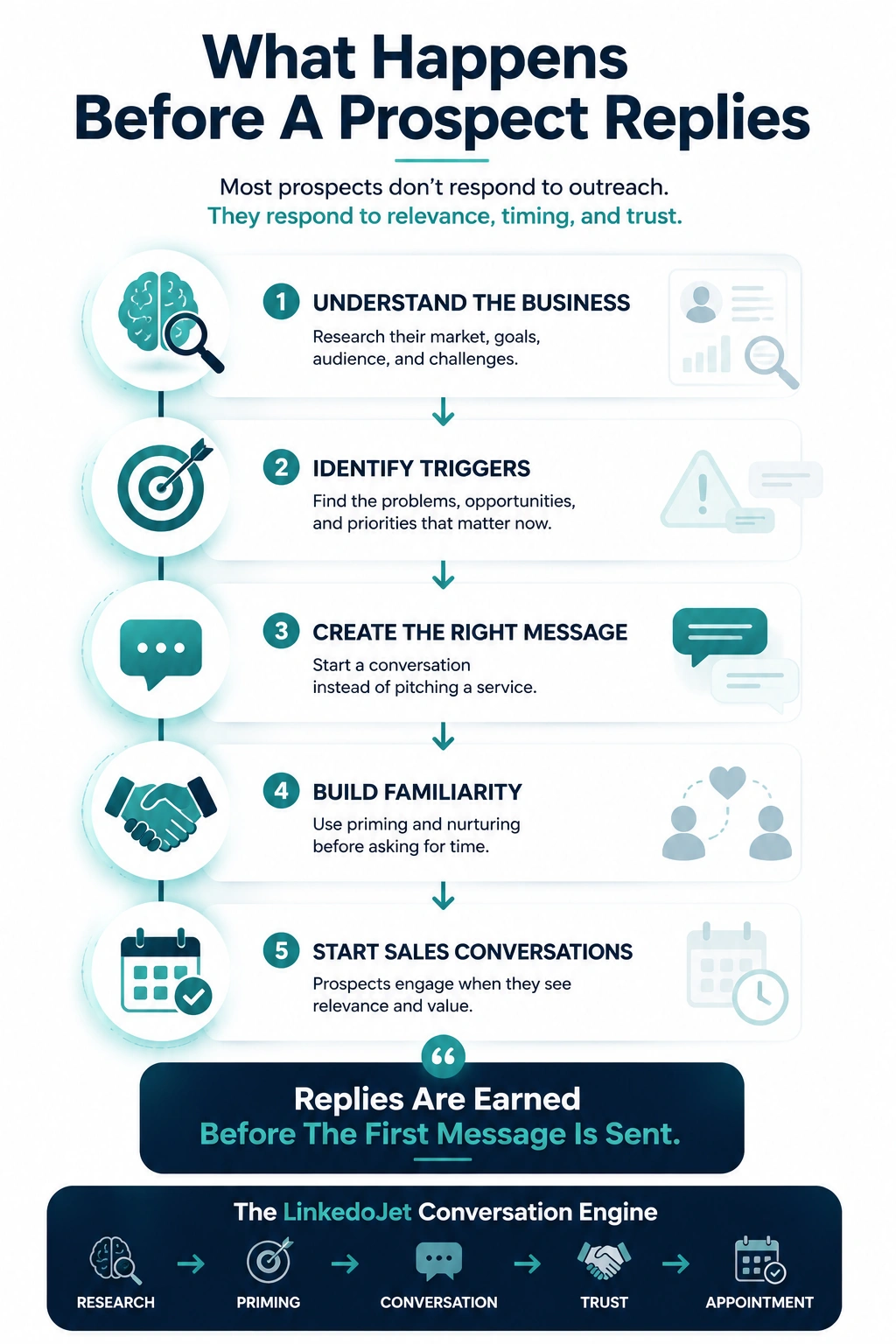
The ISO-ready LinkedIn sequence (opener → small question → credibility nugget → follow-up → nurture → scoping call)
You’re not selling ISO. You’re doing audit-prep triage in public-private, one short thread at a time.
Most sequences fail because they try to “introduce services” and ask for a meeting before the prospect has any reason to trust you.
The sequence that works in ISO is quieter. More precise. It earns a reply by making it easy for them to place themselves in a scenario.
- Opener (role + context, no pitch): Signal you understand their world. One sentence.
- Small question (easy to answer): Two options is best. It lowers the risk of replying.
- Credibility nugget (one real observation): A practical distinction like documentation vs evidence, or where Stage 1/2 commonly goes sideways.
- Gentle follow-up (neutral): One line that allows them to say “sorted” without feeling sold to.
- Nurture (useful micro-asset in-message): A short outline, a checkpoint list, or a framing question tailored to the standard.
- Scoping call (working session framing): Only once they show timing/pain/curiosity. Keep it 10–15 minutes. Make the outcome clear.
Notice what’s missing: a standards list, a capability dump, and the “can we hop on a call?” in message one.
In ISO consulting, the scoping call is earned when they admit one of these:
- an audit month
- a customer requirement / tender
- evidence collection is messy
- internal ownership is unclear
- they need a gap assessment or plan, not “templates”
Message examples you can send today (9001, 27001, 14001/45001)
Short. Role-aware. Trigger-led. No theatrics.
Connection request (general, clean, non-salesy)
- Quality/QHSE: “Hi <
>, I work with Quality/QHSE teams getting ready for ISO audits and keeping the system usable between audits. Open to connecting?” - IT/Security/GRC: “Hi <
>, I help security/GRC teams get ISO 27001 audit-ready with controls-to-evidence mapped cleanly (not just policy packs). Open to connecting?” - MD: “Hi <
>, I support SMEs when a customer/tender forces ISO work quickly—scope, plan, evidence, ownership. Open to connecting?”
After acceptance: first message (ISO 9001)
“Thanks <
After acceptance: first message (ISO 27001)
“Thanks <
After acceptance: first message (ISO 14001/45001)
“Thanks <
Soft follow-up (no reply)
“Nudging this once. Most teams aren’t short on documents—they’re short on clean evidence and clear ownership. Is evidence collection a headache for you, or is it running smoothly?”
Query-based emotional trigger (surfaces the fire drill)
“Curious—does audit prep feel like a calm runbook at your place, or does it turn into a last-minute scramble for records?”
Insight-based nurture (give value without dumping a ‘lead magnet’)
“One pattern I keep seeing: Stage 1 looks fine because the docs exist, then Stage 2 hurts because the evidence isn’t linked to process/control owners. If helpful, I can share a simple structure for an evidence pack that keeps CAPAs, internal audits, training, and approvals from becoming a scavenger hunt.”
Soft meeting ask (only after a signal)
“If you’ve got an audit month or a customer deadline in mind, want to do a quick 10–15 min scoping sanity-check? We’d map scope, sites, and what ‘ready’ actually needs to look like for the date—no sales deck.”
Close-loop (respectful off-ramp)
“All good if this isn’t on your plate right now. If an audit date or customer requirement pops up and you want a second set of eyes on readiness/scope, happy to help. Want me to circle back next quarter, or leave it there?”
Timing, cadence, and triggers that actually move replies
ISO replies aren’t random. They spike when urgency is real and the message lands in a quiet minute.
Quality and Ops leaders tend to scan early morning, then again late afternoon when they’re back at a desk. QHSE is similar—between site time and admin catch-up. IT/Security and GRC often check in bursts around risk reviews, incidents, and vendor paperwork. MDs show up early or late and have zero tolerance for fluff.
A simple cadence that doesn’t create vendor fatigue:
- Day 0: Connection request
- Day 1: First message (small question)
- Day 4: Soft follow-up (evidence/ownership angle)
- Day 9: Query-based emotional trigger (calm runbook vs scramble)
- Day 16: Nurture insight (one useful pattern + offer a short outline)
- Day 28: Close-loop (permission to pause)
The trigger list that reliably changes response rates in ISO consulting:
- an audit month (surveillance or recert)
- first-time certification tied to a customer onboarding requirement
- a tender pack calling out ISO 9001/14001/45001
- supplier audits and customer questionnaires escalating in detail
- a new site / multi-site complexity
- a safety incident / environmental event that forces process proof
- security due diligence where “we have policies” stops being enough
If you’re consistent, you stop relying on luck. You also stop getting dragged into the wrong conversations—because your questions force the real situation (or lack of one) to surface quickly.
What not to do if you want Quality/QHSE/GRC to take you seriously
A few small mistakes make you indistinguishable from cert-mill noise—and once you’re in that bucket, you won’t get a second read.
- Imply you’re a certification body. Even accidentally. “Get certified” language without context triggers instant skepticism.
- Promise speed. “Fast certification” is a credibility killer with evidence-driven buyers.
- Pitch in message one. If your first message asks for a call before they’ve revealed a trigger, you’re done.
- Dump standards like a menu. Listing 9001/14001/45001/27001 doesn’t sound expert. It sounds like a broker.
- Vague outcomes. “Improve compliance” means nothing. Say what you actually touch: gap assessment, implementation plan, internal audit program, evidence pack, SoA/evidence mapping.
- Template personalization. “Saw your profile” with no reference is worse than saying nothing.
- Over-follow up with pressure. ISO buyers aren’t ignoring you out of spite; they’re overloaded. Add clarity, then give an off-ramp.
The goal isn’t more messages. It’s fewer threads that go nowhere, and more threads that naturally surface scope, timing, and ownership.
How LinkedoJet turns this into booked scoping calls
You bring the ISO expertise. LinkedoJet runs the outbound engine so your calendar isn’t at the mercy of referrals and luck.
Most “LinkedIn tools” stop at sending messages. That’s not the job.
In ISO consulting, the hard part is staying credible while you follow up, nurturing without sounding needy, and tracking which conversations are becoming real opportunities (audit month, customer requirement, evidence gaps) versus polite noise.
LinkedoJet is built to run the full workflow, not just the first touch:
- ICP and targeting setup: we define your best-fit company profiles (industry, size, multi-site complexity, compliance pressure) and the exact role clusters you want (Quality/QHSE/Ops/GRC/MD).
- Sales Navigator prospect list building: we build and maintain clean lists that match how ISO projects actually start—by trigger and role, not broad keywords.
- AI-assisted personalization: used to tailor openers and credibility nuggets to the persona and standard without fake “profile reading.” You approve the voice and guardrails.
- Outreach execution on LinkedIn: connection requests, message sequencing, and pacing that feels human and professional.
- Reply handling + nurturing: we triage responses, surface the right diagnostic questions, and keep threads moving without pressure.
- Warm lead tracking: dashboards show who’s warm, why they’re warm (audit month, tender, questionnaire load), and what the next action is.
- Appointment generation support: when a prospect signals timing/pain, we help convert that into a short scoping call framed as a working session.
- Ongoing refinement: messaging and targeting are adjusted based on real reply patterns, not guesses.
If you’ve been doing good work but living with lumpy pipeline, this is how you get predictable: not by sounding louder, but by sounding like the person who understands evidence, scope control, and internal ownership.
Common questions ISO consultants ask before they run this sequence
How do I start a LinkedIn conversation about audit readiness without pitching ISO services?
Lead with a role-specific reality, then ask a small two-option question. Example: “Are you heading into first-time cert, or cleaning up ahead of surveillance/recert?” That frames the conversation around timing and workload—not “buy my services.”
What’s a good LinkedIn messaging sequence for ISO 9001 consulting versus ISO 27001?
ISO 9001 tends to respond to customer requirements, CAPA/internal audit fatigue, and keeping the system usable between audits. ISO 27001 responds to questionnaires, tender demands, and controls-to-evidence mapping (SoA, evidence owners, audit artifacts). Same structure, different hooks.
How do I avoid sounding like a certification body or a “cert fast” operator in my LinkedIn outreach?
Avoid “get certified” language as your headline promise. Talk about readiness: scope, evidence, ownership, internal audits, and the plan. And never imply speed as the primary outcome—serious buyers hear that as risk.
How many follow-ups is reasonable before I pause or close the loop in ISO consulting outreach?
Typically 3–4 follow-ups over 3–4 weeks, each adding clarity (not pressure), then a respectful close-loop. If they don’t respond after the close-loop, pause. If they say “not interested,” stop. If they’re “not this quarter,” nurture lightly and set a future check-in.
What are “meeting-ready” signals in LinkedIn replies for ISO work (scope, timing, evidence, ownership)?
Meeting-ready signals include: they mention an audit month, a customer/tender requirement, failed internal audits, evidence gaps, unclear control owners, a need for a gap assessment, or they ask about effort/timeline. That’s when a 10–15 minute scoping call feels like help, not a sales meeting.
See how this gets run for you (targeting, sequences, follow-up, and booked scoping calls)
This isn’t a “let’s chat” call. It’s a working session to confirm fit and show you the outbound engine we’ll operate on your behalf.
On this demo session, we’ll walk through how LinkedoJet would be set up for an ISO consulting practice specifically—so your outreach sounds like a serious implementation partner, not a cert-mill or a broker.
What LinkedoJet operationally provides:
- ICP + targeting setup built around ISO buying triggers (audit month, customer questionnaires, tenders, supplier audits, multi-site growth, incidents).
- Sales Navigator list building for the exact role clusters you care about (Quality/QHSE/Ops/Plant, IT/Security/GRC, and MD), with lists you can inspect and approve.
- AI-assisted personalization that stays grounded in role + standard + likely snag (evidence ownership, CAPAs, internal audit fatigue, SoA/evidence mapping) without fake “profile research.”
- LinkedIn outreach execution with controlled pacing, clean sequencing, and professional follow-up.
- Lead nurturing and follow-up workflows that add clarity in-message (not spammy drips), including close-loop handling and “not this quarter” nurture.
- Warm lead and appointment tracking so you can see who’s warm, why they’re warm, and what’s next—without living in your inbox.
- Appointment generation support to convert meeting-ready signals into booked scoping calls framed as working sessions.
What happens after onboarding: we build your targeting and prospect lists, load your approved sequences, start outreach, handle replies using your guardrails, and keep a visible dashboard of activity, warm leads, and booked appointments. You stay focused on delivery and scoping calls—not chasing people.
What you receive: the targeting system, live prospect lists, ISO-specific message sequences, reply-handling prompts, follow-up/nurture flows, and campaign visibility through dashboards—plus ongoing refinement as we see what gets real replies from Quality and GRC leaders.
Why this is different from ordinary LinkedIn automation tools: automation tools send. LinkedoJet runs the process—targeting, writing, personalization, execution, reply handling, nurturing, tracking, and appointment support—so your outreach creates credible threads that lead to scoped conversations.
Next step: let us run the outbound engine while you stay focused on delivery
If you’re done with lumpy pipeline and dead-end DMs, this is the clean path to more scoping calls with companies under real audit or customer pressure.
From identifying the right decision-makers to starting meaningful conversations and turning them into qualified appointments... LinkedoJet manages the entire outbound engine for your business.