
Start credible CFO / Head of IR conversations—without pitching retainers, “investor access,” or anything that smells like MNPI
If your first message sounds like “can I sell you IR services,” you’ve already lost. The win is a low-friction reply that you can nurture into a 15-minute compare-notes call after the quarter.
The frustrating part isn’t rejection. It’s sounding sloppy in front of people who live on precision.
CFOs and Heads of IR can spot the vendor angle in six words. And when they do, you don’t just get ignored—you quietly get categorized as someone who doesn’t understand disclosure boundaries, calendar reality, or how reputationally expensive a “quick call” can be.
Referrals won’t cover the gaps forever. But LinkedIn outbound only works in IR when it feels like a peer-to-peer nudge: calm, specific, anchored in public context, and asking a question they can answer safely.
What we’re not doing here:
- No spray-and-pray.
- No gimmicky personalization (“saw your post”).
- No valuation promises.
- No “we bring investors” claims.
- No fishing for sensitive details (or anything adjacent to MNPI).
What we are doing: designing conversations that land in the narrow windows where IR leaders actually take new meetings—post-earnings debrief, between conferences, after a guidance event, during a new CFO onboarding.
The persona split that changes the whole message
One sequence for “CFO/IR” is why your outreach feels generic. CFOs read for risk. Heads of IR read for execution. Pre-IPO leaders read for readiness.
Most IR firms think they need better templates. The hidden problem is conversation design.
The same sentence can feel safe to a Head of IR and risky to a CFO. That’s why “nice copy” still underperforms. Your first job is to match the prospect’s mental filter, not to describe your service line.
| Persona | What they’re protecting | Entry points that feel safe | What turns them off |
|---|---|---|---|
| Public company CFO | Credibility, predictability, guidance discipline, avoid self-inflicted volatility | Messaging hygiene, investor mix fit, recurring Q&A drift, narrative discipline | Anything that sounds like promotion, “introductions,” or a retainer pitch |
| Head of IR | Execution load, feedback quality, keeping the Street aligned, internal alignment (CEO/CFO) | Perception feedback patterns, investor targeting process, conference season signal/noise, transcript themes | Long intros, “case study” dumps, assumptions about internal priorities |
| Pre-IPO CEO/CFO | Readiness, story architecture, avoiding a messy first year as a public company | Equity story clarity, KPI consistency across materials, Q&A prep discipline, investor targeting readiness | Big claims, generic agency language, pressure to “take a call” now |
LinkedoJet builds separate micro-sequences for each persona. Same firm. Different framing, different questions, different timing logic.
The 7-message sequence (with intent notes)
This sequence is built to earn a reply first, then earn the meeting. It stays inside disclosure-safe boundaries and uses only public context.
How to use this: keep the wording tight, pick one persona angle, and don’t “mix objectives.” Each message has one job.
Connection request (10–25 words)
Intent: establish relevance without pitching.
Example: “Hi [Name] — I follow a few [sector] issuers. Noticed your recent earnings call / investor day deck. Open to connecting?”Message after acceptance: pattern-check question
Intent: get a safe, non-invasive reply (no services, no ask).
CFO-leaning example: “Quick pattern-check: are you seeing more ‘model drift’ lately—same message, but different takeaways across holders/analysts?”
Head of IR-leaning example: “Curious if you’re noticing Q&A themes getting noisier quarter-to-quarter, even when the deck is consistent?”
Pre-IPO example: “When you stress-test the equity story, do the KPIs stay consistent across deck, narrative, and Q&A prep—or do they start to wobble?”Soft problem follow-up (2–4 days later)
Intent: offer a specific observation and invite a small reply.
Example: “Seeing a lot of small/mid-cap teams get pulled into repeated ‘clarifications’ because one KPI / bridge point isn’t landing cleanly. Is that showing up for you, or is feedback pretty stable?”Query-based emotional trigger
Intent: name the real pressure without drama; yes/no/depends response.
CFO version: “Does it ever feel like you do the hard work to be precise… and the market still trades you on the wrong story?”
Head of IR version: “Do you find yourself answering the same three questions every quarter, even after you’ve addressed them directly?”Insight nurture (no link dump)
Intent: give something useful that signals you’re not here to sell in the first message.
Example: “One distinction that’s been helpful: message clarity problems vs investor mix problems. If the same holders misread the same point repeatedly, it’s usually clarity. If the questions shift with who’s showing up, it’s mix. Different fixes, and it changes what you watch in the transcript.”15-minute compare-notes ask (time-boxed, context-aware)
Intent: propose a narrow topic and respect earnings windows.
Example: “If it’s useful, happy to compare notes for 15 minutes on how teams are triaging recurring Q&A themes into message tweaks vs disclosure discipline. Usually easiest post-earnings debrief week or once you’re through the quarter.”Polite close-loop
Intent: preserve reputation, create an easy next window, avoid chasing.
Example: “No worries if timing’s off—this might be a post-earnings thing. If you prefer, just reply with ‘after earnings’ and I’ll wait, or tell me the month that’s typically calmer on your side.”
Timing and cadence that respects IR calendars
Good wording sent at the wrong time still reads as “doesn’t understand our world.” In IR, timing is part of credibility.
The biggest unforced error: pushing follow-ups through earnings prep and then acting surprised when you get ghosted. You didn’t get ignored because they hate outbound. You got ignored because you hit them when their calendar is a wall of board decks, script rounds, and internal alignment.
Practical timing guidelines (you’ll adjust by issuer, but these keep you out of trouble):
- Avoid: earnings prep week, the 24–48 hours around release/call, and obvious roadshow/conference days.
- Prefer: early morning local time, mid-week afternoons, and the post-earnings debrief week when teams review what landed vs what didn’t.
- Don’t “stack” follow-ups: if they’re short with you, go slower; if they ask a clarifying question, you can tighten the interval.
Signal-based pacing is what keeps this from feeling like automation:
- Profile view + no reply: send one more question, then pause.
- “After earnings”: acknowledge, lock a date window, and go quiet until then.
- Short reply (“maybe / depends”): ask one tight follow-up, don’t drop your credential dump.
- “Quiet period”: respect it explicitly and ask for a post-window check-in.
What gets ignored in IR inboxes (and what gets replies)
IR leaders aren’t anti-sales. They’re anti-sloppiness. Their tolerance for “vendor language” is near zero because the downside is reputation.
Ignored (or quietly blacklisted):
- “We can raise your valuation” or anything that implies price impact.
- “We can get you in front of investors” / “introductions to funds” claims.
- Long first messages with a mini case study.
- Forced familiarity (“loved your post”) when the outreach is clearly templated.
- Questions that corner them into discussing non-public plans.
- Early “are you open to switching IR firms?” pressure.
Replied to:
- Restraint: one clean idea per message.
- Specificity: a public anchor (earnings call, investor day deck, guidance event, new CFO announcement, conference participation).
- A smart, safe question: perception vs reality gap, investor mix fit, recurring Q&A drift, KPI consistency.
- Respect for boundaries: explicit nods to timing and disclosure discipline.
Here’s the quiet truth: if your outreach reads like you’re trying to “win the account,” they’ll protect themselves by not engaging. If it reads like you’re comparing notes on something real, you’ll get the one thing you need—an opening.
Handling common IR objections without sounding defensive
These aren’t rejections. They’re scope and timing cues. Treat them that way and you stay in the conversation.
Objection: “We already have an IR firm.”
Response angle: you’re not asking to replace—offer a narrow compare-notes topic.
Example: “Makes sense. Not suggesting a change. Quick question: do you feel you’re getting enough perception feedback quality to separate message clarity issues from investor mix issues? If not, happy to share a short checklist we use to spot gaps in transcripts and meeting notes.”
Objection: “We do this in-house.”
Response angle: respect it; ask about bandwidth and blind spots around investor targeting / feedback loops.
Example: “Totally fair—many teams run it tight internally. Where it usually gets hard is keeping feedback clean during conference season. Is the bigger constraint bandwidth, or is it getting consistent signal from the right investor set?”
Objection: “We’re in a quiet period.”
Response angle: demonstrate you understand; ask for the right post-window slot.
Example: “Understood—thanks for the heads up. I’ll stay out of your way. Is it better if I check back the week after the call for a short compare-notes on any Q&A themes that surprised you?”
Objection: “Circle back after earnings.”
Response angle: make it easy to keep the thread alive without nagging.
Example: “Will do. To make it painless, what’s your usual debrief window—same week, or the week after? I’ll send one note then and leave it there.”
Objection: “Not looking to change anything.”
Response angle: agree; offer a micro-value exchange tied to public materials.
Example: “That’s reasonable. If you’re open, I can share two patterns we’re seeing in how analysts are framing [sector] KPIs this year—sometimes it helps teams keep the narrative disciplined without changing the story.”
FAQ
What’s a compliant LinkedIn messaging strategy for investor relations firms (and what language should we avoid)?
Anchor every message in public context (earnings call, investor day deck, guidance event, conference participation, leadership change) and keep questions answerable without touching sensitive plans.
Avoid language that implies:
- you can influence valuation or the stock price,
- you can “bring investors” or provide investor access,
- you have inside knowledge,
- they should discuss anything non-public on LinkedIn.
The safest posture is “compare notes on patterns we’re seeing” and “curious if this is showing up for you,” then let them steer.
How should LinkedIn outreach differ for CFOs vs Heads of IR vs pre-IPO CEOs/CFOs?
CFO: risk control, credibility, guidance discipline, narrative hygiene. Keep it tight and low-promotion. Ask about model drift, recurring Q&A, investor mix fit, and message consistency.
Head of IR: execution load and feedback quality. Ask about perception feedback cleanliness, conference season signal/noise, and how they’re triaging recurring questions.
Pre-IPO CEO/CFO: readiness and story architecture. Ask about KPI consistency, Q&A prep discipline, and whether the equity story survives stress-testing without over-claiming.
When is the best time to message CFOs and Heads of IR around earnings, quiet periods, and conference season?
Best reply windows are usually early mornings, mid-week afternoons, and the post-earnings debrief week when teams assess what landed and what didn’t.
Avoid earnings prep week, the 24–48 hours around release/call, and visible travel blocks during conference season. If someone flags a quiet period, acknowledge it plainly and schedule your next touch for after the window.
What do you say when they reply: “We already have an IR firm” or “We do this in-house”?
Don’t counterpunch. Agree, narrow the scope, and keep it useful.
Try: “Not suggesting a change—quick question…” then ask something operational: perception feedback cadence, investor targeting discipline, or how they separate message clarity issues from investor mix issues. Offer a small asset (checklist, benchmark question set) instead of a pitch.
How do you follow up without nagging—especially when they say “circle back after earnings”?
Convert “after earnings” into a specific window: “same week or week after?” Then stop touching the thread until that window.
When you do follow up, keep it to one sentence and one question. No “just bumping this.” No guilt. The tone should feel like a professional reminder, not a chase.
If you want this running as an engine (not an experiment), LinkedoJet will build and operate it with you
This isn’t a “tips call.” You’ll leave with IR-specific sequences, targeting, and a working follow-up system that respects earnings windows and earns replies before asking for 15 minutes.
On the session, we’ll quickly align on your offer line (earnings support, investor targeting, perception studies, IR strategy) and then get specific about how your outbound should work in the real IR calendar—earnings prep, quiet periods, conference season, and the post-earnings debrief week.
What LinkedoJet operationally provides after onboarding:
- ICP + segmentation setup: separate tracks for public company CFOs, Heads of IR, pre-IPO CEO/CFOs, and PE-backed portfolio finance leaders—so your messages don’t read like “one sequence for everyone.”
- Sales Navigator / LinkedIn list building: we build and maintain prospect lists by sector, market cap band, geography, trigger events (new CFO, guidance reset, investor day, conference participation), and relevance filters—using public signals only.
- Compliance-safe phrasing + micro-sequences: we implement conversation-led sequences like the 7-message flow above, with wording that avoids investor-access claims, valuation promises, and anything that invites sensitive disclosure.
- AI-assisted personalization: used to reference safe, public context (earnings call themes, investor day deck framing, conference attendance, leadership changes) without turning it into cringe “I read your post” theater.
- Outreach execution: connection requests, message delivery, and cadence management that slows down around earnings and speeds up when signals suggest openness.
- Lead reply handling + nurturing: we help categorize replies (timing, incumbent, in-house, quiet period) and run follow-up workflows that keep your reputation intact.
- Warm lead tracking + appointment support: we track who’s warm, who asked for “after earnings,” and who is meeting-ready, and we help you land 15-minute compare-notes calls tied to one narrow topic.
- Campaign visibility: simple dashboards showing outreach volume, acceptance rates, reply rates, warm lead counts, and booked conversations—so you can see what’s working without guessing.
- Ongoing refinement: we tune targeting, messaging, and pacing based on real-world responses (including conference season shifts and sector-specific volatility drivers).
Why LinkedoJet is different from ordinary LinkedIn automation tools: tools send messages. LinkedoJet runs the system—targeting, sequencing, compliance-safe language, pacing logic, reply handling, nurturing, and appointment support—so the output is credible conversations, not noise.
Next step: get the IR sequences installed and running
You don’t need more templates. You need persona-based conversations, compliance-safe wording, earnings-aware pacing, and a follow-up system that turns “after earnings” into booked time.
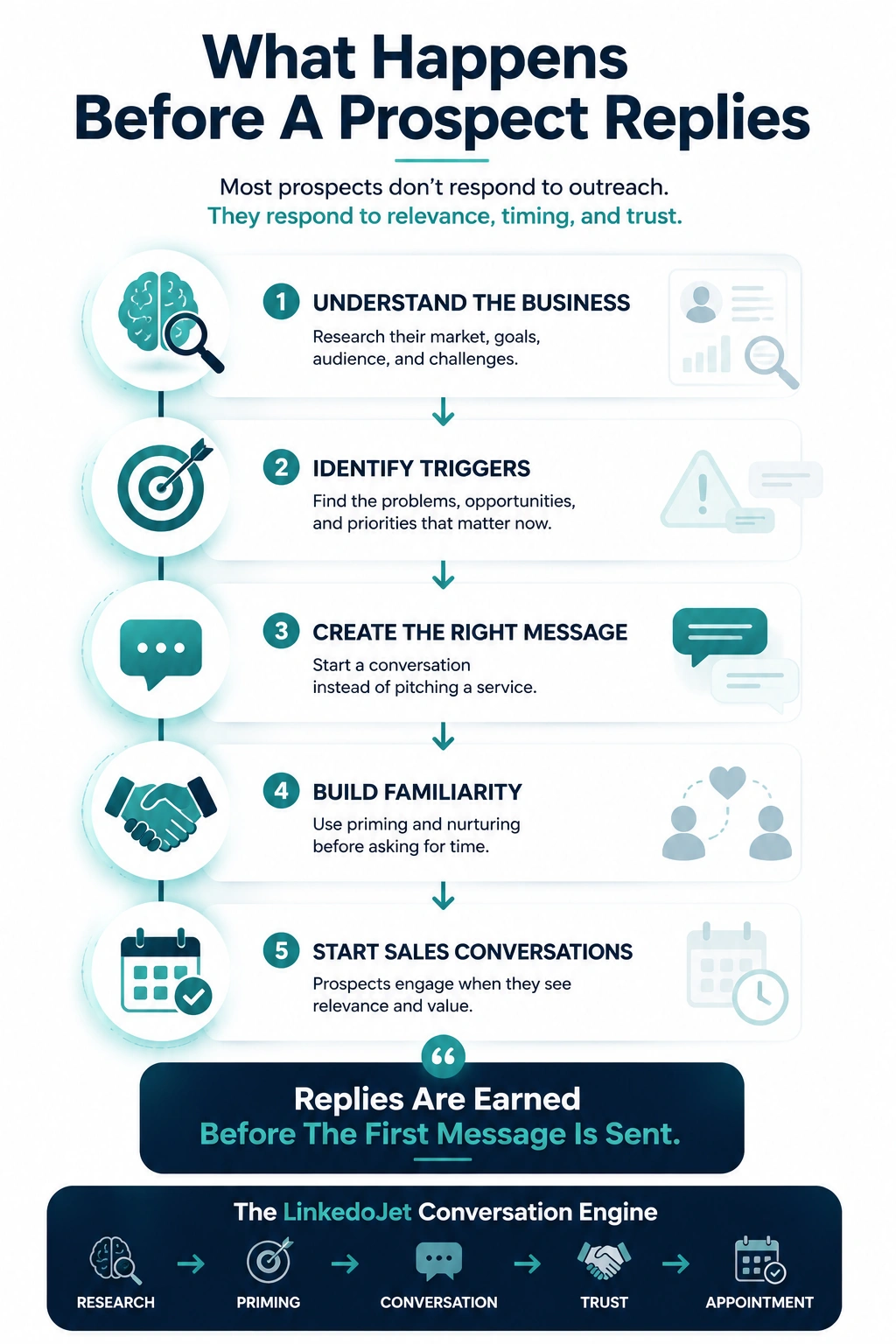
From identifying the right decision-makers to starting meaningful conversations and turning them into qualified appointments... LinkedoJet manages the entire outbound engine for your business.