
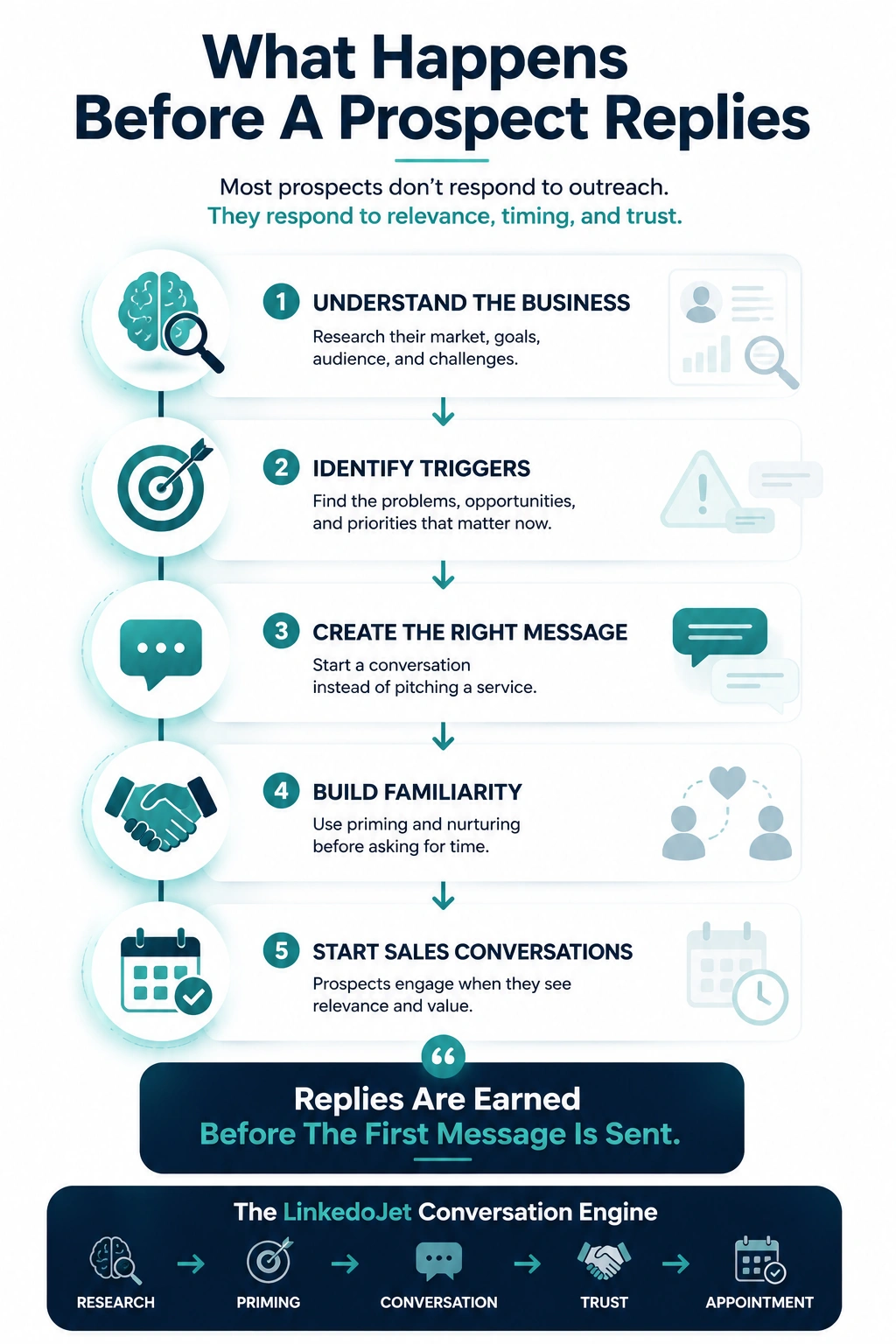
HR is measured on engagement and benefits experience—your DM lands as workload
If your outreach reads like “another wellness vendor,” you’re not being rejected. You’re being triaged.
HR leaders don’t open LinkedIn hoping to meet new vendors. They check it in tiny pockets—before the day starts, between meetings, late afternoon when inbox fatigue is real. In those pockets, anything that smells like a pitch becomes a task they didn’t ask for.
And the cost isn’t just one ignored message.
It’s the slow bleed: prospects view your profile, don’t reply, and you quietly lose the right to be heard later—right when they’re deciding whether to renew the incumbent, consolidate vendors, or do nothing because switching feels like more work than staying.
Wellness makes this worse because the category is saturated with the same claims: engagement, culture, ROI, “holistic.” HR has heard it. Total Rewards has heard it. Benefits has heard it—while also being the person who gets dragged into the uncomfortable internal question: “Is this actually being used?”
When your first touch asks for “15 minutes,” you’re forcing a decision before you’ve earned a low-friction exchange. The default move is to ignore you, or to say “send info” to end the thread.
Who this is for (and why the usual outreach motion breaks)
You sell something legitimate—platform, coaching, workshops, manager enablement—but meetings are inconsistent and pipeline feels spiky.
This is for founders, sales leads, and BD managers at corporate wellness companies selling into mid-market and enterprise HR/People Ops/Total Rewards teams.
You’re living with realities like:
- Long cycles and low bandwidth. Enterprise HR teams are juggling ER cases, manager escalations, surveys, renewals, open enrollment planning, and leadership asks like “what are we doing about burnout?”
- Category fatigue. You can have a strong program and still get filtered out because the first message sounds like the last 20.
- Adoption pressure. Even when HR likes the idea, they’re afraid of launching another “resource library” that no one uses after week three.
- Calendar-driven buying. Timing matters more than your brochure: post-survey action plans, Q1 resets, budget windows, renewal cycles, and open enrollment all change what they’ll even consider.
If you’re currently reliant on referrals, RFP luck, or a few partner channels to keep meetings coming in, that’s not a “marketing problem.” That’s an appointment-generation motion that isn’t under your control.
How HR buyers decide (and when): persona dynamics + seasonality
The hidden failure mode in wellness outreach is targeting the wrong HR persona with the wrong job-to-be-done.
Three common players:
- Benefits (or Benefits Manager/Director): cares about rollout, employee experience, comms bandwidth, privacy concerns, and whether utilization will be embarrassing when leadership asks for proof.
- Total Rewards: cares about portfolio strategy, vendor consolidation, contract shape, and whether this replaces something or adds another vendor to manage.
- People Ops / HRBPs: cares about day-to-day manager pain, hot spots (burnout, workload, conflict), and whether the program will actually change behavior on teams.
Now add seasonality:
- Post-engagement survey: action plans and “we need to show we did something” initiatives.
- Open enrollment runway: comms calendars are packed; anything new feels impossible.
- Q1 “reset”: pilots, new initiatives, and leadership visibility (often paired with “prove outcomes”).
- Budget and renewal windows: consolidation and procurement realities show up fast.
That’s why “Can we schedule 15 minutes next week?” fails. It asks for time when they’re not yet convinced the conversation will reduce their workload. For most HR leaders, “a vendor call” is an hour of context-setting, a deck, and follow-up tasks. They will avoid that unless you’ve already shown you understand the operational reality.
A conversation-led LinkedIn sequence that earns the meeting
The goal isn’t to “pitch wellness.” It’s to earn a low-friction exchange about adoption and outcomes, then invite a call when signals say timing is real.
1) Connection request (brief + role-aware)
Example:
Hi [Name]—quick one. I work with wellness teams on adoption (not just launching programs). Open to connecting?
2) After acceptance: one easy-reply question
Pick one reality they’re likely dealing with. Make it answerable in 10 seconds.
Example:
Curious—this year are you seeing more demand around burnout/stress support, or more around engagement + culture initiatives? Asking because we’re seeing different adoption patterns depending on which “why” is driving it.
3) Problem follow-up (not a bump): name the stall
Example:
One pattern we keep seeing: programs get approved, but comms bandwidth disappears and utilization stalls after week 3. Is adoption something you’re actively trying to lift this quarter, or is it more “keep it running” until renewal?
4) Leadership pressure trigger (the uncomfortable internal moment)
This is where you stop sounding like a vendor and start sounding like someone who’s sat in the meeting.
Example:
When leadership asks, “Is this actually being used?” do you have a clean utilization story, or is it messy across vendors and channels?
5) Insight nurture (small takeaway, no claims)
Offer an observation they can compare against their environment. Not a case study dump.
Example:
For hybrid teams, we’ve seen higher participation when the program is packaged as a manager toolkit (talk tracks + 10-minute rituals) rather than a “library of resources.” Does your org lean more manager-led or employee-self-serve?
6) Soft intro ask (narrow agenda + easy out)
Example:
If it’s useful, I can share the 3-message adoption audit we use to spot where participation drops (comms, manager layer, or program design). Want to do a quick 12-minute compare-notes next week? If not, I can send it in a short note.
7) Close the loop (protect goodwill + future timing)
Example:
I’ll leave it there—totally get that wellness sits behind a lot of competing priorities. If you end up revisiting adoption/utilization later in the year, happy to be a sounding board. Should I circle back after open enrollment, or is that not a focus for you?
The throughline: every touch reduces effort to respond. You’re not asking them to “evaluate a vendor.” You’re giving them a way to talk about a problem they’re already being asked about internally.
What to stop doing (in HR’s language)
HR doesn’t ignore you because they don’t care about wellbeing. They ignore you when your message creates work, risk, or ambiguity.
- Mission-led openers. “We’re passionate about wellbeing…” translates to “here comes a pitch.” Start with the operational moment: adoption, measurement, manager layer, comms constraints.
- Early meeting asks. Asking for time in the first 1–2 touches forces a decision before trust exists. It also signals you don’t understand how overloaded they are.
- Vague “culture” talk. Culture is not a buying criterion; it’s a storyline. HR buys when you can speak to the mechanics: participation drop-off, manager behavior, frontline access, privacy, reporting.
- ROI over-claims. If you promise outcomes too early, you sound like every other vendor—and you trigger skepticism, not curiosity.
- PDF drops and long case studies. Attachments are effort. “Here’s a deck” is a task. If they want a deck, they’ll ask. Until then, give one insight at a time.
- Fake personalization. “Loved your culture” and “Congrats on your award” doesn’t buy credibility. Mention their scope (Benefits/Total Rewards/People Ops) and a specific operational reality instead.
- Pretending you read the benefits guide. HR can smell it. If you don’t know, ask a tight question that makes it easy to correct you.
If you clean this up, your reply rate improves without increasing volume. More importantly: you stop burning future buyers with messages that feel like clutter.
Objections and micro-responses that keep the thread alive
Your job isn’t to “overcome” HR. It’s to keep the conversation respectful, specific, and timed to reality.
“We already have a vendor.”
Micro-response:
Totally fair—and most teams do. When you look at the last 60–90 days, is the bigger issue coverage (having a vendor) or adoption (getting consistent participation + a clean utilization story)? If adoption is the pain, I can share a quick checklist we use to spot where it’s breaking: comms, manager layer, or program design.
“Send info.”
Treat this as “I’m busy.” Don’t punish them with a deck.
Micro-response:
Will do—two sentences so it’s easy to scan: we help wellness teams improve participation by finding where adoption drops (after launch, manager layer, comms cadence) and tightening the rollout + measurement story HR needs internally. Quick question so I don’t send irrelevant info: are you more focused on lifting utilization of what you already offer, or evaluating replacements ahead of renewal?
“No budget.”
Micro-response:
Makes sense. When do wellness/benefits initiatives typically get revisited—Q1 reset, post-survey action plans, or closer to renewal/open enrollment? If you tell me the window, I can share 2–3 benchmarks on participation patterns that might help you pressure-test what you’re seeing internally.
Negative signals (when to pause)
- “We’re mid-renewal.” Don’t push. Ask when decisions reopen and offer a single relevant insight.
- “Procurement/RFP next quarter.” Stop selling in DMs. Shift to light-touch: one message per month tied to their cycle.
- Clear “not this year.” Respect it. Ask for the best re-visit month and go quiet until then.
The win is not “getting a yes” in the thread. The win is being the one vendor who didn’t add pressure—and still stayed relevant when timing changes.
FAQ
What’s the best LinkedIn messaging sequence for corporate wellness companies selling to HR and Benefits?
The best sequence is one that earns a low-friction exchange before it asks for time: connect with a role-aware note, ask one easy-reply question, follow with a specific adoption observation, mirror the internal “is this being used?” pressure moment, send one practical insight, then make a soft intro ask with a narrow agenda and an easy out. Close the loop politely if timing isn’t there.
Who should we message first—Benefits, Total Rewards, People Ops, or HRBPs—and how does the message change by persona?
Start with the persona tied to the problem you’re leading with. Adoption/utilization and comms constraints usually land best with Benefits. Vendor consolidation and portfolio changes land with Total Rewards. Manager enablement and day-to-day team pain land with People Ops/HRBPs. The message should reflect their “job to be done” (rollout + measurement vs strategy + consolidation vs manager behavior), not your product category.
How do we start a conversation about burnout and stress at work without sounding like a generic wellness pitch?
Don’t lead with “burnout solution.” Lead with the operational constraint: managers need a simple toolkit, comms bandwidth is limited, and leadership wants a measurable story. Ask a question that separates real initiatives from noise, like whether the org is seeing demand for stress support vs engagement initiatives—and then follow with one observation about participation patterns (hybrid/frontline, manager-led vs self-serve).
What should we send when an HR leader says “send info” (without dumping a deck and killing the thread)?
Send a two-sentence summary tied to the specific issue you raised (adoption drop-off, manager layer, measurement), then ask one clarifying question so they can reply quickly. If you send anything longer, you turn “send info” into homework—and you’ll rarely get a second response.
How do we respond to “we already have a wellness vendor” and still earn a conversation about adoption and utilization?
Acknowledge it, then shift the frame from vendor replacement to adoption reality: “Most teams have a vendor; the question is whether participation is where it needs to be and whether leadership believes the utilization story.” Offer a small diagnostic (comms cadence, manager layer, program design) instead of competing head-to-head on features.
Want this run as a system (not a one-off script)?
If you’re tired of “send info” dead ends and spiky meeting volume, we’ll show you how we build a repeatable HR/Benefits appointment motion—and we can operate it for you.
LinkedoJet isn’t a LinkedIn automation tool you babysit. It’s an outbound engine we manage end-to-end for corporate wellness teams—so your team can focus on delivery, renewals, and real sales conversations.
On the session, we’ll pressure-test your current motion (who you’re targeting, what you’re saying, and where threads die), then map a sequence that fits HR’s reality: role-aware prompts, seasonal timing, and adoption/outcomes language that doesn’t trigger vendor fatigue.
After onboarding, you get a working system:
- ICP + targeting setup: we define your best-fit HR segments (mid-market vs enterprise), then build persona slices (Benefits vs Total Rewards vs People Ops/HRBP) with the right seniority, geos, and company criteria.
- Sales Navigator / LinkedIn list building: we create and maintain clean prospect lists, refresh them, and segment by timing signals (renewal hints, hiring, survey season, benefits changes).
- AI-assisted personalization: we use AI to draft first-pass context (role, plausible initiatives, likely constraints), then we apply operator rules so it doesn’t read like fake personalization.
- Outreach execution: connection requests and follow-up sequences are run consistently, paced to protect deliverability and brand trust.
- Reply handling + nurturing: when HR responds with “we already have a vendor,” “send info,” or “no budget,” we keep the thread alive with micro-responses and light-touch nurturing—without forcing a meeting.
- Warm lead tracking: interested threads are tracked by persona, buying window, and next action, so nothing gets lost after “circle back after open enrollment.”
- Appointment generation support: when intent signals show up, we help convert the thread into a booked intro call with a narrow agenda that feels like a continuation—not a pitch pivot.
- Campaign visibility: dashboards show connection acceptance, reply rates, objection patterns, warm lead counts, and booked meetings—so you can see what’s working.
- Ongoing refinement: we adjust targeting, sequencing, and messaging based on replies and seasonality (survey action plans, Q1 resets, renewal windows, open enrollment run-up).
You’ll leave the onboarding with clarity on who you’re messaging, what you’re saying by persona, when you’re showing up in their calendar, and how you’ll turn cautious interest into a real intro call.
From identifying the right decision-makers to starting meaningful conversations and turning them into qualified appointments... LinkedoJet manages the entire outbound engine for your business.
Next step: turn “vendor fatigue” into booked HR conversations
If your outreach is getting polite silence, the fix isn’t more volume. It’s better targeting, better timing, and a sequence designed around adoption/outcomes—the things HR is actually being measured on.