
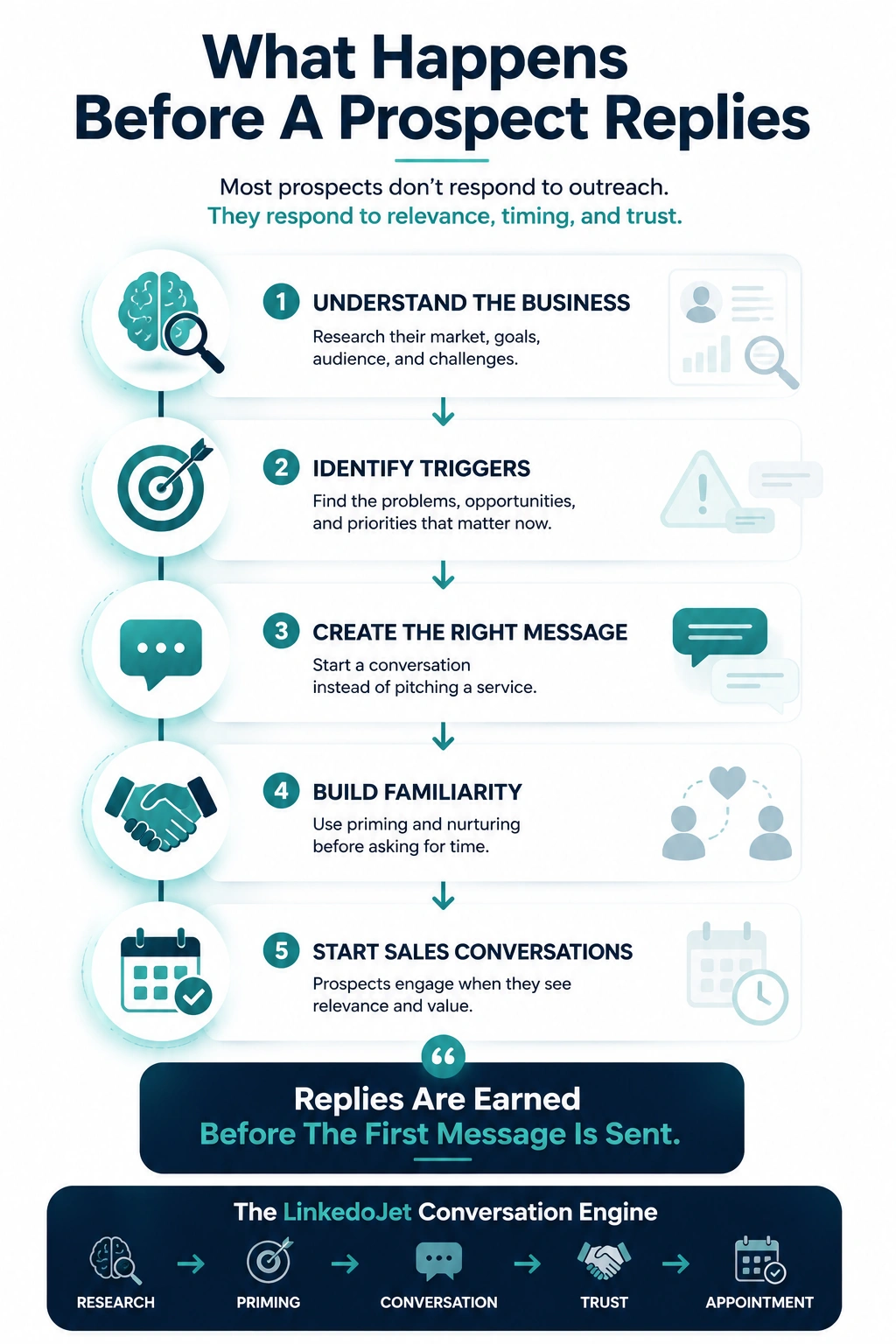
Why healthcare buyers ignore your LinkedIn outreach (and what it’s costing pipeline)
If your messages read like SaaS outreach, you’ll get SaaS results: silence. Not because they don’t care—because your first note asks them to take a risk.
You can feel it when the team is “doing the work” and still getting treated like another vendor. Activity climbs. Meetings stay flat. Confidence drops. Then founders start hovering over copy, SDR managers start pushing follow-ups harder, and suddenly outbound becomes a morale problem.
Healthcare leaders aren’t ghosting you because they’re rude. They’re ghosting because your opener forces them into a defensive posture: time commitment, internal politics, vendor sprawl cleanup, security review overhead, procurement, and the fear of pulling a thread they can’t resource.
The hidden cost isn’t just missed replies—it’s what happens downstream:
- Feast/famine pipeline because conversations don’t start consistently.
- Bad attribution (“LinkedIn doesn’t work”) when the real issue is conversation design.
- Reps chasing polite noise instead of building a real queue of warm leads.
- Positioning drift as you keep rewriting value props trying to “make it land.”
In provider and payer environments, the first message is not your pitch. It’s your credibility test. If you sound like you’re trying to accelerate their buying process, they’ll protect themselves by ignoring you.
The goal of LinkedIn outbound in healthcare is simpler—and harder: earn a small, safe reply from a risk-aware operator, then progress through micro-yeses until a call is the natural next step.
Who you’re messaging: healthcare-native segmentation + the language each role actually uses
“Hospitals” isn’t a persona. Revenue Cycle, Patient Access, and CIO/IT live in different worlds—and your sequence has to sound like you’ve been there.
The fastest way to get filtered is to write one message that tries to be relevant to everyone. A Rev Cycle leader hears “denials, AR days, payer rules.” A Patient Access leader hears “hold times, eligibility errors, abandoned calls.” A CIO hears “integration backlog, security reviews, support burden.” If you blur those together, you sound like a vendor who wants a meeting more than you want to understand the workflow.
| Buyer cluster | What they’re protecting | Language that feels native | What they tune out instantly |
|---|---|---|---|
| Revenue Cycle / Finance VP Rev Cycle, Director of Billing, CFO | Cash, predictability, political heat from denials/underpayments, staffing gaps | Denials, underpayments, charge capture, clean claims, AR days, payer rule changes, write-offs, exception handling | “We help hospitals…” broad claims; promises without acknowledging payer churn and operational drag |
| Patient Access / Operations Patient Access, Scheduling, Contact Center leaders | Throughput, patient experience, frontline burnout, capacity constraints | Call volume, hold times, eligibility verification, abandoned calls, referral leakage, no-shows, throughput | Anything that smells like a “contact center platform pitch” or ignores staffing realities |
| CIO / IT / Security CIO, IT Director, Integration, Security/Compliance | Risk, support burden, vendor sprawl, implementation failures, audit exposure | Integration effort, EHR constraints, security review, HIPAA (as table stakes), SSO, vendor posture, ticket load | Name-dropping HIPAA like it’s differentiation; “quick integration” claims; demo-first asks |
A practical outbound rule in healthcare: if your first message could be sent to any of these roles without changing a word, it shouldn’t be sent at all.
When they reply: work rhythms, timing, and what gets filtered instantly
These buyers check LinkedIn in small windows. Your sequence has to fit those windows—and respect why they’re cautious.
Most hospital and health system leaders aren’t “on LinkedIn.” They dip in. Early morning before the day fills up. Between standing meetings. Late afternoon when they’re clearing messages. If you hit them with a long paragraph or a meeting ask, you’re asking for a decision in a moment designed for triage.
What gets filtered instantly (by humans, not just spam rules):
- Demo asks in the first 1–2 touches.
- Generic value props (“reduce costs, improve outcomes”).
- Over-polished personalization (“loved your post…”) that doesn’t connect to their operational reality.
- Claims that read like a case study headline without acknowledging governance, adoption, and IT constraints.
Timing notes that actually matter:
- Mon/Tue early AM can work well for Rev Cycle and access leaders—before fires take over.
- Mid-week mid-day is often dead space; you land between meetings and get swiped away.
- Thu late afternoon can be surprisingly good for CIO/IT when they’re catching up—if your message is short and specific.
- End-of-month / quarter is rough for Rev Cycle/Finance; you’re competing with reporting pressure and payer noise.
A conversation-led LinkedIn sequence (with examples for Rev Cycle, Patient Access, and CIO/IT)
One idea per message. No platform description. No “15 minutes.” You’re earning a reply first.
Below is a sequence structure that consistently earns replies in regulated, committee-heavy environments because it does one thing well: it lets the buyer stay safe while still being honest.
1) Connection request (role-specific, non-salesy)
- Revenue Cycle: “Saw you lead revenue cycle at [Org]. I work with healthcare software teams around denials/underpayment workflows and the ‘exception handling’ drag that creeps in. Would be good to connect—always curious what’s changing on your side this year.”
- Patient Access: “Noticed you own patient access at [Org]. I spend a lot of time with teams trying to reduce eligibility/scheduling friction without burning out the contact center. Open to connecting?”
- CIO/IT: “Saw you’re on the IT/integration side at [Org]. I work with healthcare SaaS teams navigating EHR constraints + security reviews without adding support burden. Would be good to connect.”
2) First message after acceptance (micro-question)
- Revenue Cycle: “Quick question—when denials spike, is the bigger pain payer rule churn, or not having staffing capacity to work the queues cleanly?”
- Patient Access: “Curious what’s more ‘on fire’ lately: hold times/call volume, or eligibility errors creating rework downstream?”
- CIO/IT: “On your side, is the bigger bottleneck integration backlog, or security review friction when a new vendor shows up?”
3) Soft follow-up (grounded observation + low-pressure prompt)
- Revenue Cycle: “Pattern I’m hearing: teams can spot denials in reporting, but operationalizing changes across teams is where it gets stuck. Similar for you, or is it more staffing + payer changes?”
- Patient Access: “A lot of access teams can measure the leakage, but the handoffs (scheduling ↔ insurance ↔ contact center) are the drag. Is that where it breaks, or is it something else?”
- CIO/IT: “What I’m seeing: vendors underestimate the internal coordination—security docs, interface ownership, support model. Do you feel more pain from vendor sprawl, or from ‘everyone wants IT time’?”
4) Query-based emotional trigger (respectful, recognizable frustration)
- Revenue Cycle: “When you roll out changes tied to denials/underpayments, is the bigger headache clean data… or getting workflow adoption to stick across the people actually touching the claims?”
- Patient Access: “Be honest—when you try to fix access, is the pain the tech… or the reality that the front line is already buried and change feels like more steps?”
- CIO/IT: “When new tools come in, is the main issue ‘does it integrate’… or the long tail of support tickets once it’s live?”
5) Insight-based nurture (helpful, not a pitch)
- Revenue Cycle: “One thing teams miss: the time loss isn’t in the denial itself—it’s the repeat exception handling and handoffs. When you look at your top denial categories, do you track rework time anywhere, or is it mostly dollars and counts?”
- Patient Access: “Most groups underestimate the cost of ‘almost scheduled’—abandoned calls + missed follow-ups compound quickly. Are you seeing more leakage from capacity limits, or from eligibility/pre-auth friction?”
- CIO/IT: “Security review delays are often just missing documentation early (BAA posture, data flow diagram, support model). Do you have a standard checklist you force vendors through, or does it vary by department?”
6) Soft meeting request (only after a signal)
- Any role: “If it’s useful, I can share the 2–3 questions that have been getting real replies from [Rev Cycle / Access / CIO] leaders lately—without leading with a demo. Open to a quick 12-minute compare-notes next week? Tues or Thurs?”
7) Close-loop (easy out, preserve goodwill)
- Any role: “I’ll close the loop for now. If reducing [denials drag / access friction / integration backlog] gets louder later in the quarter, want me to send over a couple of the exact prompts we use to start these conversations with peers?”
Turning a cautious reply into a discovery call: micro-yeses, intent paths, and low-pressure asks
The reply is not the win. The win is turning a safe reply into shared specificity—without spooking procurement and politics.
Healthcare buyers often reply in one of four ways. Your job is to recognize the intent and respond in a way that keeps them safe.
| What they reply | What it usually means | Your best next move |
|---|---|---|
| “Yes, we’re seeing that.” | Real pain exists; they’re cautious about opening a thread | Ask a narrow clarifier: “Is it more payer rule churn or internal workflow handoffs?” Then offer a short call to compare notes, not “to show you.” |
| “Send info.” | They’ll look only if it’s short and specific | Send a 4–6 sentence note + one artifact (1-pager, checklist, or 3-bullet framework). End with a buyer-safe question. |
| “We already have a vendor.” | They don’t want a rip-and-replace conversation | De-risk: “Not trying to displace—more curious what’s working vs still manual.” Ask about a known failure mode (adoption, exception handling, integration support). |
| “Not my area.” | They might redirect if you make it easy | Ask for a pointer: “Who owns this—Rev Cycle ops, access leadership, or IT integration?” Keep it one sentence. |
Micro-yeses you’re looking for before a call:
- They confirm the problem exists (“yes, denials are up” / “access is slammed” / “integration backlog is real”).
- They name a constraint (“we can’t get IT time” / “staffing is thin” / “security review takes forever”).
- They ask a real question (“how are others handling it?”).
Then the ask should match healthcare reality: short, low-pressure, and clearly not a trap.
Better ask: “I can share two patterns I’m seeing across similar orgs—one that works, one that usually dies in governance. Want to do 12 minutes, and if it’s not relevant we’ll drop it?”
What breaks LinkedIn outreach in healthcare SaaS (hard-earned failure modes)
These aren’t “copy mistakes.” They’re credibility mistakes that trigger the ‘vendor’ reflex.
I see the same failures repeat, even in strong healthcare SaaS teams—because the pressure to create meetings pushes people back into pitch behavior.
- Starting with product. If your first message describes your platform, you’ve already lost the operator who’s juggling denials, staffing gaps, and governance.
- Asking for time before naming a believable problem. A meeting is political currency in a hospital. Don’t ask for it until you’ve earned relevance.
- Generic “healthcare is changing” language. It signals you don’t have a point of view, and you’ll waste their time.
- Name-dropping HIPAA as differentiation. HIPAA isn’t a feature. It’s the cost of entry.
- Over-personalizing without substance. “Loved your post” plus a pitch reads like a trick, even if it’s true.
- Pretending the buying path is fast. “Quick call this week?” ignores committees, InfoSec, procurement, and the fact that change competes with patient care.
- Chasing silence with more volume. More touches of the wrong message teaches your account list to ignore you.
The uncomfortable truth: healthcare outbound isn’t “hard” because the copy is hard. It’s hard because the buyer is protecting their time, their credibility, and their org from one more tool that creates work.
FAQ
How long should a LinkedIn messaging sequence be for healthcare SaaS outbound?
Plan for 6–8 touches over 14–28 days, with spacing that matches healthcare work rhythms (not daily chasing). In this niche, shorter sequences often die before you’ve earned credibility; longer sequences only work if each touch adds something useful (a clarifying question, a grounded observation, or a small insight), not “just checking in.”
What should I say instead of asking for “15 minutes” or a demo on LinkedIn?
Ask for a buyer-safe micro-step first: confirmation, direction, or a quick compare-notes chat. Example: “Curious—when denials rise, is it more payer rule churn or staffing capacity? If you’re open, I can share two patterns that have helped peers reduce the rework loop—no demo, just notes.”
How do you adjust messaging between Revenue Cycle, Patient Access, and CIO/InfoSec stakeholders?
Change the problem language and the risk you acknowledge. Rev Cycle cares about denials, underpayments, clean claims, AR days, and exception handling. Patient Access cares about call volume, hold times, eligibility errors, no-shows, and throughput. CIO/InfoSec cares about integration effort, vendor sprawl, security review friction, HIPAA as table stakes, and long-term support burden. Same product, different reality.
When is the best time to message hospital and health system leaders on LinkedIn?
Early morning (before the day becomes meetings), small mid-day gaps, and late afternoon catch-up are your best windows. Avoid long messages and avoid “can you meet this week?” during reporting crunches. Short, specific prompts outperform perfect timing—but timing helps you get seen.
How do you handle “we already have a vendor” without sounding like a rip-and-replace pitch?
Agree and de-risk. You’re not there to displace; you’re there to understand what’s working and what’s still manual. Example: “Makes sense. Not trying to rip-and-replace—curious where teams still feel the drag (exception handling, adoption, integration support). Is your current setup mostly solving it, or do you still see bottlenecks?” That keeps the conversation professional and opens a path if there’s real friction.
If you want this running reliably, LinkedoJet builds and manages the system—not just the messages
You’ll leave with role-based sequences that earn replies from Rev Cycle, Patient Access, and CIO/IT—and an outbound engine that keeps producing conversations while your team stays focused.
LinkedoJet is not a generic LinkedIn automation tool. We set up and operate a conversation-led outbound program built for risk-aware healthcare buyers.
What we do operationally:
- ICP and targeting setup: we translate your ideal accounts into role-based targeting (system size, org type, EHR realities, buyer titles, functional teams) so you stop messaging “healthcare” and start messaging the right operators.
- Sales Navigator + LinkedIn prospect list building: we build and maintain clean lists for Revenue Cycle/Finance, Patient Access/Ops, and CIO/IT/Security—separating decision-makers, influencers, and likely blockers.
- AI-assisted personalization: not “flattery.” We use AI to tailor prompts around role pressures (denials vs access throughput vs integration burden) while keeping every message restrained and human.
- Outreach execution: we run the sequences with timing aligned to healthcare work rhythms so your touches land when leaders actually check messages.
- Lead reply handling and nurturing: we categorize replies by intent (pain, curiosity, brush-off, “send info,” “already have a vendor,” not my area) and respond with the right next step—without forcing a demo.
- Warm lead tracking + appointment generation support: we track warm leads and help move them toward a call only when there’s a signal. The goal is qualified conversations, not vanity activity.
- Campaign visibility: you get dashboards that show what’s being sent, what’s getting replies, where intent is building, and where sequences are stalling.
- Ongoing refinement: we keep improving targeting, hooks, and follow-ups based on real response patterns across your buyer clusters.
What happens after onboarding: we deliver your role-based message libraries, targeting lists, sequence timing plan, and reply-intent playbook—then we run the daily execution and keep you in the loop with performance visibility and adjustments.
If you’re trying to earn replies from overloaded Rev Cycle, Patient Access, and CIO/InfoSec stakeholders, this is the difference: ordinary tools send more messages. LinkedoJet engineers the conversations, handles the follow-through, and keeps your team credible in a regulated market.
Next step: install a healthcare-ready outbound engine (without sounding like a vendor)
You don’t need more templates. You need role-based targeting, conversation design, and consistent follow-through—so replies turn into real appointments.
From identifying the right decision-makers to starting meaningful conversations and turning them into qualified appointments... LinkedoJet manages the entire outbound engine for your business.