
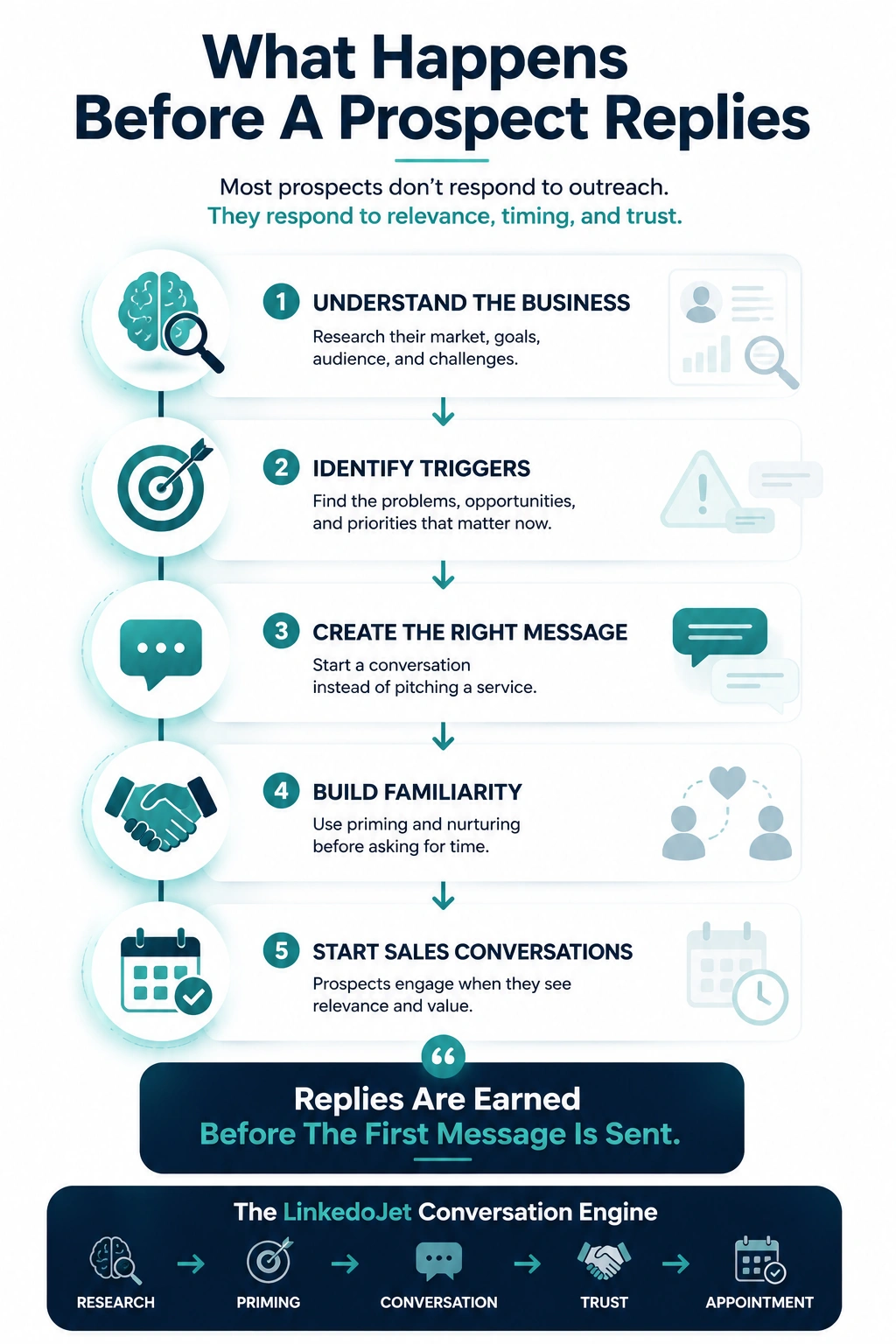
Why HR ignores wellness outreach (and what they’re protecting their calendar from)
They’re not rejecting wellness. They’re rejecting the hidden workload that comes with most wellness vendors.
HR and People Ops leaders aren’t scanning LinkedIn hoping to “discover a new wellness program.” They’re scanning for risk. Another vendor that needs comms, champions, managers to “encourage participation,” and a monthly check-in where HR gets blamed for low utilization.
That’s the quiet dread behind the non-reply: “If I respond, I’m signing up for another thing I have to run.”
If you sell corporate fitness, your product isn’t classes or an app. It’s participation without creating work. And most outbound does the opposite—it signals admin lift before you’ve earned a single minute of attention.
Here’s what HR has learned the hard way:
- Programs launch with energy, then attendance fades after week two.
- Hybrid teams don’t show up onsite consistently—so schedules “look great” and rooms stay empty.
- Shift teams can’t join if timing and coverage aren’t designed in.
- When participation is low, the vendor asks for “more promotion.” Translation: more work for HR.
So when your first message leads with “we help boost engagement,” it reads like every other pitch they’ve survived.
The fastest path to replies is not a better pitch. It’s a smaller ask: a micro-conversation about the real constraint (attendance patterns, comms fatigue, manager buy-in, multi-site rollout), with zero implied procurement motion.
Who you’re actually messaging: HR vs Benefits vs Workplace Experience vs Finance
Same company. Different fears. If you send one generic sequence to all of them, it stalls.
Corporate wellness buying committees are messy. You think you’re selling “fitness.” Internally, they’re debating adoption, vendor sprawl, and who owns the work. Your messaging has to meet each inbox where they live.
| Inbox | What they’re measured on | What makes them hesitate | What earns a reply |
|---|---|---|---|
| HR Director / People Ops | Retention, ER stability, employee experience | “This becomes another HR-owned initiative.” | Language about lowering comms/admin lift, simple cadence, champion network, manager enablement |
| Benefits / Total Rewards | Smooth operations, vendor manageability, utilization | “We can’t add another vendor / procurement will say no.” | Pilot framing, reporting on usage, clear implementation steps, minimal internal touchpoints |
| Workplace Experience | Onsite logistics, space/safety, attendance patterns | “Hybrid means empty rooms. Scheduling will be a mess.” | Constraints-first questions: multi-site coverage, peak days, shift realities, sign-up friction |
| CFO / Finance / COO (sometimes) | Spend control, consolidation, proof beyond vibes | “Another line item with no signal of impact.” | Small pilot, clear usage reporting, tightly scoped rollout, defined success criteria |
Notice what’s missing: nobody is asking for a “deck.” They’re asking (silently) whether this creates work and whether it will get used.
The participation-constraint opener: start conversations around adoption, not features
Your first job is to earn a one-line reply. Not a meeting. Not a demo.
Most corporate wellness outreach fails because it starts at the wrong altitude. It talks about programs when the buyer is stuck on: “Will anyone actually use this, and will my team pay for it in admin time?”
A participation-constraint opener does three things:
- Names a pattern you see across employers (without pretending you know their exact situation).
- Anchors on adoption reality (hybrid attendance, shift coverage, comms fatigue, manager buy-in, multi-site rollout).
- Asks one easy question that can be answered in a sentence.
Pattern language you can safely use (pick one):
- “When teams are hybrid, participation drops unless there’s a simple cadence in the first two weeks.”
- “On shift-based teams, the schedule isn’t the issue—coverage and sign-up friction are.”
- “Multi-site programs usually stall when champions aren’t defined and comms becomes ‘everyone’s job.’”
- “Wellbeing weeks create spikes, but utilization only holds if week 2 is planned.”
Low-friction questions that don’t feel like procurement:
- “Is participation the bigger challenge, or is it bandwidth to run initiatives?”
- “Do you have a champion network, or does this mostly sit with HR/Benefits?”
- “Are you seeing more drop-off because of hybrid attendance or comms fatigue?”
- “If you ran a pilot, what would ‘good utilization’ look like for you?”
A LinkedIn sequence that gets real replies (with operator-grade examples)
Short messages. One question at a time. No calendar link until they give you a signal.
1) Connection request (neutral, role-aware)
HR / People Ops:
“Hi <
Benefits / Total Rewards:
“Hi <
Workplace Experience:
“Hi <
2) First message after acceptance (one insight + one easy question)
“Thanks for connecting, <
Curious—are you seeing participation challenges with any current wellbeing initiatives, or is it more of a bandwidth issue to run them?”
3) Soft follow-up (assume busy, offer two options)
“Quick nudge in case this got buried. When wellness stalls, it’s usually one of two things:
- comms/manager buy-in (people don’t hear about it or don’t feel permission), or
- scheduling/shift coverage (they want to join but timing never works).
Which one is more true for you right now?”
4) Query-based emotional trigger (say the quiet part, gently)
“Real question—do wellbeing programs ever become ‘another thing HR owns’ unless there’s a lightweight champion network and a repeatable cadence?
I ask because that’s where we see good programs die: not because the content is bad, but because ownership gets fuzzy.”
5) Insight-based nurture (give value, don’t sell)
“One practical framework that tends to hold participation (onsite, virtual, or blended):
- Friction: sign-up and first session must be stupid simple
- Social proof: visible early adopters in week 1–2
- Rhythm: a repeatable comms template (not constant nagging)
If it’s useful, I can send the short comms cadence we use to keep week 2 from falling off a cliff.”
6) Fit-check ask (only after a signal)
“If you’re open to it, we could do a 12-minute fit check. I’ll ask how you’re structured (hybrid/multi-site/shift), what you’ve tried, and what ‘good participation’ would look like—then I’ll tell you if a pilot makes sense or if you’re better off adjusting the current approach. No demo.”
7) Close-loop (professional, timing-based re-entry)
“I’m going to park this for now. If you end up revisiting wellbeing participation after open enrollment / during Q1 planning, tell me and I’ll send a couple of rollout patterns that tend to work for hybrid teams.”
Timing, triggers, and when to pause
Corporate wellness buying isn’t constant. If you ignore the benefits calendar, you’ll misread silence as “not interested.”
HR/Benefits attention has seasons. Outreach works when it respects their internal tempo—open enrollment, vendor consolidation, budget reviews, and leadership asks for “proof of impact.”
When to pause (and switch to light nurture):
- Open enrollment crunch: they’re protecting every minute; your best move is to ask when planning restarts.
- Vendor consolidation / procurement freeze: they can’t add anyone; focus on being the helpful name that’s easy to re-open later.
- Locked-in contract year: don’t fight it—ask when renewal or evaluation starts and send one useful pattern.
What “meeting-ready” signals sound like:
- “Utilization is low” / “It started strong then faded.”
- “We don’t have bandwidth to run another initiative.”
- “Leadership wants impact, not feel-good stories.”
- “Hybrid policy changed” or “We’re opening/closing sites.”
- “We’re considering a pilot / wellbeing reset in Q1.”
If you get a pause signal, don’t keep pushing. Convert it into a calendar marker: “When does planning reopen?” Then stop. That restraint is part of what makes you not feel like a vendor.
Mistakes that kill corporate wellness replies (and the language that earns micro-commitments)
HR/Benefits don’t punish you for being small. They punish you for sounding expensive—in time.
What gets ignored
- Leading with the program: “We offer onsite classes + an app + challenges…” (They hear “setup + comms + confusion.”)
- Generic personalization: “Love your culture / your mission.” (Reads like copy-paste.)
- ROI claims with no context: healthcare savings, productivity. (Feels like procurement bait.)
- 30 minutes on the first touch: they don’t know you; they’re not giving you half an hour.
- One sequence for every title: HR ≠ Benefits ≠ Workplace Experience.
What gets answered
- Operational reality words: participation, utilization, admin lift, comms cadence, champion network, shift coverage, multi-site rollout.
- Two-option questions: “Is it more participation or bandwidth?”
- Permission-based offers: “Want the comms cadence?” not “Can I show you a demo?”
- Small next steps: a 12-minute fit check after they respond.
The goal is a micro-commitment: a one-line truth about what’s blocking adoption. Once they say it, you’ve earned the right to propose a call.
FAQ
What’s the right LinkedIn message to an HR Director about corporate wellness without sounding like a vendor pitch?
Keep it small and operational. Name a participation pattern (hybrid drop-off, comms fatigue, manager buy-in) and ask one easy question. Avoid “we offer…” language. HR replies when it feels like you’re reducing work, not adding another initiative.
How do you write a LinkedIn messaging sequence for Benefits or Total Rewards that focuses on utilization (not fluffy ROI claims)?
Anchor the sequence on utilization and vendor manageability: week 1–2 adoption, reporting on usage, and how rollout stays lightweight. Benefits leaders have heard the cost-savings pitch. What they’ll answer is a question about where utilization is breaking and what success would look like in a pilot.
How many follow-ups is appropriate before you close the loop with HR/Benefits?
Typically 3–4 touches after the connection acceptance works well: the initial question, a two-option nudge, one emotionally honest question, and one insight-based nurture. Then close the loop cleanly with a timing-based re-entry (“after open enrollment / during Q1 planning”). More than that starts to feel like campaign noise.
When should corporate wellness providers avoid outreach (open enrollment, vendor consolidation, budget freezes)?
Avoid heavy asks during open enrollment and right in the middle of vendor consolidation/procurement freezes. If you get that signal, switch to light nurture: ask when planning restarts, offer one useful rollout pattern, and stop. You’re trying to be the vendor who respects their calendar.
What are the best low-friction questions to uncover participation constraints for hybrid, onsite, and shift-based teams?
Use questions that let them answer in a sentence: “Is it participation or bandwidth?” “Is drop-off more comms/manager buy-in or scheduling/shift coverage?” “Do you have champions, or does HR own it?” “If you ran a pilot, what would good utilization look like?” These surface the constraint without triggering procurement defenses.
If you want replies you can actually book, we can run this end-to-end
Not a generic “strategy call.” A working outbound system built for HR/Benefits reality—participation constraints, admin lift, and benefits-cycle timing.
LinkedoJet is how corporate wellness and fitness providers turn cold HR/Benefits targets into real conversations and scheduled fit-check calls—without blasting generic sequences or throwing calendar links at strangers.
On the session, we’ll get specific: your offer, the employers you win with, and the buying committee you actually need (HR, Benefits/Total Rewards, Workplace Experience, and when Finance shows up). Then we map the participation constraints your message needs to surface—hybrid attendance, shift coverage, comms fatigue, manager buy-in, multi-site rollout—so your outreach sounds operationally real.
After onboarding, LinkedoJet doesn’t hand you a template and wish you luck. We set up and manage the outbound engine:
- ICP and targeting setup: define the employer types, thresholds, and exclusion rules that keep you out of “wrong timing / wrong buyer” dead ends.
- Sales Navigator + LinkedIn list building: we build segmented prospect lists by function and seniority (HR vs Benefits vs Workplace Experience vs Finance), not one blended list.
- AI-assisted personalization: tailored openers and constraint-based questions that match each persona and employer context—without sounding like a bot.
- Outreach execution: we run the connection + message sequence, with pacing that respects the benefits calendar and avoids spamming.
- Reply handling + nurturing: we route and manage replies, use light nurture when timing is wrong, and progress “curious but busy” leads without chasing.
- Warm lead tracking: clear stages for accepted/engaged/warm/meeting-ready, so nothing disappears into LinkedIn limbo.
- Appointment generation support: we help convert positive signals into booked fit-checks with tight, low-friction asks.
- Campaign visibility: dashboards that show what’s happening—reply rate, warm leads, appointments—so you’re not guessing.
- Ongoing refinement: we adjust targeting, messaging, and timing based on what HR/Benefits are actually responding to.
You’ll leave with clarity on what you’re sending, who it’s going to, how follow-ups work, and how meetings get created from real signals—not hope.
From identifying the right decision-makers to starting meaningful conversations and turning them into qualified appointments... LinkedoJet manages the entire outbound engine for your business.
Next step: turn vendor fatigue into booked fit-checks
If your pipeline is seasonal and your sequences keep stalling, the fix usually isn’t “more outreach.” It’s better targeting, tighter questions, and follow-up that matches HR/Benefits reality.