
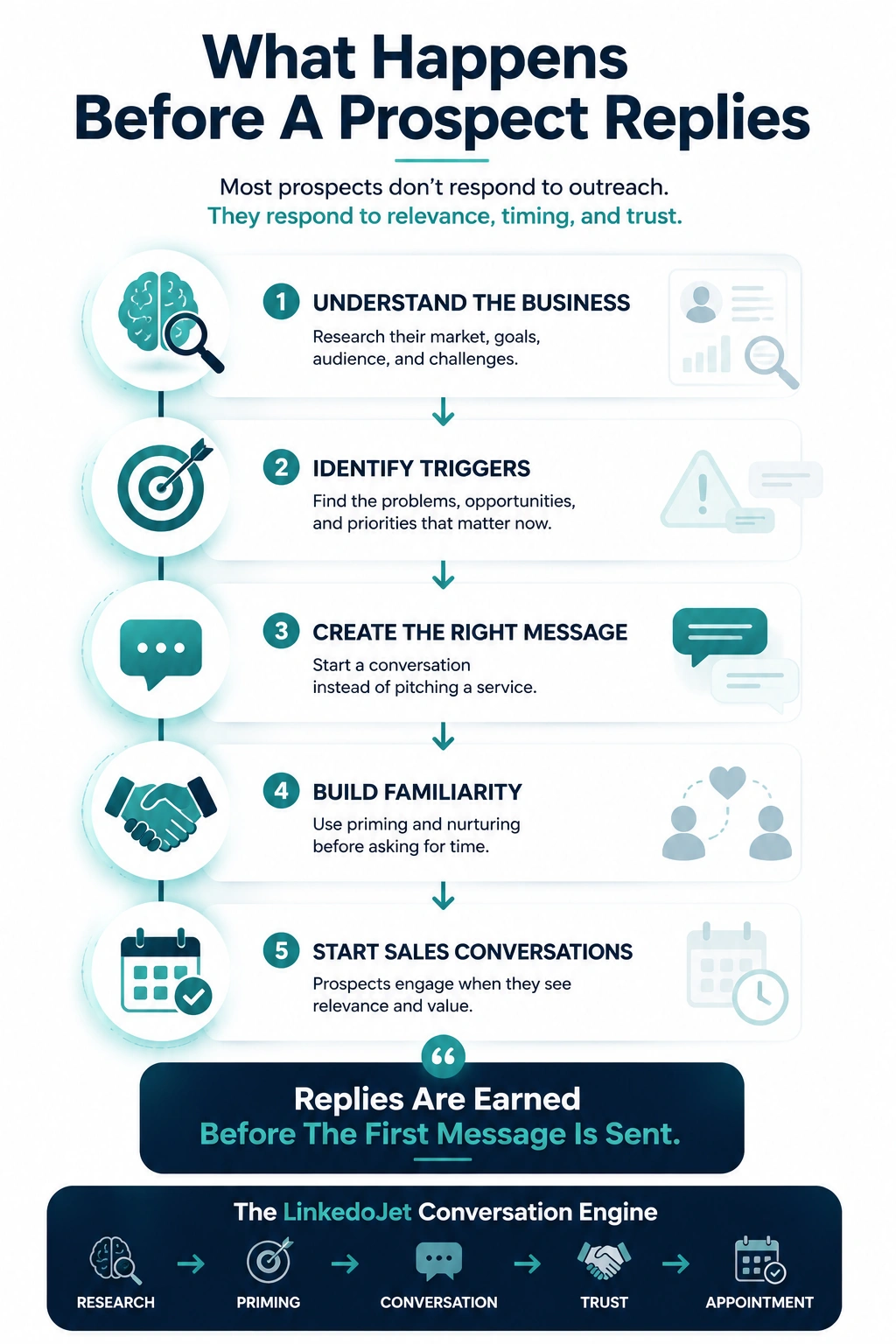
Why most ghostwriting DMs get ignored (and why it feels personal)
If your DM has to explain what you do, you’ve already lost. Not because ghostwriting “doesn’t work” — because your first impression triggers the exact risk your buyer is protecting against.
Exec buyers don’t ignore ghostwriting offers because they don’t care about visibility. They ignore them because most outreach makes ghostwriting sound like a commodity, a vanity play, or a management headache.
And the brutal part: the moment your note reads like “agency outreach,” they pattern-match you into the same bucket as the last ten people who wrote “loved your recent post” and then asked for 15 minutes.
In this category, you’re not selling posts. You’re selling trust around voice, discretion, and consistency. So the first job of your messaging isn’t persuasion. It’s earning the right to have a grown-up conversation.
The fix is not more personalization tokens. It’s conversation architecture:
- Context (prove you’re not mass-blasting)
- Micro-insight (show you understand exec voice work)
- Easy question (one-line reply, no commitment)
- Light invite (fit check only after engagement)
When you jump straight from cold DM to retainer talk, you create a credibility gap you can’t afford. The buyer’s defense mechanism is simple: silence.
Targets + timing: who’s actually messageable, and when your note lands
A clean sequence won’t save you if you’re talking to the wrong “exec” at the wrong moment. Ghostwriting isn’t an impulse buy. It becomes interesting when the cost of inconsistency shows up in their week.
The highest-reply profiles aren’t the loudest. They’re the ones under quiet pressure: they have real opinions, a reason to be visible, and no time to keep up a content rhythm.
High-signal targets for executive voice work
- Founder/CEO who posts sporadically but with sharp POV (you can see the raw thinking, then long gaps)
- VP/GM stepping into a bigger role (new scope, new scrutiny, suddenly “should be visible”)
- Partner building a niche inside a firm (recruiting, deal flow, category visibility)
- Recently funded operator who needs a narrative to land (hiring, partnerships, credibility while scaling)
- Account where posts clearly sound like multiple people (voice drift is visible; they’re already trying to delegate it)
When to send (based on how execs actually skim LinkedIn)
- Early morning tends to work because it’s “quiet scan time.”
- Late afternoon can work because meetings slow down and people clear inboxes.
- Mid-day gets buried. Your note competes with fires, Slack, and calendar churn.
- Monday is noisy. Mid-week often produces cleaner replies.
The core sequence: connect → conversation → nurture → fit check
This is designed for executive retainers. The first two touches are conversation-first. No deliverables. No portfolio. No “thought leadership packages.”
1) Connection request (context-based, non-transactional)
Example:
“Saw your take on hiring senior ICs vs managers. The part about ‘decision velocity’ was sharp. I work around exec POV/content systems and I’m always interested in how operators explain tradeoffs clearly. Open to connecting?”
2) Message after acceptance (curiosity + one-line question)
Example:
“Quick one — your posts read like real operator thinking (not ‘marketing voice’). Do you write them solo, or do you have someone helping shape drafts?”
3) Soft follow-up if no reply (grounded problem + confirm/deny)
Example:
“I ask because I keep seeing the same pattern: strong thinking, weak capture. Great ideas stuck in calls/Slack, then LinkedIn becomes ‘when I have time.’ Is that even close for you, or not really?”
4) Permissionless question that surfaces the real blocker (time vs authenticity)
Example:
“When you’ve considered getting help with LinkedIn, was the blocker more about time… or more about not wanting it to sound produced / not-you?”
5) Insight-based nurture (prove thinking, stay discreet)
Example:
“One thing that keeps voice intact is separating capture from drafting: 7–10 min audio note → pull 2–3 themes → draft → exec edit (they only touch the last 10%). Is your process more ad hoc right now, or do you already have a rhythm?”
6) Soft fit-check invite (only after engagement)
Example:
“If it’s useful, I can share how we run voice capture without adding weekly meetings, and you can tell me if it’s even worth exploring. Open to a 12–15 min fit check this week? Tue 4:30p or Thu 9:00a — and totally fine if now isn’t the moment.”
7) Clean close-loop (protect your brand)
Example:
“Closing the loop on this. Simple rule I use with exec content: one opinion, one real example, one constraint (what you won’t do). Keeps it from sounding generic. Want me to circle back in ~60 days, or should I leave it here?”
How to convert replies into appointments without rushing it
Retainers don’t close because your calendar link exists. They close because you paced the conversation like a professional and waited for meeting-ready indicators.
Your goal is a micro-commitment reply first. Once they answer one simple question, you’ve earned the right to narrow the problem. That’s where most agencies fumble — they immediately swing to “want to hop on a call?” and reset the buyer’s defenses.
Micro-commitments that keep the door open
- Binary questions: “Time or authenticity?” “Solo or supported?” “Ad hoc or rhythm?”
- Confirm/deny prompts: “Is that close, or not really?”
- Light clarifiers: “When you do post, what usually triggers it?”
Meeting-ready indicators (subtle, but obvious once you see them)
- They ask about process: voice capture, drafting, approvals, discretion
- They ask about time: “How much involvement is required?”
- They frame outcomes as credibility: recruiting, partnerships, category trust
- They admit inconsistency: “I can’t keep up” / “It comes in bursts”
- They’ve tried help before and mention what broke (voice mismatch, overhead, bland output)
Pacing rules that keep it executive-appropriate
- Don’t ask for a call in the first two touches. Earn a reply first.
- If they reply with one line, don’t answer with six paragraphs. Match their tempo.
- If they’re lukewarm, shift to nurture instead of chasing. You’re building reputation in their inbox.
- When you invite, keep it short, specific, and easy to decline.
Mistakes that sabotage ghostwriting outreach (and the cleaner alternatives)
Most “bad DMs” aren’t aggressive. They’re needy. They ask the buyer to do work (read, evaluate, decide) before you’ve earned attention.
| What kills replies | What to do instead |
|---|---|
| Opening with a portfolio drop or client proof | Open with context + a small observation about voice/rhythm; let proof come after interest |
| Listing deliverables (“X posts/week, strategy, engagement”) | Speak to outcomes they actually care about: clarity, consistency, narrative, less overhead |
| Using “thought leadership” as a vague buzzword | Use concrete language: executive POV, founder narrative, content operating rhythm, distribution |
| Asking for 15 minutes in touch #1 or #2 | Ask an easy question first; invite only after any engagement |
| Overplaying personalization (“big fan!”) with no substance | Reference one specific point and why it matters (tradeoff, constraint, unpopular opinion) |
| Promising growth (followers/virality) | Position it as credibility and consistency; execs are allergic to “creator” framing |
If you want better conversations, remove anything that smells like a package. Keep it as a peer note about voice and execution.
Mini-dialogues that keep you out of “defensive agency mode”
The fastest way to lose an exec is to argue. Your job is to validate the intent, then ask a diagnostic question that moves the conversation forward.
“I write my own posts.”
You: “That’s usually why they sound good.”
You: “Is the challenge more consistency — or is it turning raw thinking into clean posts without it eating your week?”
“We have marketing.”
You: “Makes sense. Brand marketing and executive voice are different jobs.”
You: “Do you want your LinkedIn to sound like the company… or like you?”
“I don’t want ghostwriting.”
You: “Totally fair — a lot of people don’t.”
You: “If you ever wanted support without ‘someone writing as you,’ would editorial shaping + structure (you keep the pen) be interesting, or not?”
“We tried this before and it didn’t stick.”
You: “That’s common. When it breaks, it’s usually one of three things: voice mismatch, process overhead, or bland POV.”
You: “Which one was it for you?”
“I don’t want it to sound generic.”
You: “Same. Generic is worse than quiet.”
You: “Do you already have 2–3 non-obvious opinions you’re willing to say publicly — or is it more about picking the right angles?”
Notice the pattern: no rebuttals. Just respect, clarity, and a next question they can answer in one line.
How LinkedoJet runs this as a repeatable appointment engine for ghostwriting retainers
You don’t need “more DMs.” You need a system that keeps your agency out of the spam bucket while producing a steady flow of qualified fit-check calls.
LinkedoJet is not a template library or a bot that sprays messages. We run the operational engine end-to-end so your outreach feels like real business development: discreet, paced, and specific to executive voice work.
What we set up and manage for you
- ICP + targeting setup tuned to ghostwriting retainers (founders vs VPs vs partners require different opening angles)
- Sales Navigator / LinkedIn prospect list building based on real buying signals (posting rhythm, role transitions, narrative moments)
- AI-assisted personalization that references a specific point without sounding like fake flattery
- LinkedIn outreach execution with controlled pacing across the sequence (connect → conversation → nurture → invite)
- Lead reply handling and nurturing so warm conversations don’t die in “sounds good” limbo
- Warm lead tracking and meeting-ready indicators (process/time/consistency questions get flagged)
- Appointment generation support with fit-check framing that doesn’t spook execs
- Campaign visibility through dashboards so you can see what’s working without living in the inbox
- Ongoing campaign refinement as the market shifts and patterns change
Most agencies fail here because they treat messaging as copywriting. We treat it as sequencing, timing, targeting, and follow-through — the parts that actually create calls.
FAQ
How do I pitch LinkedIn ghostwriting without sounding spammy or like a commodity service?
Stop pitching ghostwriting. Start a conversation about executive voice, consistency, and the cost of ad hoc posting. Open with context (something specific they said), then ask a one-line question about their current process (solo vs supported, time vs authenticity). Earn a reply first. Once they engage, you can introduce how you work without sounding like “another agency DM.”
What’s the best LinkedIn messaging sequence length for selling an executive ghostwriting retainer?
Plan for 5–7 touches over 2–3 weeks, including the connection request. Exec buyers often need multiple low-pressure exposures before they respond. The key isn’t length; it’s pacing and restraint: conversation-first early, insight-based nurture mid-sequence, and a fit-check invite only after engagement.
When should I ask for a call in a LinkedIn outreach sequence for ghostwriting services?
After you see engagement signals: they answer your question, ask about process/time, admit inconsistency, or reference a past failed attempt. If your first ask is a call, you’re forcing a high-trust decision without any trust. A 12–15 minute fit check lands best once they’ve already “talked” to you in the DMs.
What are the highest-signal target personas for ghostwriting agencies on LinkedIn?
Founders/CEOs with sharp POV but inconsistent rhythm, VPs/GM stepping into bigger roles, partners building a niche, and operators with visible voice drift (posts feel written by multiple people). These profiles feel the pressure of credibility and distribution — and they’re more likely to value a retainer that protects voice and reduces overhead.
How do I handle “I write my own posts” without losing the conversation?
Agree with them. Then diagnose. Most of the time, the issue isn’t capability — it’s consistency and time. Ask: “Is the challenge more keeping a rhythm, or turning raw thinking into clean posts without it taking over your week?” That keeps the conversation respectful and moves toward a fit-check without sounding like you’re trying to take their voice away.
If you want qualified retainer calls, we’ll build and run the sequence for you
This isn’t a vague “strategy chat.” You’ll see how your targeting, messaging, pacing, and follow-up will work in the real LinkedIn inbox — and what LinkedoJet will manage end-to-end after onboarding.
On the session, we’ll get specific fast: your ideal buyer profiles (founder vs VP vs partner), the triggers you should open on (voice drift, inconsistent rhythm, role change, new narrative), and the exact conversation-first sequence that earns replies without pitching.
If we’re a fit, onboarding looks like this:
- We set up ICP and targeting, then build Sales Navigator lists that reflect buying signals — not just job titles.
- We write and deploy AI-assisted personalization that references real context while keeping the tone discreet and executive-appropriate.
- We run LinkedIn outreach execution with pacing rules (timing, touch order, follow-ups) so you don’t get categorized as spam.
- We handle lead replies and nurturing so “interesting” doesn’t turn into silence. The conversation keeps moving until it’s clearly a yes, no, or later.
- We track warm leads and meeting-ready indicators, support appointment generation, and keep everything visible in dashboards so you know where conversations stand.
- We refine weekly based on what the market is actually doing (who replies, what triggers engagement, which angles cause drop-off).
Ordinary LinkedIn automation tools send messages. LinkedoJet runs the operating system: targeting, sequencing, personalization, execution, nurturing, tracking, and appointment support — with the restraint this niche requires.
From identifying the right decision-makers to starting meaningful conversations and turning them into qualified appointments... LinkedoJet manages the entire outbound engine for your business.
Next step: stop “sending DMs” and start running a controlled conversation system
If your outreach is either too pitchy (ignored) or too soft (compliments, no calls), the answer is a sequence with restraint, timing, and follow-through — plus an operator to run it daily.