
Founders don’t wake up wanting a CFO. They wake up wanting “are we safe?”
Your outreach gets archived the moment it reads like a service menu. It gets answered when it reads like decision support.
Founders don’t open LinkedIn thinking, “I should hire a fractional CFO.” They open it between meetings, half-distracted, with a running background thread: cash, margin, close, investors, payroll, surprises.
When your first line is “fractional CFO / FP&A / budgeting / QuickBooks,” you’ve already lost. Not because your offer is weak. Because you’ve signaled the same pattern they’ve been trained to ignore: outsourced finance spam.
And this niche has a nasty downside: one clumsy sequence doesn’t just fail. It sticks to your name with the exact founders you want. They talk. They forward screenshots. They remember who felt like a vendor.
The quiet cost is worse: operators spiral into forecast chaos right when you’re most valuable, and your calendar stays empty because your messaging never reaches the real trigger (runway visibility, board pressure, close pain, margin drift).
This isn’t a “copywriting” problem. It’s a diagnosis and sequencing problem.
Who this outreach motion is for (and who it will waste time on)
If you’re trying to sell “fractional CFO services,” you’ll attract shoppers and tire-kickers. If you’re trying to surface live finance tension, you’ll book founders.
This works best when:
- You serve founder-led businesses roughly $2M–$50M revenue, or startups with real burn and stakeholder pressure.
- They have a CPA/controller handling the books, but forecasting and KPI cadence aren’t owned with discipline.
- Common profiles: SaaS with churn/margin questions, agencies with delivery margin drift, ecom with inventory/working capital swings, services firms where “cash ≠ profit” is creating stress.
- There’s no full-time CFO building board narratives, cleaning KPI definitions, and keeping the close from slipping.
This will frustrate you when:
- They’re pre-revenue and still in “figure it out later” mode.
- They already have a strong in-house finance leader who owns forecast accuracy, board pack cadence, and decision-ready reporting.
- You’re targeting “any founder” instead of specific triggers (fundraise, headcount growth, close pain, pricing uncertainty, working capital squeeze).
The point of being strict here isn’t purity. It’s reputation protection. Fractional CFO outreach should feel like a calm tap on the shoulder—only where it’s relevant.
How LinkedoJet runs LinkedIn messaging for fractional CFO services
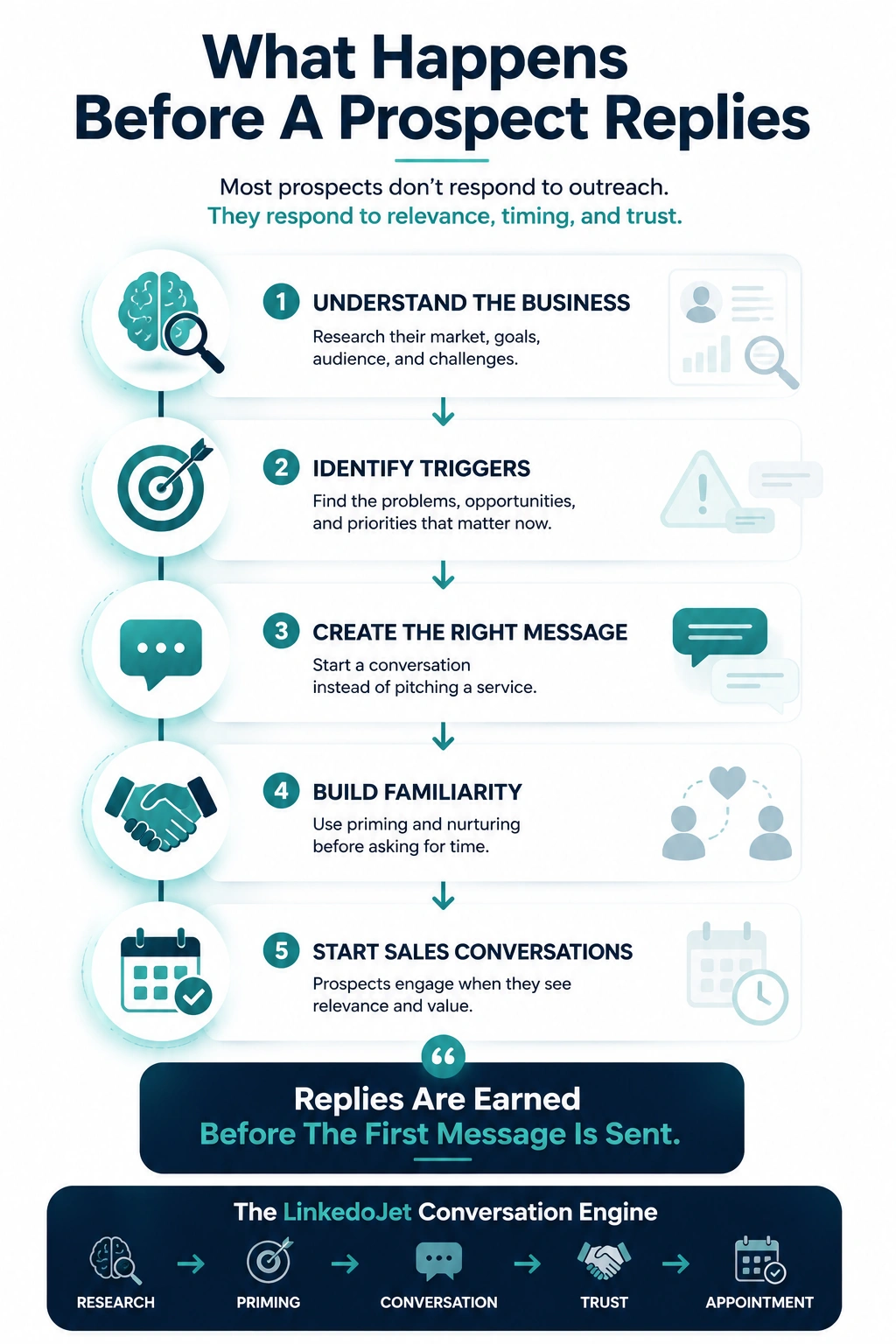
Trigger segmentation → conversation → nurture → invite. Each message has a job. Each job earns the next message.
Most sequences fail because they assume the buyer is shopping for a CFO. In reality the buyer is trying to answer: “Can I trust the numbers enough to make the next decision?”
So we run outbound like a finance cadence:
- Segment by trigger, not by industry tags. Post-fundraise reporting expectations. Hiring surge. Close slipping. Pricing/margin drift. Working capital noise. “We’re fine but I don’t trust the forecast.”
- Open with a low-friction diagnostic question a founder can answer in 10 seconds without booking anything.
- Nurture with compact operator insight (pattern recognition) that stands on its own if they read it three weeks later after a rough board meeting.
- Invite only after intent: a reply, a question back, profile visits, or obvious engagement. The call is framed as a small, specific check—not a sales event.
Operationally, LinkedoJet is not “a tool you log into.” We build the targeting system, build the lists, write the CFO-native sequence, personalize at scale with AI (without sounding templated), run the outreach, handle replies, and keep warm leads moving until they’re ready to meet.
The 7-part LinkedIn messaging sequence (CFO-native, not vendor-coded)
Short. Specific. Built to surface the trigger—then earn the right to propose a 15-minute finance cadence check.
1) Connection request (relevance, no pitch)
Example A (hiring surge): “Saw you’re growing the team this quarter. I work with founders when headcount starts outrunning the finance cadence. Open to connecting?”
Example B (funding / stakeholder pressure): “Congrats on the momentum. Quick question—are you doing monthly investor-style reporting yet, or still more ad hoc? Either way, would be good to connect.”
Why it works: it signals the moment, not your resume.
2) First message after acceptance (set tone, ask an easy diagnostic)
Example A: “Thanks for connecting. Curious—how long is your close right now (calendar days), and does the forecast get refreshed weekly or only around month-end?”
Example B: “Quick one: if someone asked ‘runway as of today’—is that a 10-minute answer or a scramble?”
Why it works: founders can answer without committing to anything. And their answer tells you which trigger is live.
3) Soft problem follow-up (no reply)
Example: “Might be a non-issue for you. The pattern I keep seeing at your stage is the close slowly slipping and KPI definitions changing month to month. Is that happening at all, or are you pretty clean there?”
Why it works: it gives them an easy “yes/no-ish” response while showing you’ve seen the movie before.
4) Query-based emotional trigger (respectful, real)
Example A: “When an investor/board member asks for a forward-looking view, is it calm… or does it turn into three versions of the truth depending on who pulls the numbers?”
Example B: “Do you feel like you have real margin clarity by product/customer, or is it more ‘we think we’re fine’ until the month closes?”
Why it works: it names the anxiety without theatrics. Founders respond to being understood, not being sold.
5) Insight-based nurture (give before you ask)
Example: “Quick operator note: the simplest ‘finance cadence’ that tends to reduce surprises is (1) weekly cash + AR/AP review, (2) one forecast refresh slot on the calendar, (3) a single KPI definition sheet that doesn’t change mid-quarter. Most chaos comes from missing just one of those.”
Optional add-on (only if it fits): “If helpful, I can send a one-page agenda for the weekly cash/forecast touchpoint. No pitch—just the checklist.”
Why it works: you’re demonstrating judgment. If they save the message and reply later, it still makes sense.
6) Soft meeting request (only after intent)
Example: “If you want, we can do a 15-minute finance cadence check. Not an audit, not a sales call. I’ll ask 6–7 questions (close timeline, forecast cadence, runway visibility, KPI definitions) and you’ll leave with 1–2 practical fixes even if we never talk again.
Are you open to Tue 9:30–11:00am or Thu 3:00–4:30pm in your time zone?”
Why it works: it’s small, specific, and de-risked. And it’s framed as decision support.
7) Final close-loop message (protect your reputation)
Example: “I’ll close the loop here so I’m not a recurring notification. If runway visibility gets noisy, the close keeps slipping, or board/investor reporting becomes a scramble, feel free to reply ‘cadence’ and I’ll send the quick checklist.”
Why it works: you exit cleanly and leave a re-open trigger that doesn’t feel needy.
What founders ignore (and why your messages get archived)
Founders are not judging your competence. They’re pattern-matching: “vendor pitch” vs “operator who gets my situation.”
- Credentials dumps: “Ex-Big 4 / 20 years experience / helped dozens of companies…” → Reads like a resume, not a reason to reply.
Better: reference a stage trigger and ask one clean question about cadence or risk. - Service menus: “Fractional CFO, FP&A, budgeting, QuickBooks…” → Sounds like outsourced accounting, even if you’re not.
Better: talk in outcomes founders actually feel: runway visibility, fewer surprises, decision-ready reporting. - Early meeting asks: “Do you have 20 minutes this week?” in message one → They haven’t decided you’re relevant yet.
Better: earn the call by diagnosing first, then offer a small “cadence check.” - Empty personalization: “Saw your profile / impressed by your growth” → Everyone says it. Nobody believes it.
Better: be specific about a plausible moment: headcount changes, new market entry, board pressure, close pain. - Pitch-deck language: “Improve financial visibility and strategic insights” → Feels like a slide, not a person.
Better: plain operator terms: close days, forecast refresh, KPI definitions, AR creep, margin surprises.
The uncomfortable truth: if your message could be sent to 500 founders unchanged, it will be treated like it was.
Replies you can reuse without getting defensive
Your job isn’t to “overcome” objections. It’s to keep the tone adult and pull the thread toward the real trigger.
“We already have a CPA/controller.”
Reply: “Makes sense—and you should. I’m not talking about replacing compliance/bookkeeping. The gap I usually see is cadence: forecast refresh, KPI definitions, and board/investor-ready narratives. Do you feel solid on forecast accuracy week to week, or does it change depending on who you ask?”
“Not right now.”
Reply: “Totally fair. Timing is usually the whole thing with finance work. If runway visibility gets noisy or the close slips again, want me to send a simple weekly cadence checklist you can run internally?”
“Send info.”
Reply: “Happy to—but rather than a brochure, what would be most useful: a one-page weekly cash/forecast agenda, or a quick ‘board pack readiness’ checklist? Either way, you can use it without hiring anyone.”
“What do you charge?”
Reply: “It depends on what you need owned. The big swing is whether it’s just cadence/forecast discipline, or also close/reporting cleanup and stakeholder reporting. If you tell me your close timeline and how often you refresh the forecast, I can point you to the right range.”
Notice the pattern: you’re not selling “fractional CFO.” You’re steering toward the decision environment they’re actually in.
Timing, cadence, and pause rules (how to stay persistent without staining your name)
Outreach that works in this niche is disciplined. You don’t chase. You keep the thread clean and findable.
When to send: founders tend to triage LinkedIn early morning, between meetings, or late afternoon. If you’re not sure of time zone, start with their HQ and adjust based on response behavior.
A simple cadence that stays respectful:
- Day 0: connection request
- Day 1: first diagnostic message after acceptance
- Day 4–5: soft symptom follow-up
- Day 9–12: query-based trigger question
- Day 16–21: insight-based nurture
- After any engagement: move to the small meeting ask
- Day 28–35: close-loop message, then stop
Pause rules (reputation > activity):
- If they say they have a full-time CFO or they’re truly too early: thank them and exit.
- If they repeatedly “like” but won’t answer: treat it as passive interest, send one insight, then pause.
- If you get a “not now”: tag the trigger and re-nurture later (after quarter-end, after a board cycle, or after hiring changes).
The goal isn’t to win on persistence. It’s to be the calm, credible message they’re relieved to find after a bad close or a tense investor question.
FAQ
What’s the best LinkedIn messaging sequence for fractional CFO services without sounding like outsourced accounting?
One that’s built around triggers and diagnosis. Segment by the moment (fundraise reporting pressure, late close, margin drift, working capital noise), open with a clean question, send one short operator insight, and only invite a call after intent shows. If you lead with a service list, you’ll get filtered as “outsourced finance.”
What should a fractional CFO say in a LinkedIn connection request to a founder or CEO?
Keep it short and situational. Reference a believable stage signal (hiring, expansion, investor pressure) and ask to connect—no pitch, no calendar link. Your job in the request is only to earn permission for the first message.
How do you ask diagnostic questions on LinkedIn without turning it into a sales call?
Ask questions that are easy to answer and don’t force a meeting: close timeline in days, forecast refresh frequency, runway visibility, whether KPIs stay consistent. One question at a time. The tone should feel like curiosity and pattern recognition, not interrogation.
How many follow-ups are reasonable for fractional CFO outreach, and when should you pause?
Four to five touches after acceptance is usually enough if each message has a distinct purpose (diagnose → symptom → trigger → insight → close-loop). If there’s no engagement after the insight, close the loop politely and stop. Protecting your reputation matters more than squeezing one more touch.
How do you respond when a founder says they already have a CPA/controller?
Agree, then reframe. They likely have compliance and transaction processing covered. The question is whether forecast cadence, KPI definitions, and stakeholder reporting are owned with discipline. Ask one follow-up that surfaces that gap without disrespecting their current team.
If you want this run end-to-end (without the spam pattern), book a working session
Not a generic “strategy call.” We’ll show you the exact targeting and sequence we’d run, and what you’ll have live after onboarding.
LinkedoJet is built for operators who don’t have time to babysit outreach—and who can’t afford reputation damage from sloppy automation.
On this session, we’ll pressure-test:
- Your ideal buyer moments (fundraise reporting, close pain, margin drift, runway anxiety, working capital squeezes) and which ones you should not chase.
- The exact decision-makers to target (Founder/CEO, COO, Head of Finance/Controller depending on stage) and how we segment lists in Sales Navigator.
- A CFO-native sequence tailored to your offer (SaaS vs ecom vs agency vs services) with diagnostic openers and nurture notes that don’t read like templates.
What you get after onboarding (operationally):
- ICP and targeting setup with clear “yes/no” filters, trigger tags, and exclusion rules.
- Sales Navigator / LinkedIn prospect list building managed for you—lists that match the trigger, not just the industry label.
- AI-assisted personalization that sounds human: light context, relevant observations, and questions that fit the prospect’s stage.
- LinkedIn outreach execution with controlled sending, spacing, and guardrails that protect your name.
- Lead reply handling and nurturing: we categorize intent (curious, not now, already covered, wrong persona) and run follow-ups that keep the thread clean.
- Warm lead tracking so “not now” doesn’t vanish—it becomes a timed re-touch around quarter-end, board cycles, or hiring changes.
- Appointment generation support: we help convert engaged replies into short “finance cadence checks,” and track show/no-show and next steps.
- Campaign visibility through dashboards so you can see what’s happening without living in DMs.
- Ongoing campaign refinement based on what founders actually reply to (and what they ignore).
Ordinary LinkedIn automation tools send messages. LinkedoJet runs a disciplined outbound motion—targeting, personalization, execution, reply handling, nurturing, and appointment support—so you get more qualified founder conversations without sounding like a vendor.
From identifying the right decision-makers to starting meaningful conversations and turning them into qualified appointments... LinkedoJet manages the entire outbound engine for your business.
Next step: turn your LinkedIn outreach into a finance-native conversation system
You bring the judgment. LinkedoJet brings the targeting, sequence, execution, nurturing, and visibility that keeps your calendar steady without burning trust.