
The real reason importers ignore exporter outreach (and what it costs you)
If your inbox is quiet or you keep hearing “send catalog,” it’s rarely a lead problem. It’s a risk problem.
You can feel it when you’re running an export desk: activity everywhere, certainty nowhere. You send connections. You send follow-ups. You send a product range. And then… silence. Or worse, a polite dead-end: “Send details.”
The painful part isn’t rejection. It’s pipeline reliability. If your outbound doesn’t turn into real buyer-side conversations, production planning becomes guesswork. You can’t forecast volume, you can’t prioritize capacity windows, and you’re one late shipment, one quality hold, or one lost distributor account away from an ugly quarter.
Most exporter messages get filtered because they open like a brochure: factory intro, certifications list, “good quality,” “best price,” big product menu. That tells a buyer nothing about the only thing they’re screening for in the first 8 seconds:
- Will this supplier reduce my risk on lead time, quality, compliance, and onboarding friction?
- Will dealing with them be work (endless back-and-forth, vague answers, price games)?
- Are they serious, or are they blasting the same pitch to 500 people?
International buyers are overloaded and risk-sensitive. Procurement is being told to dual-source and reduce inventory at the same time. Distributor owners are watching cash tied up in POs. Quality teams are tired of chasing paperwork after the container lands. Anything that smells automated or “supplier spam” gets ignored fast.
Your sequence has one job: earn micro-commitments that prove you can run a clean qualification process.
Who to message—and what each buyer role screens for
One message can’t satisfy sourcing, procurement, a distributor principal, and quality/compliance. They’re filtering for different things.
Exporter teams often aim at “Head of Procurement” and call it targeting. Then they wonder why they get blocked, ignored, or handed off to a generic inbox.
In real buying teams, the person who replies first is rarely the person who signs the PO. It’s the person who feels the operational pain right now—and that pain is role-specific.
| Role you message | What they’re really screening for | What your opener should sound like |
|---|---|---|
| Procurement / Category Manager | Total landed cost, supplier auditability, lead time risk, payment/Incoterms, ability to run a repeatable ordering process | Fit-check around lead time stability, MOQ reality, Incoterms, and what documentation is ready (COA, test reports, labeling compliance) |
| Sourcing / Supplier Development | Speed of qualification, backup options, responsiveness, sample-to-production consistency, spec clarity | “Are you qualifying backup suppliers this quarter?” + one narrow qualifier question they can answer in one line |
| Distributor Principal / Importer Owner | Margin, inventory turns, channel fit, reliability, exclusivity later (not now), how problems get handled | Talk outcomes: stable supply, fewer emergency airfreights, clear onboarding steps; avoid exclusivity talk early |
| Quality / Compliance | Documentation, consistency, change control, testing, packaging/labeling requirements, certifications that actually match their market | Ask which compliance item slows them down most (labeling vs testing vs batch traceability), not “we are ISO” |
Two exporter-specific observations that change response rates:
- Procurement hates vague flexibility. “We can do any MOQ” sounds like you’re guessing. Better: ask what MOQ band is workable and what order cadence looks like.
- Quality people don’t want your certificate list. They want to know if you can provide the right documents before first shipment and keep them consistent when specs change.
If you adjust the first question to match their filter, you stop sounding like “another supplier intro” and start sounding like a low-risk conversation.
The 7-step LinkedIn sequence exporters can actually run (with message examples)
No attachments. No product menus. No meeting ask on touch one. Just clean fit questions that earn short replies.
Think of this as a qualification path, not a pitch. You’re trying to get a buyer to give you one of three signals: they’re dual-sourcing, they have a current pain, or they’re willing to share minimal specs.
- Connection request (role-based, one reason)
Importer/Distributor: “Hi <
> — I work with manufacturers supplying < > internationally. I’m connecting with people responsible for imports/distribution in < >. Open to connecting?” Procurement: “Hi <
> — quick one: I’m in < > manufacturing/export. I connect with category/procurement leads who manage supplier qualification for < >. Open to connect?” - Message #1 after acceptance (one-line fit check)
“Quick fit check, <
> — do you typically keep a backup supplier for < > in case lead times slip, or do you stay single-source until there’s a problem?” Alternate for compliance-heavy categories: “On <
> imports, what slows you down more lately: labeling/compliance sign-off, or sample-to-production consistency?” - Message #2 (soft operational observation)
“I’m seeing importer teams asked to hold less inventory while lead times stay unpredictable. When you look at suppliers in <
>, is your bigger constraint MOQ flexibility or lead time reliability?” - Message #3 (quiet-stress prompt, buyer chooses the pain)
“When a supplier misses a ship date, what’s the bigger fallout on your side — retail penalties/customer complaints, or expensive expedited freight?”
This isn’t manipulation. It’s demonstrating you understand downstream consequences. Buyers reply because it’s their real life.
- Message #4 (useful insight + text-based resource)
“If helpful, the fastest qualifications I see follow the same pattern: clear spec sheet → sample lead time agreed → QC checkpoints confirmed → docs ready before first production. I can paste a simple 8-point spec checklist here if you want.”
Keep it text-first. Don’t drop a PDF as your first move.
- Message #5 (soft meeting request only after engagement)
“If you’re open to it, I can ask 3–4 quick questions on spec/MOQ/lead time and tell you in two minutes whether we’re even a fit. Want to do a 12‑minute call this week? I’m flexible on time zones — <
> or < > your time?” - Message #6 (close-loop, protect brand)
“No worries if timing’s off. If you ever need a backup supplier for <
> (lead time, quality hold, or re‑qualification), happy to reconnect. Should I follow up next quarter, or leave it with you?”
Follow-up logic and timing: when to push, when to pause (and how to not look automated)
Export outreach fails when follow-ups are treated like reminders instead of conversation design—especially across time zones.
Most exporters either quit after one follow-up (too timid), or they machine-gun messages (too desperate). Both create the same outcome: you look like a supplier blast.
A practical cadence that matches international buyer behavior:
- Day 0: Connection request
- Day 1: Fit-check message after acceptance
- Day 4: Operational observation question
- Day 8: Quiet-stress question (choose the fallout)
- Day 14: Useful insight + offer to paste checklist
- Day 21: Close-loop (permission-based)
Timing notes that matter in export reality:
- Respect their morning. Procurement often scans messages early local time. If you always send at your own 9am, you’ll repeatedly hit their midnight.
- Don’t stack messages. If they haven’t read the last one, a new message isn’t “persistence,” it’s noise.
- Vary the angle, not the pressure. Each follow-up should ask a different low-friction question (MOQ vs lead time vs compliance vs backup supplier). Same ask, different wording feels automated.
- Pause on hard signals. If they say “tenders only” or “approved vendor list,” don’t keep nudging for a call. Pivot to onboarding requirements and calendar windows.
The goal isn’t more touches. It’s fewer, cleaner touches that earn a reply from the right stakeholder.
When they reply “Send details / catalog / price”: the pivot that turns a brush-off into a scoped quote conversation
Dumping a catalog feels helpful. It’s usually the moment you lose control of the conversation.
“Send details” is often a polite exit. Sometimes it’s genuine interest with no time. Either way, if you respond with a full catalog and a price list, you force them into an impossible task: figure out fit, specs, and landed cost on their own. Most won’t.
Your job is to narrow scope with 2–3 questions that make a quote possible, without sounding like an interrogation.
Pivot script (copy/paste and adapt):
“Happy to. To send the right info (not a 40‑page catalog), can I confirm 3 quick points?
- Which spec matters most for you: material/grade, dimensions, or performance standard?
- Typical order cadence: monthly, quarterly, or spot buys?
- Preferred Incoterm: FOB, CIF, or DDP (and destination port/city)?”
“Once I have that, I’ll send a one‑page capability snapshot for that exact item (MOQ range, lead time range, sample timeline, and the docs we can provide). If it’s easier, we can do a 12‑minute call and I’ll capture it in one go.”
If they refuse to share anything but demand price, don’t chase. Offer a simple spec checklist:
“I can quote once I know the basics. If you tell me <
This does two things: it protects your time, and it signals you operate like a real manufacturer—not a desperate broker.
Objections, stop-signals, and redirects (already have suppliers, tenders only, exclusivity too early)
Good exporters don’t “overcome” objections. They route the conversation into the next sensible step.
“We already have suppliers.”
Reply without insulting their current setup:
“Makes sense. Most teams I speak with aren’t replacing—just keeping a backup option. Do you maintain a second source for <
“We only buy via tenders / approved vendor list.”
Don’t fight it. Ask process questions:
“Understood. When do you refresh the vendor list, and what are the onboarding requirements (docs, audits, sample approvals)? If you tell me the gate criteria, I can quickly confirm if we qualify.”
“Send price.”
Price-first buyers can be fine, but only if they’ll share specs. Redirect to scope:
“Happy to price it accurately. What’s the key spec + annual volume band, and do you buy FOB/CIF/DDP? Without that, any price would be misleading.”
“Do you have local stock / warehouse in our country?”
Don’t pretend. Credibility beats convenience claims:
“We ship from origin and work with your forwarder (or ours). If local stock is mandatory, we can discuss safety-stock options after we confirm volume and lead time expectations.”
“We want exclusivity.”
Too early is a trap. Defer to performance milestones:
“We can discuss territory/exclusivity after we’ve proven lead time + quality + volumes over a few cycles. First step is confirming specs, MOQ, and onboarding.”
Stop-signals (pause instead of pushing):
- They ask for a full catalog twice but won’t answer any scoping questions.
- They want a quote with no spec and no volume band.
- They respond only with “ok” / “thanks” and never engage on lead time, MOQ, compliance, samples, or Incoterms.
When you see these, protect your brand: close the loop politely and leave a future trigger (“backup supplier,” “re-qualification,” “new season launch,” “audit cycle”).
FAQ
What should an exporter say in a LinkedIn connection request to an importer or distributor?
Keep it short and role-based. One reason that makes sense internationally, no product list, no “best price.” Example: “I work with manufacturers supplying <
How many follow-ups should I send before I stop (and what spacing works across time zones)?
Plan for 4–5 follow-ups after acceptance over ~3 weeks, with increasing value and different angles (lead time vs MOQ vs compliance). Space them 3–6 business days apart, and send based on the buyer’s local working hours when possible. If they haven’t read the prior message, don’t stack another one the next day.
What do I do when a buyer says “send catalog” but won’t share specs?
Don’t dump attachments. Pivot to scoping: ask 2–3 questions that make a quote possible (key spec, volume/cadence, Incoterm/destination). If they still refuse, offer a short spec checklist and pause. You’re protecting time and signaling you run a real qualification process.
Should exporters message procurement, sourcing, or distributor owners first—and why?
Start where the pain is most likely to generate a reply. For many categories, sourcing/supplier development replies faster (they’re measured on options). Procurement cares about process and risk and may respond once you show you can qualify cleanly. Distributor owners reply when you talk reliability, margin, and onboarding steps—not factory stories. If compliance is heavy, quality/compliance can be a strong entry point because documentation pain is immediate.
How do I ask about MOQ, lead time, and compliance without sounding like a pitch?
Ask as a fit-check, not a claim. Use ranges and trade-offs. Example: “For <
If you want this to run consistently, we’ll build it and run it with you
Not a “tips call.” A working outbound engine: targeting, sequences, execution, nurturing, and appointment support—built for exporter reality (MOQ, lead times, compliance, samples, Incoterms).
LinkedoJet is built for teams who are done sending catalogs into the void. We set up a repeatable system that gets replies from the right buyer-side roles—importers, distributor principals, sourcing, procurement, and (when relevant) quality/compliance—and turns those replies into short qualification calls.
What we operationally provide:
- ICP and targeting setup: we define your buyer-side targets by role, category, region, and “likely-to-buy” signals (new product lines, dual-sourcing language, relevant titles, import activity proxies where available).
- Sales Navigator / LinkedIn prospect list building: we build and maintain segmented lists (procurement vs sourcing vs distributor owners), so your outreach matches each person’s decision filters.
- AI-assisted personalization: not gimmicky “I saw your profile.” We tailor openers around operational relevance (lead time stability, MOQ bands, compliance friction, sample timelines, Incoterms) while keeping the message short and human.
- LinkedIn outreach execution: connection requests + sequenced follow-ups are sent with timing that respects time zones and avoids repetitive patterns that trigger “automation” suspicion.
- Lead reply handling and nurturing: when buyers respond with “send details,” “price?,” or “we already have suppliers,” we route them into proven pivot scripts that scope the conversation instead of dumping attachments.
- Warm lead tracking: we tag intent signals (questions about MOQ, lead time, docs, samples, ports/Incoterms) and track where each conversation sits—so you’re not guessing who is real.
- Appointment generation support: we help convert engaged threads into time-boxed qualification calls, with handoff notes so your team shows up prepared.
- Campaign visibility + refinement: dashboards show volumes, reply rates, and conversation outcomes, and we adjust targeting and messaging based on what’s actually converting.
What happens after onboarding: you’ll receive role-based messaging sequences written for your category, segmented prospect lists, and a live outreach/nurture workflow running under a consistent operating rhythm. We don’t just “set up software”—we manage the process and keep improving it as the market responds.
Why this is different from ordinary LinkedIn automation tools: tools send messages. They don’t engineer the conversation, handle the “send catalog” trap, or track intent so your team knows when to call. LinkedoJet is the system around the messages: targeting, sequencing, reply handling, nurturing, and appointment support.
If you want to see what this would look like for your export motion, book a session. We’ll come prepared with a role map (who to message first), a draft sequence tailored to your category, and a clear plan for turning replies into booked qualification calls.
Next step: get a sequence that earns replies, then turn those replies into calls
You don’t need more activity. You need conversations that surface MOQ, lead time, compliance, samples, and Incoterms—so your team can qualify fast and forecast with confidence.
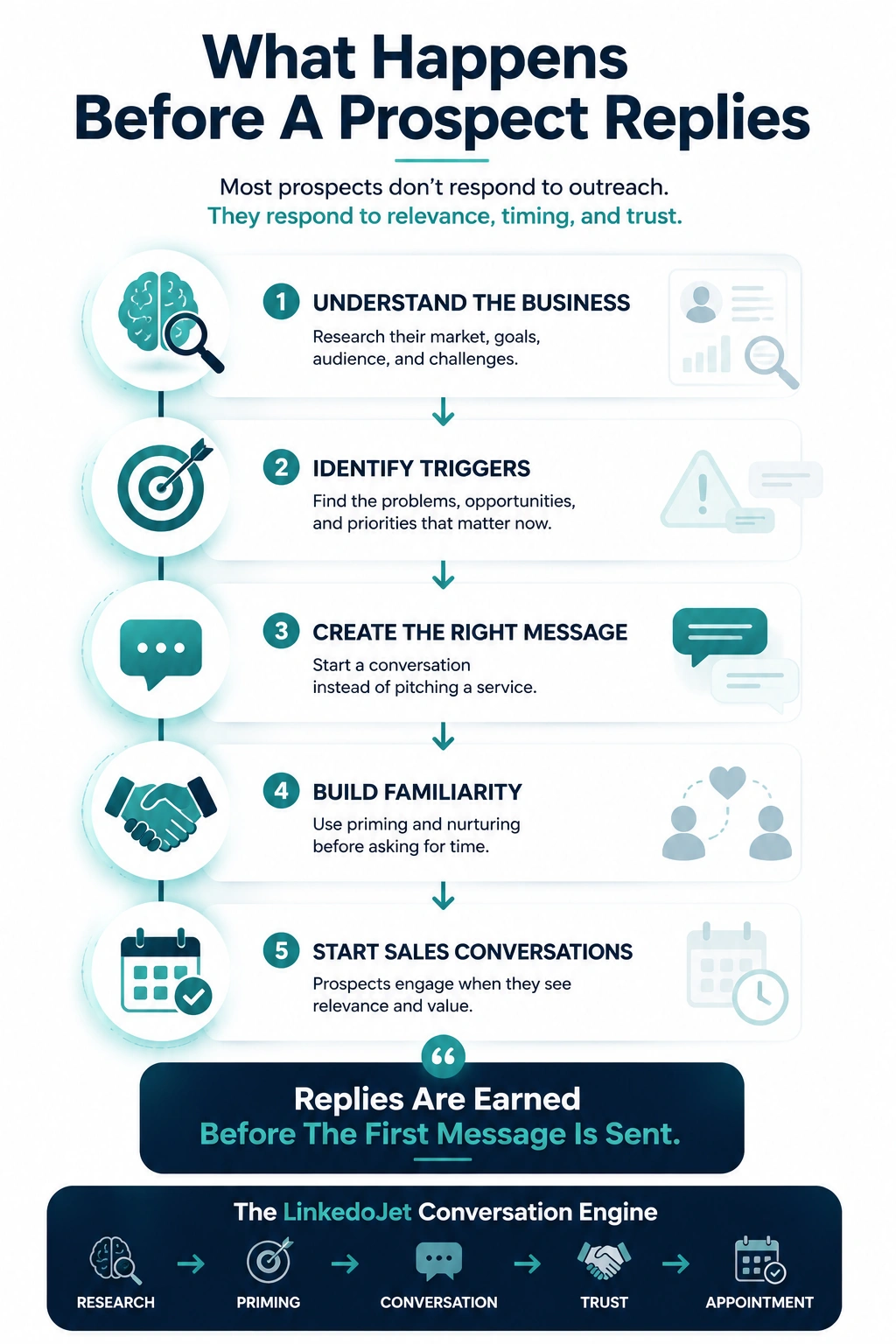
From identifying the right decision-makers to starting meaningful conversations and turning them into qualified appointments... LinkedoJet manages the entire outbound engine for your business.