
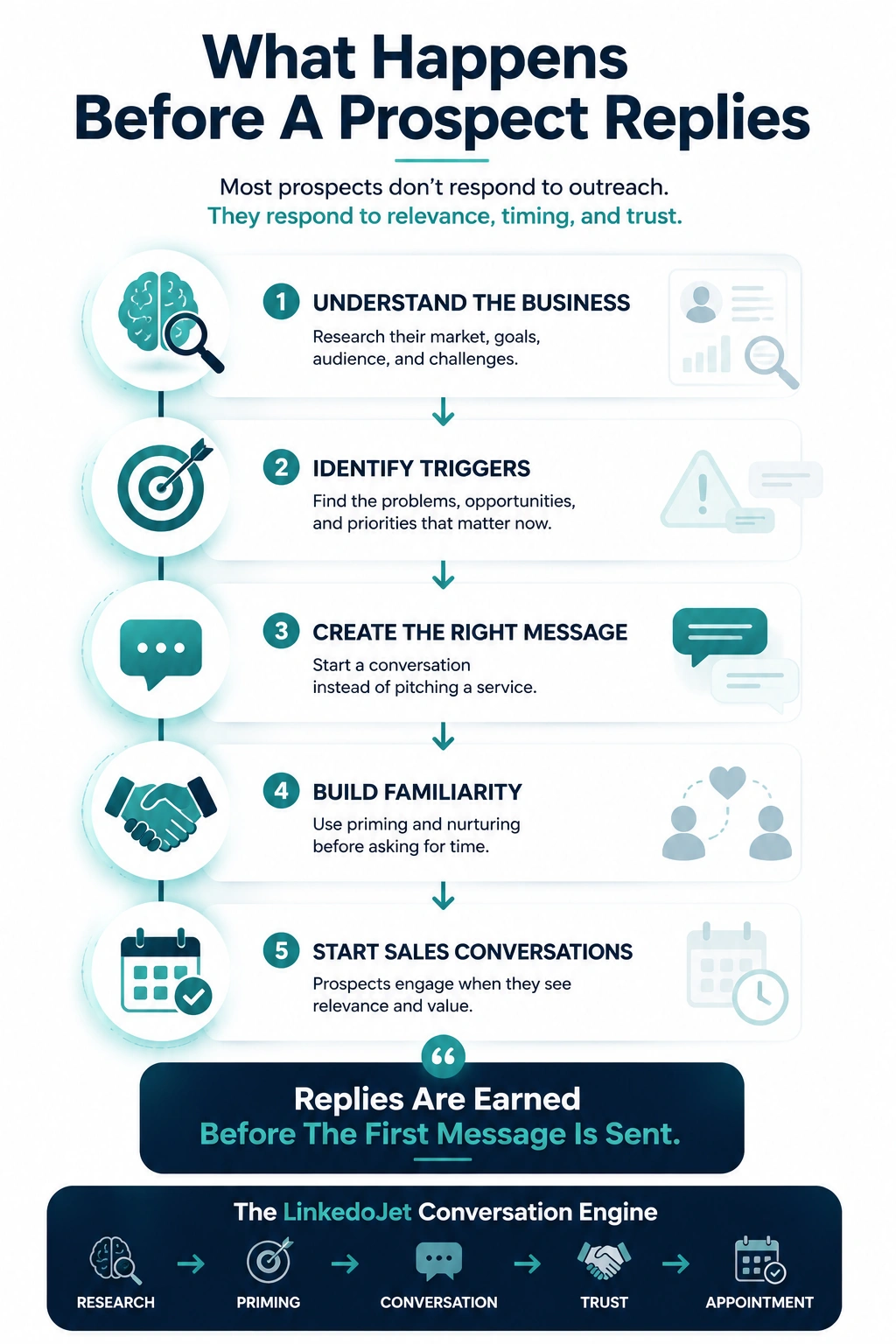
The real reason your “professional” DMs get ignored (and what it’s costing you)
If your messages feel polished but still die in silence, it’s usually not the offer. It’s the frame.
Most executive coaching outreach gets deleted in under two seconds—not because the buyer doesn’t believe in coaching, but because the message reads like coaching marketing.
Credential-first intros. “Thought you might be interested.” Big, soft claims about leadership potential. Or the opposite: a long, thoughtful paragraph that feels like a pitch deck squeezed into a DM.
To a CEO, it lands like: another person asking for my calendar. To a People/LD leader, it lands like: another vendor who hasn’t learned our buying process.
The hidden cost isn’t just low reply rate. It’s the weeks you spend “networking” while delivery work piles up. It’s the revenue swing where one delayed intro forces you to discount, take misfit work, or fill the gap with referrals you can’t control.
And there’s a quieter cost: every generic DM makes your work look generic. High-trust services don’t get forgiven for low-trust outreach.
Two buyer lanes, two message frames: CEO/founder sponsors vs People/LD buyers
One-size sequences fail because the buyer’s risk is different—even when the problem is the same.
Executive coaching gets bought in two lanes.
Lane 1: The sponsor (CEO, founder, GM, VP). They’re under pressure. They care about confidentiality, speed, and whether you can name the pattern without turning it into therapy. They respond to language like decision velocity, stakeholder alignment, tough conversations, board updates, first-90-days.
Lane 2: The process owner (VP People/CHRO, Head of Leadership Development, Talent Management). They’re managing risk and optics. They care about fit with internal programs, due diligence, confidentiality boundaries, and not making it look like someone is being “fixed.” They respond to language like leadership bench, manager capability gaps, succession risk, retention signals, program outcomes.
| Buyer | What they’re protecting | What triggers replies | What kills the thread |
|---|---|---|---|
| CEO / Founder sponsor | Time, status, privacy, decision clarity | Fast pattern recognition + one good diagnostic question | Credential dump, flattery, “I help leaders…” language, early meeting push |
| VP People / LD / Talent | Process, internal optics, fairness, procurement rhythm | Procurement-aware framing + clear, lightweight next step | Acting like they’re the end buyer, oversharing, attachments/decks too early |
If you message both lanes the same way, you’ll get the same result: polite “thanks” responses, “send details,” or nothing at all.
Timing that matches how senior leaders actually use LinkedIn (and why blasts fail)
Your sequence isn’t just words. It’s when and how it reappears.
Senior leaders don’t “hang out on LinkedIn.” They scan it in thin slices—early morning, between meetings, or late evening when the calendar finally stops yelling.
People leaders are different. They’re more likely to see messages during business hours, especially mid-morning or mid-afternoon, and they’re trained to spot vendor patterns. Three quick bumps in 48 hours reads like a tool, not a professional.
Blasts fail because they assume a clean inbox and a curious mood. Most of your buyers are reading on a phone while context-switching. If the message requires effort to understand, it dies.
- Space follow-ups. Think 2–4 business days between early touches, then 7–14 days for nurturing touches.
- Re-surface with a reason. A short question, a specific observation, or a lightweight asset. Not “bumping this.”
- Respect calendar density. If they’re in a new role, in a funding cycle, or mid-reorg, silence often means “not now,” not “convince me harder.”
The goal is to feel like a measured professional reappearing at the right moment—not a sequence trying to close.
The core sequence (7 messages) with executive-safe examples you can send tomorrow
Permission-based, short, and built to earn a real reply—not a forced meeting.
Message 1 — Connection request (under 300 characters, no pitch)
CEO / Founder sponsor:
“Noticed you’re scaling at [Company]. That 30→150 stretch can get intense on decision speed + alignment. I work with leaders in growth moments on operating cadence and stakeholder expectations. Open to connecting?”
VP People / Head of LD:
“Saw you lead People/LD at [Company]. I work with orgs on exec transition coaching and sponsor alignment (keeps it clean internally). Open to connecting?”
Message 2 — After acceptance (no meeting ask; one diagnostic question)
CEO / Founder sponsor:
“Appreciate the connect. When things are moving fast, where does it usually pinch first for you—decision speed, leadership bench, or alignment at the top?”
People/LD buyer:
“Thanks for connecting. When you bring in an external coach, what usually drives it—role transitions, performance risk, or leadership team friction?”
Message 3 — Soft problem-based follow-up (easy one-word reply)
CEO / Founder sponsor:
“Quick one—are you seeing more drag lately from unclear decision rights, or from feedback not landing across leaders?”
People/LD buyer:
“Quick check—are coaching requests hitting your desk more as proactive development, or as late-stage ‘we can’t lose this leader’ situations?”
Message 4 — Query-based emotional trigger (names the quiet cost, without exposure)
CEO / Founder sponsor:
“When you’re the one everyone escalates to, what tends to slip first—strategic thinking time, patience in key conversations, or energy?”
People/LD buyer:
“Hard question, but useful—when a leader is struggling, is it usually clarity/expectations… or stakeholder friction that no one wants to name out loud?”
Message 5 — Insight-based nurture (3–5 sentences, practical)
CEO / Founder sponsor:
“One pattern I keep seeing in exec transitions: it’s rarely ‘capability.’ It’s mismatched stakeholder expectations + no operating cadence to surface issues early. If you want, I can send a one-page checklist I use to align sponsor expectations in the first 30 days. Want it?”
People/LD buyer:
“When coaching sticks inside an org, there’s usually a tight loop: clear sponsor outcomes, a small set of behavioral commitments, and a lightweight stakeholder feedback rhythm. If it’s helpful, I can share a one-pager we use for sponsor alignment + confidentiality boundaries. Want me to send it?”
Message 6 — Soft meeting request (only after engagement signals)
Either lane:
“If it’s useful, I can walk you through how I’d structure a 30-day start around what you mentioned—15 minutes, no prep. If now’s not the right time, tell me what quarter to revisit.”
Message 7 — Close-loop (clean exit that preserves brand)
Either lane:
“I’ll close the loop so I’m not cluttering your inbox. If a transition, team friction, or leadership confidence issue pops up later, feel free to message me here.”
Signals: when to nurture, when to ask for 15 minutes, and when to pause outreach
Not every reply is progress. Not every silence is a chase cue.
Executive coaching is timing-sensitive. The same buyer who ignores you today can be the one who replies in a week because an exec resigned, a board update went badly, or a new VP isn’t landing.
Meeting-ready indicators (ask for 15 minutes)
- They answer your diagnostic question with specifics (“decision rights are muddy,” “feedback is getting avoided,” “new VP starts in 3 weeks”).
- They ask process questions (“How do you handle confidentiality?” “What does sponsor alignment look like?”).
- They reference a trigger moment: first-90-days, rapid headcount growth, cofounder tension, exec team misalignment, attrition risk.
- They ask “How would you approach this?” or “What does a 30-day start look like?”
Nurture indicators (send one useful touch, then wait)
- “Not right now” with no detail → ask what quarter, offer a one-page checklist.
- “Send details” → send a tight paragraph + one asset, no deck.
- They engage with posts but don’t reply → treat as quiet interest; keep it light.
Pause indicators (protect your brand)
- Repeated one-word deflections (“busy,” “ok,” “thanks”) after multiple prompts.
- Explicit “not interested” or “vendor list closed.”
- People leader says there’s an approved panel and no exceptions.
The discipline here is what separates “consistent conversations” from “I guess LinkedIn doesn’t work for us.”
What to stop doing if you want to stay credible with CEOs and HR/People teams
Most of this isn’t offensive. It’s just subtly disqualifying.
- Opening with credentials and school names. Senior buyers assume competence; they’re scanning for relevance.
- Vague personalization. “Love what you’re doing” reads like a template with their name dropped in.
- Diagnosing the prospect. “It seems like you’re struggling with…” triggers defensiveness and status protection.
- Implying they have a problem. Especially risky with People leaders who are managing internal optics.
- Pushing a call in message one. You haven’t earned the calendar, and you haven’t made the ask feel safe.
- Therapy-adjacent language in corporate contexts. “Healing,” “inner work,” “trauma,” “safe space” is a fast exit for many exec sponsors.
- Long paragraphs and attachments early. A busy leader won’t read it; a People leader won’t forward it.
- Treating HR/People as the end buyer. They often own process, not budget authority. Message them like process owners, not gatekeepers to “get past.”
High-trust work demands high-trust behavior before the first call.
How LinkedoJet runs this as a system: targeting, writing, measured follow-ups, and appointment support
Not software you babysit. A managed outbound engine built for senior conversations.
LinkedoJet is built for founder-led firms who can’t afford to spend two hours a day “staying visible” just to get a handful of vague replies.
Here’s what we operationally handle, end-to-end:
- ICP and targeting setup: we split your outreach into two lanes (CEO/founder sponsors vs People/LD buyers) and define what “good fit” looks like in plain language—industry, company stage, common trigger moments, and exclusion rules that protect your positioning.
- Sales Navigator + LinkedIn list building: we build and maintain prospect lists (by function, seniority, geo, growth signals, and role-change cues), so you’re not guessing who to contact.
- AI-assisted personalization: used to generate context cues and first-line variations that don’t sound scraped. A human review layer keeps it executive-safe and on-brand.
- Outreach execution: we run the connection + message sequence with measured timing so it feels like a professional re-surfacing, not a blast.
- Reply handling + nurturing: we categorize intent (curiosity vs deflection vs timing), draft responses that keep status intact, and move threads forward without forcing a meeting.
- Warm lead tracking: we track who engaged, what they referenced (transition date, team friction, sponsor questions), and when to revisit—so you stop losing “interesting” threads to inbox entropy.
- Appointment generation support: when signals turn meeting-ready, we help convert the thread into a short chemistry/fit call with clean, low-pressure language.
- Campaign visibility + refinement: dashboards show connection acceptance, reply rate by lane, message performance, and where threads stall—then we adjust targeting and copy based on what the market is actually responding to.
The point isn’t more activity. It’s more senior-grade conversations that convert without your brand paying a tax.
FAQ
What’s a good LinkedIn connection request for an executive coach that doesn’t sound like a pitch?
Keep it under 300 characters, reference a real context clue, and end with a simple permission ask. Avoid “I’d love to tell you about…” and avoid over-praising their profile. A good request sounds like a peer-to-peer nudge tied to a moment: scaling, a role transition, or leadership team alignment.
How should messaging differ when you’re approaching a CEO sponsor vs a VP People/Head of Leadership Development?
CEO sponsors respond to confidentiality, speed, and pattern recognition. People/LD buyers respond to process fit, risk management, and internal optics. Same service, different risk. Your questions should match: CEOs get “where does it pinch first?”; People leaders get “what typically triggers bringing in an external coach?”
When is it appropriate to ask for a chemistry call in a LinkedIn sequence?
After they give you specifics, ask process questions, mention a trigger moment, or ask how you’d approach a situation. If they haven’t engaged, asking for time is usually premature. The meeting ask should be short (15 minutes), no-prep, and with an easy “not now” option.
How many follow-ups is reasonable before it starts to feel like chasing?
For senior buyers, 2–3 follow-ups inside a tight window is often too much. Aim for a measured sequence: a couple of spaced nudges, then one insight-based nurture touch, then a clean close-loop. Your brand is worth more than one extra “bump.”
How do you respond to “We already have a coach” without sounding defensive or salesy?
Respect it, don’t compete. A calm reply works: acknowledge the relationship, name a specific moment where an additional lens is sometimes useful (first-90-days, stakeholder alignment, exec team friction), and ask a light question about timing. If they say no, close the loop professionally and leave the door open.
See how this looks when it’s run for you—lane split, sequences, nurturing, and booked calls
This isn’t a generic “strategy chat.” We’ll show you the actual outbound machine we run for executive coaching firms, and what you receive after onboarding.
What LinkedoJet operationally provides: we build your ICP and targeting rules, create Sales Navigator prospect lists, write lane-specific messaging (CEO sponsor vs People/LD), and run measured follow-ups that fit how senior leaders actually use LinkedIn.
How personalization works: we use AI-assisted personalization to generate context cues and variants (role changes, growth moments, leadership signals) while keeping the tone executive-safe. No profile-scrape cringe. A human review layer keeps it tight.
What happens after onboarding: you get a live campaign with two distinct buyer lanes, approved message templates, prospect lists that refresh, and a follow-up schedule that feels professional—not frantic. We handle daily outreach execution so your calendar doesn’t depend on you “being active.”
Lead nurturing and follow-up workflows: when someone replies, we categorize intent (curious, timing, deflection), draft the next message, and nurture with short insights or a lightweight diagnostic asset. The goal is to move from “interesting” to “worth a short call” without pushing.
Warm leads and appointments: we track warm threads, key details (transition dates, sponsor concerns, process questions), and the right moment to ask for a 15-minute chemistry/fit call. We also support the handoff so you’re stepping into a primed conversation, not a cold intro.
Visibility: you get dashboards showing acceptance, reply rate by lane, and where conversations stall—so we refine targeting and messaging based on reality, not hope.
Why this is different from ordinary LinkedIn automation tools: tools send messages. LinkedoJet runs the system—targeting, writing, execution, reply handling, nurturing, tracking, and appointment support—so you get consistent senior conversations without sounding like everyone else.
Next step: put your LinkedIn outbound on rails—without losing the high-trust feel
From identifying the right decision-makers to starting meaningful conversations and turning them into qualified appointments... LinkedoJet manages the entire outbound engine for your business.