
Why ESG decision-makers ignore your LinkedIn outreach (and what “vendor risk” looks like in their inbox)
If your message sounds even slightly like “help with ESG,” you’re invisible. Not because they don’t care—because it reads like time-cost plus risk.
ESG leaders don’t “browse LinkedIn.” They triage it.
Between a reporting calendar, internal data-owner wrangling, Legal questions about defensibility, and Procurement’s process, most inbound outreach is treated as a potential distraction at best—and a vendor risk at worst.
That’s the part most consultants miss. You’re not competing with other consultants. You’re competing with the buyer’s fear of starting something they can’t control: another platform pitch, another “end-to-end ESG partner,” another thread that turns into a meeting request before anyone’s even agreed what the problem is.
“Vendor risk” in a sustainability inbox looks like this:
- Broad claims (“CSRD/Scope 3/assurance readiness”) that signal you don’t know what’s actually breaking inside their org.
- Premature meeting asks that feel like you’re trying to pull them into a sales process while they’re managing committee politics.
- Attachments and links early—especially PDFs—because compliance-minded teams don’t click first and ask questions later.
- Forced personalization (“loved your post”) that reads like template glue.
The commercial cost isn’t just low reply rate. It’s the wrong replies.
You get price-checks, “send info,” or people who can’t sponsor internal change. Meanwhile your calendar stays empty, utilization gets lumpy, and you end up back where you started: referrals and RFP scraps.
Micro-relevance beats “help with ESG”: pick one issue, one moment, one easy question
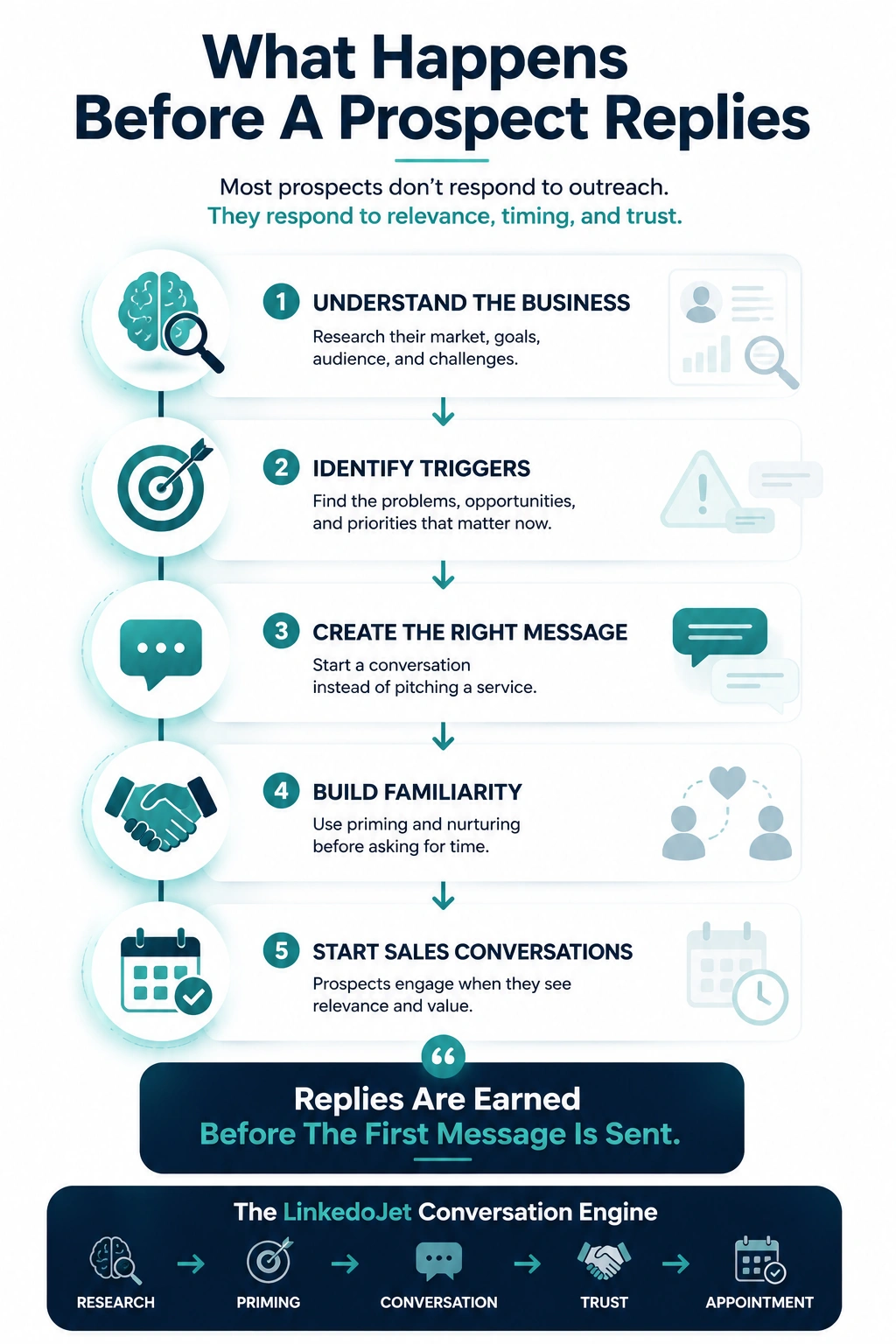
The first 2–4 touches aren’t about selling. They’re about reducing uncertainty and earning permission to go one layer deeper.
Most ESG outreach fails because it tries to be comprehensive.
But comprehensive reads as expensive, time-consuming, and hard to defend internally. A CSO can’t “just take a call” when Finance will ask about controls, Legal will ask about claims risk, and Procurement will ask about vendor scope before anyone’s even agreed there’s a problem worth solving.
Your job in messaging is to make the first reply feel safe.
That happens when you anchor on one narrow friction that sophisticated teams actually deal with, in language they use internally:
- Evidence gaps: “We have a narrative, but the audit trail is messy.”
- Boundary decisions: “We can’t get alignment on what’s in/out, and methodology keeps getting revisited.”
- Controls ownership: “Who owns the numbers, and who signs off when assurance asks?”
- Supplier response rates: “The chase is dragging and internal teams are tired.”
- Tool vs process mismatch: “We bought software; the operating model didn’t magically appear.”
Then you ask an easy question that can be answered in one line. Not “Can we hop on a quick call?”
Better: a quick state-check that reveals whether a scoping conversation is even warranted.
Buying committee map: how CSO, Finance, Legal, Procurement, and Ops read the same message differently
ESG rarely buys single-threaded. Your message has to land with the person reading it and survive the handoff when they pull others in.
| Persona | What they’re protecting | What they’ll reply to on LinkedIn | Safe question to open with |
|---|---|---|---|
| CSO / Head of Sustainability | Delivery against a calendar; reputation; internal alignment | Execution friction and “why this keeps getting stuck” moments | “Where does it slow down most right now—data owners, boundaries, or evidence?” |
| CFO / Controller / Finance | Controls, audit trail, sign-off risk, assurance expectations | Defensibility language: ownership, documentation, repeatability | “When assurance asks for the trail behind a KPI, is it straightforward or a scramble?” |
| General Counsel / Compliance | Claims risk, governance, external scrutiny, consistency | Methodology clarity, governance, review process | “Do you have a clean record of boundary/methodology decisions and approvals?” |
| Procurement / Vendor Management | Scope clarity, vendor onboarding friction, risk, process integrity | Clear scope, predictable engagement model, low chaos | “When Sustainability brings a vendor in, what usually slows onboarding—scope, risk review, or stakeholders?” |
| Ops / EHS / Supply Chain | Workload, practicality, supplier participation, data collection | Anything that reduces chasing and rework | “Are supplier response rates the bottleneck, or is internal data ownership the bigger drag?” |
Notice what’s missing: your service list.
In ESG, credibility is shown by what you choose to not say early. The committee doesn’t reward ambitious promises. They reward restraint, specificity, and a clear sense that you understand how assurance and internal governance change the buying process.
The sequence (with examples): earn replies first, then earn the scoping call
Short messages. One point. One easy question. No links unless requested. No meeting ask until there’s a reason.
1) Connection request (15–25 words)
Example: “Hi [Name]—I work with sustainability teams untangling evidence trails + boundary decisions ahead of reporting/assurance. Thought it’d be useful to connect given your role at [Company].”
2) First message after acceptance (no pitch, just a state-check)
Example (CSO / Sustainability): “Quick question—where does ESG work bog down most for you right now: data owner accountability, boundary decisions, or pulling evidence when stakeholders ask?”
Example (Finance): “When Finance gets pulled into ESG reporting, it’s usually controls + audit trail. Do you already have clear ownership/documentation for key KPIs, or is it still ad hoc?”
3) Problem-check follow-up (2–3 days later, if no reply)
Example: “Common pattern I’m seeing: strong narrative, weak evidence trail—especially once assurance prep starts. Is the pain more in collecting evidence, or getting alignment on methodology/boundaries?”
4) Defensibility trigger (pressure, without drama)
Example: “When Legal/Finance asks ‘show me how you got this number’—is it straightforward to trace, or does it turn into a scramble across data owners?”
5) Insight nurture (small value, offered in-chat)
Example: “If helpful, I can paste a simple checklist we use for ‘audit-ready’ evidence: what to document, who owns it, and what usually breaks under review. Want it here?”
If they say yes, paste 6–8 bullets in-chat. No links. Keep it practical.
6) Soft scoping ask (only after engagement)
Example: “Happy to keep this async, but if you want faster clarity: I can walk you through how teams set up an evidence + controls trail that survives assurance (owners, artifacts, review cadence). Would 15 minutes next week be useful—or should I send a one-page summary instead?”
7) Close-loop (professional, preserves credibility)
Example: “I’ll close the loop for now—timing is usually the constraint here. If it’s useful, I can reach back out closer to your next reporting/assurance prep window. Prefer that, or should I stop reaching out?”
What ESG leaders ignore (realistic bad patterns) and how to rewrite them without sounding like marketing
If your message increases perceived time-cost or compliance risk, you won’t get a “maybe.” You’ll get nothing.
Bad pattern: capability dump + vague relevance
Don’t: “We help companies with CSRD, Scope 3, double materiality, ESG strategy, and reporting. Can we schedule a quick call?”
Rewrite: “Curious—are you already confident in your evidence trail for the ESG numbers, or is that still the messy part? (I’m asking because that’s where assurance prep tends to bite.)”
Bad pattern: forced personalization
Don’t: “Loved your post! Your sustainability leadership is inspiring.”
Rewrite: “Saw you’re leading sustainability at [Company]. Quick one: is the bottleneck internal data owners, supplier responses, or aligning boundaries/methodology?”
Bad pattern: links, decks, PDFs in message 1–2
Don’t: “Here’s our deck/case study—let me know what you think.”
Rewrite: “I have a short ‘evidence + controls’ checklist I can paste here if useful. Want it?”
Bad pattern: arguing with objections
Don’t: “Even if you already have a platform, we can still add value across the whole ESG program.”
Rewrite: “Makes sense. When you say you have a platform/partner—does it cover the operating model too (owners, evidence, review cadence), or is that still mostly manual?”
The goal isn’t to be “clever.” It’s to sound like someone who has sat in the meetings where ESG work falls apart: unclear ownership, last-minute evidence scrambles, supplier chasing, and committee sign-off cycles that don’t match the calendar.
Timing and pacing for ESG calendars: when reply rates change (and why stakeholders move at different speeds)
Great messaging sent at the wrong moment still dies. ESG work has seasons, and the committee doesn’t feel pain on the same day.
Most sustainability leaders check LinkedIn in thin slices: early morning before the first meeting, between calls, or end-of-day when they’re clearing messages. That means your sequence has to be respectful: short notes, spaced touches, and a clear reason for each ping.
Timing patterns that consistently change engagement:
- Planning windows: when teams are deciding what’s “in scope,” assigning owners, and trying to avoid surprises later.
- Pre-reporting crunch: when evidence gaps surface and “we’ll fix it later” stops working.
- Assurance prep: when defensibility becomes a Finance/Legal problem, not just Sustainability’s.
- Supplier engagement campaigns: when response rates stall and Ops/Supply Chain feels the pain directly.
Pacing guidance that fits the reality:
- Connection request → wait for acceptance.
- Message 1 within 24 hours of acceptance (while you’re top of mind).
- Follow-up 2–3 business days later.
- Defensibility trigger 4–6 business days after that.
- Nurture insight ~1 week later (offer value, no link).
- Soft scoping ask only after they engage, or when they’ve reacted/asked a question.
One nuance: Procurement and Finance often move slower on “random outreach,” but faster once there’s a defined scope and a defensible reason to evaluate. That’s why your early messages should create scope clarity—not push a meeting.
How LinkedoJet operationalizes appointment generation for ESG advisory
Not “automation.” A managed outbound engine built around persona targeting, risk-sensitive conversation design, and disciplined follow-up that doesn’t damage your name.
If you’re running a serious ESG advisory practice, the real constraint isn’t knowing what to say once. It’s running the system every week without slipping back into generic messages, random follow-ups, or list quality problems that poison outcomes.
LinkedoJet is built for that operational reality:
- ICP and targeting setup: we translate your best-fit engagements into a clean targeting spec (industries, size bands, geo, triggers like CSRD rollout, assurance readiness, supplier programs) and define who matters on the committee.
- Sales Navigator + LinkedIn prospect list building: we build and maintain role-specific lists (CSO/Sustainability, Finance/Controller, Legal/Compliance, Procurement, Ops/Supply Chain) so you’re not single-threaded.
- AI-assisted personalization: not fake flattery—light, contextual relevance (role, timing, likely friction) that keeps messages human and specific without turning into a research project.
- Outreach execution: connection requests, sequencing, pacing, and follow-ups handled consistently, with language that respects vendor fatigue and compliance sensitivity.
- Lead reply handling + nurturing: we tag replies by intent (curious, blocked, delegated to Procurement, “already have a partner,” timing) and run the next best message to keep momentum without forcing a call.
- Warm lead tracking: we track signals like stakeholder mentions (“loop in Finance”), constraints (“next quarter”), and pain language (“audit trail is messy”), so you don’t lose promising threads in a busy week.
- Appointment generation support: when the thread earns it, we guide the handoff into a scoped conversation with the right framing and the right stakeholders.
- Campaign visibility + refinement: dashboards show what’s working by persona and angle (evidence, boundaries, supplier engagement), and we adjust weekly based on real replies—not guesses.
This is how you get out of the referral trap without becoming “that ESG vendor” in someone’s inbox.
FAQ
How many LinkedIn touches should an ESG messaging sequence include before asking for a call?
Plan for 5–7 touches total, but don’t treat it like a countdown. In ESG, the call ask earns its place after engagement (a reply, a clear pain statement, or them referencing another stakeholder). For many committees, the first 2–4 touches should stay in “permission-building”: one narrow issue, one easy question, and a small insight offered in-chat.
What are good LinkedIn message examples for CSRD, assurance readiness, or Scope 3 supplier engagement—without pitching?
Use a single friction plus a state-check question. Examples:
- CSRD: “Are you more stuck on double materiality alignment, or on documenting decisions so they survive internal review?”
- Assurance readiness: “When someone asks for the evidence trail behind a KPI, is it already packaged—or does it turn into a scramble across teams?”
- Scope 3 suppliers: “Is the bottleneck supplier response rate, or internal time spent cleaning/normalizing what comes back?”
How do I adjust messaging for a CSO vs CFO/Controller vs Procurement without changing my core offer?
Keep the core offer the same (reducing rework and making reporting defensible). Change the entry point:
- CSO: execution friction, calendars, stakeholder scrutiny.
- Finance: controls, ownership, audit trail, repeatability.
- Procurement: scope clarity, onboarding steps, risk review, predictable engagement model.
You’re not reinventing your services—just speaking to what each role is paid to protect.
What should I say when they reply: “We already have a platform/partner” or “Procurement handles vendors”?
Don’t argue. Ask a diagnostic that separates “tool/partner exists” from “problem solved.” Examples:
- Already have a platform/partner: “Makes sense—does it cover the evidence + controls operating model too, or is that still mostly manual across data owners?”
- Procurement handles vendors: “Totally. Before it hits Procurement, what do you need internally—clear scope, stakeholders, and a reason it’s worth evaluating?”
Should I send links, decks, or PDFs in early LinkedIn messages for ESG consulting?
Not unless they ask. Early links raise friction and can trigger compliance instincts (“I’m not clicking that”). If you want to nurture, offer a short checklist or framework and paste it directly in-chat. If they request a deck, send it—but treat that as a sign they’re ready for a more formal next step.
See what this looks like when it’s run as a system (not a burst of messages)
Book a demo session and we’ll show you the exact targeting + sequence we’d run for your firm—then what you receive after onboarding when LinkedoJet runs it week after week.
This isn’t a generic “strategy chat.” It’s a working session to pressure-test whether LinkedIn can reliably produce qualified scoping calls for your ESG advisory—without you sounding like another vendor.
On the session, we’ll:
- Confirm your best-fit buyer roles (CSO/Sustainability, Finance/Controller, Legal/Compliance, Procurement, Ops/Supply Chain) and which thread you should start with.
- Build a first-pass targeting spec and show how we turn it into Sales Navigator searches and clean prospect lists.
- Draft or refine a risk-sensitive messaging sequence anchored to one narrow friction (evidence trail, boundary decisions, controls ownership, supplier response rates), with persona variants that still sound like you.
- Define the follow-up logic for common ESG objections (“already have a platform/partner,” “Procurement handles vendors,” “next quarter,” “confidential process”) so replies turn into real threads—not dead ends.
After onboarding, LinkedoJet operationally provides: ICP and targeting setup, Sales Navigator/LinkedIn prospect list building, AI-assisted personalization, outreach execution, reply handling and nurturing, warm lead tracking, appointment generation support, plus campaign visibility through dashboards and ongoing refinement based on what prospects actually say.
You’ll see where interest is building (which persona, which angle, which objection), what to do next in the thread, and when it’s time to move from messaging to a scoped call with the right stakeholders.
Ordinary automation tools send templates. LinkedoJet runs the full outbound process with guardrails—so your credibility goes up, not down.
Next step: get a sequence that earns replies—and a workflow that turns replies into scoped calls
From identifying the right decision-makers to starting meaningful conversations and turning them into qualified appointments... LinkedoJet manages the entire outbound engine for your business.