
Your LinkedIn outreach shouldn’t sound like a software vendor (and they can tell in 3 seconds)
ERP/CRM buyers don’t ignore you because they don’t need help. They ignore you because your message reads like someone who disappears when the project gets uncomfortable.
CFOs, COOs, Heads of RevOps, and IT directors live in governance calls, escalation threads, and “why doesn’t this reconcile?” meetings. They check LinkedIn in short, distracted windows—early morning, between calls, late afternoon. Anything that smells like a pitch gets mentally filed under risk.
And ERP/CRM work is judged on risk. Not logos. Not “capabilities.”
If your first line is “we implement NetSuite/Salesforce/Dynamics,” you’ve already told them you’re interchangeable. Worse: you’ve told them you’re going to pull them into a sales motion while they’re trying to keep quarter-end close from turning into a blame game.
The brutal part is you can be excellent at delivery and still be invisible. Referrals and “right place, right time” keep you fed—until they don’t. Then a big SI gets in early, frames the narrative, and you’re competing inside a vendor queue you never asked to join.
Your goal on LinkedIn isn’t to sell an implementation. It’s to earn a reply that signals, “this person understands how these projects actually go sideways.”
Six high-trust entry points that actually start ERP/CRM conversations
These aren’t “pain points.” They’re the moments where someone’s credibility is on the line—and they quietly look for a second set of eyes.
- Post-go-live stabilization that never ends
What they’re thinking: “We shipped, but we’re still living in workarounds.”
What they’re afraid of: “Leadership thinks this was a waste and wants someone to blame.” - CRM adoption and reporting trust issues
What they’re thinking: “The CRM is a reporting tool nobody believes.”
What they’re afraid of: “Forecast calls become political because the numbers don’t match reality.” - Data quality / migration risk
What they’re thinking: “We can’t cleanse our way out of this in the last two weeks.”
What they’re afraid of: “Bad data becomes permanent debt and the ‘system’ takes the fall.” - Integrations breaking order-to-cash
What they’re thinking: “Everything works… until the handoffs.”
What they’re afraid of: “One brittle connector turns into revenue leakage and a support fire.” - Month-end close taking too long
What they’re thinking: “We’re still reconciling in spreadsheets like it’s normal.”
What they’re afraid of: “Audit pressure exposes how manual this really is.” - Forecasting hygiene / pipeline scrutiny
What they’re thinking: “We’re arguing about definitions instead of decisions.”
What they’re afraid of: “RevOps gets blamed for process while Finance gets blamed for the number.”
Notice what’s missing: “digital transformation.” Nobody wakes up wanting that. They wake up wanting the system to stop creating ambiguity—because ambiguity creates meetings, and meetings create exposure.
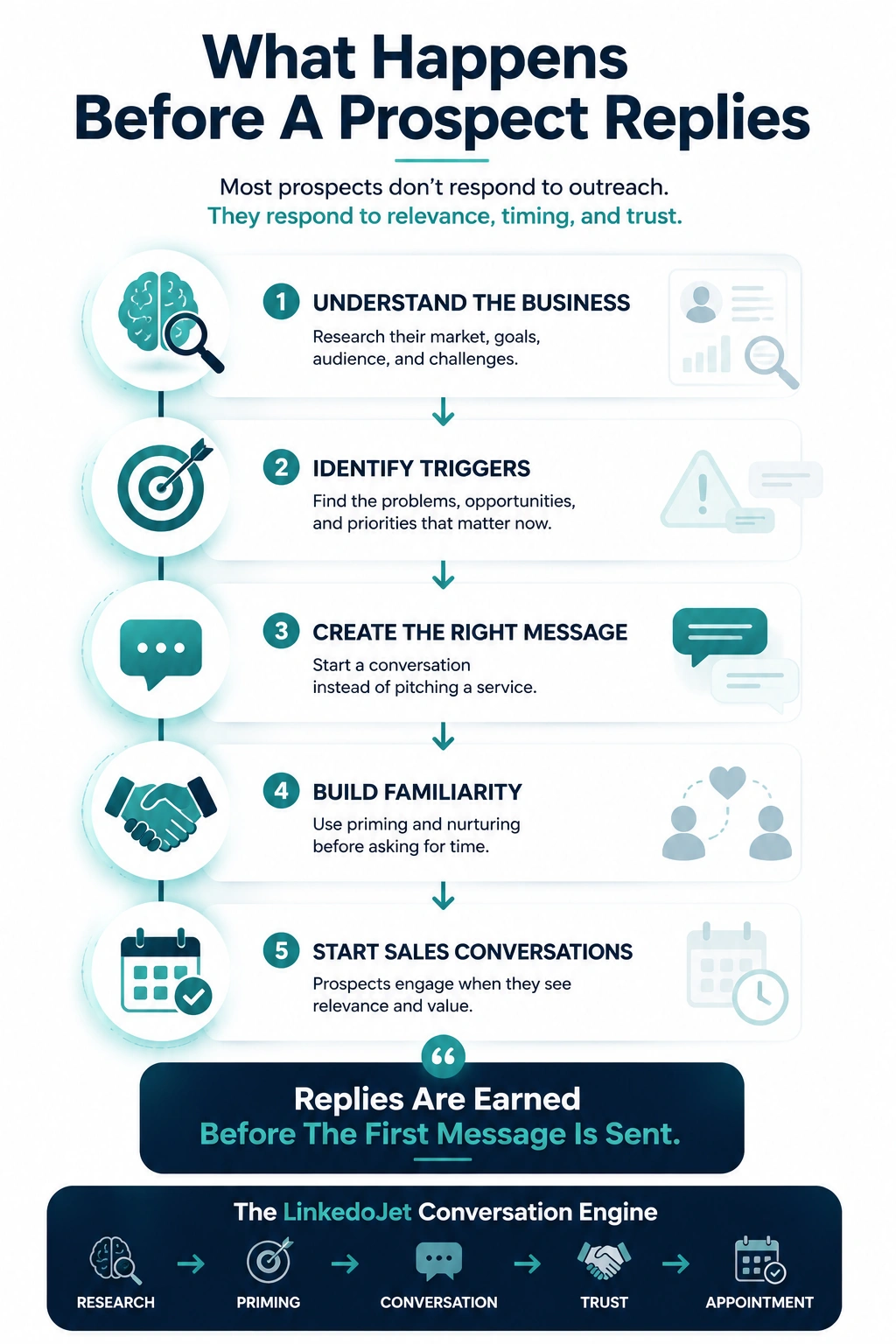
The sequence logic: relevance → credible observation → low-effort question → nurture → soft invite
Fewer messages. Better replies. And you stop sounding like an SDR wearing a consultant badge.
ERP/CRM outbound fails when you ask for a meeting before you’ve earned a reason to talk. The bar is higher because the buyer has been burned: requirements “signed off” that weren’t real, UAT rushed, integrations hand-waved, training treated like a checklist, and then everyone acts surprised when adoption collapses.
The fix isn’t a clever template. It’s a conversation structure that matches how stakeholders think:
- Relevance: role + context (not flattery).
- Credible observation: one sentence that signals you’ve seen delivery reality (data, adoption, governance, integrations, close).
- Low-effort question: yes/no or A/B that they can answer in five seconds.
- Nurture: short operator insights that help them name what’s happening internally.
- Soft invite: “sanity check / compare notes” once there’s engagement or a clear pain signal.
A full ERP/CRM-native message sequence (7 touches) that earns scoping calls
Short, delivery-aware, and easy to reply to. Use placeholders sparingly. Don’t cosplay personalization.
| Touch | Channel | Message (copy/paste, then lightly adjust) |
|---|---|---|
| 1) Connection | Connect note | “{FirstName} — saw you’re leading {RevOps/Finance/Ops/IT} at {Company}. Quick question on {CRM adoption/reporting trust/month-end close} once connected. Happy to connect.” |
| 2) Diagnostic opener | DM (after acceptance) | “Appreciate the connect. One pattern I keep seeing: CRM becomes a reporting layer people don’t fully trust, so teams start running ‘shadow numbers’ in spreadsheets.
On your side right now, is the bigger issue A) data quality/definitions or B) adoption/process?” |
| 3) Respectful follow-up | DM (no reply) | “Not sure this is on your radar. If it is, which bucket is closest?
1) duplicate/dirty data 2) forecasting hygiene 3) integrations + handoffs (quote-to-cash) 4) month-end close friction 5) post-go-live stabilization Happy to point you to the right questions either way.” |
| 4) Pressure question | DM | “When leadership asks why CRM pipeline numbers don’t match finance outcomes, where does it usually break first for you—process or data?
(I ask because the fix is totally different depending on which one is true.)” |
| 5) Insight nurture | DM | “Small scoping guardrail that saves pain later: if there isn’t a named owner per workflow (lead→oppty, quote→order, billing, renewals), the system turns into a set of compromises—and three months later it looks like ‘bad data.’
Curious if that’s showing up at {Company}, or if you’re dealing with a different flavor of mess.” |
| 6) Soft invite (after engagement) | DM | “If it’s useful, I’m happy to do a 15-minute sanity check with you—just compare notes on where adoption/data/integrations typically derail and what to validate before it becomes a bigger cleanup.
Would Tue 8:30–9:00am or Thu 4:00–4:30pm work your time?” |
| 7) Close-loop | DM | “No worries if now isn’t the moment. Want me to circle back after quarter-end / after go-live?
Or if there’s a better owner for this (RevOps vs Finance vs IT), point me in the right direction and I’ll take it from there.” |
Two rules that keep this sequence “consultant-grade”:
- Don’t claim outcomes. Name patterns and ask questions. Confidence without over-promising is the signal.
- Don’t escalate urgency. ERP/CRM stakeholders can smell manufactured pressure. Tie follow-ups to their world, not your quota.
Why ERP/CRM stakeholders ignore most LinkedIn messages
This is the stuff that quietly damages your brand in accounts you actually want.
- Capabilities-first openers: “We implement {platform}.” To them, that reads: “Here comes a sales cycle.”
- Meeting ask in message 1–2: You’re asking for time before you’ve shown you understand the failure mode (data migration, adoption, governance, integrations, close).
- Vague personalization: “Saw your profile / loved your post.” It’s not flattering anymore. It’s a tell.
- Transformation language: “Improve efficiency, drive growth.” ERP/CRM buyers hear: “I won’t be here when this gets messy.”
- No delivery reality: If you don’t reference testing, ownership, change management, definition drift, integration debt, or reconciliation… you haven’t earned credibility.
- Wrong stakeholder: You hit a power user or coordinator, get a polite response, then wonder why nothing progresses.
When you sell high-stakes delivery, your outreach is part of delivery. It sets expectations. It signals how you think. If it feels like a vendor blast, they assume your project motion will feel the same.
Timing, cadence, and stakeholder pivots (so you get read—and you don’t get trapped)
You’re not chasing replies. You’re staying present until a real business moment makes the conversation timely.
Cadence that fits their day: 7 touches can work, but it should feel spaced and respectful. Early morning and late afternoon tend to outperform midday, because midday is wall-to-wall calls and task switching.
Business-moment triggers that get attention:
- Quarter-end and board reporting weeks (forecast scrutiny, reconciliation pressure)
- Audit prep / controls reviews (close process, SOX-ish documentation, traceability)
- Go-live windows + the 30–90 days after (stabilization, backlog reality)
- Pipeline resets (stage definitions, handoffs, CPQ/billing alignment)
- Integration incidents (middleware brittle, sync failures, duplicate records)
Qualification cues (when to invite): If they mention month-end close pain, “numbers don’t match,” duplicate records, forecasting misses, integration breakage, stalled UAT, adoption complaints, or leadership pressure to show ROI—your “compare notes” invite is timely.
Stakeholder pivot lines (without being awkward):
- “Quick check—who typically owns reporting trust on your side: RevOps or Finance?”
- “Is adoption being driven by Ops/enablement, or is it sitting with IT?”
- “When this escalates internally, who ends up chairing the steering committee?”
Stop/pause signals (protect your name):
- “Please email procurement” (you’re being routed into a queue)
- “We’re mid-implementation and I’m not involved in vendor decisions” (not an owner)
- A clear “no” + no alternative timing (close-loop and move on)
- They only ask for your deck/pricing before any context (they’re shopping, not scoping)
FAQ
What’s a good LinkedIn messaging strategy for ERP/CRM consultants without sounding like “we implement X”?
Lead with a delivery-aware pattern, not your platform list. One credible observation (adoption, reporting trust, integration debt, close friction), then a binary question. If they can answer in five seconds, you’ll get more replies—and the replies will be higher quality.
How long should a LinkedIn messaging sequence be for CFOs, COOs, RevOps, and IT leaders in ERP/CRM?
Usually 6–8 touches works if it’s spaced and tied to business moments. The sequence should feel like calm check-ins, not daily pursuit. If you’re forcing urgency, you’ll get ignored—or routed to someone who can safely say “not me.”
What are practical LinkedIn message examples for CRM adoption, reporting trust, and forecasting hygiene issues?
Use short prompts like: “Is the bigger issue data/definitions or adoption/process?” or “When numbers don’t match, where does it break first—process or data?” Then follow with a small scoping guardrail (workflow owner per handoff, definition lock before dashboards, UAT pace as an adoption predictor).
How do I message about ERP data migration or integrations without triggering a “vendor blast” reaction?
Talk about risk signals, not promises. Example: “On migrations, the surprise is rarely the extract—it’s the mapping decisions and exception handling.” Or: “Most integration incidents are ownership problems, not tooling problems.” Then ask a simple question: “Are you more worried about scope creep or migration surprises?”
How do you qualify whether the person replying actually owns budget and project risk (vs. a user or coordinator)?
Ask who chairs decisions when it escalates: “Who owns reporting trust—RevOps or Finance?” and “Who runs the steering committee?” Owners talk about deadlines, risk, and internal alignment. Non-owners talk about tickets, training, and “IT handles it.” Pivot politely and keep the thread clean.
If you want this to run consistently, we’ll build and operate it with you
Not a generic “strategy chat.” A working outbound engine for ERP/CRM consulting that sounds like a calm operator—and produces qualified scoping conversations.
On the session, we’ll look at your current positioning and the exact stakeholders you’re trying to reach (CFO/COO/RevOps/IT), then pressure-test your message against real ERP/CRM buying reality: delivery risk, governance, integrations, adoption, month-end close, and “system is live but not trusted.”
If there’s a fit, LinkedoJet doesn’t hand you templates and wish you luck. We operationally provide:
- ICP and targeting setup: define the accounts, roles, and exclusion rules so you stop collecting low-authority replies.
- Sales Navigator + LinkedIn prospect list building: we build and maintain lists by stakeholder type (Finance, Ops, RevOps, IT) and buying signals.
- AI-assisted personalization: used to tailor credible openers and “why this, why now” lines without fake flattery or brittle macros.
- Outreach execution: we run the sequence, control cadence, and keep it consistent even when your team is deep in delivery.
- Lead reply handling and nurturing: we route, tag, and help manage responses so “not now” becomes “after quarter-end” instead of disappearing.
- Warm lead tracking + appointment generation support: we track warm threads, stakeholder pivots, and booking readiness; you get help converting engagement into real scoping calls.
- Campaign visibility: dashboards that show what’s sending, what’s landing, and where conversations stall.
- Ongoing refinement: we adjust targeting, message angles, and follow-up triggers based on replies from your market.
After onboarding, you receive a live targeting system, active prospect lists, production-ready sequences, and a managed follow-up workflow that protects your brand while keeping you present in the right accounts.
Ordinary automation tools help you send more. LinkedoJet is different: we handle the targeting, the sequence design, the execution, the nurturing, and the tracking—so your outreach reads like a delivery-led advisor, not a vendor blast.
From identifying the right decision-makers to starting meaningful conversations and turning them into qualified appointments... LinkedoJet manages the entire outbound engine for your business.
Next step: turn “we should fix this” into booked scoping calls
You’ll walk away with a stakeholder-aware sequence, a clear targeting plan, and a managed follow-up motion that keeps conversations alive through quarter-end, audit prep, and go-live windows.