
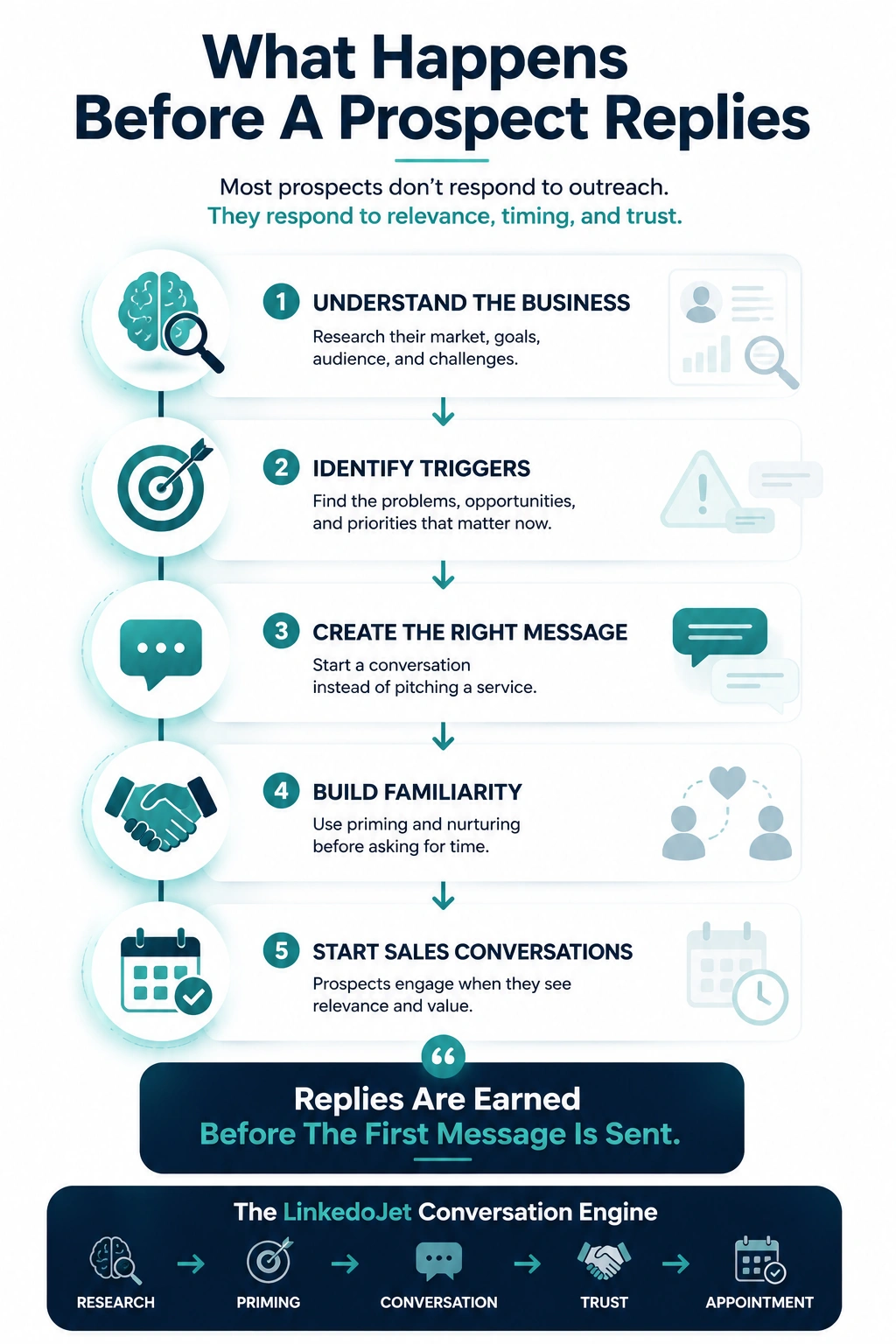
CISOs aren’t ignoring you. Your message looks like every other vendor.
Most security leaders don’t “decide” to ignore LinkedIn. They skim, pattern-match, and protect their attention.
You already know the feeling: a rep says “CISOs don’t reply on LinkedIn,” and you can’t quite prove them wrong. But you also know it’s not the product. It’s the first touch. One pitch-first DM and your brand gets filed under noise—and in security, that label tends to stick.
The hidden cost isn’t just low reply rates. It’s missed timing windows: audit evidence collection, tool consolidation, a fresh board question, a new security leader inheriting a mess, an incident in the sector. Those are the moments when a short, competent conversation can turn into a meeting. They’re also the moments you lose when your outreach creates work, triggers defensiveness, or smells automated.
Security leaders live in chopped-up time: standups, escalations, vendor risk questionnaires, exception approvals, and the constant background hum of “prove it.” They open LinkedIn in small windows—early morning, between meetings, late evening—and they will not spend that window educating a vendor.
If your sequence asks them to do mental lifting (“tell me about your priorities”), claims a vague outcome (“improve your security posture”), or jumps to a calendar too fast, you don’t just lose a reply. You quietly poison the account for when they actually are looking.
Who this is for—and who you’re really messaging inside the account
This playbook is for cybersecurity GTM teams selling into mid-market and enterprise where trust is the product wrapper:
- MDR, MSSP, SOC augmentation
- GRC, third-party/vendor risk, compliance tooling
- Pentest, attack surface management, vulnerability management
- IAM and identity sprawl controls
- Security awareness and human-risk programs
- Cloud security and posture controls
And it’s for the operators who own pipeline outcomes: founders, CEOs, Heads/VPs of Sales, SDR/BDR leaders, and GTM leads who are tired of watching activity masquerade as progress.
You’re not “messaging a CISO” in a vacuum. You’re messaging a buyer who is accountable to:
- SecOps reality (alert fatigue, false positives, tuning, handoffs)
- GRC reality (SOC 2 / ISO 27001 / HIPAA / PCI evidence, audit readiness, policy-to-proof gaps)
- CIO/IT reality (consolidation pressure, budget scrutiny, vendor sprawl)
- Board reality (“how do we know we’re covered?”)
That’s why “send a deck” is often a dismissal. Not because they’re rude—because a deck implies procurement work, internal selling, and follow-up they don’t have time for. If you can’t reduce cognitive load in the first two messages, you won’t earn the right to ask for 20 minutes.
Conversation engineering: earn the 1st reply, then the 2nd, then permission for a short call
Most teams treat LinkedIn messaging as a copy problem. Write better templates. Add “personalization.” Send more follow-ups.
In cybersecurity, it’s a trust-and-permission problem. CISOs decide fast whether engaging you will create extra work, risk, or political drag inside the org.
The sequence has one job at a time:
- First reply: prove you’re safe to answer. Narrow relevance + low-friction question.
- Second reply: show competence without performing. Small insight, grounded in their reality.
- Permission: a call ask that feels like a quick sanity check, not a sales process.
LinkedoJet is built around this flow. Not “send DMs at scale.” We set up targeting and lists in Sales Navigator, generate AI-assisted personalization that stays grounded (no fake familiarity), execute outreach with measured pacing, handle replies and follow-up workflows, and track warm leads and appointments so you can see what’s moving—and what’s stalling—at the account level.
What CISOs ignore on LinkedIn (and why it fails inside security inboxes)
You can almost hear the internal eye-roll when these show up:
- “Noticed we’re both in cybersecurity…” It’s non-specific, and it signals you didn’t choose them for a real reason.
- “We help improve your security posture.” That’s a slogan, not a situation. It forces them to ask, “how?” and they won’t.
- Premature calendar asks. If the first two touches ask for 15 minutes, it reads like a quota move, not a peer conversation.
- Over-technical dumps without context. Listing detections, frameworks, “AI,” or integrations without anchoring to their pressure (audit evidence, SOC capacity, vuln backlog) is just noise.
- Fear hooks and implied incompetence. “Are you protected from X?” is a trap. Nobody wants to answer that in writing.
Here’s the pattern: the more your message sounds like it was written for any security leader, the less likely it is to get a reply from this one.
And the penalty is real. Security is a small community. The wrong tone doesn’t just reduce response rate—it reduces future willingness to engage when you finally have a credible angle.
A CISO-safe sequence with real message examples (connection → close-loop)
These are written to feel like a competent operator: narrow, calm, and easy to answer. Edit the pressure point to match your category (MDR vs GRC vs vuln mgmt vs IAM), but keep the structure.
1) Connection request (no pitch)
Example: “Hi <
2) First message after acceptance (one-line, low-friction question)
Example (MDR/SOC): “Quick one, <
Example (GRC): “Are you seeing more time go into vendor risk reviews this quarter, or has it stayed flat?”
Example (vuln mgmt): “Is your bottleneck more on finding issues, or on getting them remediated across teams?”
3) Soft follow-up (grounded observation + either/or)
Example: “If it helps, what we see a lot is teams buying tools, but the drag is in tuning + handoffs + reporting when audit asks ‘show me.’ Is that pain more on evidence or on ops bandwidth for you?”
4) Pressure trigger (name the human reality without being dramatic)
Example: “One thing I hear from security leaders: vendors promise ‘coverage,’ but the hard part is defending decisions internally when someone asks ‘how do we know?’ Is that a live conversation for you this quarter?”
5) Insight nurture (3–5 lines, useful without a meeting)
Example (MDR eval):
“When teams evaluate MDR, the strongest signal isn’t tool count. It’s: (1) how alerts get triaged into actions, (2) how they handle noisy identity events, and (3) what ‘proof’ looks like in a quarterly review. If you want, I can send the 1-page scorecard we use to compare providers.”
6) Soft meeting ask (only after engagement or a clear initiative)
Example: “If you’re open to it, happy to do a quick 15–20 min compare-notes on how teams are validating coverage and reporting for audits without adding headcount. I’m free Tue 11:30am or Thu 3pm <
7) Close-loop (protect the account)
Example: “I’m going to close the loop on my side, <
Notice what’s missing: feature dumps, “AI-powered” claims, and manufactured familiarity. The sequence earns permission through small, credible steps.
Timing, cadence, and pause logic (security leaders don’t respond to rapid-fire follow-ups)
If you compress outreach, you signal automation. In security, that’s a fast path to being ignored.
A practical cadence that fits how CISOs actually read LinkedIn:
- Day 0: Connection request (no pitch)
- Day 1–2: First message (one-line question)
- Day 5–6: Soft follow-up (either/or)
- Day 10–12: Pressure trigger (accountability moment)
- Day 16–18: Insight nurture (1-page asset offer)
- Day 21: Soft ask or close-loop depending on signals
Pause logic matters more than the template:
- If they mention active incident response or “heads down this week,” stop pushing. Switch to a single supportive note and set a later re-touch.
- If it’s audit crunch (SOC 2 evidence, ISO surveillance, PCI), shorten your questions and focus on proof/reporting, not tooling.
- If they engage once then go quiet, don’t chase daily. Send one insight, then close-loop. Professionals remember restraint.
LinkedoJet runs this pacing intentionally. We’re not trying to “win” a reply with pressure. We’re trying to earn a conversation without burning the account—then keep nurturing warm leads over weeks as priorities shift.
Qualification and routing: turning replies into meetings without losing trust
In cybersecurity, most replies are not “yes, let’s meet.” They’re routing, deflection, or cautious testing. Treat them correctly and you keep momentum. Handle them poorly and you turn a live thread into a dead end.
When they say: “Send info.”
Response: “Happy to. To make it relevant—are you more focused on (a) reducing triage/ops drag or (b) proving coverage/compliance to stakeholders? I’ll send a 1-page overview aligned to that. If it’s easier, I can also share a short scorecard your team can use internally.”
When they say: “Talk to my SecOps lead / GRC manager.”
Response: “That makes sense. Who owns evaluation on your side—<
When they say: “We already have a vendor.”
Response: “Totally fair. Not trying to rip-and-replace. Quick check: are you happy with them on (a) day-to-day operations and response and (b) the proof/reporting side when leadership asks questions? If there’s any gap, I’m happy to share a neutral benchmark checklist—no meeting required.”
Meeting-ready signals (what to watch for)
- They mention a live initiative: consolidation, SOC capacity, identity sprawl, vuln backlog, upcoming audit, board scrutiny
- They ask how you scope, what the process looks like, or what “good” looks like
- They route you to the right owner and stay in the thread
- They ask for a scorecard/checklist and then ask a follow-up question
This is where most teams drop the ball. They get a reply, then they dump a deck or force a meeting ask. The better move is to keep the conversation narrow, give them something they can forward internally, and ask for a short call only when the thread shows intent.
FAQ
What should a cybersecurity vendor say to a CISO on LinkedIn without sounding like mass outbound?
Say less, but be more specific. A short connection note with no pitch, followed by a one-line question tied to a real pressure point (audit evidence, SOC capacity, vuln backlog, vendor risk) gets more replies than “personalized” compliments. The goal is a safe, easy first reply—not a sales conversation.
How long should a LinkedIn messaging sequence run before you close the loop with a security leader?
Usually 2–3 weeks with measured spacing. Security leaders aren’t sitting in LinkedIn all day, and rapid follow-ups read like automation. If there’s no engagement after an insight-nurture touch and a polite close-loop, pause and shift to light-touch nurturing rather than repeated nudges.
What are “meeting-ready” signals in cybersecurity LinkedIn conversations?
Look for initiative language and process questions: “We’re evaluating,” “We’re consolidating tools,” “Audit is coming up,” “We’re buried in triage,” “Who else have you seen solve this?” Also watch for routing where they introduce SecOps/GRC and stay involved. That’s real intent.
How do you respond when a CISO says “send info” or “talk to my SecOps lead”?
Don’t dump a generic deck. Ask one narrowing question so what you send is relevant, then offer a short asset they can forward internally (scorecard, checklist, 1-page). If they route you to SecOps/GRC, confirm who owns evaluation and propose a tight 15–20 minute compare-notes call with a clear output you’ll send back.
How do you avoid burning target accounts with the wrong first message in a small security community?
Avoid fear hooks, vague value props, and premature meeting asks. Keep personalization truthful (no fake familiarity), keep questions low-friction, and use professional pacing. If there’s no engagement, close-loop politely and stop. Restraint protects reputation—and gives you a second chance when timing changes.
See what this looks like for your exact CISO segment—then let us run it for you
This isn’t a generic “strategy call.” We’ll show you how LinkedoJet builds and operates a CISO-safe outbound engine end-to-end, with sequences your team can stand behind.
If your team is stuck in connect → follow-up → “send deck” loops, the fix usually isn’t more messages. It’s better targeting, better conversation flow, and disciplined follow-through.
On the session, we’ll walk through:
- Targeting and list building: how we set ICP filters and build Sales Navigator prospect lists (CISO vs SecOps vs GRC vs CIO) so your outreach hits the right owner for the initiative.
- AI-assisted personalization: how we generate personalization that stays grounded (role + pressure + context) without “creepy” profile references or fake familiarity.
- Sequence and pacing: the exact touch pattern we’d run for your offer, including pause logic around audits and incident windows.
- Reply handling and nurturing: how we route “send info,” “talk to my team,” and “already have a vendor” into next steps that keep momentum and protect trust.
- Tracking and visibility: how warm leads and booked meetings are tracked, and how you’ll see performance through dashboards (by segment, message, and sequence stage).
After onboarding, LinkedoJet operationally provides: ICP and targeting setup, Sales Navigator/LinkedIn prospect list building, AI-assisted personalization, LinkedIn outreach execution, lead reply handling and nurturing, warm lead tracking, appointment generation support, campaign visibility through dashboards, and ongoing campaign refinement.
This is why we’re different from ordinary LinkedIn automation tools: we don’t just send messages. We manage the system—targeting, conversation design, execution, and the follow-through required to turn cautious security-buyer replies into real meetings.
Next step: get a CISO-safe sequence you can deploy without burning accounts
If you’re serious about selling into security, you need outreach that earns permission and survives internal scrutiny. We’ll help you build it—and run it.
From identifying the right decision-makers to starting meaningful conversations and turning them into qualified appointments... LinkedoJet manages the entire outbound engine for your business.