
Your reel isn’t the problem: why corporate buyers ignore portfolio-first outreach (and what it costs you)
Most corporate video agencies don’t have a quality problem. They have a conversation problem.
Marketing and Comms leads don’t wake up wanting “a video vendor.” They wake up wanting the launch to ship, the exec to sound credible, the event to look busy, the hiring push to feel real, and the review cycle to not explode.
So when your first message is a portfolio link and a meeting ask, you’re making them do the hardest part upfront: imagine a project, justify budget, predict stakeholder drama, and decide whether you’ll create more work for them.
They’re not ignoring you because they dislike video. They’re ignoring you because your outreach doesn’t reduce risk.
The cost isn’t “low leads” in the abstract. It’s operational pain:
- Unpredictable revenue and lumpy production schedules.
- Crew idle some months, overloaded the next.
- Too much dependency on referrals and the occasional RFP win.
- Weeks lost to “send the reel” requests that never turn into a scoped conversation.
If you want appointments, your sequence has to sound less like a vendor and more like a producer who’s seen where projects go sideways: approvals, versioning, legal, exec availability, and last-minute changes that rewrite the shoot plan.
Who actually buys corporate video: 6 buyer profiles, what they’re measured on, and what they won’t reply to
You can target “Head of Marketing” all day and still miss the people who reply first.
In corporate video, budget and influence are split across teams. The first responder is often the person trying to protect their calendar from chaos.
| Buyer profile | What they’re measured on | What they won’t reply to | What gets their attention |
|---|---|---|---|
| Marketing Director / Head of Brand | Campaign performance, content calendar, brand consistency | “We’re full-service” + reel link + meeting request | Specific deliverable patterns (hero + cutdowns), timeline realism, how reviews are handled |
| Internal Communications | Exec messaging, internal adoption, stakeholder alignment | Anything that feels like external ad creative talk | Exec prep, teleprompter/rehearsal approach, approval pathways (Comms, Legal, HR) |
| Employer Brand / HR | Hiring velocity, authenticity, candidate experience | Glossy brand-film pitches with vague outcomes | Fast capture days, repeatable testimonial format, distributed teams, privacy/consent handling |
| L&D / Enablement | Training completion, comprehension, versioning by role/region | “We make amazing videos” with no operational detail | Modular lesson structure, updates without reshoots, captioning/accessibility, review guardrails |
| Event Marketing | Deadlines, deliverables, speaker coordination, recap distribution | Long intros and “let’s chat” messages | On-site logistics, same/next-day selects, social cutdowns, predictable shot lists |
| Creative Ops / Content Studio / Content Manager | Throughput, turnaround times, review workflow, vendor management | Portfolio dumping and “quick call?” | Bandwidth relief, clean handoffs, naming/version control, who owns feedback |
Notice the pattern: nobody is rewarded for “trying a new vendor.” They’re rewarded for shipping work without a fire drill.
Your messaging should read like you understand that job.
The sequence, step-by-step: connection request + first message that earns a one-sentence reply
The goal of the first two touches is not to sell. It’s to get a clean reply and earn the right to ask a second question.
Two rules that change everything for video agencies:
- Project-shaped beats service-shaped. “Executive update + approvals” lands better than “corporate video.”
- One-sentence questions win. If they need to think, they’ll save it for later. Later never comes.
1) Connection request (no pitch, just a reason)
Example:Hi <
Why it works: it references a real trigger (volume + approvals), not a compliment about their “impressive work.”
2) First message after acceptance (producer tone, quick scoping)
Example:Thanks for connecting. Quick one — when you’re planning video for the next 60–90 days, what’s usually driving it on your side: an exec comms push, campaign cutdowns, customer stories, or internal training? No need for detail — just trying to understand what your calendar tends to fill up with.
This is the whole move: make it easy to answer, and make it feel safe.
Follow-ups that sound like a producer: friction points, calm pressure, and intent signals (without asking for a call too early)
Follow-up is where most agencies get weird. Either they disappear, or they start sounding needy.
The better path: name a friction point they recognize, then ask a low-effort question that invites a one-line vent.
Follow-up 1 (48–72 hours): friction point check
Example:Quick follow-up, <
Follow-up 2 (4–7 days): the “fire drill” question
Example:Different angle — when video requests stack up internally, what breaks first: bandwidth, approvals, or getting usable soundbites out of leaders? I’m trying to understand where the pressure shows up before it becomes a fire drill.
Nurture message (7–12 days): a practical micro-insight
Example:One thing we’ve seen help: agreeing on review guardrails before shoot day — who gives feedback, how many rounds, and what counts as “scope change.” It sounds basic, but it prevents the edit from becoming a Slack thread with 12 people rewriting the story. Is that similar to how your team runs reviews, or do you have a different workflow?
When to ask for a meeting (intent signals)
Don’t ask for a call because you sent three messages. Ask when they give you a handle to grab:
- They mention an upcoming launch, event, or exec initiative.
- They say editing backlog, internal bandwidth, or “we’re trying to do it in-house.”
- They ask for examples, pricing, turnaround, or process.
Soft meeting request example:Got it — sounds like you’re juggling <
You’re giving them an easy yes, and an easy no. That’s why it works.
When they say “send your reel”: the 1-question qualifier + 2–3 relevant samples that move the deal forward
“Send your reel” is not a buying signal. It’s a stall that keeps you at arm’s length.
If you dump a Vimeo link, you’ll get a like, maybe a “nice work,” and then silence. Because you still haven’t helped them scope, justify, or de-risk.
The one-question qualifier (ask first)
Example:Happy to. Quick clarifier so I don’t spam you with irrelevant work — is this more for (1) exec comms/internal rollout, (2) customer story, (3) paid social cutdowns, or (4) event recap?
If they answer, you’re in a real conversation.
Send 2–3 samples, each with one line of context
Example send:
Sample A: Exec update — tight turnaround, two rounds of stakeholder review, and light on-camera coaching to keep it natural.
Sample B: Customer story — handled legal approvals + release flow and built a hero cut plus six cutdowns for different channels.
Sample C: Event recap — on-site capture with a shot list built for social + internal recap, delivered selects fast without chaos.
Relevance beats volume. You’re not trying to impress them. You’re trying to make the project feel concrete.
If they won’t answer anything (but keep asking for “more”)
Hold the line politely:
I can send more, but I don’t want to bury you in links. If you tell me the distribution (internal vs external, paid vs organic) I’ll send the closest match and a simple scope template you can reuse internally.
Common mistakes in video agency outreach (gear talk, “full-service,” vague personalization, and missing adjacent stakeholders)
You can spot losing outreach in the first sentence. It’s the stuff that signals, “I’m about to make you do work.”
- Leading with gear or cinematic language. Corporate buyers are thinking about stakeholder alignment and approvals, not your lens package.
- “We’re full-service.” That translates to “I’m going to sell you everything,” not “I’ll make this easy.”
- Portfolio dumping. A reel with no framing forces them to guess what applies to their situation.
- Generic personalization. “Saw you’re a marketing leader” isn’t personalization. It’s filler.
- Meeting-first sequencing. Asking for a call before any intent exists is how you get ignored.
- Only targeting obvious budget holders. Creative Ops, Content Managers, and Internal Comms often reply first. They’re protecting bandwidth and process. Win them, and the budget owner becomes easier.
The quiet killer: service-shaped messaging.
When you talk about what you do (“corporate video production”), you sound like everyone else. When you talk about what they’re trying to ship (“exec update series with legal review and three stakeholders”), you sound like a safe pair of hands.
How LinkedoJet builds this end-to-end (targeting, timing, follow-up logic) so replies turn into scoped discovery calls
Most teams think the hard part is writing a clever opener.
In practice, appointments come from the system around the message: who you target, what scenario you anchor to, how follow-ups progress, and how replies are handled so the conversation doesn’t die in someone’s inbox.
LinkedoJet is built for that reality. Not “send 200 DMs.” A managed outbound engine that keeps your outreach human, specific, and timed to how Marketing/Comms teams actually buy video.
What we set up for you
- ICP and targeting setup: we translate your offers (retainer content, exec comms, customer stories, employer brand, event coverage, paid social packages) into buyer scenarios and the job titles that actually respond.
- Sales Navigator / LinkedIn list building: we build and maintain prospect lists across budget owners and adjacent stakeholders (Creative Ops, Content Managers, Internal Comms, L&D).
- AI-assisted personalization: not fake flattery—tight, scenario-based personalization that references real triggers (event season, hiring pushes, content cadence, role context) and keeps the question easy to answer.
- Outreach execution: connection requests, message timing, and follow-up pacing aligned to how these buyers check LinkedIn in the gaps.
- Lead reply handling and nurturing: we help manage replies, route objections (“we have a partner,” “budget,” “later this quarter,” “send your reel”), and keep conversations moving without pestering.
- Warm lead tracking + appointment support: we track warm signals, capture context, and support the handoff into a scoped discovery call when intent shows up.
- Campaign visibility + ongoing refinement: dashboards that show what’s getting replies, what’s stalling at “send reel,” and what sequences are producing real meetings—then we adjust.
The outcome isn’t “more activity.” It’s more scoped conversations with people who can greenlight work or pull the right stakeholders into the room.
FAQ
What’s the best LinkedIn messaging sequence length for a corporate videography agency?
Plan for 5–7 touches across 2–3 weeks: a connection request, an opener, 2 follow-ups that name real production friction, one short nurture insight, and a professional close-loop. Corporate buyers are buried; consistency beats intensity. If you’re getting replies, you can shorten the sequence and move to scoping questions sooner.
How do I message marketing directors about video production without sounding like every other vendor?
Stop selling “video.” Sell a familiar situation: campaign cutdowns piling up, stakeholder review chaos, an exec needing to sound natural on camera, or a launch needing assets in multiple formats. Then ask one scoping-style question they can answer in a sentence. The tone should feel like a producer trying to prevent problems, not a salesperson trying to win attention.
Who should I target besides Head of Marketing for corporate video (Internal Comms, Creative Ops, L&D, HR)?
Internal Comms, Creative Ops/Content Studio, Content Managers, Employer Brand/HR, L&D/Enablement, and Event Marketing owners. These are often the people who feel the operational pain first and respond faster. They also influence vendor shortlists because they’ll be stuck managing the process.
What do I say when a prospect replies “send your reel” but won’t answer questions?
Ask one clarifier first (use case or distribution channel), then send 2–3 tightly relevant samples with one sentence of constraints/outcomes each. If they still won’t answer anything, politely set a boundary: you can send more, but you need one detail to avoid spamming them. You’re trying to move from “impressed” to “scoped.”
How do I follow up on LinkedIn without being pushy when they’re busy and buried in approvals?
Follow up with calm specificity: name a friction point (feedback loops, legal review, versioning, exec availability) and ask a low-effort question. Avoid “just checking in.” Give them an easy out and a clean next step when intent appears: a quick scope swap to pressure-test deliverables and the review flow.
If you want this sequence built for your agency (and run consistently), book a LinkedoJet demo session
This isn’t a generic “strategy call.” We’ll show you how LinkedoJet runs targeting, messaging, follow-up, and nurturing so corporate buyers move from “send the reel” to a scoped discovery call.
What LinkedoJet operationally provides: we build and manage the outbound engine behind your LinkedIn appointment flow—ICP targeting, Sales Navigator list building, AI-assisted personalization, message sequencing, reply handling, warm lead tracking, and appointment generation support.
What happens after onboarding: we translate your offers (retainers, exec comms, customer stories, employer brand, event packages, paid social deliverables) into buyer-specific scenarios and sequences. Then we launch campaigns with the right job titles and adjacent stakeholders, paced to how buyers actually check LinkedIn.
What you receive:
- Prospect lists built from Sales Navigator (kept clean and current).
- Messaging sequences that sound producer-led: approvals, versioning, timelines, stakeholder reality.
- AI-assisted personalization that stays grounded (no creepy “I stalked your post” energy).
- Follow-up logic that applies calm pressure and surfaces intent signals.
- Reply handling and nurturing workflows so warm leads don’t go cold in your inbox.
- Tracking for warm conversations and booked meetings, plus dashboards for visibility.
- Ongoing refinement based on what’s getting replies and what’s stalling.
How targeting and prospect list building work: we map your ICP into specific departments and roles (Marketing, Brand, Internal Comms, Creative Ops, L&D, HR/Employer Brand, Event Marketing), then build segmented lists so each message is anchored to a believable scenario.
How AI-assisted personalization is used: to generate small, relevant context and keep questions project-shaped (deliverables, review cycles, distribution), not to spray generic compliments at scale.
How nurturing and follow-up workflows operate: we run sequences that progress from low-friction scoping questions to micro-insights (like review guardrails), then to a short “compare notes” ask when intent appears.
How warm leads and appointments are tracked: every reply is categorized, routed into the right next step, and tracked so you know which conversations are worth human time and which should be gently parked for later-quarter follow-up.
Why this is different from ordinary LinkedIn automation tools: tools send messages. LinkedoJet runs the operating system: targeting, copy, pacing, reply handling, nurturing, visibility, and iteration—so your outreach stays human and produces meetings you can actually scope.
Next step: turn your LinkedIn outreach into a calm, repeatable appointment flow
You don’t need a louder pitch. You need a sequence that makes corporate video feel concrete, low-risk, and easy to scope—then a system that runs it consistently.
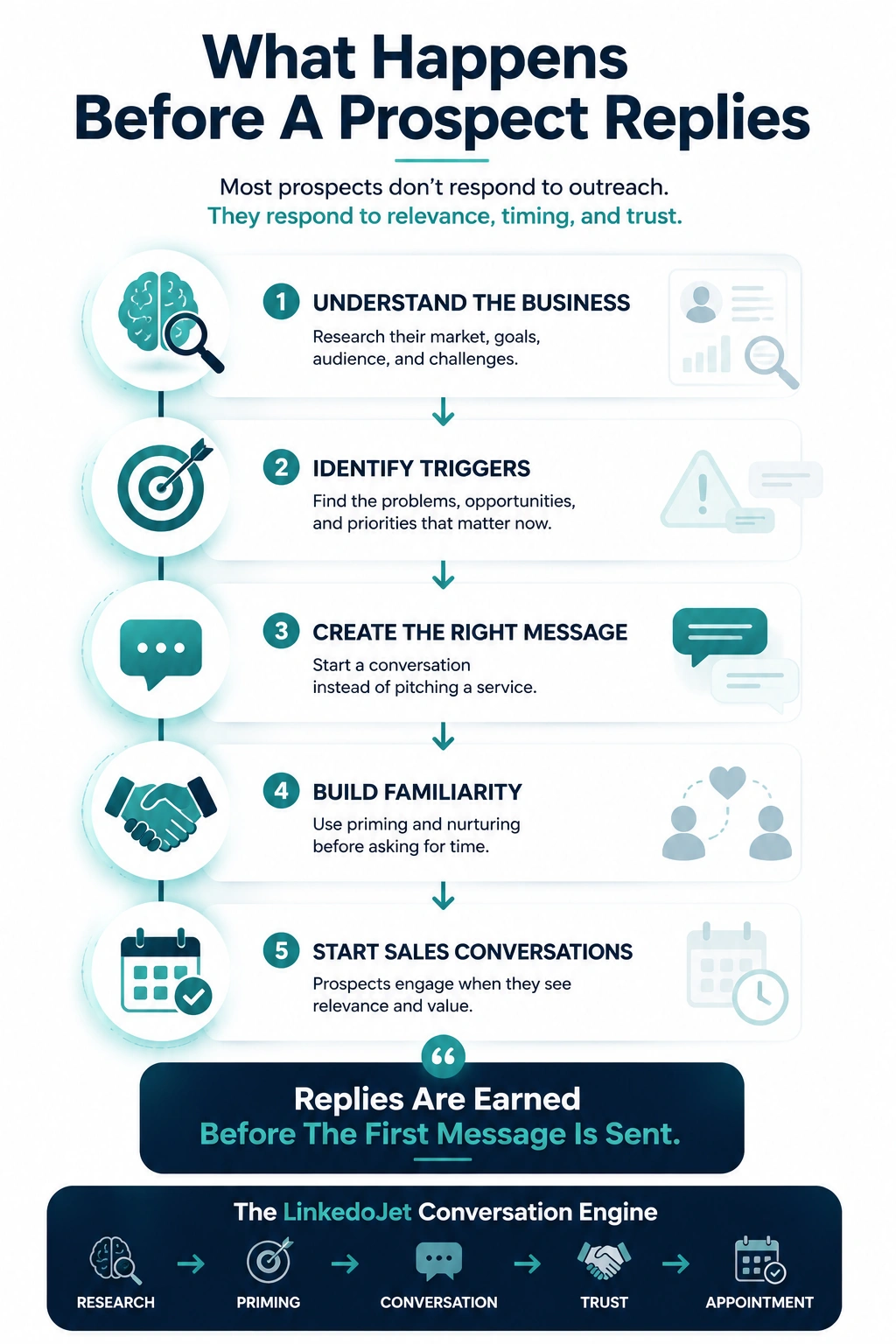
From identifying the right decision-makers to starting meaningful conversations and turning them into qualified appointments... LinkedoJet manages the entire outbound engine for your business.