
Why your LinkedIn outbound gets ignored in corporate training (and the cost of staying referral-dependent)
Your next deal won’t come from telling L&D you “run leadership workshops.” It comes from sounding like someone who understands what makes a rollout fail after week two.
You can feel it when your pipeline goes thin: delivery leaders start asking what’s coming, you hesitate on hiring facilitators, and pricing gets “flexible” because you need something—anything—on the books.
Meanwhile, LinkedIn looks busy. You get connection accepts. You get the occasional “Thanks—send info.” And then nothing turns into an actual scoping call where you can diagnose stakeholder buy-in, cohort logistics, reinforcement, and measurement.
The hidden tax is time. Your team burns weeks in polite chat threads that never reach the real question: “What’s the risk if this program doesn’t land, and what do we do about it?”
Corporate training buyers aren’t filtering for “best curriculum.” They’re filtering for implementation confidence. Their inbox is full of vendors pitching content. If your message doesn’t signal you understand manager bandwidth, change fatigue, and how adoption is sustained, you get sorted into the “generic workshop provider” pile—fast.
Who you’re messaging (Head of L&D vs HR Director vs business sponsor) and how the conversation must change
Same company. Different anxieties. If your sequence doesn’t branch by persona, you’ll get vague replies—or the wrong stakeholder entirely.
A Head of L&D isn’t shopping for a workshop. They’re trying to protect outcomes and credibility. If the program gets “great feedback” but behavior doesn’t change, they’re the one defending budget next quarter.
An HR Director is typically thinking in consistency and risk: manager effectiveness, onboarding quality, employee experience, and whether training reduces the number of fires their team is putting out.
A business leader sponsoring training (sales, operations, CX, regional leadership) is thinking performance and disruption: “Will this move the number without pulling my team out of the field for weeks?”
| Persona you’re in | What they’re protecting | What earns a reply | What gets ignored |
|---|---|---|---|
| Head of L&D / Talent Development | Adoption, reinforcement, measurement, stakeholder alignment | Rollout realities + a diagnostic question (“where does it break?”) | Catalog language, attachments, “our leadership program” |
| HR Director / People Ops | Consistency, manager effectiveness, onboarding quality, risk reduction | Practical outcomes + low-friction next step (“which is closer?”) | Long paragraphs, vague “culture” claims |
| Business sponsor | Performance, time cost, adoption without disruption | Specific performance tension + minimal-disruption framing | “Transformational journey,” big meeting ask on touch one |
So the goal of your first 3–4 touches isn’t to “sell training.” It’s to get them to reveal context. Context is what earns a scoping call.
The core LinkedIn message sequence (7 touches) with corporate-training examples and branching replies
Short, skimmable, and built to create a real exchange—not a brochure request.
Touch 1 — Connection request (context, not flattery)
Example: “Hi <
Touch 2 — After acceptance (one diagnostic question)
Example: “Thanks for connecting. Quick question—this quarter are you more focused on manager capability (new managers/coaching) or performance programs (sales/frontline consistency)?”
If they pick one: ask one narrowing question. “Got it. Is this more about strengthening day-to-day coaching habits, or handling a wave of new managers?”
Touch 3 — Non-responder follow-up (familiar pain, no drama)
Example: “The pattern I keep hearing: programs get approved, but reinforcement dies after week 2 because managers are buried. Is that something you’ve wrestled with, or are you in a different situation?”
Touch 4 — Query-based emotional trigger (where rollouts break)
Example: “When a program ‘doesn’t land,’ what’s usually the blocker for you—manager follow-through, attendance, or leaders not modeling the behaviors?”
Branching logic:
- Manager follow-through: “Makes sense. Do you have any manager enablement baked into the rollout (prompts, practice loops, coaching guides), or is it assumed?”
- Attendance/time: “Is the pushback coming from operations leaders protecting time, or from employees juggling shift coverage / travel / quotas?”
- Leadership modeling: “Do you have an executive sponsor who will reinforce the behaviors, or is it more ‘L&D-owned’?”
Touch 5 — Insight-based nurture (one compact framework)
Example: “One small shift that improves adoption: we design the reinforcement plan before the cohort starts—manager prompts, 10-minute practice loops, and a simple measurement cadence (what changes by week 2, 4, 8). Happy to share the one-page rollout map if useful.”
Touch 6 — Soft meeting request (15–20 minutes, scoped)
Example: “If you’re open to it, I can ask 4–5 quick questions and tell you what we’d do differently for a rollout like yours (so it sticks after the workshops). Would a 15-minute chat next week be silly, or potentially useful? Tue 11:30 or Thu 2:00?”
Touch 7 — Close the loop (easy out, preserve goodwill)
Example: “No worries if now isn’t the right time. Should I circle back next quarter, or would you prefer I stop reaching out?”
Priming and credibility without fake personalization: the only signals HR/L&D actually respond to
They don’t want you to compliment a post. They want you to show you understand what they’re dealing with this month.
The strongest “personalization” in corporate training is rarely personal. It’s situational.
- Hiring waves: new managers promoted too fast; onboarding volume spikes.
- Reorgs / new regional leaders: inconsistent leadership habits show up overnight.
- Sales ramp / new product launch: enablement exists, but adoption is patchy in the field.
- Engagement survey timing: pressure to “do something,” but fatigue with performative initiatives.
- Customer experience initiatives: frontline consistency matters more than inspiration.
Use those signals to lead with an observation and a question—never a claim.
Example for Head of L&D: “Seeing a lot of teams roll out manager training after a promotion wave, then struggle with reinforcement because managers aren’t enabled to coach. Are you in that zone right now, or more focused on measurement and proving impact?”
Example for HR Director: “When onboarding scales quickly, consistency becomes the issue—not effort. Are you solving more for manager effectiveness, or for reducing variance across teams/regions?”
Example for business sponsor: “When performance is the goal, the friction is usually time. Are you trying to raise execution without pulling people out of the day job?”
What HR/L&D typically ignores (uncomfortably accurate) and the fixes that raise reply quality
If your messages read like a training catalogue, they’ll treat you like one.
What gets ignored
- “We deliver leadership programs / DEI workshops / sales training” as the opener.
- Long paragraphs that force them to work to find the point.
- Attachments or decks in the first touch (“here’s our brochure”).
- Asking for 30 minutes before they’ve even told you what they’re solving.
- “Transformation” language that feels like you’re selling vibes, not rollout reality.
- Fake familiarity (“Loved your recent post”) with no link to a real people problem.
Fixes that actually change the conversation
- Swap program-first for rollout-first: talk reinforcement, stakeholder alignment, measurement cadence.
- Ask binary questions: “more manager capability or performance programs?” beats “tell me about your needs.”
- Earn the right to send anything: “Want the one-page rollout map?” instead of pushing a deck.
- Keep one idea per message: they read LinkedIn between meetings, not in deep work blocks.
- Branch by persona: L&D = adoption/measurement, HR = consistency/risk, sponsor = impact/disruption.
If you do this well, you’ll notice something subtle: replies stop being polite and start being specific. That’s when pipeline becomes buildable.
Conversation-to-appointment signals: when to advance, when to pause, and how to handle common objections
You don’t “close” an L&D leader on LinkedIn. You earn a scoping call by recognizing when the thread has enough truth in it.
Meeting-ready signals (advance to a 15–20 minute scoping call)
- They mention rollout scale (cohort size, regions, frontline vs corporate).
- They name an audience (new managers, senior leaders, sales, supervisors).
- They reference constraints (time, manager bandwidth, global delivery, shift coverage).
- They bring up deadlines (Q3 push, post-engagement survey, new leader start date).
- They hint at past failure (“we tried training and it didn’t stick”).
- They ask for examples/frameworks (“how do you measure it?” “what does reinforcement look like?”).
Signals to pause (or change the goal)
- Repeated “send info” with zero specifics after you ask two narrowing questions.
- They route you to procurement with no sponsor and no business problem stated.
- “We only use our internal academy and won’t consider external,” stated clearly.
Common replies and what to say next
“Send info.”
“Happy to. Quick so I send the right thing—are you looking at this for new managers or experienced leaders? And is the bigger issue adoption or measurement?”
“We already have preferred vendors.”
“Makes sense. When preferred vendors are in place, the gap is usually rollout consistency or reinforcement. Are you fully covered there, or is that where things get messy?”
“No budget right now.”
“Understood. Is the constraint budget, or is it that there’s no sponsor pushing for change this quarter? If you tell me which, I’ll stop bothering you with the wrong follow-ups.”
“We tried training and it didn’t stick.”
“That’s the most honest reason to be cautious. When it failed, was it because managers didn’t reinforce, stakeholders weren’t aligned, or the measurement was fuzzy? If you’re open, I’ll share how we prevent that specific failure mode.”
How LinkedoJet runs this as a system: targeting, timing windows, AI personalization, nurturing, tracking, and appointment support
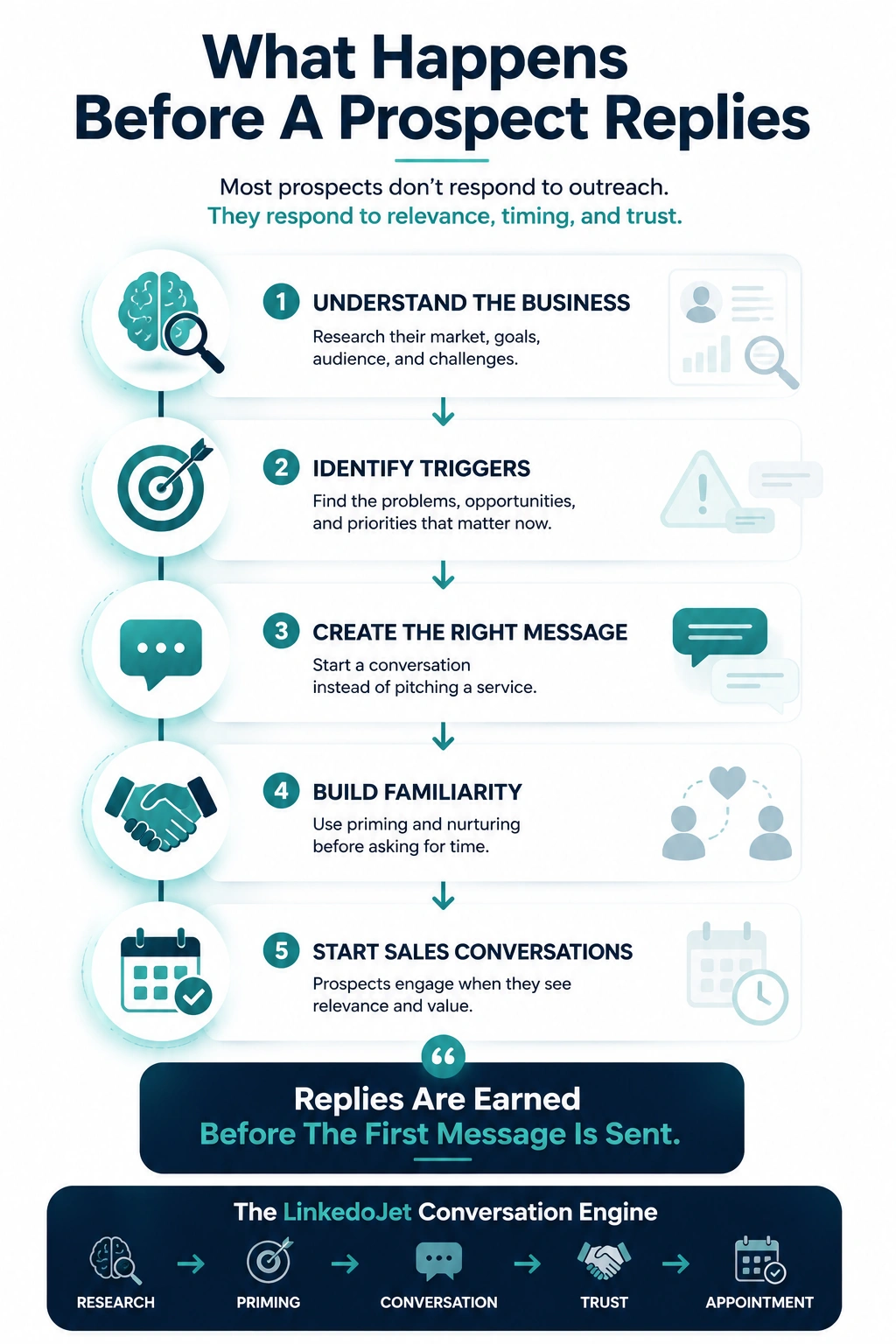
This only works when the message, targeting, timing, and follow-up discipline are managed like an outbound engine—not a “send some DMs” task.
LinkedoJet is not a LinkedIn automation tool with prettier templates. It’s the operating system behind consistent, persona-based appointment generation for corporate training teams.
What we set up (so you’re not guessing)
- ICP and targeting: we define who you win with (industry slices, org size, geo, maturity) and who actually buys (Head of L&D, HRD/People Ops, talent leaders, plus business sponsors where relevant).
- Sales Navigator / LinkedIn list building: we build and maintain prospect lists by persona, including filters that matter in this niche (regions, seniority, functions, growth signals).
- Sequence + branching: one core sequence, then persona branches and reply-handling rules so your team doesn’t get dragged into “nice to meet you” loops.
How execution works week to week
- AI-assisted personalization: used to adapt the opener and diagnostic question to the persona and trigger (reorg, onboarding growth, frontline consistency, sales execution) without pretending you’ve read their life story.
- Outreach execution: connection requests, follow-ups, and timing windows built around how HR/L&D actually reads LinkedIn (short windows, skimmable messages).
- Lead nurturing and follow-up workflows: we keep warm threads alive with small, credible nudges (frameworks, rollout maps, targeted questions) until timing is right.
- Warm lead tracking: replies are tagged by persona, buying stage, and “meeting-ready signals” so you know who to prioritize and why.
- Appointment generation support: when a thread hits the right signals, we help convert it into a 15–20 minute scoping call with the right framing (implementation risk, reinforcement, measurement), not a product pitch.
- Campaign visibility: dashboards show what’s happening—volume is not the point; conversation quality and booked scoping calls are.
- Ongoing refinement: we adjust targeting, hooks, and branches based on what HR/L&D is actually responding to that month.
This is how you stop relying on referrals without lowering your positioning. You show up like a serious training partner who understands what makes programs stick.
FAQ
What’s a good LinkedIn messaging sequence for selling corporate training to HR and L&D?
A simple 7-touch sequence works well: contextual connection request, one diagnostic question after acceptance, two problem-based follow-ups, one insight-based nurture (a one-page rollout idea), a soft 15–20 minute scoping ask, and a polite close-loop. The win isn’t “more touches.” It’s getting them to reveal rollout context (audience, constraints, timeline, what’s failed before) so a scoping call makes sense.
How do I message Heads of L&D vs HR Directors vs business leaders without sounding like a vendor pitch?
Anchor to what they’re protecting. Heads of L&D respond to adoption, reinforcement, measurement, and stakeholder alignment. HR leaders respond to consistency, manager effectiveness, onboarding, and risk reduction. Business sponsors respond to performance outcomes with minimal disruption. Keep your first questions binary (“which is closer?”) and avoid leading with your program names.
What should I say when an HR/L&D leader replies “send info”?
Don’t send a deck immediately. Ask two narrowing questions so you can send something relevant: “Happy to—quick so I send the right thing: is this for new managers or experienced leaders? And is the bigger issue adoption (reinforcement) or measurement (proving impact)?” If they answer, you have enough specificity to offer a short scoping call without forcing it.
How many follow-ups is reasonable for corporate training outreach on LinkedIn?
Five to seven touches across 2–3 weeks is reasonable when each message is short, skimmable, and adds a new angle (diagnostic question, rollout failure mode, compact insight). L&D timing shifts constantly; the close-loop message matters because it preserves goodwill and lets you re-enter next quarter without feeling spammy.
What are strong meeting-ready signals in L&D conversations (and what signals mean “stop”)?
Advance when they mention scale, audience, constraints, deadlines, past failure, or ask for frameworks/examples. Pause when they keep saying “send info” with no specifics after two questions, push you to procurement with no sponsor, or clearly state they won’t consider external partners. Your goal is a real scoping call—not a thread that drifts for weeks.
If you want this running by next week, book a working session
Not a vague “discovery call.” We’ll pressure-test your targeting and build the sequence and branching so your team starts the right HR/L&D conversations—and converts them into scoping calls.
In this session, we’ll look at your current outbound (or lack of it) and build a persona-based LinkedIn sequence for corporate training buyers: Heads of L&D, HR/People Ops, and business sponsors. You’ll leave with messaging that sounds like a training partner who understands rollout risk—manager bandwidth, reinforcement, stakeholder alignment, and measurement—rather than another vendor pushing workshops.
Operationally, LinkedoJet provides the full engine:
- ICP and targeting setup tailored to your training offers (leadership, sales, DEI, frontline, blended pathways) and the buyers who actually sponsor work.
- Sales Navigator / LinkedIn prospect list building by persona, including ongoing list maintenance so you’re not prospecting from stale searches.
- AI-assisted personalization that adapts openers to real triggers (promotion waves, reorgs, onboarding growth, CX initiatives) without fake flattery.
- Outreach execution with timing windows and follow-up discipline, so the sequence runs consistently while your team stays focused on calls and proposals.
- Lead reply handling and nurturing using branching logic: what to do with “send info,” preferred vendor objections, budget deferrals, and “training didn’t stick” skepticism.
- Warm lead tracking so you can see who is meeting-ready (scale, constraints, timelines) vs who is just being polite.
- Appointment generation support to convert the right threads into 15–20 minute scoping calls with clean framing and next steps.
- Campaign visibility through dashboards so you can manage conversation quality, not vanity metrics.
- Ongoing campaign refinement as you learn which personas, hooks, and offers produce the best scoping calls.
After onboarding, you’re not “left with a tool.” You get a managed outbound motion: fresh prospect lists, sequences that branch by persona, AI-assisted message drafting, consistent sending, follow-ups, and clear tracking of warm leads and booked appointments.
That’s the difference between automation and an outbound engine. From identifying the right decision-makers to starting meaningful conversations and turning them into qualified appointments... LinkedoJet manages the entire outbound engine for your business.
Next step: get your corporate-training outbound running like a system
If you’re tired of polite connects and “send info,” the fix isn’t more templates. It’s persona-based targeting, branching sequences, and disciplined follow-up—managed end-to-end.