
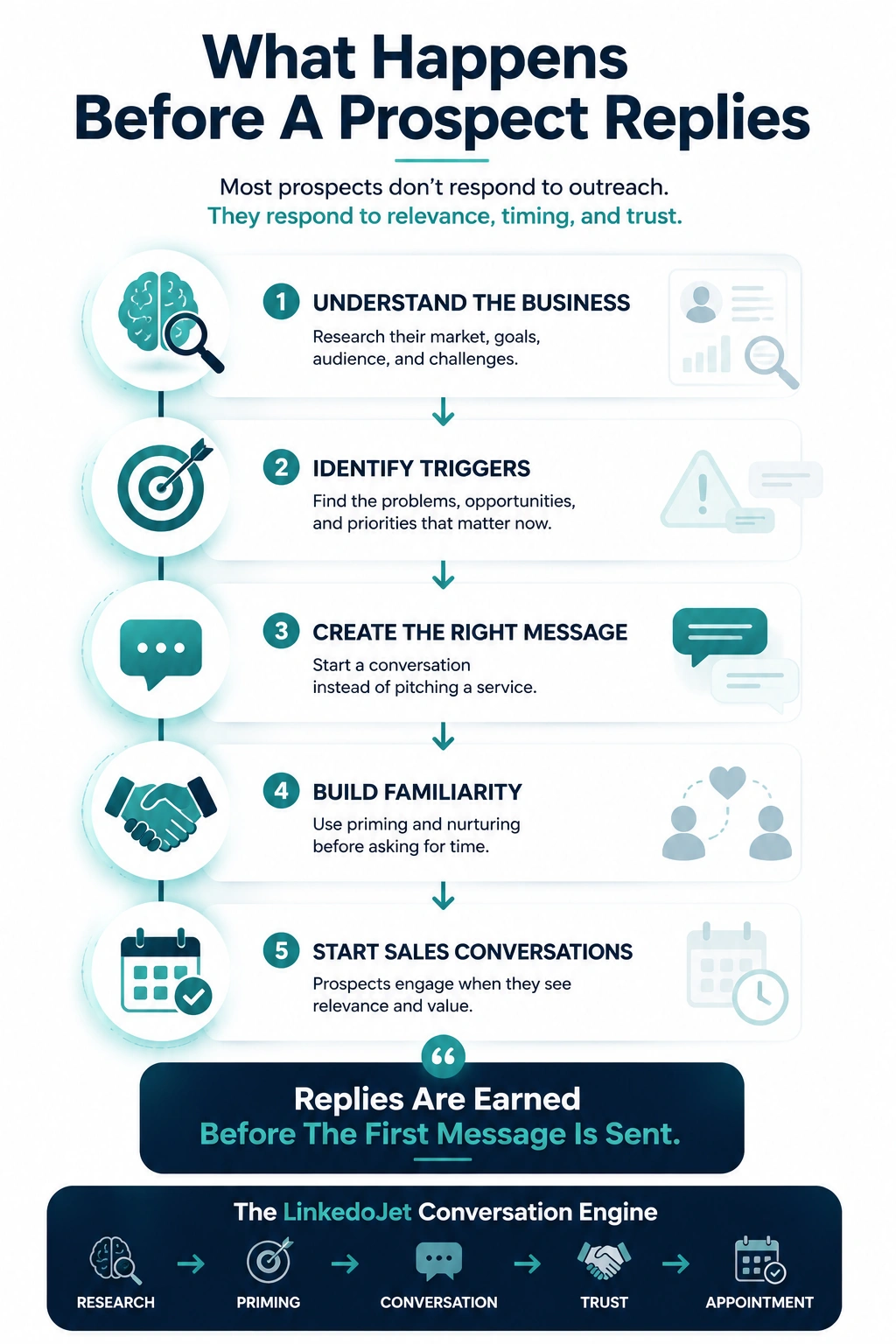
The outcome: replies early enough to shape the shortlist (without sounding like a holiday promo)
If your LinkedIn outreach reads like a catalog teaser, you’re already late. The win is simple: get the right internal owner to reply while they can still change the plan.
You’re not losing deals because your gifts aren’t good.
You’re losing because HR, an EA, Marketing, or CS made a safe decision weeks ago. Then you show up in October like every other “Q4 gifting partner” and get the polite brush-off: we already have someone.
That line doesn’t mean they love their vendor. It often means the timeline is locked, procurement is involved, and nobody wants to be the person who swapped suppliers and caused late deliveries, wrong branding, or a thousand address issues.
The shift that changes appointment volume isn’t “more automation.” It’s conversation design that reduces perceived operational risk. Your messages should make it easy for a busy stakeholder to reply with one sentence—without feeling like they just opened a sales cycle.
This playbook gives you a sequence that earns early replies, surfaces real intent signals, and only asks for 15 minutes when it’s earned.
Niche reality check: the chaos your prospects are protecting themselves from
Corporate gifting looks fun from the outside. For the buyer, it’s a risk board.
- Headcount changes after you’ve already kitted inventory.
- Address collection that turns into a spreadsheet nightmare (and a privacy conversation).
- “Premium” expectations with a mid-market budget and exec opinions.
- Brand approval delays that compress the production window.
- International shipping surprises and customs roulette.
- Replacement handling when packages go missing or arrive damaged.
- Reporting requests from Finance or People Ops two days before the board update.
And the silent killer: they already have a vendor, but they’re not happy. They’re just terrified of switching when the deadline is real.
So when your outreach leads with options (catalogs, pricing ranges, “premium boxes”), their brain hears: more decisions, more work, more ways to get blamed.
LinkedIn works in this niche when you respect the constraint: they don’t want “cool gifts.” They want fewer fires.
Your job is to name the messy parts calmly, then ask a question they can answer quickly—because a reply is the only thing that gets you into the real conversation early enough to matter.
The shortlist is cross-functional. Your messaging has to be, too.
Most gifting outbound targets HR only. That’s why it stalls.
At 200–5,000 employee companies, gifting decisions often get shaped by whoever will carry the operational load—and whoever gets blamed if it goes wrong.
| Persona | What they’re protecting | What gets a reply |
|---|---|---|
| HR / People Ops | Program consistency, inclusivity, ship-to-home reliability, minimal admin, reporting | Risk-reducing language: replacements, address flow, dietary restrictions, global handling, timelines |
| Executive Assistant / Office Manager | Speed, fewer decisions, white-glove handling, making their exec look good | A “supportive operator” tone: you make it easy, you catch details, you don’t add steps |
| Marketing | Brand control, unboxing, approvals, event deadlines, inventory | Deadline empathy + brand risk control: proofing, kitting accuracy, delivery windows, contingency plans |
| Customer Success / Account Management | Account moments, expansion, avoiding awkward gifts, policy boundaries | Motion-based talk tracks: renewals, onboarding milestones, exec gestures that don’t feel like bribery |
One practical note: if you only message HR, you’ll get routed. If you message HR and the likely execution owner (EA/Office Manager) with different talk tracks, you get earlier truth.
Not more meetings—better meetings, with the person who can actually move things.
The 7-message LinkedIn sequence (operator-grade examples you can send Monday)
This is built to earn a reply first. The meeting ask comes later, and only after a signal.
Connection request (no pitch; just context)
“Hi <
>—quick connect. I work with teams on ship-to-home gifting (new hire kits / appreciation / client thank-yous). Not selling in the invite—just figured we overlap with < >.” Why it works: it’s specific, it’s not a seasonal blast, and it doesn’t force them to respond.
Message 1 (after acceptance): give a menu so replying is easy
“Thanks for connecting. Quick question—at <
>, is gifting mostly (a) employee programs like onboarding/appreciation, (b) customer moments like renewals/onboarding, or (c) event kits? Just trying to understand which lane you’re in.” Operator note: menus beat open-ended questions. Busy people can answer with one letter.
Message 2 (soft follow-up): name one failure mode without fear-mongering
“The part that usually creates the fire drill isn’t picking the items—it’s address collection + last-minute changes + replacements. Is that a headache on your side too, or do you have it pretty dialed in?”
Keep it calm. You’re giving them permission to say “it’s a mess” without losing face.
Message 3 (query-based emotional trigger): let them vent safely
“When gifting lands on your plate, what tends to cause the most last-minute scrambling: addresses, approvals, or shipping windows?”
This question gets answered because it’s about their reality, not your product.
Message 4 (nurture with a micro-insight): be useful, not impressive
“Small timeline rule we’ve learned: once branding isn’t locked, the whole program becomes ‘maybe’—and shipping windows get tight fast (especially international). If you’re ever doing kits for an event, we try to lock art + SKU list before address collection even starts.”
Give one lesson. Don’t turn it into a lecture.
Message 5 (soft meeting ask): a 15-minute sanity-check, with an out
“If you’re open to it, happy to do a 15-min sanity-check on your next gifting moment—just comparing timelines + ship-to-home + replacements (no catalog pitch). If it’s not on your roadmap right now, totally fine—just tell me what season to circle back.”
Notice: you’re not asking for “a quick call” in a vacuum. You’re offering a narrow outcome.
Message 6 (close the loop politely): protect goodwill
“Going to close the loop so I’m not that person in your inbox. If helpful, I can send a one-page ‘what usually breaks’ checklist (addresses / approvals / international / replacements). Want it? If not, I can circle back in late summer before Q4 planning.”
In this niche, timing is everything. A professional close keeps the door open for the right window.
When to send (so you’re early, not “another Q4 vendor”)
Most teams message hardest when demand spikes. That’s also when buyers go numb.
You want planning windows—when they can still change suppliers without risking public failure.
| Gifting moment | When planning really happens | What to reference in your opener |
|---|---|---|
| Q4 holiday / end-of-year appreciation | Late summer → early fall (earlier for global) | “When do you usually lock branding + ship-to-home flow?” |
| SKO / sales kickoff kits | 6–10+ weeks before the event | “Are kits shipping to hotel, office, or home?” |
| Conferences / event kits | 6–10 weeks before (more if custom builds) | “Who owns approvals + deadline risk—Marketing or Ops?” |
| New hire kits / onboarding waves | Early Q1 and whenever hiring ramps again | “Are you doing on-demand shipping or batch drops?” |
| Customer moments (renewals / milestones) | End-of-quarter and pre-renewal windows | “Do you segment gifts by account tier, or keep it consistent?” |
And yes—when they’re actually on LinkedIn:
- Early morning before the first internal scramble starts.
- Midday between meetings (especially People Ops and Marketing).
- Late afternoon when EAs and Office Managers are clearing tasks.
If you’re sending at 8:30pm with a “quick chat?” you’re competing with nothing—because they’re not looking.
What they ignore (and why it triggers “we already have someone”)
Corporate gifting buyers have seen every version of the same message. They can smell a seasonal blast in the first line.
- Catalog-first messages: “Thought you’d like our options…” translates to “please do homework for me.”
- Pricing ranges on first touch: signals you’re trying to qualify them, not help them run a program.
- “Premium gifts” language: sounds like swag. HR and CS, especially, don’t want anything that feels gimmicky.
- Generic personalization: “Loved your profile / congrats on the role” is noise when the real problem is address chaos and approvals.
- Meeting ask before any intent: “Quick call?” gets routed to procurement purgatory or ignored.
- Only targeting HR: if the EA/Office Manager is executing, HR may not even see the pain until it’s too late.
The irony: the more you try to sound exciting, the less safe you feel.
Safe wins. Calm competence wins. Messages that acknowledge constraints—without dramatics—win.
Frequently asked questions
How do I message HR/People Ops about employee appreciation gifts without sounding like swag?
Lead with program risk, not “cool items.” Try: “Quick question—when you run appreciation, what’s the hardest part to keep under control: ship-to-home addresses, inclusivity/dietary needs, or replacements when things go missing?” HR replies when you reduce admin work and embarrassment risk.
What’s a good LinkedIn outreach message to an Executive Assistant for client gifts or exec gestures?
Speak to speed and fewer decisions. Example: “Are you the person who ends up coordinating exec thank-you gifts? If yes—do you prefer a ‘few curated choices’ approach, or ‘tell us the context and we handle it end-to-end’ (including addresses + replacements)?” Make them feel supported, not managed.
How long should a LinkedIn messaging sequence be for corporate gifting before I close the loop?
Seven touches is plenty when each message has a job: context → quick menu → operational pain → safe vent question → one useful insight → narrow 15-min sanity-check ask → polite close. If there’s no signal by then, pause and re-time to the next planning window (don’t chase into annoyance).
When should corporate gifting vendors start outreach for Q4 holiday gifting, SKO, or conference/event kits?
Earlier than feels comfortable. Late summer/early fall for Q4 (earlier for global). Six to ten weeks before SKO or conferences (longer if custom kitting + approvals). The best time to message is when they’re choosing process, not when they’re begging vendors to hit a deadline.
What do I say when they reply “we already have a vendor” (without arguing)?
Agree and reduce pressure. Example: “Makes sense—most teams do. If you’re happy with them, I won’t try to change your mind. Quick question though: do they handle ship-to-home + replacements smoothly, or is that where it gets messy?” If they say it’s fine, offer a checklist and ask when to circle back. If they hint at pain, you’ve earned the 15-minute sanity-check.
If you want this running for you, not sitting in a doc, we’ll build and operate it.
LinkedoJet isn’t a “tool you log into.” It’s an outbound operating system: targeting, message sequencing, execution, nurturing, and appointment support built around how corporate gifting is actually bought.
What LinkedoJet operationally provides:
- ICP + targeting setup for corporate gifting (HR/People Ops, EAs/Office Managers, Marketing, CS/AM, Sales leaders) with the right filters and exclusions so you’re not spamming the wrong orgs.
- Sales Navigator + LinkedIn prospect list building so you’re consistently in front of the people who shape shortlists—before the window closes.
- AI-assisted personalization that’s actually useful: situational priming (new hire kits vs SKO vs conferences vs Q4 vs renewal moments), not “love what you do.” Every message is designed to earn a simple reply.
- LinkedIn outreach execution with a paced, role-specific sequence (connection + follow-ups) that avoids the promo-blast vibe.
- Lead reply handling and nurturing so warm conversations don’t die in your inbox. We keep the thread alive with calm, operationally-aware prompts.
- Warm lead tracking and clear visibility into who’s showing intent signals (timelines, vendor dissatisfaction, ship-to-home complexity, procurement constraints).
- Appointment generation support to move from “this is interesting” to a clean 15-minute sanity-check with the right stakeholder—without forcing it.
- Campaign visibility through dashboards so you can see connects, replies, warm leads, and meetings—by persona and by gifting motion.
- Ongoing campaign refinement as seasons shift (Q4 planning, conference season, onboarding waves, end-of-quarter customer motions).
What happens after onboarding: we finalize targeting, build your prospect lists, write the persona talk tracks, and launch outreach that’s timed to real gifting planning windows. As replies come in, we triage signals, nurture the “not now” leads, and tee up meeting-ready conversations so your team steps into calls with context, not guesswork.
What you receive: active campaigns, tested sequences by persona, continuously refreshed lists, reply insights, warm-lead views, and a reliable flow of conversations that turn into qualified appointments—without you becoming the follow-up engine.
Why this is different from ordinary LinkedIn automation tools: tools send messages. LinkedoJet runs the system—targeting, copy, execution, reply handling, nurturing, tracking, and the handoff that gets meetings booked in the real world of address chaos, approvals, and shipping windows.
Next step: turn corporate gifting seasonality into predictable conversations
You don’t need louder outbound. You need earlier replies from the people protecting the program—and a system that knows when to ask for 15 minutes.
From identifying the right decision-makers to starting meaningful conversations and turning them into qualified appointments... LinkedoJet manages the entire outbound engine for your business.