
The real reason CRE LinkedIn outreach dies: no market reason, no decision window
If your messages don’t sound like a broker with a real reason to reach out, they don’t get ignored—they get remembered for the wrong reason.
Most CRE teams don’t have a “LinkedIn problem.” They have a timing problem.
You can have a clean target list—owners in a corridor, tenant decision-makers in a submarket, active investors in a product type—and still end the month with the same story: a few polite accepts, a handful of vague replies, and zero new meetings that actually matter.
Then a partner asks, “What’s new business look like?” and you’re left pointing at activity instead of conversations.
The brutal part: in CRE, bad outreach doesn’t just fail quietly. It leaves a residue. Principals talk. Asset managers forward screenshots. Leasing teams remember the firm that sounded like a blast.
What changed isn’t attention span. It’s context. Rate moves, lender posture, cap rate resets, sublease waves, concessions creeping, occupancy pressure—decision windows open and close faster than your standard cadence. And the people you want (owners, heads of real estate, investors, developers) glance at LinkedIn in short bursts: early morning, between tours, late afternoon at the desk. Anything that reads like a canned “sequence” gets swiped away instantly.
The hidden failure mode: teams treat messaging like a template problem instead of a reason-to-reach-out problem. No asset type. No submarket. No friction point. No credible “why now.”
If you want meetings, you don’t start with a meeting ask. You start with a market sentence that’s obviously true, then a question that earns a two-line reply.
Who this is for (and why the message has to change by persona)
The same words land differently depending on who’s reading them—and what they’re responsible for that quarter.
CRE outbound falls apart when a team uses one voice for everyone. Owners don’t read like occupiers. Developers don’t respond like investors. Property managers aren’t a “back door” without cost.
| Persona | What they’re protecting | What gets ignored | What gets read |
|---|---|---|---|
| Owner / asset manager / principal | NOI, vacancy, debt maturity, reputation with partners | “We have buyers/tenants for you” with no specifics; immediate call request | Asset type + submarket + a real friction (concessions, sublease pressure, refi) + a simple timing question |
| Occupier / corporate real estate / CFO/COO | Cost certainty, flexibility, internal stakeholders, not getting trapped | Vendor-y value props; “thought leadership” blurbs | Renewal window / utilization / sublease exposure + “are you seeing this too?” |
| Investor / acquisitions | Basis, exit, financing constraints, IC narrative | Pretending you know their buy box; generic “deal flow” pitch | Product type + submarket + underwriting friction (debt terms, cap reset) + “are you waiting or still active?” |
| Developer | Timing, entitlement risk, pre-leasing, capital partners | “Let’s connect” with no angle | One sentence on leasing velocity / construction pricing / lender stance + “how are you thinking about starts?” |
| Property manager | Occupancy, renewals, owner relationship | Using them to fish for the owner; repeated nudges | A respectful question about renewal pressure or vacancy trend + permission-based ask to route to the right person |
Two quick contrasts your team can internalize:
- Gets ignored: “Saw your profile and would love to learn more about your business. Do you have 15 minutes this week?”
- Gets read: “Quick one—seeing more sublease space hit [Submarket] office over the last 60 days. Are you dealing with any renewal pressure in the next 6–12 months?”
The second one doesn’t beg for time. It earns a reply because it sounds like someone who’s actually watching the market.
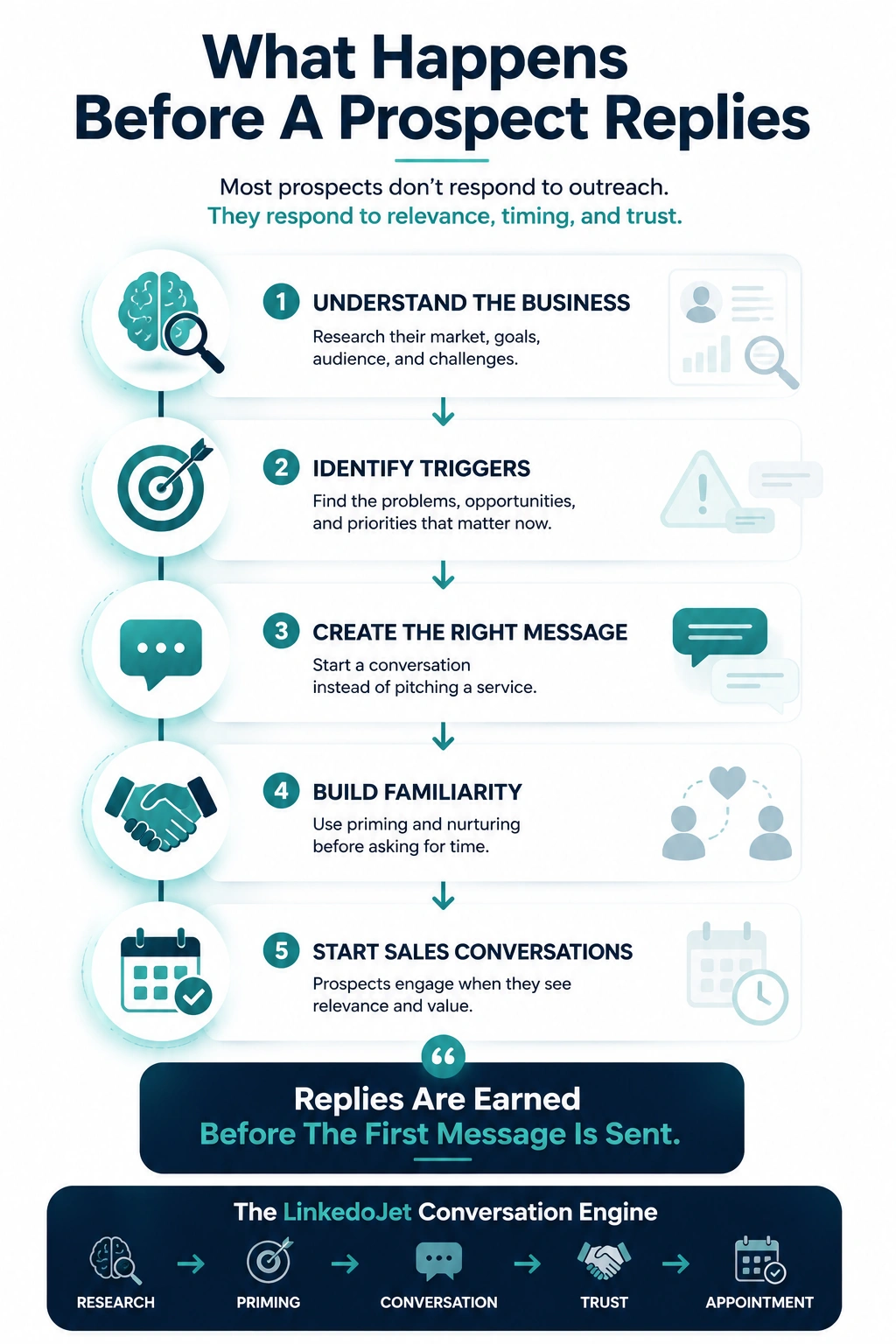
The LinkedoJet system: targeting → reason-to-reach-out → conversation engineering → nurturing → appointment conversion
This is appointment generation through relevance and timing—not volume.
LinkedoJet exists for teams who already know their market, but don’t have a clean outbound engine that turns that knowledge into consistent conversations.
Here’s the operational reality: brokers are in tours, underwriting, OMs, chasing signatures, putting out fires. The outreach engine has to run even when the day gets swallowed.
How we run it:
- ICP and targeting setup: We define the exact personas (owner/operator, asset manager, head of real estate, acquisitions, development, PM) and the filters that matter in your world—asset type, submarket, portfolio size, tenant industry, job function, seniority.
- Sales Navigator / LinkedIn prospect list building: We build, QA, and maintain the lists so you’re not guessing or scraping. Lists are segmented by persona and “reason-to-reach-out” angle.
- Reason-to-reach-out library: We turn your market reality into repeatable hooks: concessions moving in a pocket, sublease inventory climbing, debt maturities, cap rate reset behavior, leasing velocity, lender posture, construction pricing, entitlement delays.
- AI-assisted personalization (done like a human would): We use AI to tailor the opening line to the asset type/submarket/context without the cringe “loved your post” fluff. Then we human-check the voice so it sounds like your shop.
- Outreach execution: Connection requests and follow-ups go out on a disciplined cadence that respects CRE reputation.
- Reply handling + lead nurturing: When people respond, we route and categorize intent (curious, busy, wrong person, timing window, hard no). Follow-ups get smarter—new context, not repeated nudges.
- Warm lead tracking + appointment generation support: We track warm signals (renewal month, vacancy, IC timing, lender conversation) and help convert those into short compare-notes meetings.
- Campaign visibility + refinement: You see what’s working through dashboards: acceptance rate, reply rate, meeting-ready signals, and which angles are producing real conversations.
This is why LinkedoJet isn’t “a LinkedIn automation tool.” Tools send messages. We manage the system that decides who, why, when, and what happens after they reply.
A 7-touch CRE messaging sequence that books meetings without sounding like a blast
Short, broker-native notes. Easy questions. New context on follow-ups. Meeting asks only when timing shows up.
Below are examples you can hand to a leasing or investment sales team. The discipline is the point: one clear market hook, one simple question, and follow-ups that add context (not pressure).
Touch 1 — Connection request (neutral, non-needy)
- Owner / investor: “Hi [Name] — I track [Asset Type] activity in [Submarket] and wanted to connect to compare notes as pricing/financing has been moving around. — [Your Name]”
- Occupier / tenant decision-maker: “Hi [Name] — I’m in the weeds on leasing conditions in [Submarket] (TI/free rent/sublease). Thought it’d be useful to connect. — [Your Name]”
Touch 2 — After acceptance (earn a two-line reply; no meeting ask)
- Owner / asset manager: “Appreciate the connect. Quick question: are you dealing with any meaningful lease roll or vacancy in [Submarket] over the next 6–12 months, or is it mostly steady for you?”
- Investor / acquisitions: “Curious—are you still underwriting buys in [Submarket] at today’s debt terms, or mostly in ‘watch and wait’ mode until financing settles?”
- Occupier / CRE lead: “Quick one: is your team inside a renewal window in the next 12–18 months, or is the bigger issue right now sublease exposure / utilization uncertainty?”
Touch 3 — Soft problem follow-up (specific friction, gentle tone)
- Owner / investor: “I’m seeing concessions creep on a few [Asset Type] deals in [Submarket] and a little more sublease competition than last quarter. Is that showing up in your assets too, or not really?”
- Occupier: “Not sure if you’re seeing it, but we’ve had a couple tenants get surprised by how aggressive landlords are getting on term/credit even while TI/free rent stays loose in pockets. Is that consistent with what you’re hearing?”
Touch 4 — Query-based risk trigger (surface timing pressure without drama)
- Owner / principal: “When partners ask ‘what’s the plan if a suite goes dark,’ do you feel like you have enough comp/lease intel in [Submarket] right now—or is it still changing week to week?”
- Investor: “Are lender conversations affecting your hold/sell timing this year, or are you still getting comfortable basis with the cap reset?”
- Occupier: “Have you had any ‘surprise’ internal pressure lately—someone upstairs pushing for a decision timeline on space before you’ve got clean options?”
Touch 5 — Insight-based nurture (one paragraph, no attachment)
- Owner / investor: “Quick note from what we’ve seen in [Submarket]: for [Asset Type], the spread between asking and signed rents is widening, but deals are still clearing when ownership is decisive on TI and early renewals. The teams waiting for ‘perfect’ usually end up negotiating from a weaker spot. If you want, I can share the range we’re seeing on TI/free rent for comparable suites.”
- Occupier: “One small trend: sublease space is setting the tone in parts of [Submarket], which is giving tenants more leverage than last year—if they move early enough to create options. Late-stage renewals are still getting squeezed. If you’re in a window, happy to sanity-check where terms are landing.”
Touch 6 — Soft meeting request (only after engagement or clear signal)
- Owner / investor: “If it’s relevant on your side, open to a quick 10-minute compare-notes call? No pitch—just sanity-check comps/concessions in [Submarket] and see if any timing is coming up (lease roll, debt, disposition review). I’m free Tue 11–1 or Thu 3–5.”
- Occupier: “Happy to do a short 10–15 minute working session to benchmark renewal terms / TI / free rent in [Submarket]. If you’re not in a window, no worries—just tell me when it becomes real and I’ll step back.”
Touch 7 — Close-loop (protect reputation; leave a clean re-entry)
- “I’ll close the loop so I’m not popping up every week. If timing changes—renewal window opens, vacancy hits, lender terms shift, or you’re doing a hold/sell review in [Submarket]—happy to compare notes. If you’d rather I don’t follow up again, just say so and I’ll mark it.”
Meeting-ready signals vs pause signals (read replies like a broker, not an SDR)
Your job isn’t to “handle objections.” It’s to detect timing and protect the firm’s name.
Most teams either push too early (burns trust) or back off too fast (misses windows). The fix is simple: treat replies like market signals.
Signals they’re meeting-ready
- They reference a month or window: “renewal in March,” “debt rolls Q4,” “IC next month.”
- They mention a real condition: vacancy, a dark suite, tenant churn, sublease competition, a requirement, expansion planning.
- They ask for something specific: “What are you seeing on TI?” “Any comps in that corridor?” “Where are cap rates clearing?”
- They correct you (good sign): “We’re more focused on [different submarket/product].” That’s engagement.
- They hint at internal pressure: partner questions, board visibility, CFO scrutiny, timing sensitivity.
Signals to pause (and how to respond)
- “We already have a broker.” Respect it. “Makes sense. If you’re open to it, I’m happy to be a second set of eyes on comps/concessions in [Submarket] when something comes up. Any renewal/debt/disposition window on the horizon, or is it quiet?”
- “Not looking.” Don’t argue. “Totally fair—timing is everything. When does it become real again for you (renewal window, hold/sell review, refi)?”
- “Not the right person.” Thank them, ask for the correct contact once, then stop. CRE circles are small.
- “Remove me / stop.” Confirm and suppress immediately. Reputation beats persistence.
- Annoyance. Close-loop with a clean exit. No extra follow-ups.
This is where most “automation” products do damage: they don’t understand intent. LinkedoJet does. Replies get tagged, routed, and handled with the same discretion you’d expect from a senior broker protecting the brand.
How this fits a real CRE BD rhythm (and why it works when the day gets chaotic)
Your team shouldn’t need a two-hour block to create pipeline. It should work in the cracks of the day.
Real CRE days don’t leave room for “content calendars” and perfect outreach sessions. You get 10 minutes before calls. A gap between showings. That late-afternoon window when you’re back at the desk and the phone finally stops ringing.
A working outbound rhythm looks like this:
- Daily LinkedIn windows (10–20 minutes): handle new accepts, reply to active threads, and send the next touch only where it makes sense.
- Follow-up prompts tied to context: no “just bumping this.” Every follow-up includes a new market angle relevant to the persona and submarket.
- Warm lead handling: when someone signals timing (renewal month, vacancy, IC, lender talk), the system moves them into a meeting track instead of leaving them buried in inbox history.
- Compare-notes meetings as the conversion: short, practical calls that feel like normal CRE behavior—sanity-check comps, benchmark concessions, pressure-test underwriting assumptions.
LinkedoJet is built to run that rhythm for you. After onboarding, we set up targeting and prospect lists, deploy persona-specific sequences that sound broker-native, execute the outreach, and manage replies and nurturing so opportunities don’t die in follow-up limbo. You get visibility into what’s happening and what’s working—without asking your team to become full-time SDRs.
When this is done right, the outcome is calm: more two-line replies, more “here’s our timing” disclosures, and a steadier flow of qualified meetings that don’t feel forced.
FAQ
What’s a credible reason-to-reach-out for CRE on LinkedIn if I don’t have an active requirement?
Anchor to something that’s objectively moving in their world: sublease inventory in a submarket, concessions shifting for a product type, lender terms tightening/loosening, cap rates clearing differently, leasing velocity, or a common timing window (renewals, debt maturities, disposition reviews). Then ask a question that lets them answer without committing.
You’re not claiming a requirement. You’re starting a market conversation that reveals whether timing exists.
How many follow-ups is too many for owners or principals before it feels like spam?
In CRE, it’s less about the count and more about whether each touch brings new context. A clean 5–7 touch cadence works when:
- each message is short,
- each one introduces a fresh market angle (not a re-ask), and
- you close-loop professionally if they stay silent.
If your follow-ups are “bumping this,” two is too many.
What should change in the sequence for owners/investors vs occupiers/tenant decision-makers?
Owners/investors respond to NOI protection, vacancy, debt timing, and underwriting friction. Occupiers respond to renewal windows, flexibility, utilization uncertainty, and not getting boxed into a bad lease.
Practically: keep the structure the same (hook → question → context → nurture), but swap the question:
- Owner/investor: “Any lease roll, vacancy, debt maturity, or hold/sell review coming up?”
- Occupier: “Any renewal window, expansion/contraction planning, or sublease exposure?”
How do you ask for a meeting without sounding like a vendor or a generic appointment setter?
Call it what it is: a short compare-notes working session. Make it optional. Tie it to a concrete output (comps, concessions, underwriting assumptions, renewal benchmarks). And ask only after you have engagement or a timing signal.
“Open to 10 minutes to sanity-check comps and concessions in [Submarket]? If timing isn’t real, no worries.” lands far better than “Do you have 15 minutes this week?”
What do you say when they reply: “We already have a broker” or “Not looking”?
Don’t fight it. Respect it and reposition as a second set of eyes.
- Already have a broker: “Makes sense. If you ever want a quick benchmark on current terms in [Submarket], I’m happy to share what we’re seeing. Any renewal/debt/disposition timing on the horizon?”
- Not looking: “Totally fair—timing is everything. When does it become relevant again (renewal window, hold/sell review, refi)?”
The goal is to learn timing without creating friction.
See how LinkedoJet runs CRE outreach end-to-end (and what you get after onboarding)
This isn’t a vague “strategy chat.” We’ll show you the exact targeting, sequences, and follow-up logic we’d run to turn your owner/occupier/investor lists into real conversations—and booked compare-notes meetings.
If you book time, come with one asset class and one market you care about (example: industrial in [Submarket], office in a corridor, multifamily in a pocket). We’ll walk through how we’d build outreach that sounds like your shop—tight, market-driven, and reputation-safe.
What LinkedoJet operationally provides:
- ICP + targeting setup: we define who you should message (and who you should avoid) by persona, submarket, asset type, and seniority.
- Sales Navigator prospect list building: we build segmented lists (owners vs occupiers vs investors vs developers) and keep them clean over time.
- AI-assisted personalization: we tailor openers to the right market context (concessions, sublease pressure, cap/financing shifts, lease roll, debt maturity) so it reads like a broker’s note—not a template.
- Outreach execution on LinkedIn: we send the connection + follow-up cadence with disciplined pacing.
- Lead nurturing + follow-up workflows: we add new market context in follow-ups, route replies, and keep warm threads alive without pestering.
- Warm lead tracking: we capture meeting-ready signals (renewal month, vacancy, IC timing, lender conversation) so opportunities don’t disappear in inbox history.
- Appointment generation support: when timing shows up, we help convert the thread into a short compare-notes call that feels natural in CRE.
- Campaign visibility: dashboards show list health, acceptance/reply rates, warm lead volume, and which market hooks are creating real conversations.
- Ongoing refinement: we adjust targeting and messaging as the market shifts—because CRE context changes quarter to quarter.
What happens after onboarding: we stand up your targeting and lists, load persona-specific sequences by market/asset type, start outreach, and manage the day-to-day reply handling and nurturing. Your team stays focused on deals; the outbound engine stays consistent.
Why this is different from ordinary LinkedIn automation tools: automation blasts messages. LinkedoJet manages the full system—who you go after, the market reason you lead with, how the conversation is engineered, how replies are handled, and how meetings are earned without damaging credibility.
From identifying the right decision-makers to starting meaningful conversations and turning them into qualified appointments... LinkedoJet manages the entire outbound engine for your business.
Next step: turn your target list into booked CRE conversations
If your team has the market knowledge but the outreach isn’t converting, the fix isn’t more volume. It’s a broker-native messaging system with disciplined follow-up, reply handling, and meeting conversion.