
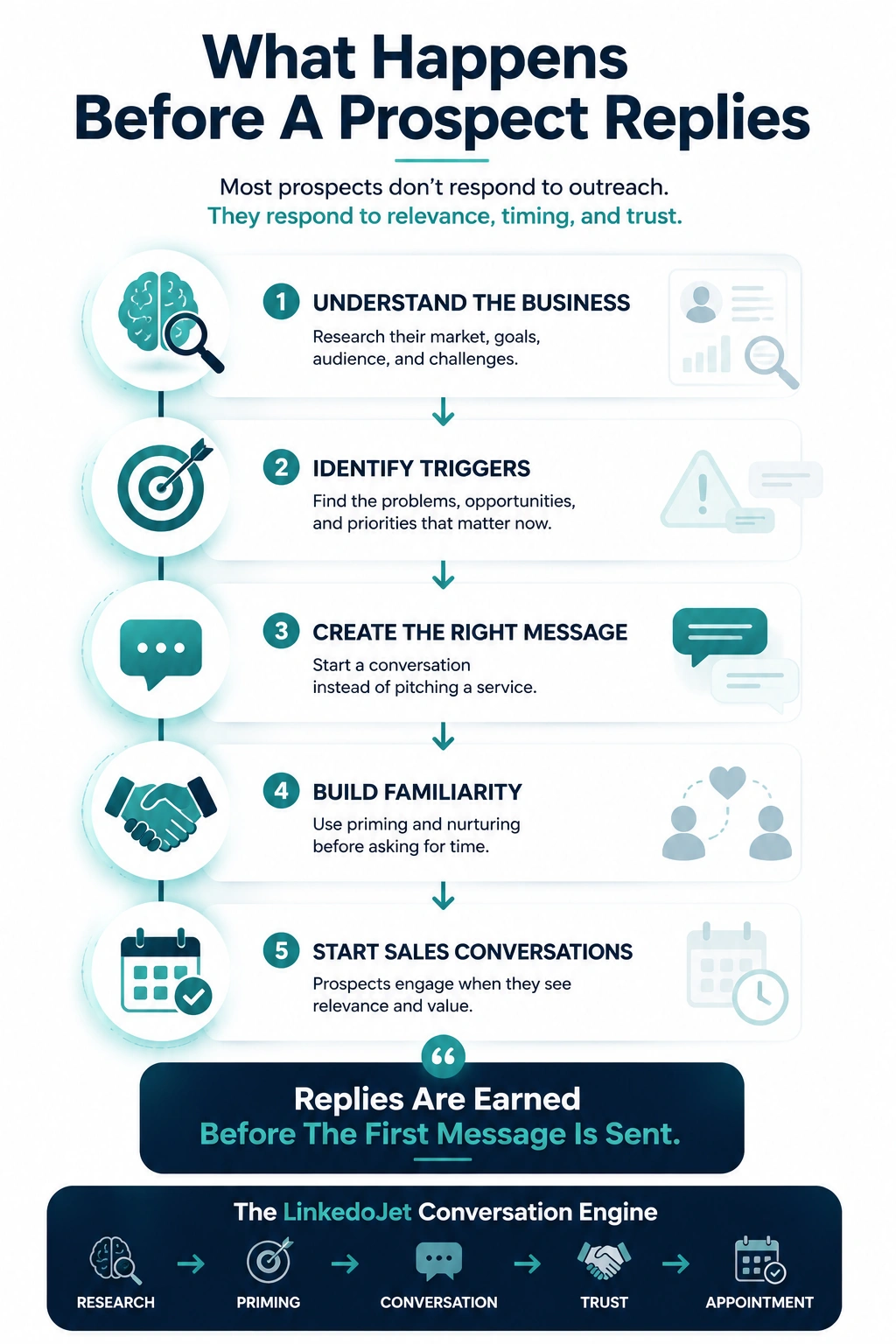
Your targeting might be fine. Your messaging layer is what’s broken (and it’s costing you target accounts)
If you’re hitting the right accounts and still getting silence, it’s rarely “LinkedIn doesn’t work.” It’s that your buyers can smell the sequence in two lines.
You know the feeling: the quarter gets tighter, leadership wants more meetings, and your team does “activity” because it’s the only knob left to turn.
Connection requests go out. First messages go out. Follow-ups go out. Your dashboards look busy.
And the people you actually need inside target accounts don’t answer.
That silence isn’t neutral. It’s brand debt with the exact accounts you’re trying to land—RevOps leaders who live in routing arguments, Sales Ops folks who can’t break reporting, Finance partners who are in spend-control mode, Security teams who are drowning in vendor reviews. Each ignored touch trains them to categorize you as “another vendor asking for time.”
The worst part is the internal drift it creates. SDRs start blaming lists. Founders start jumping into DMs at night. Teams default to calendar links earlier and earlier because “maybe we just need to ask.”
But meetings don’t come from asking harder. They come from earning a reply first.
Why SaaS buyers don’t reply: pattern-matching, fake personalization, and premature meeting asks
Enterprise and mid-market operators are seeing the same three moves, all day:
- Surface-level “personalization” (“saw you’re hiring,” “loved your post”) that doesn’t connect to a real initiative.
- A generic value prop that could be sent to any company with a CRM and a quota.
- An immediate meeting ask that forces them to do work before they have a reason to care.
They’re not ignoring you because they’re rude. They’re ignoring you because they’re busy, skeptical, and trained by hundreds of bad sequences to protect their attention.
Pattern recognition is brutal on LinkedIn right now. The moment your message reads like “Step 1 of 6,” you’ve lost. Especially if you mention category/product in message one or you paste a calendar link before you’ve earned any curiosity.
There’s also a timing mismatch most teams miss. Your buyer might actually have the problem you solve—but it isn’t their current fire. SaaS priorities rotate fast: a CRM migration breaks reporting, a new VP changes pipeline definitions, security review freezes new tools, finance asks for consolidation, CS flags renewal risk. If your note doesn’t attach to a living initiative, it gets filed under “later,” which often means never.
The LinkedoJet method: job-to-be-done angles, one-line context, and questions that earn the first reply
Conversation-first outbound is not “softer.” It’s more precise.
LinkedoJet’s messaging system is built around reply intent: we start with an angle that maps to the prospect’s job-to-be-done, add one line of context that proves we understand the world they operate in, then ask a question that’s easy to answer without a meeting.
Here’s the structure we use:
| Component | What it does | SaaS-native example |
|---|---|---|
| Narrow angle | Picks one operational wedge; avoids “we help companies grow” mush. | Routing + SLA breakdown, forecast hygiene, renewal risk, security review friction, tooling adoption. |
| One-line context | Signals credibility without performing “research theater.” | “A lot of RevOps teams are seeing pipeline volume stay flat while stage progression drops.” |
| Low-friction question | Makes replying easier than ignoring. | “Is this more a handoff issue or a stage criteria issue for you right now?” |
| Stop condition | Protects brand and prevents spammy chasing. | If they opt out, mention policy/compliance, or signal vendor fatigue → pause and switch to light nurturing tied to real moments. |
Notice what’s missing: product dumps, “thought you’d find this valuable,” and early calendar links. You can earn a meeting later. First you earn permission to keep talking.
When we build angles for SaaS teams, we usually start with 6–10 “operator truths” that buyers recognize instantly:
- Pipeline coverage looks fine… and the quarter still misses.
- Leads are being generated… but sit unworked or get worked by the wrong reps.
- Attribution debates are louder than growth.
- Tool adoption lags the purchase decision.
- Security review is the real sales cycle.
- Finance is forcing consolidation; every new vendor is suspect.
Your first message should sound like someone who has sat in those meetings.
Multi-threading inside one account: different entry points for RevOps, VP Sales, Finance, Security/IT (same positioning, different hooks)
Most outbound fails in enterprise because it’s single-threaded. One “champion” goes quiet and the deal never even starts.
Multi-threading doesn’t mean coordinated spam. It means you approach the same account with consistent positioning and persona-specific entry points, so you can earn small conversations across the committee—without looking like you copy/pasted the org chart.
Here are conversation hooks that work because they meet each persona where they already have stress:
| Persona | What they secretly worry about | Conversation-first entry point |
|---|---|---|
| RevOps / Sales Ops | Routing, SLA compliance, dirty data, reporting trust. | “When pipeline coverage looks fine but the quarter slips, do you usually find it’s stage hygiene or lead handoff?” |
| VP Sales / Sales Leader | Rep productivity, pipeline quality, deal slippage, coaching signal. | “Are you seeing more ‘meetings’ but fewer deals that actually progress past discovery?” |
| Finance | Vendor sprawl, renewal leverage, spend scrutiny, ROI proof. | “Are you in consolidation mode this half, or still adding tools when there’s a clear gap?” |
| Security / IT | Risk, data access, implementation load, procurement friction. | “When a new revenue tool comes up, is the blocker usually security review time or internal implementation bandwidth?” |
Same account. Same thesis. Different doors.
Done right, multi-threading increases your surface area without raising your spam footprint. You’re not chasing. You’re creating multiple chances for timing to be right with someone inside the account.
A full LinkedIn sequence that sounds like SaaS (mobile-length examples + stop conditions)
These are intentionally short. If it can’t be read in three seconds between meetings, it won’t get answered.
1) Connection request (credible context, no flattery)
“Quick connect — I work with SaaS RevOps/Sales teams around pipeline hygiene + routing. Curious how you’re thinking about stage progression going into quarter-end.”
2) First message after acceptance (angle + one-line context + easy question)
“Thanks for connecting. I’m seeing a lot of SaaS teams with steady pipeline volume but weaker stage progression lately. Is that showing up for you, or is it more of a lead handoff/routing issue?”
3) Soft problem follow-up (adds meaning; gives reply handles)
“Pressure-test question: when the forecast call gets tense, is it usually (a) stage criteria isn’t consistent, (b) deals slip late, or (c) reps are working too many bad-fit opps?”
4) Query-based emotional trigger (names the frustration they feel)
“When coverage looks fine but the number still misses, what’s the usual culprit on your side — process, data, or reps gaming stages?”
5) Insight-based nurture (small useful observation + optional artifact)
“Small observation from recent builds: a lot of teams think they have a top-of-funnel problem when it’s really response time + routing rules creating ‘ghost leads.’ If it’s useful, I can share a one-page checklist we use to spot where replies/opps die. Want it?”
6) Soft meeting request (narrow outcome; no “demo” energy)
“If you’re open to it, happy to compare notes for 15 mins. We’ll map where conversations/replies die in your current outbound (opener vs follow-up vs timing) and I’ll send back a messaging plan your team can run. What does next week look like?”
7) Close-loop (protects brand; sets a clean re-open condition)
“All good if now isn’t the moment. If it’s easier, tell me when this becomes relevant — post quarter-end, after a CRM change, or ahead of renewals — and I’ll circle back then.”
Timing, spacing, and SaaS reality: when different personas actually check LinkedIn
If your sequence is “five touches in five days,” you’re not persistent—you’re self-identifying as a sequence.
B2B SaaS buyers tend to check LinkedIn in short windows:
- Early morning before internal standups and dashboards (RevOps and operators live here).
- Gaps between calls (sales leaders and managers skim, don’t read).
- Late afternoon when follow-ups happen and the day loosens slightly.
Midday is usually meeting-heavy. Long messages get skimmed and mentally deferred.
Spacing is part of conversation design. A simple cadence that avoids looking automated:
- Connection request
- After acceptance: message within 24 hours
- Then 2–3 follow-ups spaced 3–5 business days apart (each adding meaning)
- A nurture note 10–14 days later if the account is strategic
And yes, personas have different rhythms:
- RevOps/Sales Ops: early, decisive, wants crisp problem framing.
- VP Sales: between calls; respond to anything that helps them label why pipeline feels “off.”
- Finance: planning cycles and renewal windows; respond to spend-control language, not “growth.”
- Security/IT: respond when risk and workload are acknowledged; they ignore anything that sounds like “just one quick tool.”
When LinkedoJet runs campaigns, we don’t treat timing as an afterthought. We treat it as a conversion layer.
Frequently asked questions
What should a B2B SaaS SDR message on LinkedIn say if you can’t pitch in message one?
Say something the buyer can agree or disagree with quickly. Pick one operational wedge (routing, stage hygiene, implementation load, renewal risk), add a one-line context that sounds true in their world, then ask a question that’s easy to answer without a meeting. If your message requires them to understand your product to respond, it’s doing too much.
How long should a LinkedIn messaging sequence be for enterprise SaaS (and how far apart should messages be)?
Think in “meaningful touches,” not a fixed number. For most enterprise motions: 4–6 total messages after the connection (including the meeting ask), spaced 3–5 business days apart, with one later nurture touch 10–14 days out for strategic accounts. The moment you compress touches too tightly, you trigger pattern-matching and get muted.
How do you multi-thread an enterprise account on LinkedIn without looking coordinated or spammy?
Use consistent positioning but different entry points per persona. Don’t send the same template to five people. Approach RevOps with pipeline hygiene/routing questions, Sales leadership with progression and rep focus, Finance with consolidation/renewal pressure, and Security/IT with risk + implementation bandwidth. Keep messages short and avoid synchronized timing—natural spacing reduces the “campaign” smell.
What do you message a RevOps leader about that doesn’t sound like every other vendor?
RevOps responds to specificity: handoff, routing rules, SLA compliance, attribution debates, and reporting trust. A strong opener looks like: “Seeing more pipeline volume but weaker stage progression lately—are you treating that as stage criteria, routing, or rep focus?” It signals you understand the problem without asking them to decode a pitch.
How do you handle replies like “we already have a tool for that,” “not a priority,” or “send info” without killing the thread?
“We already have a tool”: pivot to adoption and process. “Makes sense—most teams do. Is the gap more adoption/behavior, or are you missing a specific workflow?”
“Not a priority”: test for triggers. “Totally fair. Does it usually come back up around quarter-end, renewals, or after a CRM/process change?”
“Send info”: send one tight paragraph tailored to their role plus a choice-based next step. “Want the one-page checklist, or a 10-minute compare-notes call to see if this is even relevant?” Avoid dumping decks.
If you want this running as a system (not a one-off script), here’s how LinkedoJet helps
This isn’t a “strategy chat.” It’s the entry point to an outbound engine we build and operate with you—target accounts, persona angles, conversation-first sequences, nurturing, and appointment conversion.
On the session, we’ll quickly confirm your ICP, deal motion (founder-led vs SDR/BDR), and the accounts that actually matter this quarter. Then we’ll show you how we’d run conversation-first LinkedIn outbound for your team:
- ICP and targeting setup: we translate “who we sell to” into filters that hold up in the real world (titles, seniority, geo, tech context, and account fit).
- Sales Navigator + LinkedIn list building: we build and QA prospect lists by persona inside target accounts, so you’re not betting the quarter on one champion.
- Persona angles + conversation design: we write mobile-length outreach that earns replies (job-to-be-done wedge, one-line context, low-friction question) and define stop conditions so you don’t burn brand.
- AI-assisted personalization (used carefully): not “cute openers.” We use AI to tailor the angle and language to persona/context while keeping it human and believable.
- Outreach execution: LinkedoJet runs the day-to-day LinkedIn outreach workflow so your team isn’t stuck doing manual sends or guessing cadence.
- Reply handling + lead nurturing: we route replies, suggest responses, and manage follow-ups that add meaning—especially when timing is off but the account is right.
- Warm lead tracking + appointment support: warm conversations are tracked, tagged, and progressed; meeting asks happen when the thread is earned, not forced.
- Campaign visibility: you get dashboards that show what’s happening—reply signals, angle performance, account penetration—not just raw activity.
- Ongoing refinement: we tune angles, questions, and pacing based on real replies, not opinions.
After onboarding, you don’t just receive templates. You receive a running outbound program: refreshed lists, tested angles per persona, managed outreach, nurtures that keep you relevant in long cycles, and consistent appointment-generation support.
And to be explicit: LinkedoJet is more than an automation tool. Tools send messages. We build and operate the conversation system that makes the right people reply—and turns those replies into qualified meetings.
From identifying the right decision-makers to starting meaningful conversations and turning them into qualified appointments... LinkedoJet manages the entire outbound engine for your business.
Next step: turn target accounts into real conversations (then meetings)
If your lists are fine but replies are dead, you don’t need louder outreach. You need better conversation design, multi-threading, and a system that follows through until a meeting is earned.