
The real reason architecture outreach dies: credibility and timing
Most firms aren’t losing work because they lack talent. They’re losing it because they show up after the project is already shaped.
There’s a particular kind of stress that shows up when your backlog is six months out and you can feel the future becoming someone else’s decision.
A developer hires the “usual firm” before you even hear about the deal. A facilities team locks capex and phasing without design in the room. You get pulled into an RFP where you’re a number—then your week disappears into late-night proposal heroics for work you don’t even want.
LinkedIn is supposed to be the release valve. But architecture outreach usually collapses for two reasons:
- It can’t signal competence fast. Your inbox doesn’t give you 10 minutes to explain how you prevent entitlement surprises or stop test-fit churn. If the first message reads like a brochure, you’re done.
- It can’t respect timing. Most buyers aren’t “shopping for an architect.” They’re dealing with lease events, due diligence, a prototype rollout, deferred maintenance turning into capex, or a lender-driven schedule. If your message doesn’t match that reality, it becomes noise.
When those two fail, your options shrink to referrals and late-stage RFPs—because those are the only channels where someone already trusts you enough to talk.
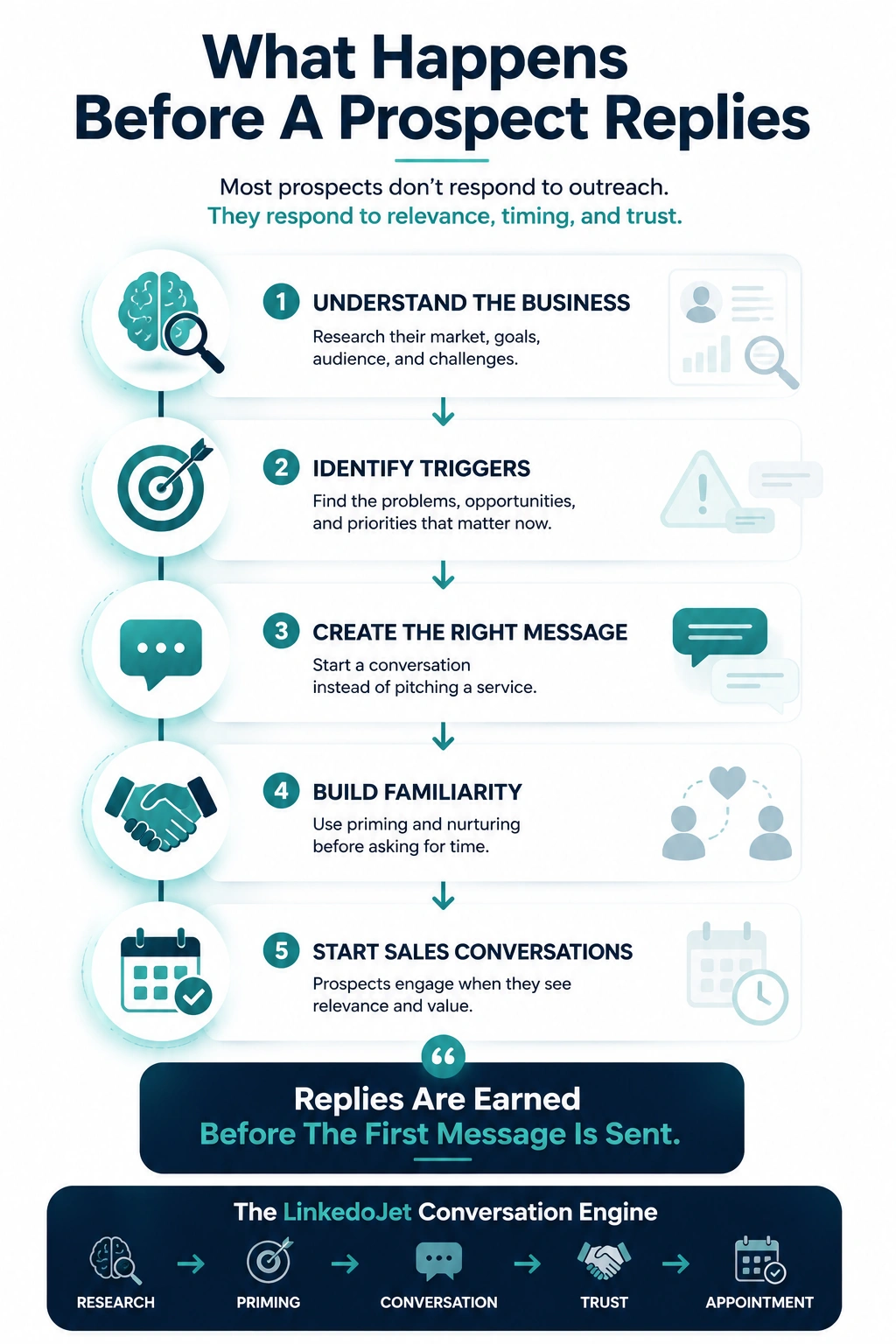
The fix isn’t more volume. It’s a paced, role-aware conversation system that earns permission early, stays present without pestering, and naturally turns into a short “compare notes” call when the planning window becomes real.
Who you message (and what each role is trying to de-risk)
Same building. Different incentives. If you send the same opener to everyone, you’ll get the same result: silence or “send info.”
Architecture buyers don’t buy “design.” They buy reduced risk: fewer surprises, fewer re-dos, less downtime, less schedule drift, and less internal friction.
Here are the lanes that actually matter—and what to anchor your conversation to:
| Buyer lane | What they’re protecting | What gets their attention in a first conversation |
|---|---|---|
| Owners / asset managers | Capex predictability, portfolio standards, repositioning ROI, tenant retention | How early feasibility and scope control prevents VE whiplash and surprise downtime |
| Developers | Pro forma, entitlement/permitting risk, DD deadlines, lender pressure | Permit path clarity, utility/MEP capacity constraints, schedule compression realities |
| Tenant reps / brokers | Speed, deal momentum, protecting client trust | Fast test-fits that don’t create rework; clear go/no-go constraints before the client over-commits |
| Facilities leaders | Occupied phasing, safety, downtime, budget governance, internal approvals | Phasing plans that keep operations running; decision paths that reduce internal churn |
| GC/CM / design-build partners | Constructability, coordination, schedule discipline, clean handoffs | Early coordination patterns that reduce RFIs and late conflicts; realistic sequencing |
One more nuance: principals and BD leads read LinkedIn in scraps of time—early morning, between meetings, late afternoon. So your message has to land in 12 seconds. If it needs context, it won’t get it.
What gets ignored in architecture inboxes (and what it signals about you)
Decision-makers don’t ignore you because they’re rude. They ignore you because your message tells them you’re shopping for any project.
Common messages that quietly poison credibility:
- The glossy intro: “Hi [Name], we’re an award-winning full-service architecture firm…”
Signals: brochure energy, not situational competence. - The generic compliment: “Love what you’re doing at [Company]!”
Signals: you don’t have a real reason to reach out. - The forced personalization: “Congrats on your recent post about leadership…” then a pitch.
Signals: you’re borrowing their content to justify your outreach. - The immediate meeting ask: “15 minutes this week?”
Signals: you’re trying to advance your calendar, not reduce their risk. - The capability list: “We do workplace, healthcare, education, industrial…”
Signals: low selectivity; you’ll chase whatever moves.
Architecture is a high-trust purchase with downstream consequences. Owners and developers get punished for “interesting” picks that miss schedule or budget. Facilities leaders get punished for downtime and safety problems. Brokers get punished if the deal slows down and the client blames them.
So when your message reads like a portfolio dump, it doesn’t just get ignored—it puts you into the mental bucket of “vendor trying to get on a list.” And once you’re there, the only door left is an RFP.
A sequence that earns replies: connection → question-first → consultative follow-ups → nurture → soft ask → close the loop
You’re not trying to “sell architecture” in a DM. You’re trying to start a credible thread that reveals timing and constraints.
Below is a practical sequence you can run without sounding needy. It’s built around one idea: ask one intelligent question that someone in their role can answer in 10 seconds.
1) Connection request (light, role-aware, no pitch)
Owner / asset manager version
“Hi [Name]—saw you oversee [portfolio type] in [region]. I work with teams on early feasibility/test-fit questions before scope gets locked. Happy to connect.”
Developer version
“Hi [Name]—noticed you’re active in [asset type/market]. Quick connect? I’m often pulled in during DD/feasibility when entitlement or schedule is tight.”
Facilities version
“Hi [Name]—saw you lead facilities for [type of operations]. I’ve been around a lot of occupied renovations where phasing/downtime decisions drive everything. Happy to connect.”
2) First message after acceptance (question-first, project-stage reality)
Owner / developer
“Appreciate the connect. When you’re looking at a [repositioning / adaptive reuse / new build] in [market], what tends to slow things down most early—permit path uncertainty, budget alignment, or phasing decisions?”
Facilities / tenant-side
“Thanks for connecting. On occupied work, is the bigger headache usually downtime during construction, or getting internal capex approvals to move at the pace the business wants?”
3) Consultative follow-up (practical check, not a chase)
Developer
“One pattern I see: teams run fast on test-fits, then get hit with late constraints (utility/MEP capacity, fire/life-safety, landlord criteria) and have to redo the work. Do you have a standard for locking the basis-of-design before DD closes, or does it vary deal to deal?”
Owner / asset manager
“Curious how you handle scope control on repositioning work. Do you tend to set a hard ‘no-surprises’ budget guardrail early, or do you let options run longer and tighten after tenant interest becomes clearer?”
4) Emotional-trigger question (subtle consequence, in their language)
Developer
“When DD is tight, what ends up surprising teams more in your experience—entitlement risk, or hidden capacity constraints (power, loading, egress) that force a redesign?”
Facilities
“When projects go sideways internally, is it usually because phasing wasn’t thought through early, or because approvals/budget owners weren’t aligned on what ‘good’ looks like?”
5) Insight nurture (small, credible nugget, no attachment)
“Quick thing we’ve found useful: three early questions that reduce test-fit churn—(1) who can veto layout changes late, (2) what standards must be met (brand, life-safety, accessibility), and (3) what’s the real decision date vs the ‘public’ date. If it’s helpful, I can share how we structure the first ~10 days so feasibility doesn’t drag. Worth it?”
6) Soft meeting ask (compare notes, offer an out)
Developer / owner
“If you’re open to it, I can share how teams de-risk [permit path / scope lock / phasing] early without over-designing. Would a 12-minute ‘compare notes’ call next week be useful? If now isn’t the window, tell me what quarter you usually plan capex/DD and I’ll circle back then.”
Facilities
“Happy to walk through a simple approach to occupied phasing that reduces downtime surprises. Open to a quick 12-minute call? If you’re not planning work until later, just tell me the month you typically kick off capex planning.”
7) Close-the-loop message (protect goodwill; keep timing)
“I’ll close the loop for now—totally understand these cycles can be long and not every quarter is a planning quarter. If a feasibility/test-fit need pops up or you’re heading into a repositioning/renovation cycle, I’m happy to be a resource. Want me to check back after [month/quarter], or should I leave it with you?”
Spacing, light touches, and the triggers that make replies spike
If your sequence is built like a seven-day SaaS cadence, it will feel wrong for architecture.
Most project intent forms quietly. The “real” decision is often made in private threads before there’s a name, a budget, or a public timeline. That’s why patient, credible presence beats pressure.
A pacing pattern that works (without becoming a pest)
- Day 0: Connection request
- Day 1–2 after acceptance: Question-first opener
- Day 6–10: Consultative follow-up
- Day 18–25: Insight nurture
- Day 35–45: Soft meeting ask (with an “out”)
- Day 60–90: Close-the-loop, then pause
After that, your best follow-ups are trigger-based, not calendar-based. You re-enter with a reason that makes sense to them.
Triggers worth building into your nurturing
- Lease signings, relocations, sublease activity, headcount growth
- Funding announcements, acquisitions, portfolio buys/sells
- Permit filings, zoning conversations, municipal approvals
- Leadership changes (new COO, head of facilities, development lead)
- Prototype rollouts, multi-site programs, standard refresh cycles
- Public hints of repositioning or deferred maintenance turning into capex
The point isn’t to “stay in front of them.” It’s to show up like a professional who understands when the work becomes real.
Meeting-ready vs nurture-only signals (and when to pause)
Not every reply is an invitation to pitch. Some are simply the market telling you where you sit in the timing curve.
Signals they’re meeting-ready
- They reference a window: “We’re looking at Q3,” “DD closes in six weeks,” “Capex is being set now.”
- They mention a site/building: address, city, asset, campus, portfolio segment.
- They ask about process: “How do you run feasibility?” “How do you handle occupied phasing?”
- They share a constraint: utility capacity, permitting risk, downtime limits, stakeholder approvals, tenant standards.
- They pull in someone else: “Looping in my PM,” “I’ll introduce you to our owner’s rep.”
- They ask cost/schedule tradeoffs instead of aesthetics.
Signals to nurture (not force)
- “Not planning anything right now.”
- “We already have an architect.”
- “We only work from referrals.”
- “Send info.”
Those aren’t dead ends. They’re a prompt to shift to permission-based nurturing.
Simple responses that keep dignity (and the thread)
- “We already have an architect.”
“That makes sense—most teams do. When things get tight, is it usually because the permit path surprises you, or because scope/budget alignment happens too late? If you ever want a second set of eyes on feasibility assumptions, happy to be a resource.” - “We only work from referrals.”
“I respect that. My goal isn’t to wedge into an RFP—more to be on-deck when a feasibility/test-fit question shows up and you want a quick sanity-check. When do you typically lock capex or DD planning—specific quarter?” - “Send info.”
“Happy to. Before I send anything, what’s more relevant: occupied phasing experience, entitlement/permitting navigation, or early scope/budget control? I’ll keep it to one page.”
If they don’t respond after a clear close-the-loop, pause. Wait for a real trigger. Re-enter with a grounded reason, not “just checking in.”
FAQ
How do you message real estate developers on LinkedIn as an architect without sounding like you’re shopping for any project?
Anchor the message to a developer reality (DD timelines, entitlement risk, utility/MEP capacity, lender schedule pressure) and ask one specific question they can answer quickly. Avoid “we’re a full-service firm” and avoid asking for a call in message one. The fastest credibility signal is showing you understand what derails deals early.
What’s a good LinkedIn connection request message for architects that doesn’t feel pitchy?
Keep it short, role-aware, and factual. Mention the lane (portfolio/market/type of work), reference early-stage feasibility/test-fit work, and simply ask to connect. No portfolio. No “15 minutes.” Example: “Saw you oversee [portfolio type] in [region]. I’m often pulled in early when feasibility or phasing questions pop up. Happy to connect.”
How long should a LinkedIn messaging sequence be for architecture firm business development?
Longer than you want, lighter than you think. A solid baseline is 5–7 touches over 45–90 days, then shift to trigger-based follow-ups (lease events, funding, permit activity, leadership changes, capex cycles). Architecture intent forms quietly; your job is to be credible and present when timing turns real.
What do you say when the prospect replies: “We already have an architect” or “We only work from referrals”?
Acknowledge it without defensiveness, then reposition as a low-pressure resource for feasibility and risk reduction. Ask a timing question (“When do you typically set capex/DD?”) or a constraint question (“What usually surprises teams—permit path or capacity constraints?”). The win is permission to stay in the loop, not an immediate switch.
Should we send a portfolio in the first messages if they ask to “send info”?
Not blindly. First ask what they actually care about (phasing, permitting, scope/budget control, prototype rollouts). Then send something narrow (one page or a short note) that matches that concern. A generic portfolio dump reads like you’re trying to earn attention with volume instead of competence.
If you want this running as a system (not a side project), here’s how LinkedoJet supports it
We build and operate the outbound conversation engine for long-cycle professional services—so your team can stay focused on delivery while qualified intro calls keep showing up.
In a short working session, we’ll look at your current positioning and the buyer lanes you’re trying to reach (owners/asset managers, developers, tenant reps/brokers, facilities leaders, GC/CM partners). Then we’ll show you exactly how we’d turn that into a role-aware LinkedIn sequence that earns replies without portfolio dumping or bid-chasing.
What LinkedoJet operationally provides (not software access):
- ICP + targeting setup: we define the roles, markets, asset types, and “trigger conditions” that actually correlate with project intent.
- Sales Navigator / LinkedIn list building: we build and maintain clean prospect lists by lane (so you’re not mixing developers with facilities with brokers in one generic blast).
- AI-assisted personalization: we generate light, believable personalization tied to real signals (portfolio type, market activity, role scope) without creepy overreach.
- Outreach execution: we run the connection + messaging sequences with pacing that fits architecture cycles.
- Reply handling + nurturing: we help categorize replies (meeting-ready vs nurture) and run follow-ups that keep threads alive without “checking in.”
- Warm lead tracking: every conversation gets tracked so timing doesn’t disappear into someone’s inbox.
- Appointment generation support: we support the handoff from warm thread to booked intro call, including soft-ask language and stakeholder routing.
- Dashboards + visibility: you see what’s being sent, what’s landing, what’s converting, and which lanes are underperforming.
- Ongoing refinement: we adjust targeting, prompts, and sequence steps based on response quality—not just response rate.
After onboarding, you’re not left with a “template.” You get a managed outbound motion: segmented lists, role-specific sequences, ongoing nurture around triggers (permits, funding, relocations, capex cycles), and a clear view of which conversations are turning into real project-intent intros.
Why this is different from ordinary LinkedIn automation tools: tools send more messages. LinkedoJet engineers the conversation, runs the workflow, and supports the appointment outcome—built for trust-heavy, long-cycle services where timing is everything.
If you already have a decent referral base, this is how you stop living on it. You become the on-deck firm earlier—before the deal is shaped and before the RFP machine starts.
Next step: get a role-aware sequence built and running
You’ll leave with targeting by buyer lane, message sequences that sound like real architecture BD, and a managed nurture process that turns timing into intro calls—without dragging principals into daily chasing.
From identifying the right decision-makers to starting meaningful conversations and turning them into qualified appointments... LinkedoJet manages the entire outbound engine for your business.