
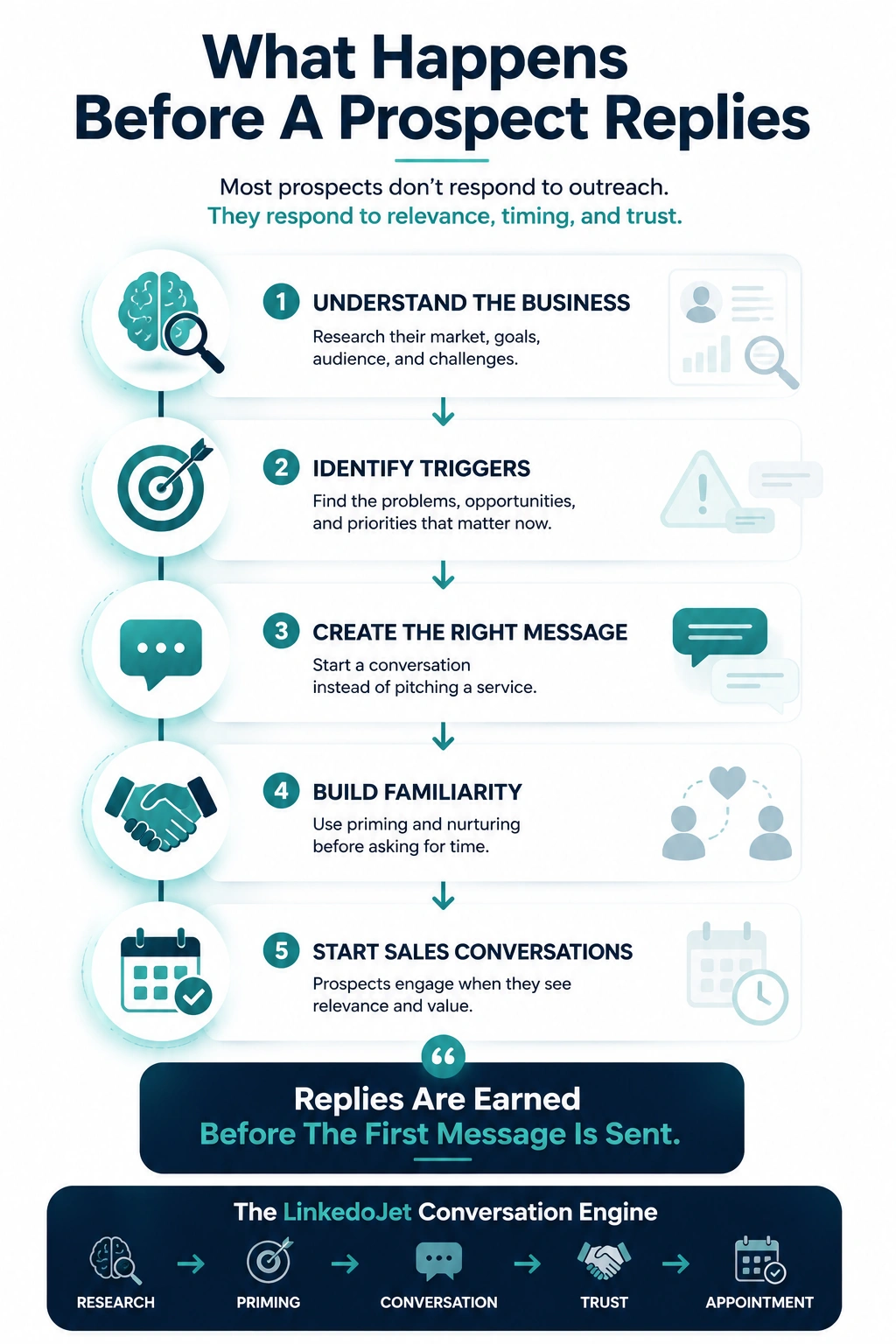
Start more real exit-planning conversations—without sounding like you’re selling a list
If referrals aren’t filling the calendar, LinkedIn should help. But one sloppy DM can spook a founder, leave a written breadcrumb, and quietly damage your name in a small market.
You know the feeling: you send a “perfectly reasonable” message and the reply (if you get one) is cold. Guarded. Or worse—silent, because the founder read it as you think I’m for sale.
For brokers, the problem isn’t volume. It’s exposure.
Owners with real businesses ($1M–$20M revenue, often owner-dependent, often mid-transition without admitting it) protect privacy like a reflex. They don’t want employees, competitors, lenders, or even partners interpreting a LinkedIn message as a signal. So they ignore anything that feels like a process is being started in writing.
On the buy-side, it’s a different trap. Searchers and PE associates are flooded with “deal flow” pings that say nothing about criteria. They’re not offended—they’re just trained to delete.
The cost shows up quietly: fewer discreet owner conversations, fewer mandate-worthy relationships, and a buyer list that goes cold because the only touchpoints are either irrelevant blasts or long gaps of silence.
This playbook is built around one belief: LinkedIn works for brokers when it’s run like discreet conversation engineering—two separate tracks (seller and buyer), with intent-aware pacing and stop rules that protect credibility.
How owners and buyers actually read LinkedIn (and why one-line questions win)
Most outreach fails because it treats messaging like copywriting. In brokerage, it’s a trust arc. The first job is to make it safe to answer.
Owners read for risk. Not “is this interesting,” but “does this create a written record that implies something?” Anything that hints at valuation, selling, buyers waiting, or “representation” can trip that wire—especially if they’re at a stage where even thinking about a transition feels like disloyalty to their team.
Buyers read for relevance. They’re fine with directness, but only when it’s specific: industry, geography, EBITDA band, add-ons vs platform, majority vs minority. If you can’t anchor quickly, you look like another broker fishing.
Timing is underrated. Owners often check LinkedIn early morning, between meetings, or after-hours when they have mental space. Buyers tend to respond during business hours, but only when the ask is easy and tight.
That’s why one-line questions beat long paragraphs. A founder can answer a safe question without committing. A buyer can answer criteria without “opening a loop” they’ll be chased on.
Seller track: discreet mandate outreach sequence (with short message examples)
Goal: earn a small reply that reveals timing/interest, then nurture safely until a short “compare-notes” call becomes the natural next step. No listing language. No implied sale.
1) Connection request (discreet, permission-based)
Option A (industry + geography):
“Hi <
Option B (owner milestone trigger):
“Hi <
2) First message after acceptance (calm opener + safe question)
Trigger-led:
“Thanks for connecting, <
3) No-reply follow-up (problem-based, multiple choice)
“Quick follow-up, and I’ll keep it brief. When owners wait until they’re ‘ready,’ the thing that usually bites them is one of these: (a) owner-dependence, (b) messy add-backs, (c) customer concentration, (d) thin second layer. In <
4) Query that matches the real emotion (respectful, not dramatic)
“Different angle—do you see yourself wanting optionality while you still enjoy running the business, or do you prefer not to think about it until energy/market forces your hand? Either is reasonable; I’m mainly curious how you think about timing.”
5) Insight-based nurture (authority without pitching)
“One thing I’m seeing: buyers in <
6) Soft meeting request (sanity check, short, confidential)
“If it’s useful, happy to do a 12–15 minute exit-readiness compare-notes call. No pressure and nothing needs to be decided. If you prefer, we can keep it high-level and confidential. Would Tue morning or Thu afternoon be easier?”
7) Final close-loop (no guilt, simple re-entry)
“I’ll leave it here so I’m not a nuisance. If you ever want a discreet valuation-range discussion or just the prep steps, reply ‘timing’ and I’ll send two options.”
Buyer track: criteria-led relationship sequence (searchers, independents, PE) with examples
Goal: keep serious buyers warm without blasting teasers. You’re building a clean criteria record so when something fits, your message is welcomed—not tolerated.
1) Connection request (criteria-led, not “deal flow”)
Option A (searcher/independent sponsor):
“Hi <
Option B (PE associate):
“Hi <
2) First message after acceptance (one crisp criteria question)
“Appreciate the connect. Quick criteria check—are you primarily focused on <
Alternate question (fast to answer):
“Majority deals only, or will you look at structured minority when the operator is strong?”
3) No-reply follow-up (two-option prompt)
“Quick check, <
4) Nurture note (market observation, not a claim)
“Small observation from the last few months: in <
5) Soft meeting request (efficiency framing)
“So I don’t send you irrelevant teasers—want to do a 10-minute criteria sync? I’ll keep it practical: industry focus, EBITDA band, add-on appetite, and any hard ‘no’s.”
6) Close-loop with permission + keyword restart
“No worries either way. If you want to stay on my ‘only send when it fits’ list, reply with your ideal EBITDA range + geography, and I’ll keep it tight.”
Common LinkedIn mistakes brokers make (and the credibility-safe alternative)
Most brokers don’t lose deals because they’re “bad at outreach.” They lose because the message creates pressure before trust.
| What breaks trust | What works instead |
|---|---|
| Implying an owner is selling (“thought you might be considering options”). | Talk about succession/exit timing as a normal operator topic; ask a safe, non-committal question. |
| Long credibility paragraphs about “our buyer network.” | One relevant line + one question. Proof comes later, after a reply. |
| Asking for a call in message one. | Earn a small “timing” reply first. Then a short compare-notes call is natural. |
| Dropping links, decks, CIM language, or attachments early. | Permission-based nurture: “Want a one-page checklist?” Keep it non-sensitive. |
| Fake personalization (“impressive profile,” “saw your post”). | Use real triggers: GM hire, second site, consolidation, tenure milestone, management depth signals. |
| Treating buyers like a blast list (“sending deals weekly”). | Criteria-led pings, infrequent, only when it fits. Buyers remember restraint. |
One more that’s rarely said out loud: if your follow-ups sound like “checking back,” you’re training people to avoid you. Follow-ups should add value or reduce friction—never guilt.
Signals, stop rules, and when to move to a confidential compare-notes call
The constraint isn’t writing “better messages.” It’s reading intent correctly and only advancing when the prospect’s language says it’s safe.
Seller signals
- Meeting-ready language: “What’s the range?”, “How do buyers think about add-backs?”, “How long does a process take?”, “How do you keep staff from finding out?”, “What would we need to clean up first?”
- Curious / early: “Not selling,” “Maybe in a few years,” “Just wondering what it could be worth,” “We’ve talked about succession but haven’t done anything.”
- Negative / stop: irritation, “remove me,” or heightened sensitivity about employees/partners seeing anything. Also: any hint they feel targeted or exposed.
Buyer signals
- Meeting-ready language: “Our criteria is active,” “We’re deploying this quarter,” “We need add-ons in X,” “We’re seeing too much auction,” “We want more proprietary.”
- Warm but not active: they answer criteria but don’t ask follow-ups. That’s a nurture track, not a chase.
- Negative / stop: “Send deals” with no criteria, or annoyance at outreach. Don’t argue—ask one criteria question or pause.
Simple stop rules (protect your reputation)
- If you get a clear “no,” acknowledge and stop. Don’t “circle back” in 30 days.
- If there’s no reply after 2 follow-ups on sellers, move to a light permission-based nurture (quarterly insight) or pause.
- On buyers, if they won’t give criteria, don’t keep pinging. The relationship isn’t real yet.
How to transition to a call (without making it weird)
Seller: “If it helps, we can do a 12–15 minute compare-notes call—confidential, no pressure. We’ll keep it high-level: timing, preparation, and what tends to move value in <
Buyer: “Quick criteria sync so I don’t waste your time—10 minutes and I’ll only send when it fits.”
FAQ
How do I message a founder about exit planning on LinkedIn without implying they’re for sale?
Anchor on succession planning and timing as a normal operator topic, not a sales trigger. Avoid any sentence that reads like “you’re selling.” Use a situational reason (GM hire, second location, consolidation, founder tenure) and ask a safe question they can answer in one line—e.g., whether they’ve ever pressure-tested a valuation range or thought about what a transition would need to look like eventually.
Keep it short. If you feel the need to explain, you’re probably saying too much.
What’s a good LinkedIn connection request for business brokers that doesn’t feel like a pitch?
Make it permission-based and specific: industry + region + your lane (succession/exit timing). Example: “I work with owner-led <
No buyer claims. No “representation.” No valuation talk.
How many follow-ups is reasonable before it starts to feel like pressure (for sellers vs buyers)?
Sellers: typically 1 initial message + 2 follow-ups max. After that, either pause or switch to a low-frequency nurture that’s permission-based and non-sensitive.
Buyers: 1 initial criteria question + 1 follow-up. If they won’t answer criteria, stop chasing. If they do answer, you can nurture lightly when you have a relevant observation or a true fit.
What should I say when an owner replies “not selling” or “just curious”?
Don’t “overcome” it. Agree and de-risk. Example: “Totally fair—most owners I talk to aren’t ‘selling.’ When you do think about it, is it more ‘someday’ or do you want optionality in the next 12–24 months?”
If they say “just curious,” give them a safe next step: a one-page prep checklist, a few common diligence questions, or a quick compare-notes call framed as informational and confidential.
How do I keep search funds and PE associates warm without blasting “deal flow” messages?
Run a criteria-led system: capture industry focus, EBITDA band, geography, add-on appetite, and any hard “no’s.” Then only message when (1) their criteria shifts, or (2) you have a true fit, or (3) you’re sharing a small market observation worth replying to.
Buyers don’t reward frequency. They reward relevance—and they remember who doesn’t waste their time.
If you want this running weekly (without risking your name), we’ll build and operate the two-track system with you
This isn’t “send more DMs.” It’s a discreet seller conversation track plus a criteria-led buyer track, operated end-to-end with visibility and control.
When you work with LinkedoJet, you’re not getting a generic automation tool. You’re getting an outbound operating system built for brokerage realities: confidentiality, timing, and the difference between a curious owner and an active mandate.
What we set up: we define your ICPs (sell-side and buy-side separately), build Sales Navigator targeting, and produce clean prospect lists (owners by industry/geo/size signals; buyers by mandate, role, and stated criteria). We also create two message sequences that are restraint-first: safe openers, easy-to-answer questions, permission-based nurture, and clear stop rules.
How personalization works: LinkedoJet uses AI-assisted personalization to reference real, observable context (growth triggers, consolidation signals, role changes) without sounding like “saw your profile” fluff. Every message stays within broker-safe language—no “for sale” breadcrumbs.
What happens after onboarding: we execute outreach daily, handle routing and reply handling workflows, and tag intent so your team knows what’s what: curious vs not now vs active. Sellers who respond get nurtured respectfully until the language indicates it’s time to offer a short compare-notes call. Buyers get criteria syncs and light-touch market notes so they stay warm without being blasted.
What you receive: clear dashboards for campaign visibility (who was contacted, reply rates, intent tags, warm leads), an always-current buyer criteria log, and appointment generation support so intro calls are set when the signal is there—not forced on message one.
Why this is different: ordinary LinkedIn automation focuses on sending. LinkedoJet focuses on sequencing intent, protecting credibility, and turning replies into real conversations your team can close.
From identifying the right decision-makers to starting meaningful conversations and turning them into qualified appointments... LinkedoJet manages the entire outbound engine for your business.
Next step: put discreet seller outreach and buyer criteria syncs on rails
If your calendar is too referral-dependent, the fix isn’t louder messaging. It’s a controlled system that starts safe conversations, reads intent, and earns calls without leaving a paper trail that makes owners nervous.