
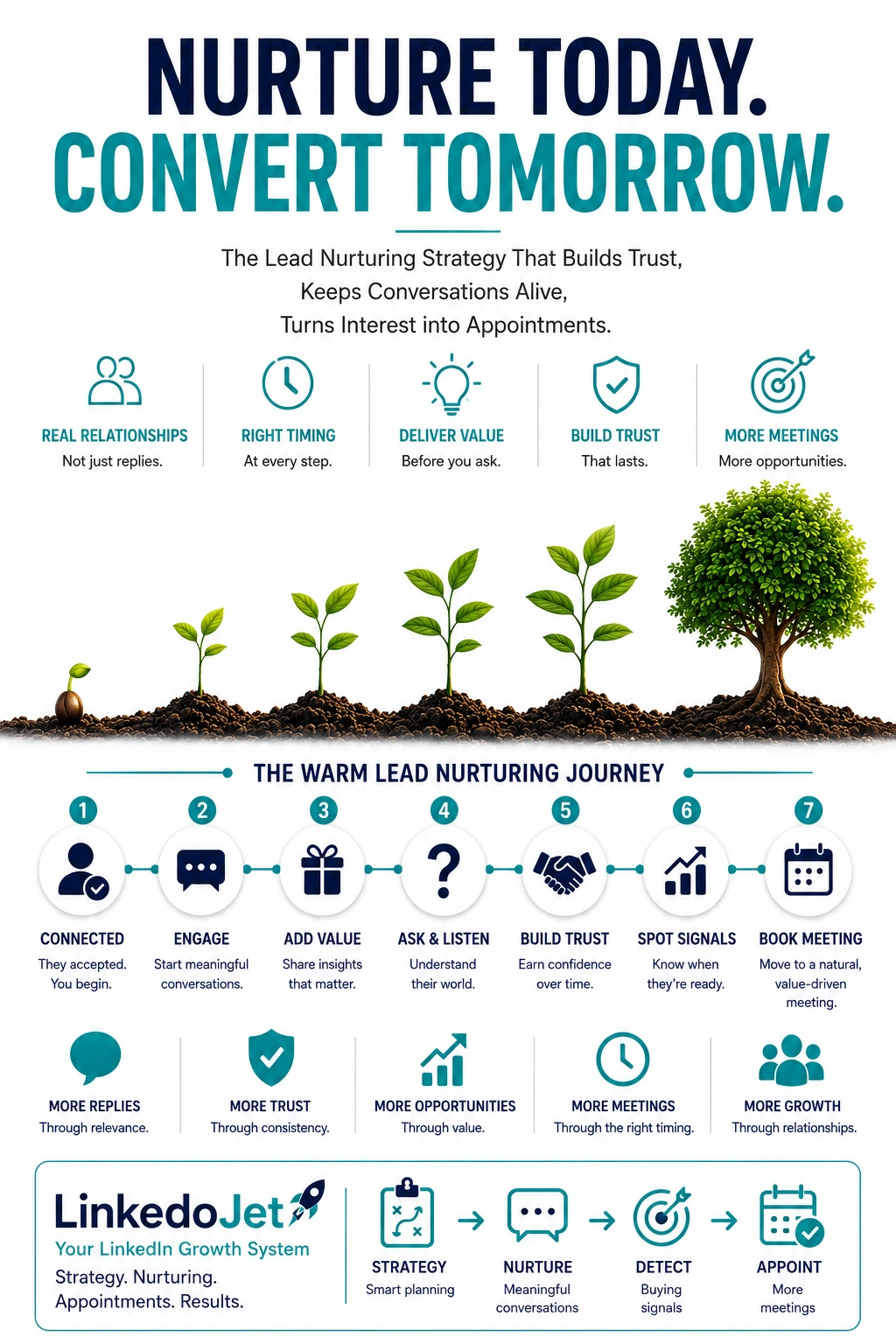
The “almost shortlisted” problem in localization
Warm signals show up. Pipeline doesn’t.
You connect with a Head of Localization. They accept. A Loc PM replies once: “Thanks—might look at options this year.” Someone from Product or Marketing Ops views your profile after you post about multilingual launches.
Then the thread dies.
Not because you’re bad at what you do. Because switching an LSP is political and operationally risky. Releases don’t pause for vendor evaluations. Procurement wants paperwork before anyone has agreed on scope. And no one wants to be the person who introduced quality regression right before a launch.
So your contact does the safest thing: they keep the incumbent, keep you as a “maybe,” and move on with their week.
The cost is quieter than a lost deal. It’s the mid-funnel leak where you keep restarting conversations instead of progressing them. You spend time writing thoughtful follow-ups, but you don’t earn the details that actually create a scoping call: content types, locales, review ownership, acceptance criteria, and timing against release cycles.
Meanwhile, urgency spikes happen without you—new locales, a quality fire, a vendor reset—because you weren’t the low-risk option when the pressure hit.
Warm intent isn’t “one more follow-up.” It’s a temperature model.
Localization buyers go quiet for predictable reasons. Treating every warm lead as call-ready is how you start sounding needy.
If you sell localization long enough, you learn the uncomfortable truth: most “sounds good” replies are not buying signals. They’re permission to exist in their vendor orbit.
What changes outcomes is having a simple way to tag what the signal actually means, and what kind of next touch keeps you relevant without pushing.
Signals worth tagging (localization-specific)
- Workflow questions: file formats, CMS/TMS mentions, “how do you handle in-country review,” “do you support X,” “can you integrate with Y.”
- Expansion signals: hiring a localization role, new language selector on the site, posts about LATAM/APAC growth, new game/feature launch notes mentioning new regions.
- Quality governance signals: LQA posts/comments, MT/AI policy discussions, “terminology consistency,” complaints about review loops or linguistic feedback timing.
- Timing pressure: “we’re slipping,” “support tickets are up,” “marketing can’t hit deadlines,” “we need vendor options for procurement.”
A plain-language temperature model
| Temperature | What it usually means in localization | What they need next |
|---|---|---|
| Warm-curious | They’re collecting options; incumbent is fine for now; switching feels like work. | Low-friction credibility: small insights, a simple question, and proof you understand operations. |
| Warm-evaluating | They’re socializing vendor options internally; procurement or stakeholders will show up soon. | De-risking: clarify workflow + stakeholders; offer a scoping path or a pilot brief they can forward. |
| Warm-urgent | Quality, turnaround, or process is actively failing; launches are threatened; vendor roster is reopening. | Fast scope capture: languages, content types, cadence, review model, acceptance criteria, and next-step call. |
A trigger-based cadence that respects release cycles
Fewer touches. Higher relevance. Timed to their world.
Localization teams don’t ignore you because they hate vendors. They ignore you because they’re mid-sprint, mid-launch, or mid-review-loop. Random “checking in” bumps arrive at the worst moment—string freeze week, campaign localization, or quarterly planning—and you become noise.
Instead, run a cadence that uses two clocks:
- Time-based: light, spaced touches that keep the thread alive.
- Trigger-based: moments where relevance is obvious (launches, new locales, hiring, vendor/AI governance talk).
Week-by-week (starting after connection acceptance)
- Week 0–1: Context + one narrow question (in-country review, terminology governance, TMS handoff). Goal: a short reply, not a call.
- Week 2: One operational insight they can react to (LQA acceptance criteria, review-loop bottlenecks, last-minute copy handling).
- Week 4: Proof touch: a compact outcome framed in workflow terms (less rework, fewer review iterations, faster cycle time).
- Week 6–8: Soft reopen with an easy out + easy answer (new locales this quarter? centralized review or market-by-market?).
- Ongoing: Trigger messages when something changes: job post, new language on site, a new market announcement, procurement chatter, MT/AI policy update.
Notice what’s missing: daily nudges, guilt, and “just circling back.” You’re staying present until urgency and internal permission line up.
Follow-up snippets that sound like a localization operator (and why they exist)
Each message has a job: earn a small reply, clarify workflow, or reduce perceived risk.
1) After connection acceptance (context + low-friction question)
Message:Thanks for connecting. Quick question from your seat—where do localization projects usually get stuck for you: in-country review loops, terminology/glossary alignment, or the handoff into your TMS/CMS?
Why it works: You’re not pretending to know their stack. You’re offering three real failure points and inviting a simple answer.
2) After they reply once (build on their words + one scoping question)
Message:Makes sense. When teams say “we may look at options this year,” it’s usually tied to either quality governance or turnaround predictability. For you, is it more about product strings, marketing web/content, or support/knowledge base?
Why it works: You’re narrowing scope without forcing a meeting. Content type selection changes everything (workflow, tools, review owners, and metrics).
3) Educational nurture (teach without lecturing)
Message:One thing I see a lot: LQA disputes aren’t really “quality” problems—they’re acceptance-criteria problems. If the reviewer guidance is vague, you get late feedback + rework. Do you run a defined error taxonomy / pass-fail threshold, or is it more subjective right now?
Why it works: It’s a useful frame with a binary-ish question. Easy to answer. Hard to ignore.
4) Insight-based follow-up (AI/MT policy without hype)
Message:Curious how you’re handling MT/AI governance internally. The teams that stay sane separate “what can be MT-assisted” from “what must be human-owned,” and they document it so procurement doesn’t turn it into a rate-only conversation. Do you have a written policy, or is it still evolving?
Why it works: You’re speaking to internal politics: governance, risk, and procurement dynamics.
5) Proof touch (credibility without bragging)
Message:Recent pattern from a SaaS team: once glossary ownership + review routing were clarified, their review-loop iterations dropped (fewer “fix this wording” rounds) and release localization stopped being the critical path. If your team ever wants a lightweight way to pressure-test review routing, I can share the checklist we use.
Why it works: Operational outcome, not chest-thumping. And the offer is a forwardable artifact.
6) Soft reopen after mild silence (easy out + easy reply)
Message:No rush on this—timing is usually the whole game with localization. Are you planning any new locales in the next quarter, or mostly keeping the current language set stable?
Why it works: Gives them an out, and the question is concrete.
7) Buying-signal response (when urgency shows)
Message:Got it—if turnaround is slipping, I’d want to understand two things before suggesting anything: (1) what content types are driving the pain (product strings vs marketing vs support), and (2) who owns final approval (central team vs market reviewers). If you’re open to it, a quick 15–20 min scoping call usually gets this clear fast, and we can outline a low-risk pilot that won’t disrupt your release cadence.
Why it works: You’re responding to urgency with de-risking and scope capture, not a generic pitch.
8) Dormant lead revival (weeks/months later, trigger-based)
Message:Saw you’ve added a new language on the site recently—nice move. Quick question: are you handling in-country review market-by-market, or routing everything through one central owner? If helpful, I can send a short pilot brief template teams use to sanity-check scope before procurement gets involved.
Why it works: It’s anchored to a visible trigger and offers something practical.
9) Close-loop (respectful exit)
Message:I don’t want to keep nudging if the timing isn’t there. I’ll pause outreach on my side. If a trigger comes up—new locales, vendor review, or a release crunch where you want second-source coverage—feel free to message me and I’ll respond quickly.
Why it works: You preserve goodwill and stop being “the follow-up person.”
Objections and buying signals: stay relevant, don’t spar
Localization buyers aren’t trying to beat you. They’re trying to avoid risk.
“We already have a vendor.”
Translation buyers say this even when they’re unhappy. It can mean: the incumbent is politically safe, procurement is locked, or they only swap vendors when something breaks.
Move: shift from replacement to resilience.
- Second-source coverage for launch spikes (overflow without drama).
- Domain-specific support (regulated content, app store listings, technical docs).
- Quality audit / workflow assessment that doesn’t threaten the incumbent.
“Can you send pricing?”
Per-word talks without content type and leverage data are how teams pick the wrong vendor and blame “quality” later.
Move: answer with a scope gate.
Happy to share a range, but it’ll be misleading without two details: what content types dominate (product/marketing/support), and how you handle leverage (TM/MT) + review ownership. If you share those, I’ll send a clean range and the assumptions so procurement doesn’t misread it.
“Procurement needs options.”
Move: make them look good internally. Offer a forwardable one-pager: pilot scope, governance expectations, and what success looks like (cycle time, rework, LQA threshold).
Signals that it’s time to ask for a scoping call
- They mention new locales, a launch deadline, or a shift in release cadence.
- They ask about TMS integration, handoffs, file formats, or review routing.
- They surface quality governance: LQA, acceptance criteria, or reviewer disputes.
- They mention vendor evaluation, roster refresh, or procurement reopening.
When you see these, your meeting ask should be a de-risking step with a clear output: a scoped pilot path, not “let’s chat.”
Mistakes that kill warm localization leads fast
Most sellers lose credibility in the middle, not the first message.
- Asking for a call before you understand workflow. If you haven’t clarified content types, locales, and review ownership, the call feels like homework for them.
- Leading with a rate card when scope is undefined. It turns a complex workflow purchase into a commodity comparison.
- Saying “quality” without explaining how LQA is defined and governed. Buyers hear “trust us,” not “we can operate.”
- Ignoring stakeholder reality. The Loc PM cares about handoffs and review loops. Product cares about release risk. Marketing cares about deadlines. Procurement cares about paperwork and defensibility.
- Sending generic PDFs. Buyers don’t forward “about us” decks. They forward pilot briefs, checklists, and governance summaries that reduce internal friction.
- Over-following up during crunch weeks. If you ping during string freeze or launch localization, you train them to ignore you forever.
- Acting like switching vendors is easy. It isn’t. Your job is to make the next step low-risk: second-source, audit, or pilot with tight boundaries.
FAQ
What counts as a “warm” LinkedIn lead for translation and localization buyers?
Warm means there’s a plausible operational thread, not just a connection. Think: a reply that references timing (“later this year”), a question about formats/TMS/review, engagement with LQA or MT governance posts, a profile view after you posted about multilingual launches, or a trigger like new locales/hiring for localization.
How often should I follow up on LinkedIn without becoming noise during release cycles?
Anchor on relevance, not frequency. A simple pattern is Week 0–1 (one question), Week 2 (one insight), Week 4 (one proof touch), Week 6–8 (soft reopen), then only trigger-based messages. If they’re in launch mode, fewer touches with higher specificity beats “just checking in.”
What should I send after someone asks about translation pricing on LinkedIn?
Send a range only with assumptions, and pair it with two scoping questions so you don’t get trapped in a rate-only conversation. Ask what content types dominate (product vs marketing vs support) and who owns review approval. Then offer a forwardable pilot brief template procurement can live with.
How do I handle “we already have a vendor” without sounding defensive or desperate?
Don’t argue replacement. Offer resilience: second-source coverage for launch spikes, a domain-specific lane, or a lightweight quality/workflow audit that doesn’t threaten the incumbent. The goal is to become the safe backup plan when something breaks.
When is the right time to ask for a scoping call in a localization vendor evaluation?
When they surface timing pressure, workflow questions (handoffs, TMS/CMS, review routing), governance questions (LQA/acceptance criteria), or procurement signals (vendor roster refresh). Frame the call as 15–20 minutes to capture scope and outline a low-risk pilot—not as a general intro.
If you want this run as an engine (not a one-off sequence)
LinkedoJet builds and operates the targeting, outreach, and warm-lead nurturing system so your team stops losing “almost shortlisted” conversations.
You’re not failing because you don’t follow up enough. You’re failing because warm intent isn’t being captured, tagged, and nurtured in a way that matches how localization buying actually works—release cycles, stakeholder politics, procurement gates, and incumbent inertia.
LinkedoJet isn’t a LinkedIn automation tool you “set and forget.” It’s an operated outbound system:
- ICP + targeting setup: we help define the buyer map (Head of Localization, Loc Program Managers, Product, Marketing Ops, Support, Procurement/Vendor Mgmt) and build Sales Navigator lists that match your ideal accounts and signals (new locales, hiring, growth announcements).
- Prospect list building: we continuously source and refresh lists, segmenting by industry (SaaS, ecommerce, gaming, regulated) and by likely localization motion (product strings vs marketing vs support).
- AI-assisted personalization: we generate human-sounding openers tied to real triggers (release activity, language expansion, governance topics) while keeping claims honest—no pretending we “saw your stack.” Your team approves the voice; the system handles the repetition.
- Outreach execution: connection requests and follow-ups are sent on a controlled cadence that respects the reality of localization teams during string freeze and launch weeks.
- Reply handling + nurturing: when replies come in, we route them by temperature (warm-curious / evaluating / urgent) and support next-step responses that clarify workflow: locales, content types, review routing, LQA expectations, and timeline.
- Warm lead tracking: every warm thread is tracked with notes and tags so you don’t restart conversations from scratch after a quiet month.
- Follow-up workflows: we run trigger-based nurtures (job changes, new language selector, new market push, AI/MT policy chatter) so you show up when relevance is obvious.
- Appointment generation support: when buying signals appear, we help convert them into 15–20 minute scoping calls with a clear output (pilot scope + evaluation path) and keep visibility on attendance and outcomes.
- Campaign visibility: dashboards show what’s being sent, what’s working, where replies stall, and which segments produce scoping calls.
- Ongoing refinement: messaging, targeting, and cadence are adjusted based on real reply patterns—especially around procurement gates and “we already have a vendor” responses.
After onboarding, you receive a working outbound program: segmented targeting lists, approved messaging for each nurture moment, operational tagging for warm intent, and an appointment flow designed for localization evaluations (second-source, audit, or pilot—whatever fits your sales motion).
If you book a demo session, we’ll show you exactly how we’d structure your localization nurturing paths, what we’d track, and how we turn early LinkedIn interest into scoped conversations your team can actually close.
Next step: turn warm interest into scoping calls you can win
You’ll stop chasing dead threads and start running a calm, credible nurture system that fits localization buying cycles.
From identifying the right decision-makers to starting meaningful conversations and turning them into qualified appointments... LinkedoJet manages the entire outbound engine for your business.