
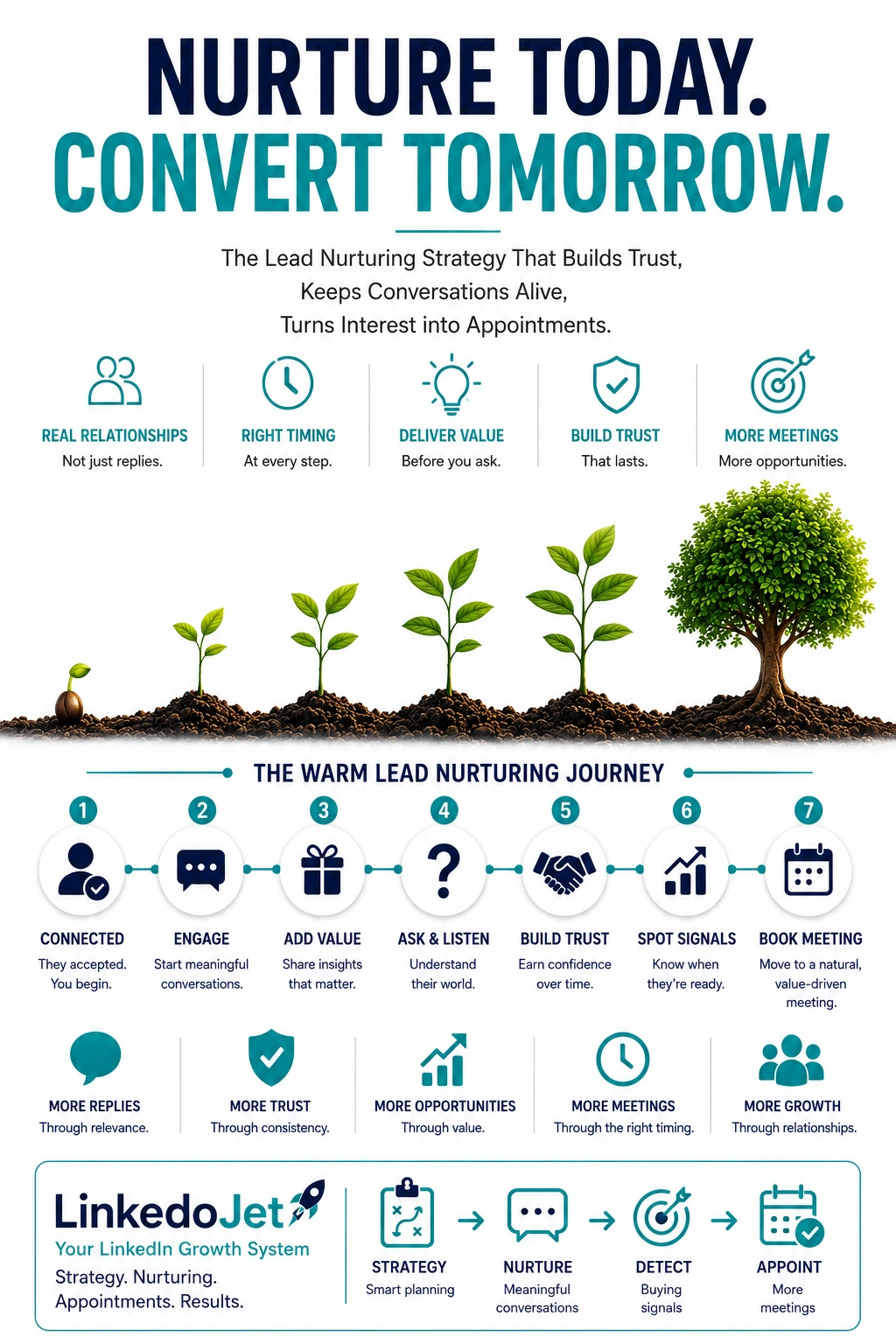
Why warm LinkedIn threads die in enablement (and the cost of rushing to “a demo”)
If you sell into Sales Enablement and RevOps, a warm reply isn’t permission to pitch. It’s a test: do you understand rollout reality, adoption risk, and the politics of getting Sales to actually change?
You can feel it when it happens.
A Director of Enablement accepts your connection after a comment thread about ramp time. A VP replies “sure, send it.” Someone views your profile right after your post on coaching load. You think you’ve got momentum.
Then you do what most teams do: you send a deck, drop a demo link, ask “what are your pain points?”, and try to move it to a calendar this week.
Silence.
And in enablement, that silence carries a specific kind of sting. It’s not just “no response.” It’s the sense that you turned a peer conversation into a vendor cadence. You didn’t just lose a meeting—you taught someone in a small community that you sound like every other enablement platform pitch.
Commercially, the damage stacks up fast:
- Founder/AE time gets wasted twice. Once to earn the warm signal, again chasing a thread that was mishandled.
- Pipeline becomes unpredictable. You can’t forecast LinkedIn because warm intent isn’t being converted with any consistency.
- Your champions never form. Enablement leaders don’t buy in isolation; if you don’t help them build internal alignment, the deal dies quietly.
- You burn future timing. Many enablement initiatives are “next quarter” by nature—if you make them feel sold to, they won’t come back when the window opens.
This is why “connect → pitch → demo” collapses in this niche. Enablement leaders are juggling onboarding cohorts, QBR prep, new VP resets, tool clean-up, and governance. When they say “send it,” they’re usually not asking for a demo. They’re checking if you can reduce change risk and speak their language.
What “warm” means in enablement: intent signals worth protecting (and what they usually predict)
Warm isn’t “they replied.” Warm is “they revealed context.” Even tiny context.
Enablement buyers are overloaded and trained to ignore anything that smells like a sequence. So when they engage, the signal is often subtle—and easy to destroy if you respond like an SDR.
Here are warm signals that actually mean something in enablement deals, and what they tend to predict:
| Warm signal | What it usually means | What you’re allowed to do next |
|---|---|---|
| Accepted connection after a specific comment thread (ramp time, onboarding, MEDDICC friction) | You’re on their radar as “operator-ish,” not a vendor yet | Offer a small artifact tied to that topic; don’t ask for time |
| “Sure, send it” / “Curious—what do you mean by that?” | They’re screening for relevance and change risk | Ask one enablement-native narrowing question before sending anything |
| Profile view after your post on adoption measurement or content graveyards | They’re dealing with the exact failure mode you described | Send a 3–5 line message with a useful frame, not a product pitch |
| Asks about rollout timeline, integrations, security, stakeholders | Real evaluation behavior (cross-functional buying is starting) | Propose a short working session with a defined output |
| “We already have Highspot/Seismic/Gong” | Tool sprawl anxiety + fear of another platform nobody adopts | Shift to governance/adoption/use-case fit; don’t argue features |
| Engages with a teardown or operational post (inspection cadence, coaching loops) | They care about operating rhythm and enforcement | Offer a one-pager they can share internally (scorecard/rollout outline) |
The hidden mistake is treating all these signals like the same thing. They’re not.
An Enablement Manager who viewed your profile after an onboarding post needs a light, curiosity-led nudge. A VP who replies “send it” needs you to quickly prove you understand rollout, governance, and stakeholder alignment. A RevOps leader who asks about data capture is testing whether you can fit into their CRM truth.
Warm intent is fragile. Preserve it, and you earn a conversation over weeks. Mishandle it, and you create the worst outcome: polite silence from a buyer who would have been a champion later.
A temperature model that matches enablement buying: curious → initiative → evaluation → champion
If you’re getting ghosted, it’s usually because you’re asking for a meeting at the wrong temperature.
Enablement deals progress when you move the conversation from interest to initiative, from initiative to evaluation, from evaluation to champion. Not when you push for a demo because you finally got a reply.
Here’s a plain-language model that maps to how enablement work actually gets bought:
| Temperature | What’s true in their world | What your next message must accomplish | What you should avoid |
|---|---|---|---|
| Curious | They like the idea, but it’s not mobilized. They’re mid-quarter, mid-fire. | Confirm which initiative it touches (onboarding, coaching, messaging consistency, pipeline inspection) and offer a small artifact. | “Want a demo?” and long PDFs. |
| Initiative exists | Something is changing (new VP, pipeline miss, new product launch), but owner/timing isn’t settled. | Clarify owner, timing window, and what success would look like in one metric they’d defend. | Generic discovery questions. |
| Active evaluation | They’re comparing options and managing tool overlap. RevOps and Sales leadership are in the mix. | Reduce change risk: rollout plan, governance model, adoption measurement, integration path. | Feature dumps and “we do everything” claims. |
| Champion forming | They’re testing internal narrative: why now, why this, why it won’t fail like the last tool. | Give them internal ammo: a 1-page rollout outline + scorecard + stakeholder map prompts. | Pushing them to “just get on a demo” with no output. |
This model also helps your team stop arguing about “how many follow-ups.” The real question is: did the temperature change?
If the temperature didn’t change, sending another “checking in” message is just you announcing that you’re measured on activity.
The silence triggers: language, timing, and asks that make enablement leaders disengage
When enablement leaders go quiet, it’s rarely because they’re offended. It’s because the thread stopped feeling useful.
The fastest ways to cause that shift:
- Language mismatch. You talk “platform, features, seats.” They think “rollout, governance, coaching load, adoption.”
- Bad timing assumptions. You act like “this week” is normal. Their reality is onboarding cohorts, QBRs, pipeline inspection, and quarter planning. Many initiatives are “after the next cohort.”
- The wrong ask. You ask for a demo when they want a usable output (a plan, a scorecard, a measurement approach).
- Collateral dumping. A deck is easy for you, expensive for them. It’s another thing to read, interpret, and defend internally.
- 48-hour follow-ups. Nothing says “I’m running a sequence” like tight spacing and escalating urgency.
Then there are the niche-specific landmines.
If they say “we already have Highspot/Seismic/Gong,” and you respond with “we integrate with those,” you missed the point. They’re not asking about integrations; they’re signaling tool sprawl and adoption trauma. They’re wondering: will this become another content library nobody uses?
If you ask “what are your pain points?” you force them to do labor in a DM thread with a vendor. Enablement leaders don’t want to write your discovery notes for you.
And if you pitch “AI personalization” as the hook, you may spook the exact buyers you want. Enablement and RevOps are sensitive to anything that looks like spam, policy risk, or brand damage—especially on LinkedIn.
The fix isn’t clever copy. It’s pacing, intent memory, and a conversation that earns the right to a call.
Message moments that earn the right to a call (10 situations, each with intent and an example)
Below are the moments that actually move enablement threads forward. Not as templates. As intent-driven moves.
After connection acceptance (first warm follow-up)
Intent: earn a second interaction by giving something small and useful.
Example: “Appreciate the connect—saw your comment on ramp time. When teams miss ramp targets, it’s usually not content volume, it’s reinforcement. If helpful, I can send a one-page rollout outline we use to keep onboarding from becoming a ‘week 1 firehose.’ Want the version for SMB reps or enterprise?”After “sure, send it”
Intent: narrow scope with one enablement-native question so you don’t dump collateral.
Example: “Will do. Quick check so I send the right thing—are you looking at this through onboarding, ongoing coaching, messaging consistency, or pipeline inspection? (Different plans depending on what you’re trying to change.)”Educational nurturing
Intent: give a grounded insight tied to how enablement actually operates.
Example: “One pattern I keep seeing: content libraries don’t fail because reps hate content—they fail because there’s no reinforcement loop. If you’re measuring adoption, ‘logins’ won’t tell you much. The better signal is behavior: did the right talk track show up in stage 2 calls? Are managers coaching to it?”Insight-based follow-up on the current landscape
Intent: show you understand tool sprawl + workflow fatigue without sounding cynical.
Example: “Enablement stacks are getting messy: CI tools, LMS, CMS, CRM plugins, AI note-takers… and reps are tired. How are you proving enablement impact to Sales leadership right now—manager coaching activity, stage conversion, ramp-to-first-meeting, something else?”Proof-based nurture (mini story)
Intent: demonstrate change management and measurable outcomes, not ‘we installed software.’
Example: “We worked with a team that already had a library and a CI tool. The issue was governance: managers weren’t reinforcing, and RevOps couldn’t see usage tied to outcomes. They ran a 4-week rollout with a simple scorecard (adoption + behaviors + outcomes). The first win wasn’t ‘more content’—it was consistent call structure in early stages, and stage-to-stage movement improved enough that Sales stopped fighting the process.”Soft reopen when the thread cools
Intent: respect calendar reality and give an easy out without disappearing.
Example: “Quick sanity check—does this sit after your next onboarding cohort, or is it more of a QBR/inspection cadence project? Either answer is fine; I just don’t want to keep nudging if the timing isn’t there.”Buying-signal response
Intent: tighten the frame for a call when signals move from curiosity to evaluation.
Example: “If you’re already thinking about rollout + stakeholders, a short working session might be useful. In 20 minutes we can map (1) the initiative you’re solving (onboarding vs coaching vs messaging), (2) who needs to sign off (Enablement/RevOps/Sales), and (3) what a low-risk first rollout would look like. If it’s a fit, then a demo actually makes sense.”Soft meeting request (working session, not ‘demo’)
Intent: ask for time with a concrete output they can reuse internally.
Example: “Would a 20-minute working session be helpful if we leave you with a one-page rollout plan + an adoption measurement outline you can share with RevOps/Sales? If we can’t make that useful, we shouldn’t book anything.”Dormant lead revival (timely enablement trigger)
Intent: re-enter with relevance and a new angle so it doesn’t feel like the same ask.
Example: “Saw a lot of teams kick this back up during quarter planning / new VP resets. If you’re heading into planning, I can share a simple enablement scorecard framework that helps answer ‘what do we measure besides logins?’ Still relevant, or should I close the loop?”Final close-loop (reputation-safe)
Intent: protect credibility in a small community; leave a specific door open.
Example: “I’m going to stop nudging after this—appreciate the earlier exchange. If you end up revamping onboarding, standardizing playbooks, or get asked to prove enablement ROI, reply ‘scorecard’ and I’ll send the one-page framework we use. No pressure.”
Notice what’s happening: you’re not “following up.” You’re progressing temperature while reducing change risk. That’s what earns a call with enablement buyers.
How LinkedoJet operationalizes warm follow-up: role routing, intent memory, pacing, and next-best action
Most teams don’t fail at warm nurturing because they lack effort. They fail because they don’t have a system that remembers context and controls behavior.
LinkedoJet is built to run warm LinkedIn conversations like an outbound engine, not a burst of founder energy.
Operationally, here’s what we handle end-to-end:
- ICP and targeting setup: we define the enablement buying committee in practical terms (Enablement leadership, RevOps, Sales leadership, sometimes GTM Ops), then build targeting that reflects how your deals really get approved.
- Sales Navigator + LinkedIn prospect list building: we create and maintain clean lists by role, segment, and likely initiative signals (onboarding, coaching, messaging consistency, forecasting/inspection).
- AI-assisted personalization (reputation-safe): we use AI to draft context-aware openers and follow-ups based on real triggers (post engagement, role, initiative language), then constrain it with guardrails so it doesn’t sound like a bot or cross compliance lines.
- Outreach execution: connection requests and message delivery run consistently without turning into a spam sequence.
- Lead reply handling and nurturing: when someone replies “send it,” “not this quarter,” or “we already have Seismic,” the response is routed by role and temperature, with the right next move (artifact, question, stakeholder prompt, timing check).
- Warm lead tracking: we track original intent signals (comment thread vs profile view vs direct reply) so the conversation doesn’t lose its why.
- Appointment generation support: when temperature reaches meeting-ready (rollout questions, stakeholder talk, integration/security mentions, active evaluation language), we help frame a short working session that produces an internal artifact—then book the meeting.
- Campaign visibility through dashboards: you see what’s working: which roles respond, what angles move temperature, where threads stall, and where pacing is too tight.
- Ongoing campaign refinement: we adjust targeting, angles, and nurturing paths based on replies and real buyer behavior, not wishful thinking.
The difference versus ordinary LinkedIn automation tools is simple: automation pushes messages; it doesn’t manage intent. LinkedoJet keeps the thread coherent—role-based, temperature-based, paced like a peer conversation—so you can earn meetings without becoming “that vendor.”
FAQs
How long should LinkedIn lead nurturing take for sales enablement deals?
Plan for multi-week, not multi-day. Some threads convert fast when a new VP reset or onboarding failure creates urgency, but many enablement initiatives are tied to quarter planning, QBR cycles, or the next onboarding cohort. A good nurture system changes temperature over time: curiosity → initiative clarity → evaluation behavior → meeting-ready.
What are the most reliable buying signals from Heads of Enablement and RevOps on LinkedIn?
Look for signals that indicate internal work is starting: questions about rollout timing, governance, stakeholder involvement, measurement, integrations/security, or comments like “we’re standardizing playbooks” and “adoption is the issue.” RevOps signals often show up as data/CRM questions and a focus on what can be measured and enforced.
How do I follow up when they say “we already have Highspot/Seismic/Gong”?
Don’t argue features. Treat it as tool sprawl + adoption fear. Ask a governance question that reveals whether the problem is content, reinforcement, coaching, or measurement: “Is the gap that reps can’t find things, or that managers can’t reinforce and prove behavior change?” Then offer a small artifact (scorecard/rollout outline) that reduces perceived change risk.
What should I send instead of a deck when a prospect replies “sure, send it”?
Send something they can actually reuse internally: a one-page rollout outline, a sample adoption scorecard (adoption + behaviors + outcomes), or a short checklist for avoiding the “content graveyard.” Pair it with one narrowing question so you keep the thread two-way, not a content dump.
How do you revive a LinkedIn conversation with a RevOps leader without sounding like an SDR cadence?
Re-enter with a timing trigger that matches their operating rhythm (quarter planning, pipeline inspection cadence, new VP, tooling cleanup) and give them an easy choice-based reply. Keep the posture low-pressure: “Still relevant or should I close the loop?” RevOps leaders respond better to specificity and outcomes than to repeated “checking in.”
See the nurture system built for enablement buyers (and take the guesswork off your AEs)
This isn’t a generic “discovery call.” If you’re already getting warm LinkedIn signals, we’ll show you how to turn them into meeting-ready threads with pacing, intent memory, and role-based follow-up that sounds like enablement—not software sales.
On this session, we’ll do three practical things:
- Build a role-based nurture map for Enablement vs RevOps vs Sales leadership, including what each role cares about (rollout, governance, measurement, enforcement) and what each role tends to ask before they’ll take a call.
- Define “meeting-ready” for your team so AEs stop pushing demos after “send it” and start earning short working sessions with a concrete output.
- Turn your current warm signals into a follow-up system: message moments, spacing rules, and the internal-friendly artifacts that keep threads alive (rollout outline, adoption scorecard, measurement plan).
If you decide to work with LinkedoJet, here’s what happens after onboarding—operationally:
- We set up your ICP and targeting system, then build Sales Navigator / LinkedIn prospect lists by role, segment, and initiative signals.
- We run AI-assisted personalization that stays grounded in real triggers (profile views, post engagement, initiative language) and stays reputation-safe for a buyer group that hates spam.
- We execute LinkedIn outreach workflows with controlled pacing so you don’t look like an SDR cadence in DMs.
- We handle lead reply routing, nurturing, and follow-up workflows—including “not this quarter,” “we already have X,” and “send it”—so intent doesn’t get lost and the conversation progresses.
- We track warm leads and appointments with clear visibility: what’s in nurture, what’s heating up, who’s asking evaluation questions, and which angles are creating real buying conversations.
- We provide appointment generation support: when a thread hits the right temperature, we help frame and book a short working session that produces an internal artifact (not a generic demo).
- We keep improving the engine through ongoing campaign refinement based on replies and conversion behavior, not vanity metrics.
Ordinary LinkedIn automation tools send sequences. LinkedoJet manages the conversation: targeting, execution, reply handling, nurturing, tracking, and the handoff into qualified meetings—without burning credibility with enablement leaders.
Next step: turn “send it” into a real working session (without chasing)
You don’t need more activity. You need a follow-up system that remembers intent, respects enablement calendars, and asks for a call only when the thread has earned it.
From identifying the right decision-makers to starting meaningful conversations and turning them into qualified appointments... LinkedoJet manages the entire outbound engine for your business.