
Three warm threads that look promising—then stall
The problem isn’t “no interest.” It’s interest that can’t safely become a meeting yet.
You know the threads.
The VP Sales likes your post about forecast calls turning into therapy sessions. You send a clean follow-up. They respond once—then nothing. Not because they disagreed. Because they got pulled into a re-forecast, a rep churn problem, and a board deck that now needs “pipeline coverage by segment” by tomorrow morning.
The Head of RevOps views your profile after you comment on lifecycle definitions. They accept the connection. They even say “interesting.” Then they disappear because “definitions” isn’t a task—it’s a political negotiation across Sales, Marketing, and CS, and they don’t want to open that door without cover.
The founder replies “yeah Salesforce is a mess” and then goes quiet for a month. They’re not ignoring you. They’re in a tool migration hangover where every change request creates downstream work, and nobody wants to be the person who sponsors “RevOps consulting” until the next miss makes it undeniable.
Most warm LinkedIn leads don’t go cold. They get dragged back into the operating system: quarter-end fire drills, attribution fights, routing that breaks quietly, a new VP Sales starting, Clari not landing, a CRM admin leaving, comp plan changes.
The cost isn’t just a missed meeting. It’s the lumpy, referral-dependent pipeline that forces you into “take whatever closes” mode—right when you should be choosing accounts and shaping scope.
RevOps lead temperature: light, active, problem-aware
One cadence kills reply rates because it mismatches depth.
Most consultants treat “warm” like one state. Then they run one nurture pattern: a couple follow-ups, a link, a meeting ask. It works on the tiny slice of buyers who are already cleared to meet. It fails on everyone else.
In RevOps, the constraint is rarely curiosity. It’s internal friction. Replying means they’re admitting something is broken—routing, definitions, forecast discipline, CRM hygiene—and that admission can create work and political exposure.
| Temperature | What you’re seeing on LinkedIn | What’s true operationally | Your job next |
|---|---|---|---|
| Light interest | Profile view, reaction, connection acceptance | They recognize the pain category but aren’t ready to “own a project” | Earn a 1-line reply with a tight question, no meeting ask |
| Active interest | Comment, short reply (“interesting”), asks what you mean | They’re testing if you speak operator language or consultant fluff | Narrow the symptom into a root category and share a micro-diagnostic |
| Problem-aware | They describe a mess: “we don’t trust forecast,” “routing is inconsistent,” “definitions aren’t consistent,” “CRM migration” | A trigger may be near, but they still need a contained first step they can justify | Propose a scoped working session with a clear output and easy out |
If you ask for a meeting at light interest, you force them into “do I want a project?” before you’ve even named the problem. If you keep sending thought leadership to a problem-aware lead, you’re stalling right when they need a path to action.
A conversation progression that earns trust
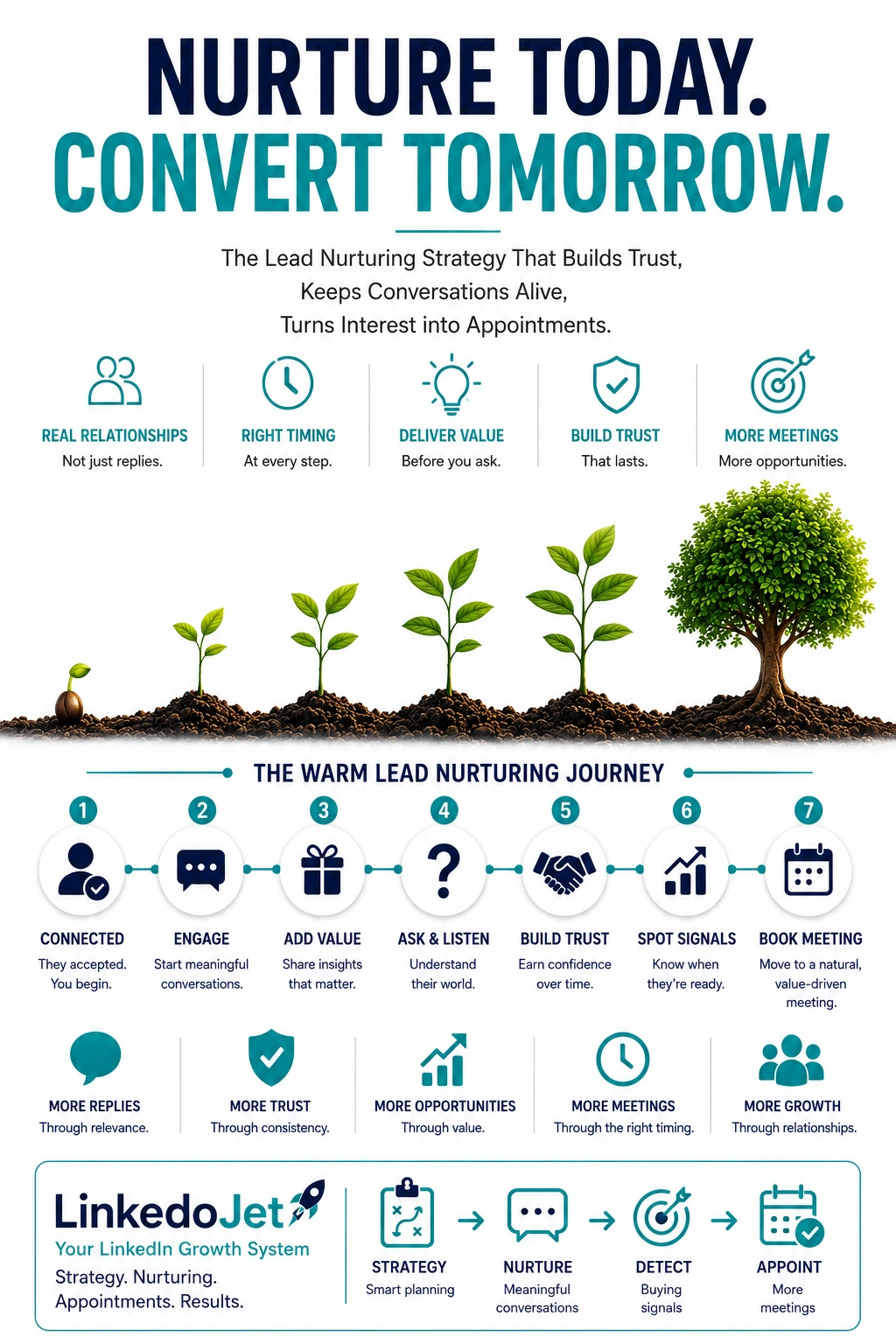
Treat the thread like an audit trail: symptom → root category → urgency → sponsor → contained next step.
RevOps buyers don’t buy “consulting.” They buy relief from recurring embarrassment: forecast surprises, board pressure, CRM chaos, handoffs that break, marketing/sales attribution wars, pipeline stages that don’t mean anything.
Your nurture has to move the thread forward without forcing a commitment too early.
- Symptom: Reflect what they’re already feeling in their own language. (“Forecast is political.” “Routing is inconsistent.” “Duplicates everywhere.”)
- Root category: Sort it quickly so you don’t spiral into a 30-message thread. Most RevOps messes fall into a few buckets: definitions, process, governance/adoption, data integrity, tooling, or operating rhythm.
- Urgency: Find the calendar. Month-end? Quarter planning? New VP Sales? CRM migration? Board meeting? That’s where decisions get made.
- Sponsor: Identify who can carry it internally. The person replying might be the operator, not the economic buyer.
- Contained next step: Offer a small, safe move with a clear output. Not “let’s chat.” More like: “30 minutes to produce a one-page problem statement + 2–3 hypotheses + what to check in Salesforce/HubSpot this week.”
Message bank (RevOps-native, non-templated)
These are continuation messages. Each has a purpose and a moment.
1) First warm follow-up after connection acceptance (no meeting ask)
Message:Thanks for connecting — saw you’re owning RevOps across [Sales/RevOps] right now. Quick question: if you had to pick one thing that’s most fragile this quarter, is it forecast trust, routing/SQL quality, or stage discipline?
Intent: Earn a one-line reply by offering tight options that match real RevOps pain.
2) Follow-up after a prospect replies (narrow to root category)
Message:Makes sense. When teams say “forecast is off,” it’s usually one of two things: reporting is fine but the definitions aren’t enforced, or definitions are fine but process/adoption is drifting. Which one sounds closer for you?
Intent: Convert “interesting” into a diagnostic fork without sounding like an interrogation.
3) Educational nurturing message (micro-framework they can run internally)
Message:Small framework that’s saved a few teams time: pipeline leakage usually sits in (1) definitions (what stages actually mean), (2) process (when/how it’s updated), or (3) governance (who enforces + what happens when it slips). If you want, tell me which CRM you’re on (SFDC/HubSpot) and I’ll share the 10-minute sanity check we use to spot which bucket you’re in.
Intent: Offer practical value that doesn’t require a meeting or a content download.
4) Insight-based follow-up (calendar/event triggered)
Message:Heads up — this is the part of the month where routing + stage hygiene quietly breaks because everyone’s chasing the number. If it’s useful, I can send the short checklist we use to catch “looks fine in dashboards, wrong in reality” before the forecast call turns into a debate.
Intent: Be timely and specific; give them a low-friction “yes.”
5) Proof-based nurture (vignette, no chest-thumping)
Message:Quick story you might recognize: sales-led SaaS, reporting looked clean, but stage criteria weren’t enforced so forecast became political. We didn’t start with tooling — we tightened definitions, added a lightweight governance rhythm, and made the handoff rules explicit. The outcome was boring (in a good way): fewer surprises and fewer arguments. If your pain feels similar, what’s the most contested stage right now?
Intent: Build credibility with a believable operational arc and a question that keeps it moving.
6) Soft question to reopen the conversation (easy one-line reply)
Message:Quick check — are you more focused right now on pipeline visibility (forecast/reporting) or lead flow quality (routing/SQL hygiene)?
Intent: Reduce cognitive load; make replying feel easy.
7) Buying-signal response (contained first step)
Message:Got it — “we’re changing our CRM / routing is inconsistent / forecast isn’t trusted” is usually the moment the hidden debt shows up. If you’re open, the clean first step is a 30-minute working session to map the symptom → likely root causes, then we leave you with a short checklist of what to pull from Salesforce/HubSpot (and what to ignore). No big engagement decision in that call.
Intent: Match urgency, but keep the step safe and defensible.
8) Soft meeting request (scoped, with output + easy out)
Message:If it helps, we can turn this into a tight scoping call: 30 minutes, output is (1) a one-sentence problem statement, (2) 2–3 hypotheses, (3) what to verify in your CRM this week, and (4) whether a small sprint is even worth doing. I’m free Tue 11–1 or Thu 2–4 ET — either work? Totally fine if now isn’t the moment.
Intent: Ask without pressure, and make the call about a deliverable, not “getting to know each other.”
9) Dormant lead revival (2–6 weeks quiet)
Message:Circling back on the routing + stage-discipline thread you mentioned. I’m guessing priorities shifted (they usually do around quarter-end). If this is back on the list, what’s the bigger pain right now: reps not trusting the fields, or the fields not reflecting reality?
Intent: Prove you remember the actual issue and restart with a diagnostic question.
10) Final polite close-loop (preserve relationship)
Message:No worries if this isn’t a priority right now. If it pops back up around planning/board prep, I’m easy to find. Want me to send a short checklist for validating stage definitions before next quarter?
Intent: Exit cleanly while planting a future re-entry point tied to their calendar.
Why warm RevOps leads go silent (and how to stay useful)
Silence is usually capacity + politics, not rejection.
When you sell RevOps work, you’re stepping into a messy room. The mess is the point. But it means your buyer is constantly choosing what pain to face this week.
Here’s what actually kills warm threads:
- You follow up during quarter-end fire drills. They’re triaging pipeline review, comp exceptions, and rep performance. Your message becomes “one more thing.”
- You send a “here’s what we do” paragraph. It reads like homework. And homework is exactly what they’re avoiding.
- You push a meeting before naming the symptom. Now they have to justify a call without a clear internal narrative.
- You talk tool-first when the issue is governance/adoption. They’ve already bought tools. The scar tissue is real.
- You share content that doesn’t match their stage. Too generic feels like noise. Too advanced feels like a lecture.
- You ignore politics. The person messaging you might need a VP Sales sponsor, or a founder’s permission, or a CFO’s timing window.
What works instead is staying situationally helpful. Short messages. Narrow questions. Calendar-aware nudges. Micro-diagnostics they can run between meetings.
If you’re not sure what to say, don’t send “checking in.” Send a fork that helps them sort the problem in one line: reporting vs definitions, routing vs stage discipline, data integrity vs process.
Buying-signal detection + disqualification (avoid the political traps)
Knowing when to lean in is half the win. Knowing when to pause protects your time and your name.
Warm nurturing isn’t about persistence. It’s about reading the room.
Signals to lean in (they’re giving you a doorway)
- Tooling change: “We’re moving HubSpot → Salesforce,” “new CPQ,” “new enrichment,” “new routing.”
- Forecast distrust: “We don’t trust our forecast,” “forecast calls are political,” “Clari isn’t landing.”
- Routing + SQL pain: “Routing is inconsistent,” “SQL quality is down,” “handoffs are broken.”
- Definition fights: “Stages don’t mean anything,” “lifecycle definitions aren’t consistent.”
- Board/leadership pressure: “Board is asking about pipeline coverage,” “new VP Sales starts next month.”
- They ask about process: “How would you approach this?” “What do you look at first?”
Signals to ignore (or treat as light interest)
- Likes/reactions with no other engagement.
- “Interesting” with no detail, after you’ve already offered an easy fork question.
- Generic curiosity about RevOps as a concept (often content consumption, not intent).
Disqualify or pause when the deal will get you stuck
- No owner + mid-reorg: “We’re reorganizing and nobody owns RevOps right now.” (Offer a checklist, then step back.)
- Vendor-shopping without a sponsor: They want “options” but can’t name who will approve time/money.
- Full RevOps function for a tiny budget: Scope mismatch creates resentment on both sides.
A clean disqualify protects your brand. You can still be helpful without chasing.
FAQs
How do I nurture LinkedIn leads for RevOps consulting without asking for a meeting too early?
Use a temperature model and earn the next reply before you earn the next meeting. At light interest, ask a tight operator question with two or three realistic options (forecast vs routing vs stage discipline). At active interest, narrow the symptom into a root category and offer a micro-diagnostic. Only propose a call once they’ve named a problem in their language—and frame it as a contained scoping step with a clear output.
What follow-up cadence works for warm LinkedIn leads when prospects are in quarter-end or a tool rollout?
Keep it humane and calendar-aware: a short check-in 2–4 days after a signal, then 7–10 days later with a timely observation (month-end, planning, rollout), then a 2–4 week revival if they go quiet. The cadence matters less than the depth match: quarter-end messages should reduce work (checklist, fork question), not introduce it (long pitch, big ask).
What are the most reliable RevOps buying signals in LinkedIn conversations (and what should I ignore)?
Lean in when they mention a trigger: forecast distrust, routing issues, inconsistent definitions, CRM migration, new VP Sales, board pressure, attribution fights, or tool adoption failure. Treat likes and profile views as light interest until they reply with a symptom. Ignore “interesting” if they won’t answer a narrowing question—assume bandwidth, not rejection.
Can you share LinkedIn lead follow-up message examples that don’t sound templated for RevOps buyers?
Yes—use messages that sound like an operator continuing a real thread: ask whether the pain is reporting vs definitions, routing vs stage discipline, data integrity vs process. Offer a 10-minute sanity check in Salesforce/HubSpot. Reference real moments (month-end, re-forecast, tool rollout) and keep the message short enough that replying feels safe.
How do I convert a LinkedIn thread into a scoped discovery call with a clear output (not a vague “chat”)?
Once the symptom is named, propose a 30-minute scoping call with deliverables: a one-sentence problem statement, 2–3 hypotheses, what to pull from the CRM, and whether a small sprint is worth it. Offer a time window and an easy out. The call is a decision aid, not a commitment to a broad engagement.
If you want this run daily, LinkedoJet will operate it with you
Targeting, AI-assisted personalization, outreach execution, reply handling, and warm-thread nurturing—so your RevOps pipeline isn’t left to memory and mood.
LinkedoJet isn’t a tool you log into when you remember. It’s an outbound engine we help run.
Before outreach starts, we set up your ICP and targeting system (roles, seniority, segments, geo, tech context) and build Sales Navigator/LinkedIn prospect lists that match how RevOps consulting actually gets bought: VP Sales sponsors, Heads of RevOps operators, founders when the trigger is board/forecast/tooling.
Then we execute the outreach with AI-assisted personalization that stays grounded in RevOps reality. Not fake compliments. Context: forecast pain, routing breakage, stage definitions, attribution disputes, CRM hygiene, and tool adoption scars. The goal is simple: earn replies that contain symptoms, not polite dead-ends.
When replies come in, LinkedoJet supports lead reply handling and nurturing. Threads get tagged by temperature (light, active, problem-aware), and the next-best follow-up is prompted based on what they said and where they are in their calendar. You keep the operator voice; we keep the progression consistent.
Over the following weeks, we run humane follow-up workflows that respect quarter-end and rollout chaos. Warm leads are tracked so you don’t lose the thread right before the trigger hits. When buying signals show up—“we don’t trust forecast,” “routing is inconsistent,” “we’re changing our CRM,” “definitions aren’t consistent”—we help convert the conversation into a contained scoping call with a clear output.
You also get visibility. LinkedoJet provides campaign dashboards so you can see what’s happening: targeting coverage, message performance, warm-lead counts by temperature, reply themes, and booked appointments. And we refine the campaign as patterns emerge (which roles respond, which pain angles convert, where threads stall).
What this is not: ordinary LinkedIn automation blasting sequences. If you sell RevOps, your reputation is the product. The system has to protect trust while still moving threads forward.
If you book a session, we’ll review your current targeting and warm-thread patterns, show you how we’d structure the nurture progression, and outline what we’d run after onboarding—list building, personalized outreach, follow-up workflows, warm-lead tracking, and appointment generation support.
Next step: turn warm threads into scoped calls without rushing the buyer
If your LinkedIn inbox is full of “almost,” the fix isn’t more messages. It’s better progression, better timing, and a system that doesn’t forget.
After onboarding, LinkedoJet sets up targeting, builds your prospect lists, runs AI-assisted personalization, executes LinkedIn outreach, handles and nurtures replies, tracks warm leads, and supports appointment generation—so you stay relevant until the trigger hits, then convert cleanly into a scoped call.
From identifying the right decision-makers to starting meaningful conversations and turning them into qualified appointments... LinkedoJet manages the entire outbound engine for your business.