
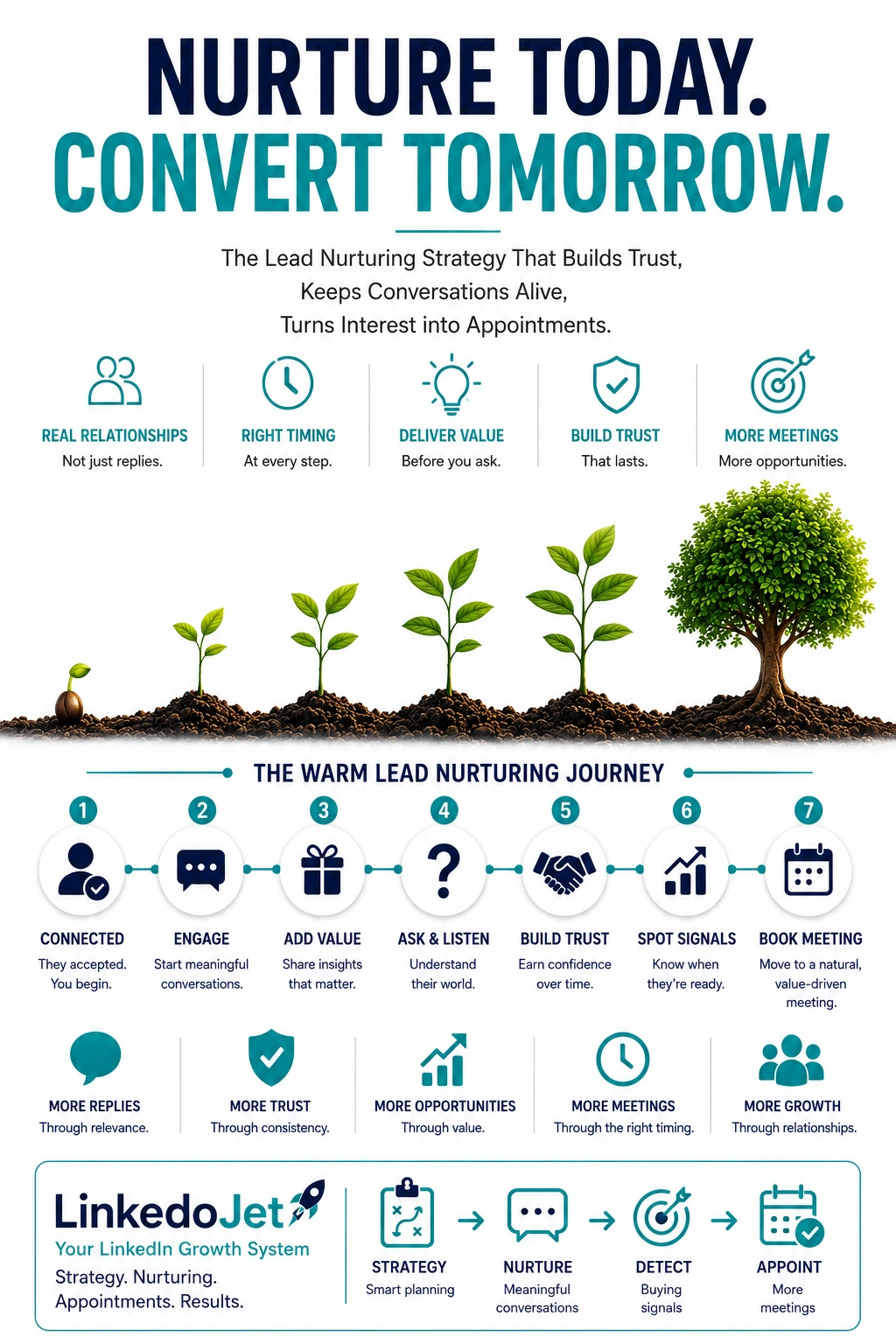
The quiet failure: when “good to connect” turns into pipeline limbo
Warm touchpoints feel like progress until you walk into the BD meeting with a list of names… and nothing moving toward a req.
You know the pattern.
A Head of Talent accepts your connection. A founder replies “good to connect.” A hiring manager likes a post about time-to-hire. You send a thoughtful note. Then the thread just sits there—polite, weightless, and going nowhere.
It’s not just lost deals. It’s brand damage by a thousand tiny silences.
Every time a conversation dies after that first flicker of interest, you get mentally filed with the agencies who push for a call too early, send “any updates?” every week, and try to prove value by dumping CVs before there’s even a scorecard. When you show up again, you’re not “the specialist who runs clean remote searches.” You’re “another recruiter in my inbox.”
And the commercial cost is real: your pipeline becomes lumpy. Your forecast becomes vibes. You end up over-weighting cold outbound the week you need meetings, because your “warm list” isn’t actually warm—it’s un-routed.
The worst part is the emotional tax. You can feel the credibility slipping when you type a follow-up that sounds like everyone else. You hesitate, you delay, and the gap gets bigger. Now you’re not nurturing. You’re reviving. And revival always feels more desperate than progression.
Why hiring leaders go silent (and why it’s rarely “no”)
Remote hiring buyers don’t ghost because your message was bad. They go quiet because their world is messy, and most agencies make it messier.
Hiring-side decision makers are overloaded and cautious. They’re juggling internal TA, two existing vendors, interview loops that keep slipping, and headcount plans that change mid-quarter.
When you’re selling remote hiring services, the bar is higher than “we can find candidates.” Remote adds constraints that make buyers risk-averse: time zones, comp bands vs location rules, async expectations, and the reality that “remote” isn’t a role—it’s an operating model.
So silence tends to come from a few very human places:
- Bandwidth collapse: they were genuinely open, then a key interview process went sideways, a manager went on PTO, or delivery pressure spiked.
- Shifting headcount: “approved” turns into “paused” turns into “maybe next month,” and nobody wants another vendor relationship to manage during uncertainty.
- Vendor fatigue: they’ve already been burned by generic shortlists, irrelevant outreach, and agencies that start with candidates instead of intake discipline.
- Remote-specific fear: they’ve seen late-stage drop-off, comp pushback, and “profile drift” when the scorecard is vague. They won’t take a call with someone who sounds like they’ll add noise.
When you treat that silence like rejection, you either disappear (and lose timing) or you push harder (and lose trust).
The actual job of warm nurturing is calmer: stay credible, stay relevant, and make it easy for them to re-engage when urgency returns—without training them to ignore you.
A temperature model that actually fits recruiting BD
Stop calling everything “warm.” Assign a temperature, then match the ask to the stage.
Most agency follow-up fails because the conversation has no progression system. You’re guessing when to push and when to wait, so every message risks sounding like pressure.
Use a simple four-stage model for LinkedIn warm leads:
| Stage | What you’re seeing on LinkedIn | What to do next | What to avoid |
|---|---|---|---|
| Curious | Profile view, post engagement, connection accepted, polite “good to connect” reply | Ask a one-line question; offer a small artifact; keep it light | “Quick call?” / “Send the JD” / fee talk |
| Problem-aware | Mentions hiring pain: shortlist quality, drop-off, time-to-hire, remote constraints | Share a relevant micro-insight; confirm the constraint; propose a tiny next step | Generic positioning (“we recruit across roles/industries”) |
| Active | Role open or imminent; asks about regions/time zones, comp cap, speed, process | Run mini-calibration in chat; propose a 15-minute calibration to align scorecard + timeline | Sending candidates before intake; over-promising speed |
| Urgent | “Open 2 months,” “pipeline is weak,” “none qualified,” “need EMEA,” “blocked delivery” | Diagnose fast; book calibration; align decision path; confirm constraints | Spray-and-pray follow-ups; long messages; big decks |
This model does two things: it protects your brand, and it protects your time. You stop chasing Curiosities like they’re Actives. You stop “nurturing” Urgents with content when they need alignment and action.
Signal-based follow-up: match the message to what they actually did
The signal tells you what they’re ready for. Your job is to respond like someone who’s run real remote searches, not like someone filling a sequence.
Warm lead nurturing works when you treat each signal as a different doorway into the conversation.
- Profile view after a remote hiring post: they’re curious, scanning credibility. Keep it short. Ask a one-line question about what role types are on their roadmap, or what tends to break in their process.
- Content engagement (likes/comments): they’re reacting to a pain or belief. Follow up on the specific theme: late-stage drop, comp transparency, time zones, interview loops, async expectations.
- Polite reply (“good to connect”): they’re acknowledging you, not inviting a pitch. Earn a micro-commitment—permission to send a checklist, a benchmark, or a scorecard outline.
- Role-specific questions: now you can get sharper. Ask 2–3 calibration questions in-thread, then offer a 15-minute calibration to align scorecard + timeline.
The mistake is treating every signal as permission to sell. A profile view is not a buying signal. It’s a credibility check. If you respond with a meeting ask, you fail the check.
Another quiet killer: over-personalizing irrelevant details (“saw you like skiing”). Hiring leaders don’t want a pen pal. They want confidence that you’ll run a disciplined intake, protect their time, and not flood them with mismatched candidates.
Message examples you can actually send (without sounding like a CV-dumping vendor)
Short, situational, and built around micro-commitments that earn a calibration call.
First warm follow-up after connection acceptance
When to use: connection accepted; you have a real reason to reach out (job post, new hire, remote growth signal).
Message:
Thanks for connecting, <
Follow-up after they reply (including “we’re covered right now”)
When to use: they respond, but signal timing or low urgency.
Message:
That makes sense—most teams I speak to are trying to avoid adding more vendors unless there’s a real gap. If helpful, I can send a one-page scorecard outline we use for remote <
Also—when does headcount planning usually firm up for you (month-end, quarter-end, post-funding, after OKR reviews)? Happy to check back around that window instead of doing random bumps.
Educational nurturing message (short, not a lecture)
When to use: Problem-aware leads; they engaged with hiring process content; you want to stay useful.
Message:
One remote hiring pattern I keep seeing: late-stage drop-off spikes when the calibration call doesn’t lock “must-have” vs “nice-to-have” with examples. The fix is boring but effective—write the scorecard as observable behaviors (what good looks like in week 4), not traits. If you want, I can share the 6-question calibration prompt we use to get hiring managers aligned in 10 minutes.
Insight-based follow-up (market signal tied to a question)
When to use: they’ve been quiet; you have a real signal to reference (comp pushback, location constraints tightening, time-zone requirements narrowing).
Message:
Quick heads-up from recent remote searches: we’re seeing more comp pushback when roles are “remote” but effectively require overlapping core hours in a single region. Candidates read that as hybrid-without-saying-hybrid. Are you seeing slower acceptance / more negotiation on your side, or is your funnel still moving?
Proof-based nurturing (process, not bragging)
When to use: they need evidence you run a tight intake and protect quality.
Message:
For what it’s worth, the last time we supported a remote <
Soft question to reopen the conversation
When to use: thread went quiet after early interest.
Message:
Assuming you got pulled into hiring fires. Simple check—are you still paused on adding outside support, or is <
Buying-signal response (diagnose before prescribing)
When to use: they express urgency: “open 2 months,” “none qualified,” “need EMEA,” “pipeline weak.”
Message:
Got it—that’s a real signal, not a “we’ll see.” Before I suggest anything, can I ask 3 fast calibration questions?
1) What are the non-negotiables (stack/region/time-zone overlap/security constraints)?
2) What’s the comp band you can actually close at (not the wish number)?
3) What does your interview loop + decision timing look like right now?
If you’re open, the quickest way to get this unstuck is a 15-minute calibration. We’ll align on the scorecard and the process so the shortlist doesn’t create more work for you. Want to grab a slot?
Soft meeting request (working session tone)
When to use: Active or Urgent; they’re willing to discuss scorecard/process/timeline.
Message:
Rather than a generic call, would a 15-minute calibration be useful? We can align the scorecard (must-haves vs tradeoffs), confirm comp + time-zone constraints, and map the interview loop so candidates don’t drop late-stage. If timing isn’t right, no stress—just tell me when you’d want to revisit.
Dormant lead revival message (offer a small artifact)
When to use: they went quiet after some traction; likely blocked by budget/internal alignment/hiring manager bandwidth.
Message:
Circling back gently, <
Final polite close-loop message (protect the brand)
When to use: repeated silence; you want to stop chasing without burning the bridge.
Message:
I’m going to close the loop on my side so I’m not adding noise. If a role opens and you want a quick calibration, just reply “calibration” and I’ll send a couple of times. Either way—appreciate the connection.
Where warm threads die in recruiting BD (and how to stop looking like every other agency)
Most stalls come from one of five moves that scream “vendor,” not “partner.”
If your warm leads keep stalling, it’s rarely because you didn’t follow up enough. It’s because the follow-up made them feel managed.
- Premature escalation: asking for a call right after “good to connect.” A busy Head of Talent reads that as “here comes the pitch.”
- Identical nudges: “checking in,” “any updates,” “bumping this.” Those don’t create a reason to respond.
- CV dumping as proof: sending candidates before intake signals low bar. It also creates work for the buyer and undermines your credibility on process.
- Generic positioning: “we recruit across roles/industries.” Hiring leaders don’t buy breadth. They buy reduced risk on a specific hard-to-fill role.
- Ignoring the remote constraints: no mention of time-zone overlap, comp vs location reality, async culture fit, or interview loop discipline. Remote buyers hear “spray-and-pray.”
The fix is a progression system built around micro-commitments:
- A one-line answer (role family, biggest hiring failure mode, timing window)
- Permission to send one useful artifact (scorecard outline, calibration prompt, comp sanity-check)
- A short calibration when they show willingness to discuss scorecard + process + timeline
That last point matters: meeting readiness shows up when they’ll talk about how they decide, not when they say “send profiles.” “Send profiles” is often a deflection. Or a test to see if you’ll behave like the noisy agencies.
How LinkedoJet runs this as a system (tagging, routing, escalation, and when to pause)
Warm nurturing works when it’s operational, not improvisational. LinkedoJet builds the engine that keeps your agency credible until urgency spikes.
LinkedoJet isn’t “a LinkedIn automation tool.” It’s the operating system behind consistent client acquisition—especially the messy middle between first interest and a real intake.
Here’s how we run warm LinkedIn nurturing for remote hiring agencies:
- ICP + targeting setup: we define who actually buys (Heads of Talent, HRD, hiring managers, founders/COO) and the remote-specific filters that matter (location policies, role families, stage signals, hiring velocity).
- Sales Navigator prospect list building: we build and maintain lists that reflect real buying pools, not vanity titles. We segment by role family relevance (e.g., engineering vs product vs revenue) so your follow-ups sound intentional.
- Signal tagging: connections, profile views, engagement, replies, and role questions get tagged so you’re not guessing what the “warmth” means.
- Temperature staging: Curious → Problem-aware → Active → Urgent, with stage-appropriate prompts and asks.
- AI-assisted personalization: we generate context that sounds like a recruiter who understands remote constraints (scorecards, comp reality, time zones, async) without weird over-personalization.
- Outreach execution: the system runs the day-to-day sends and pacing so you don’t fall into frantic bursts before the BD meeting.
- Reply handling + nurturing: replies are routed by intent (timing, questions, objections, “send profiles”), with ready-to-send responses that keep the thread moving.
- Escalation rules: we only push to a 15-minute calibration when buying signals show up—willingness to discuss scorecard, process, timeline, constraints.
- Pause rules: if they’re on a freeze, locked into an exclusive partner, or ask to stop—LinkedoJet backs off to occasional high-signal touches instead of annoying check-ins.
- Warm lead tracking + appointment support: warm threads, next actions, and booked calibrations are tracked so nothing dies quietly after “good to connect.”
- Campaign visibility: dashboards show what’s happening (signals, replies, stage movement, appointments) so you can manage BD like an operator, not a guesser.
- Ongoing refinement: we adjust targeting, messaging, and cadence based on what’s converting in your niche and what’s stalling.
The outcome is simple: your agency stops “hoping warm leads come back,” and starts running a controlled progression that turns the right warm signals into calibration calls—without sounding like every other recruiter in their inbox.
Questions that come up when you start doing this properly
What’s a reasonable LinkedIn follow-up cadence for recruiting agency BD without annoying hiring managers?
Anchor it to temperature and signal, not a fixed sequence. For Curious leads, 1 touch every 10–21 days is usually enough if each message adds a reason to respond (question, artifact, relevant observation). For Problem-aware, you can move to 7–14 days. For Active/Urgent, follow the conversation rhythm—same day or next day replies—then switch to a 15-minute calibration instead of stretching the thread out.
How do I nurture a Head of Talent who says “we’re covered right now” without going quiet?
Accept it as timing, then earn permission for a light, useful touch. Offer one artifact (scorecard outline, calibration prompt, process benchmark), ask when planning typically firms up (month-end/quarter-end/OKR review), and set a respectful check-in window. The goal is to stay credible so when the internal team gets overloaded or a hard role opens, you’re the first message they answer.
What are the most reliable buying signals on LinkedIn for recruiting services (remote roles)?
Look for specificity and constraint-sharing: they name a role family, talk about regions/time zones, mention comp caps, admit the pipeline isn’t converting, or ask “how fast could you start.” Another strong signal is willingness to discuss scorecard and interview loop. “Send profiles” by itself is not a buying signal—it’s often a test.
How do I move from warm LinkedIn messages to a 15-minute calibration call without sounding salesy?
Don’t “pitch a call.” Propose a working session that removes friction: align must-haves vs tradeoffs, confirm comp band and time-zone constraints, and map the interview loop so candidates don’t drop late-stage. Give an easy out if timing isn’t right. Buyers say yes when the call feels like it will save time, not consume it.
What should I send instead of candidates when a prospect asks to “share profiles” before an intake?
Send discipline. Offer a scorecard outline, a 6-question calibration prompt, or a shortlist quality checklist. You can also offer a comp range sanity-check for the role family and location policy. Frame it as protecting their time: you don’t want to create work by sending mismatched profiles without alignment on must-haves, interview loop, and decision timeline.
If you want this running without living in LinkedIn all week
Book a demo session and we’ll show you the exact system LinkedoJet uses to turn warm LinkedIn touchpoints into calibration calls and client intake meetings—without burning trust.
You’re not here for more connection requests. You’re here because the middle is broken: “good to connect” turns into silence, and your pipeline becomes unpredictable.
LinkedoJet operationally provides the full outbound engine for remote hiring agencies:
- ICP and targeting setup tailored to who actually signs search agreements (Heads of Talent, HRD, hiring managers, founders/COO) and the remote constraints that shape buying decisions.
- Sales Navigator prospect list building with segmentation by role family and likely hiring triggers—so your nurturing stays relevant when headcount moves.
- AI-assisted personalization that reads like an operator: scorecard discipline, comp reality, time zones, async expectations, interview loop friction—without cringey “saw you like…” filler.
- LinkedIn outreach execution with pacing that respects hiring-side bandwidth.
- Lead reply handling and nurturing routed by intent (timing, role questions, objections, “send profiles”), so warm threads don’t die because nobody knew what to say next.
- Warm lead tracking across temperature stages (Curious → Problem-aware → Active → Urgent) with clear next actions and escalation rules.
- Appointment generation support so buying signals turn into a 15-minute calibration and then an intake—cleanly, without sounding salesy.
- Campaign visibility through dashboards so you can see signals, replies, stage movement, and booked appointments.
- Ongoing campaign refinement based on what’s converting and what’s stalling in your niche.
What happens after onboarding: we implement your targeting and lists, set the conversation progression logic, load stage-based follow-ups and reactivation touches, and start running outreach + nurturing daily. You get visibility, you get warm-thread control, and you stop relying on “remembering to follow up.”
What you receive: a managed system—targeting, prospect lists, personalization, outreach, nurturing workflows, warm lead tracking, and appointment support—built to keep your agency credible until urgency shows up.
Why this is different from ordinary LinkedIn automation tools: tools send messages. They don’t build your targeting, don’t route intent, don’t handle replies, don’t manage warm lead temperature, and don’t help you turn real buying signals into scheduled calibrations. LinkedoJet does.
From identifying the right decision-makers to starting meaningful conversations and turning them into qualified appointments... LinkedoJet manages the entire outbound engine for your business.
Turn warm threads into calibration calls—without chasing
If you already have LinkedIn warmth, the fastest win is a progression system: signal tagging, temperature staging, stage-appropriate follow-ups, and clean escalation to a 15-minute calibration when buying signals appear. LinkedoJet sets this up and runs it with you.