
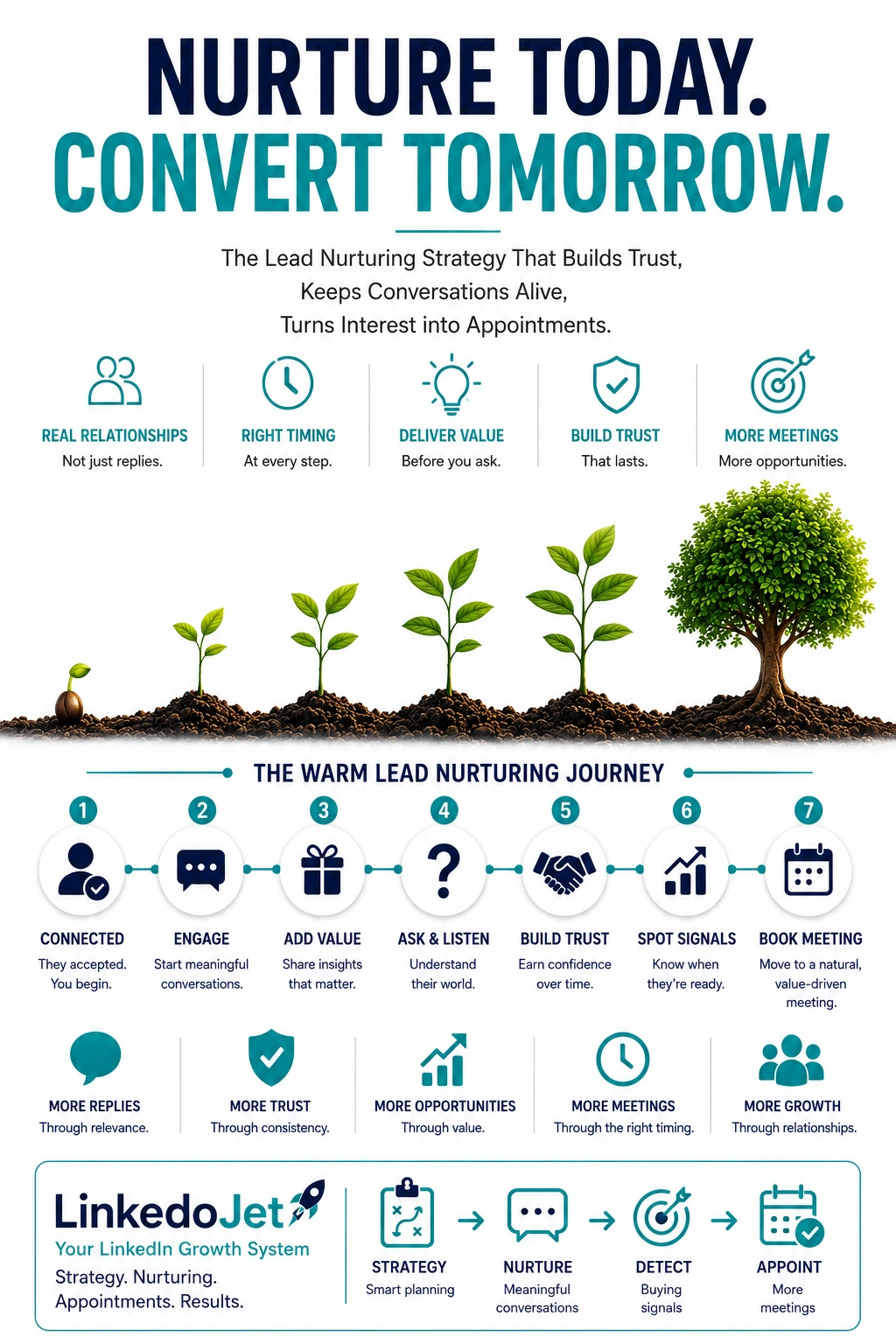
Warm doesn’t mean ready—and dead threads are quietly stealing your next intake calls
If you’re getting accepts, occasional replies, and even profile views after you comment on a hiring post… but nothing turns into a role briefing, you’re not alone. You’re also not “bad at BD.”
Warm LinkedIn leads in recruitment are slippery. A Head of Talent can be open on Monday and disappear by Wednesday because the req got merged, the approver changed, internal TA stepped in, or nobody wants to admit there’s a freeze.
The painful part is the energy drain: you do the right things—connect, respond, follow up—then you’re left staring at a thread that makes you feel needy if you ping again.
Most agencies lose the account in this window. Not because the buyer hated you. Because your next message asked for too much, too early.
Here’s what “warm” usually looks like in staffing (and why it’s deceptive):
- Connection accepted after you referenced a hiring post, their function, or a mutual context.
- One reply to a lightweight question (“what are you seeing in the market?” / “are you building that team this year?”).
- Profile view right after you commented on a role post or liked a hiring-related update.
- Engagement with content about hiring process, compensation, or interview speed.
- A micro-question that signals curiosity (“How long are notice periods right now?”).
Warm is not a stage in your CRM. It’s a timing-and-context state. Your job is to stay relevant until the hiring window opens—then earn the right to a short calibration call that saves them time (and protects them from the agency behavior they hate).
A simple lead-temperature model that fits staffing reality: Green / Amber / Grey
Stop treating warm like “interested.” Treat it like a read on urgency, risk, and timing—and tailor the next message to that.
Recruitment follow-up fails when every lead gets the same cadence and the same ask. A hiring manager in pain doesn’t need a “checking in.” They need a recruiter who can calibrate the problem quickly. Someone who isn’t hiring right now doesn’t need a push. They need a reason to remember you later.
| Temperature | What you’re seeing | What your next message must achieve |
|---|---|---|
| Green (active / urgent) | Mentions a role title, backfill, headcount, urgency, low supplier quality, “we can’t find X,” “our process is slow,” “comp is tricky,” hiring post, interview loop pain | Confirm the hiring context fast: must-haves vs nice-to-haves, timeline, interview stages, comp reality, what “good” looks like. Then offer a 15-minute calibration. |
| Amber (probable / brewing) | Team growth, new manager, funding, project start, quarter planning talk, “later this quarter,” “we’re building,” but no live req | Stay useful without forcing it: share a relevant benchmark or question that surfaces constraints (location, comp, speed). Get permission to check back at a sensible time. |
| Grey (not now, but receptive) | Accepts connection, light engagement, asks a market question, polite reply with no timing | Earn future access: give a small piece of context, offer a lightweight resource (checklist/benchmark), and set a low-pressure recheck point. |
The point is control. When you match message to temperature, you stop burning accounts with premature meeting pushes. You also stop wasting your team’s time “following up” on leads that aren’t actually in a hiring moment.
Why hiring-side buyers go quiet (and what to do instead of “checking in”)
Silence in staffing usually means one of a few very specific realities. If you can name the reality without making it awkward, you become the adult in the room.
Hiring managers and Heads of Talent don’t ignore you because your copy wasn’t clever. They ignore you because the downside of engaging the wrong recruiter is high: CV dumping, wasted interviews, internal stakeholder noise, and the sense they’re losing control of the process.
Common quiet-reasons I’ve seen repeatedly:
- Vendor fatigue: they’re already getting hit with “quick chat?” messages, and every reply invites more.
- Internal TA control: the Head of Talent doesn’t want a manager going rogue with suppliers. The manager doesn’t want to admit they’re stuck.
- Freeze / re-approval: headcount pauses happen mid-week. Nobody announces it on LinkedIn.
- Procurement creep: even if the manager wants help, they can’t engage without a vendor process.
- Decision drift: no alignment on level, comp, location, or interview loop—so the “req” is more of a wish.
What changes in your follow-up when you accept those realities:
- Fewer nudges, more relevance. Every message needs a reason that makes sense to them, not to your CRM.
- Fewer asks, more calibration. You’re not selling a call; you’re reducing hiring risk.
- More permission language. “If it’s not on your radar, I’ll leave it” is disarming when it’s genuine.
One recruiter move that works surprisingly well: name the mess without drama. “Totally get it if priorities shifted” gives them a graceful way to re-engage.
Recruiter DM examples that keep threads alive and earn a calibration call
Short. Human. Specific to hiring outcomes. Use these as-is, then adapt the bracketed parts to the situation.
First warm follow-up after connection acceptance
When to use: they accepted your connection (often after a hiring post, mutual context, or role-related engagement). Goal is permission + one-question calibration, not a meeting.
Message:
“Thanks for connecting, [Name]. I reached out because I noticed you’re hiring in [function/role type] and I’m often pulled into the tricky ones (tight comp, hybrid constraints, long notice).
No pitch—quick question: when you hire [role], what usually breaks first for you: candidate quality, interview speed, or comp expectations?”
Follow-up after a prospect replies
When to use: they replied once. Goal is to keep momentum by narrowing the brief in-message.
Message:
“Helpful—appreciate that. When you say [their phrase], is this more [role A] or [role B] in practice?
And are you hiring in [location] only, or open to [remote/other region] if the profile is right?”
Educational nurturing message
When to use: Amber/Grey leads. Goal is to be useful and credible without asking for time.
Message:
“Quick market note in case it helps: for [role] we’re seeing notice periods stretch to [X–Y] weeks, which is pushing offers into ‘candidate re-think’ territory if the interview loop runs long.
If you want, I can share the two interview steps that tend to reduce drop-off without adding meetings.”
Insight-based follow-up
When to use: they’ve been quiet but previously engaged. Goal is a real conversation about constraints.
Message:
“Something I’m seeing on [role] searches: they stall when the must-haves aren’t ruthlessly defined early—so you end up interviewing ‘maybe’ candidates and losing two weeks.
Curious—when you last hired [role], what ended up being the true non-negotiable?”
Case-study or proof-based nurturing message
When to use: when you need credibility without bragging. Goal is to demonstrate process discipline.
Message:
“We just worked a hard-to-fill [role] where the first shortlist was getting ‘not quite’ feedback. The fix wasn’t more CVs—it was a 15-minute calibration on level + comp reality + what ‘good’ meant in week one.
After that, the shortlist tightened and interviews stopped drifting. If you ever want it, I’m happy to share the calibration checklist we used.”
Soft question to reopen the conversation
When to use: thread went quiet. Goal is an easy fork-in-the-road answer.
Message:
“Quick sense-check, [Name]—is hiring for [function/role] on your radar this quarter, or more of a later-in-the-year thing?
Either way is fine; I’d rather not be noise.”
Buying-signal response
When to use: they mention a role, urgency, supplier frustration, or process pain. Goal is to move into calibration mode.
Message:
“Got it—that’s a real hiring moment.
To make sure we’re not wasting cycles: what are the must-haves vs nice-to-haves for this [role]? Any hard constraints on comp, location, or timeline?
Also, how many interview stages are you running today, and where do candidates tend to drop off?
If you’re open, we can do a 15-minute calibration call to align the brief and process—then I’ll tell you honestly if it’s the kind of search we can run cleanly.”
Soft meeting request (calibration / intake)
When to use: after you’ve surfaced enough context that a call feels like a time-saver.
Message:
“Would it be useful to do a quick intake/calibration on this? 15 minutes, tight agenda: profile (must-haves), comp reality, timeline, interview stages, and what a ‘good shortlist’ looks like.
I’m free [Tue 11:00–12:00] or [Thu 15:00–16:00]. If neither works, tell me what’s easier and I’ll work around it.”
Dormant lead revival message
When to use: weeks of silence. Goal is relevance + easy reply + no guilt.
Message:
“Hey [Name]—assuming priorities shifted since we last spoke (that’s normal). I noticed [trigger: quarter planning / new leader / hiring post / team growth update].
If you’re touching [role] at all this quarter, I can share what we’re seeing right now on comp + candidate availability. Worth it, or should I leave you in peace until things firm up?”
Final polite close-loop message
When to use: you want to protect the account and stop chasing. Goal is to step back while staying positioned as competent.
Message:
“I’m going to close the loop on my side so I’m not cluttering your inbox.
If a hard-to-fill [role] lands (or an internal process gets stuck), message me and I’ll send a quick calibration checklist / market snapshot to help you pressure-test the brief before you burn interview time.”
Cadence that fits staffing reality: protect the account, vary the reason, match the temperature
If your cadence feels like “follow-up theater,” buyers can smell it. Good cadence is quiet confidence: spaced, relevant, and easy to ignore without penalty.
The mistake is following up on a schedule. The better move is following up when you have a reason that makes sense to a hiring-side buyer.
A practical cadence guide (adjust for your market and seniority level):
- Green: tighter spacing because the hiring moment is live. 1–3 days between messages is fine if each message progresses calibration (profile, comp, process, timeline). If you’re repeating yourself, stop.
- Amber: 7–14 days between touches. Each touch should bring a new angle: a benchmark, a trade-off, a short process observation, or a permissioned check-in tied to quarter planning.
- Grey: 21–45 days. Stay present with one useful note or a clean close-loop that makes it easy for them to come back when hiring becomes real.
Ways to vary the “reason to follow up” so you don’t sound like the same message wearing different clothes:
- A specific market shift (comp bands, notice periods, candidate availability).
- A process insight (where similar searches stall, how to reduce drop-off).
- A timing prompt (quarter planning, project kick-off, seasonal spikes).
- A credibility moment (tight lesson from a recent search, not a trophy story).
- A forked question (this quarter vs later; internal vs external help).
Also: stop sending long paragraphs about your services. Hiring-side buyers don’t need your agency story. They need proof you can run a clean search and not waste their week.
Ethical timing cues on LinkedIn: signals you can act on without sounding creepy
You can use signals to time follow-up. Just don’t narrate the surveillance.
LinkedIn is full of “permissionless” cues. The line is simple: use the cue to choose your angle, not to prove you noticed them.
- Profile view after you comment on a hiring post: treat as Amber. Send a light, permission-based opener with one calibration question. Don’t say “saw you viewed my profile.”
- They engage with hiring/process content repeatedly: send an educational nurture note (“we’re seeing offer-stage drop-off when X happens”). Keep it short.
- Job posts or hiring announcements: Green or high Amber depending on seniority. Ask one question that clarifies urgency and constraint (location/comp/interview speed).
- Team growth / funding / new project chatter: Amber. Timing-based prompt: “Is [function] hiring on the roadmap this quarter or later?”
- Leadership change (new VP, new Head of X): Amber to Green. Offer a calibration lens: “Usually the first hires set the bar—happy to share what we’re seeing for [role] right now.”
- They post about being stretched / delivery pressure: Green signal for process help. Messaging angle: reduce time-waste, tighten shortlist quality, avoid interview churn.
What not to do (and why it backfires in staffing):
- Turn the connection into an immediate pitch. You become “another agency.”
- Ask “any roles?” It signals you haven’t done the work and you’ll likely CV dump.
- Push candidates before calibration. Buyers read it as volume-first behavior.
- Follow up every 48 hours. You don’t look persistent; you look unmanaged.
- Vague personalization. “Love what you’re doing” makes sophisticated buyers distrust everything that follows.
FAQ
What counts as a “warm” LinkedIn lead for a recruitment or staffing agency?
Warm means they’ve given you a real signal: they accepted your connection with context, replied once, asked a small market question, engaged with hiring-related content, or viewed your profile after you interacted with a hiring post. It’s not “interested.” It’s “aware and receptive enough to talk when timing lines up.”
What’s a practical LinkedIn follow-up cadence for recruiters without becoming noise?
Match cadence to temperature. Green leads can handle closer spacing if you’re actively calibrating (profile, comp, process, timeline). Amber is usually weekly to bi-weekly with a new reason each time. Grey should be light-touch monthly or less, often with a clean close-loop posture so you protect the account.
How do I follow up with hiring managers on LinkedIn without being pushy or sounding like every other agency?
Drop the meeting ask until you’ve earned it. Use permission language, one sharp calibration question, and relevance tied to their likely constraints (location, comp, interview speed, candidate drop-off). The tone that works is “I’m here if this becomes real” rather than “I need your time.”
How do I revive a dead LinkedIn conversation with a hiring manager or Head of Talent?
Assume priorities changed and give them an easy reply. Use a trigger (quarter planning, new leader, hiring post) or offer a quick benchmark (“happy to share what we’re seeing for [role] right now”). Avoid guilt, avoid “just checking in,” and include a graceful exit.
What are buying signals from hiring managers on LinkedIn that justify a calibration (intake) call?
Direct signals: role titles, headcount, urgency, backfills, complaints about supplier quality, time-to-hire pressure, or questions about fees/exclusivity/process. Subtle signals: they talk about comp ranges, interview stages, internal capacity limits, or say “not hiring right now” while still asking market questions. When you can clarify must-haves, comp reality, and process in 15 minutes, a calibration call is justified—and often welcomed.
If you want fewer dead threads, you need a system—not more willpower
LinkedoJet helps recruitment agencies run warm-lead nurturing like an operating rhythm: consistent, relevant, and tracked—so the right conversations turn into intake calls when timing is real.
Here’s what we operationally provide (this is not a “here are some tips” call, and it’s not a generic LinkedIn automation tool):
- ICP and targeting setup for hiring-side buyers you can actually win (hiring managers, Heads of Talent, HRBPs, business leaders), segmented by role families, regions, and hiring patterns.
- Sales Navigator / LinkedIn prospect list building so your team isn’t guessing who to message—or recycling stale lists.
- AI-assisted personalization that stays grounded in hiring reality (signals, role context, constraints) rather than fake flattery.
- LinkedIn outreach execution with temperature-aware sequences that don’t burn accounts.
- Lead reply handling and nurturing so warm replies don’t die when you’re in delivery mode.
- Warm lead tracking (why they’re warm, what was last discussed, what the next-best touch should be, when to pause).
- Appointment generation support to move the right threads into 15-minute calibration/intake calls at the moment there’s a real hiring signal.
- Campaign visibility through dashboards so you can see volume, reply quality, warm lead movement, and where conversations stall.
- Ongoing campaign refinement based on what buyers actually respond to in your niche (not theory).
On the session, we’ll look at your current outbound motion (or lack of one), the roles/markets you want to win, and the typical points where your conversations go quiet. Then we’ll outline the exact operating setup: targeting, message angles by temperature, follow-up cadence, and the handoff point into a calibration call.
After onboarding, you’re not left with a template pack. You receive a managed outbound engine: lists, sequences, personalization, execution, nurturing workflows, and visibility—run week to week so your team can focus on delivery while conversations keep moving.
Why LinkedoJet is different from ordinary LinkedIn automation tools: tools send messages. LinkedoJet runs the system around the messages—targeting, timing, reply handling, nurture logic, and booked-call support—so warm interest turns into real intake conversations.
Next step: turn warm threads into booked intake calls—without chasing
If you’re already getting accepts and replies, the upside is close. The gap is follow-up discipline: temperature, timing cues, nurturing, and a clean shift into calibration.
From identifying the right decision-makers to starting meaningful conversations and turning them into qualified appointments... LinkedoJet manages the entire outbound engine for your business.