
Why warm podcast leads go silent on LinkedIn (and what it’s costing your studio capacity)
If your DMs are full of “almost,” you don’t have a lead problem. You have a momentum problem.
You know the pattern.
They like a clip. Comment on a guest announcement. View your profile twice in a week. Accept the connection. Maybe even ask, “How much does this cost?”
Then the thread dies in the quiet middle.
Not because they’re flaky. Because podcast decisions don’t die at the top. They die at the point where someone has to own the weekly reality: who hosts, who approves, who shows up, and what happens when the first two episodes don’t magically create pipeline.
That’s where your studio takes the hit:
- Capacity planning becomes guessing. You can’t forecast retainers because half your “pipeline” is trapped in DMs with no next step.
- You keep hunting for new leads while warm opportunities quietly cool.
- Follow-up turns into mental load. Production is running. Sales gets “later.” Later becomes never.
Most agencies treat warm follow-up like persistence: check in until they book.
But podcast services aren’t bought on desire. They’re bought when the buyer can picture a sustainable workflow and can name an internal owner.
When you push for a call too early, prospects feel it. Not as pressure—more like, “We don’t even know what we’re building yet.” And when you wait too long, you disappear into the noise of launches, quarter resets, and internal meetings.
The goal of nurturing isn’t to get a reply. It’s to move them one decision forward: from vague enthusiasm to clarity on format, ownership, cadence, and the first 30–45 days of execution.
The lead-temperature model that matches podcast buying cycles: Curious → Considering → Coordinating → Committed
Podcast retainers get approved through internal coordination, not “high intent” keywords.
If you sell production, editing, booking, distribution, repurposing, or growth packages, your buyer’s brain is usually doing two calculations at once:
- Will this actually ship every week? (workload + approvals)
- Will this be worth the attention? (content output + sales enablement + partner value)
Warm LinkedIn signals tell you interest. They don’t tell you readiness. That’s why a simple temperature model stops the guessing.
| Temperature | What it looks like on LinkedIn | What they’re actually deciding | Your job in follow-up |
|---|---|---|---|
| Curious | Engages with clips, accepts connection, profile views, light replies | “Is this relevant to us?” | Earn permission to keep talking. Offer something concrete and low-friction. |
| Considering | Asks about process, timeline, pricing range, or “how do you handle X?” | “Is this realistic for our team?” | Reduce risk. Shape concept + format. Surface workload constraints early. |
| Coordinating | Mentions stakeholders, approvals, host availability, quarter planning | “Can we run this internally?” | Give them a workflow + ownership plan they can forward internally. |
| Committed | Discusses timing, budget, examples, wants to see packages | “Who do we pick, and what’s next?” | Make the call specific. Narrow scope. Get to a working session, not a vague chat. |
This is the hidden mistake: most agencies treat every warm lead as “book a call.”
But the buyer isn’t buying a call. They’re buying certainty that the show won’t die after six episodes, that clips will actually ship, and that approvals won’t turn into a weekly fight.
So your follow-up has to match the stage. Curiosity gets insight. Considering gets clarity. Coordinating gets a plan. Committed gets a clean, scoped invite.
Message examples you can actually send (by stage) to shape the decision and earn the next step
Short. Specific. Operator language. No “checking in.”
1) First warm follow-up after connection acceptance
Use when they accepted but haven’t engaged further. You’re setting a helpful tone and offering something concrete without pitching.
“Thanks for connecting, <
2) Follow-up after a prospect replies
Use when they answer a question or react to your message. You don’t need to “sell.” You need a readiness signal.
“That makes sense. When you picture the show working, is it more ‘founder thought leadership’ or ‘customer/operator stories’? The answer changes the format and how much lift your team has week to week.”
3) Educational nurturing message
Use when they’re curious but drifting. Teach something that prevents common failure (especially repurposing that feels native on LinkedIn).
“Quick one I’ve seen a lot: teams default to 60-minute interviews and then struggle to turn it into LinkedIn clips that feel native. We’ve had better results starting with 25–35 minutes, tighter segments, and planning the first 10 clip angles before recording. Happy to share an example outline if helpful.”
4) Insight-based follow-up
Use when they post about an initiative and you can connect it to a show angle. This lands because it helps them picture episodes, not outcomes.
“Saw your post about <
5) Case-study / proof-based nurturing message
Use proof as risk reduction. The real objection is usually time and internal coordination, not editing quality.
“One reference point: we worked with a B2B team where the sticking point was ‘we don’t have time.’ The fix wasn’t more editing—it was a producer-led prep doc + a 20-minute pre-call so the host shows up with structure. After that, recording stopped being the bottleneck. If you want, I can send the prep doc format.”
6) Soft question to reopen the conversation
Use when a thread cools. Give them an easy binary response.
“Curious where this landed on your side—did the podcast idea get a green light for this quarter, or is it more of a ‘when we have breathing room’ project?”
7) Buying-signal response
Use when they show timing intent (“Q3 launch,” “new product,” “founder wants to do more thought leadership”). Acknowledge and narrow scope.
“If you’re aiming for a Q3 launch, the main decision you’ll want locked is format + ownership: who hosts, who approves, and what cadence is realistic. Want to do a quick 15-minute working session to map that and see if it’s even worth building around?”
8) Soft meeting request
Use when they’ve engaged enough to justify a call, but you want it to feel diagnostic—not a pitch.
“If it’s useful, we can do a short intro call and I’ll walk you through what a sustainable weekly workflow looks like—recording, guest ops, editing, and repurposing—based on your team size. If it’s not a fit, you’ll still leave with a clear plan.”
9) Dormant lead revival message
Use when it’s been a while. Name the real reason (timing) and make it easy to decline.
“Circling back, <
10) Final polite close-loop message
Use when you’ve followed up properly and it’s time to protect your brand.
“Last note from me on this thread. If podcast becomes a priority later—launch support, guest pipeline, or just getting consistent clips out—happy to reconnect. Want me to check back in a few months, or would you rather I leave it here?”
Three warm scenarios podcast agencies see every week—and the follow-up path for each
You’re not chasing. You’re guiding the next decision.
Scenario A: They’re engaging with clips, but they’re not ready to own the project
What you’ll see: consistent likes/comments, maybe a connection accept, occasional “this is great” energy.
What’s happening: they like the idea of a show, but they can’t picture who will host, who will approve, and how it fits into a weekly rhythm.
Follow-up path:
- Curious → send the 1-page workflow offer (approvals + rhythm) or a quick insight about episode length and clip planning.
- Considering → ask a format-shaping question (founder show vs customer/operator stories) and mirror back the workload implications.
- Coordinating → give them a simple “who owns what” breakdown they can forward to a marketing lead or chief of staff.
Scenario B: They ask about pricing, but it’s really a risk question
What you’ll see: “What does this usually cost?” or “Do you do booking + clips?” and then silence after you answer.
What’s happening: pricing is a proxy. They’re trying to estimate internal lift and the chance the show fizzles.
Follow-up path:
- Answer with a range, but immediately anchor on what drives the range: cadence, approvals, repurposing volume, and who’s providing guests.
- Then ask a coordination question: “Who would own approvals week to week?” That single question often surfaces the real blocker.
- Offer a short working session only after they’ve engaged on workflow: “Want to map a sustainable weekly setup based on your team size?”
Scenario C: They had intent, then priorities moved
What you’ll see: earlier excitement (“we should do this”), then a quarter reset, a launch, or a founder goes quiet.
What’s happening: no internal owner, or the project got parked because it wasn’t tied to a concrete output plan (clips, newsletter, sales enablement).
Follow-up path:
- Revive with a timing-friendly question (“green light this quarter or parked?”).
- If they say “later,” ask permission to close the loop and offer to check back at a specific time window.
- If they say “still interested,” move them to Coordinating fast: “Who needs to be comfortable with the workflow for this to happen?”
Notice what’s missing: begging for a call.
The thread stays warm because every message helps them picture the project surviving week 4, not just episode 1.
Common follow-up mistakes in podcast services (and the fixes that keep threads alive)
Most “no response” isn’t rejection. It’s uncertainty you didn’t resolve.
- Mistake: Asking for a call before the show concept is shaped.
Fix: Earn the call by shaping format + workflow first. One good clarifying question beats three follow-ups. - Mistake: Talking about downloads early.
Fix: Start with operational certainty: cadence, approvals, clip output, sales enablement, partner distribution. Growth talk lands later, once the machine ships content reliably. - Mistake: Ignoring workload fear (“we’ll never keep up”).
Fix: Lead with how you reduce lift: producer-led prep, tighter episode structure, a clip plan before recording, and a clear owner on approvals. - Mistake: Long paragraphs that feel like a proposal inside a DM.
Fix: Two to four lines. One point. One question. Let them breathe. - Mistake: Re-sending the same “just checking in.”
Fix: Each touch should advance a decision: clarify format, clarify ownership, clarify timing, or offer a tangible artifact (prep doc, workflow page, outline). - Mistake: Sharing beginner content (“how to start a podcast”) to senior buyers.
Fix: Share operator content: episode planning, guest ops, approval flow, repurposing workflow, and “why shows stall after episode 3.”
The best warm follow-up feels like project-shaping. The buyer shouldn’t feel sold. They should feel relieved: “Okay, this is how we’d actually run it.”
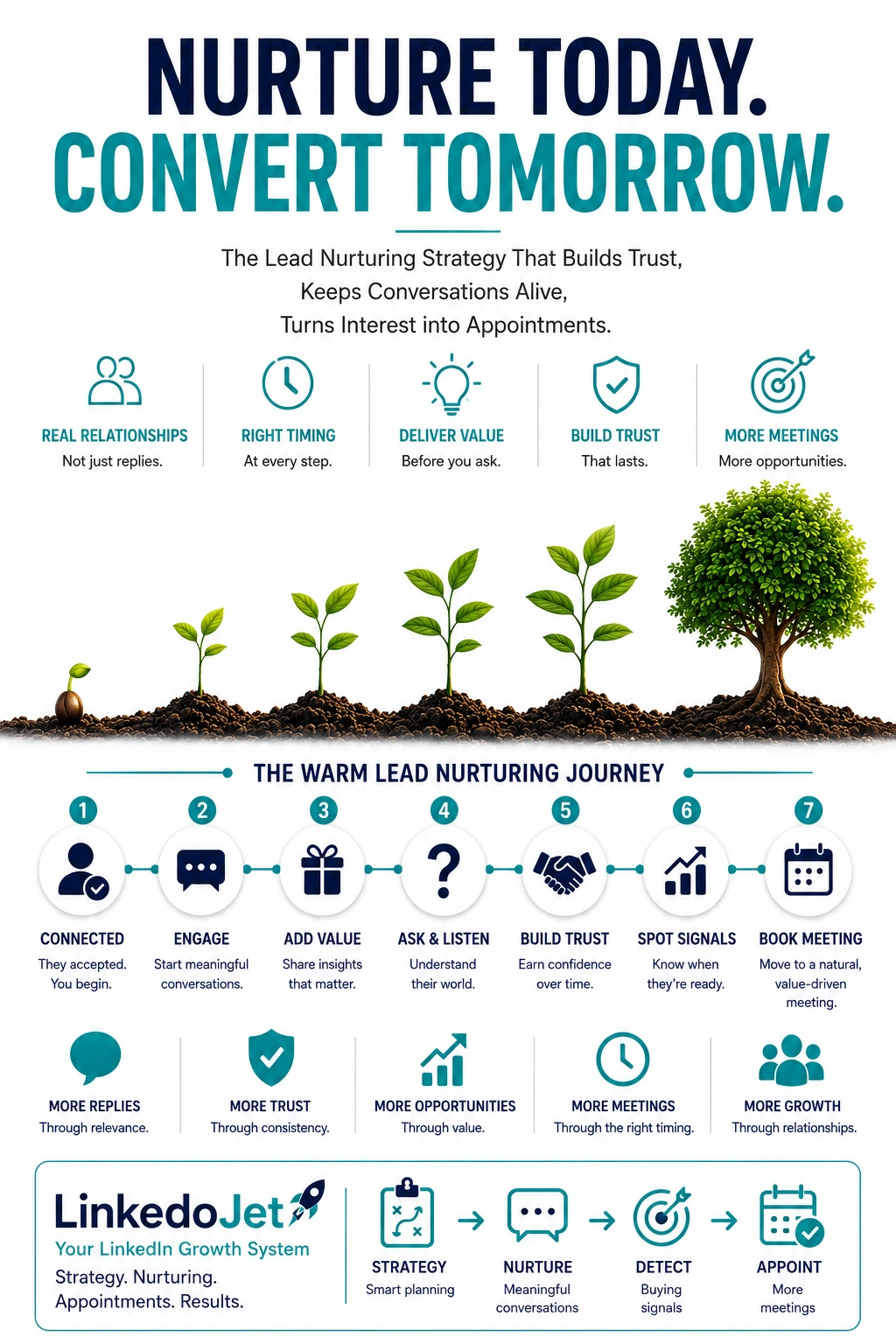
How LinkedoJet runs warm lead follow-up as an operating system (timing, reply handling, temperature tracking)
You don’t need more activity. You need a system that remembers, responds, and moves deals forward while you run production.
Most LinkedIn “automation” falls apart right where podcast agencies hurt most: the warm middle.
Because the hard part isn’t sending invites. It’s knowing what to say after a comment, after a pricing question, after a quarter reset—and doing it consistently without sounding like a bot or a desperate founder.
LinkedoJet is built to run the full outbound motion, not just message volume. Operationally, that means:
- ICP and targeting setup: we define the buyer types you actually close (founders, heads of marketing, partnerships, growth) and the contexts that trigger demand (positioning changes, product launches, thought leadership pushes, “we tried a podcast and it fizzled”).
- Sales Navigator / LinkedIn prospect list building: we build and maintain lists by role, company type, and intent signals—so your team isn’t working from a stale spreadsheet.
- AI-assisted personalization: not gimmicky compliments. We use AI to draft messages that reference real context (their initiative, their content angle, likely internal constraints), then keep it in your voice.
- LinkedIn outreach execution: connection + first messages go out consistently, with safeguards to avoid spammy patterns.
- Lead reply handling and nurturing: when someone responds, we route the thread into the right temperature stage and use stage-matched follow-ups (insight, clarity question, workflow plan, scoped invite).
- Warm lead tracking: every thread is tagged (Curious/Considering/Coordinating/Committed), with next actions scheduled so warm deals don’t get lost behind client delivery.
- Appointment generation support: when coordination signals show up (stakeholders, host availability, timeline/budget hints), we move the conversation into a specific working session invite—without jumping the gun.
- Campaign visibility through dashboards: you can see what’s warming, what’s stalling, and where follow-up is breaking down.
- Ongoing campaign refinement: we adjust targeting, messaging, and timing based on real replies—especially the subtle objections around workload, approvals, and sustainability.
For podcast agencies, the payoff is simple: fewer dead threads, more controlled momentum, and a pipeline you can plan against.
FAQ
What’s a practical LinkedIn follow-up cadence for podcast production and growth retainers?
Think in stage-based touches, not “days since last message.” For most warm threads: a light follow-up 2–4 days after connection acceptance, a second touch the next week with a useful insight, then a coordination question when they show any reply or intent signal. If they go quiet, shift to a timing question around quarter/launch planning and close the loop politely if there’s no pull.
How do I follow up when someone asks about pricing but isn’t ready for a call?
Answer with a range, then immediately explain what drives it (cadence, approval load, repurposing volume, guest booking). After that, ask one question that surfaces readiness: “Who would own approvals week to week?” Pricing questions are often workload questions in disguise.
How do you revive an inactive LinkedIn conversation about podcast services without sounding needy?
Use a clean timing check and give them an easy out: “Did the podcast idea get a green light for this quarter, or is it more of a ‘when we have breathing room’ project?” If they say it’s parked, close the loop and offer a specific time to reconnect (e.g., after a quarter reset).
What are the strongest buying signals for podcast agency offers (production, repurposing, guest booking)?
The best signals sound like internal coordination and output pressure: “we’re reworking positioning,” “our founder wants to do more thought leadership,” “we need more top-of-funnel content,” “we tried a podcast and it fizzled,” “we can’t get execs to show up consistently,” “we want tighter clips for LinkedIn,” “we need someone to handle guest outreach,” or “we’re planning Q3 campaigns.” Treat these as timing triggers—then move the conversation toward format + ownership.
Should we talk about downloads and audience growth early, or focus on workflow and content output first?
Start with workflow and content output. Most B2B buyers green-light podcasts when they believe it won’t become a weekly burden and they can see how it supports sales enablement, partnerships, and consistent content. Growth matters, but it lands better once the “we can ship this” question is settled.
If you want, we’ll build your warm-lead follow-up system with you—then run it
This isn’t a generic “strategy call.” It’s a working session to turn your warm LinkedIn signals into a predictable intro-call path for your podcast offers.
When you book a demo session, we’ll look at your current LinkedIn threads (the ones that warmed up and then stalled) and map them to a simple temperature path: Curious → Considering → Coordinating → Committed.
Then we’ll show you what LinkedoJet operationally provides if we work together:
- Targeting systems: we set up ICP filters and Sales Navigator list-building around your real buyers (founders, heads of marketing/growth, partnerships) and the moments that trigger podcast demand (launches, positioning shifts, content output pressure).
- Prospect list building: we build and maintain the lists, so outreach isn’t dependent on someone remembering to “do LinkedIn” between client calls.
- AI-assisted personalization: we draft short, relevant messages that reference their context (initiative, content angle, likely approval constraints) and keep it consistent with your agency voice.
- Outreach workflows: connection + message sequences that feel human and stage-appropriate—no awkward pushes for calls when they’re still trying to picture the workflow.
- Lead nurturing and follow-up: we handle the warm middle with temperature-based timing: insight when they’re curious, clarity questions when they’re considering, workflow/ownership plans when they’re coordinating, and scoped invites when they’re committed.
- Reply handling: replies don’t sit in a founder inbox for a week. We help route, respond, and keep momentum without long paragraphs or repetitive nudges.
- Warm lead tracking + dashboards: you can see what’s warming, what’s stalling, and what’s turning into calls—so pipeline stops being a feeling.
- Appointment generation support: when someone signals real coordination (stakeholders, host availability, quarter timing, budget hints), we move the thread into a specific working session invite.
What happens after onboarding is the point: LinkedoJet doesn’t hand you software and wish you luck. We run the outbound engine with you—targeting, execution, nurturing, and refinement—so your team can focus on delivery and still keep pipeline moving.
Why LinkedoJet is different from ordinary LinkedIn automation tools: we’re not “automating DMs.” We’re managing a conversation system with stage logic, reply handling, warm-lead tracking, and appointment support—built around how podcast retainers actually get approved (workflow certainty + internal ownership).
Next step: map your warm-lead paths and stop losing deals in the quiet middle
If you already have warm LinkedIn signals, you’re closer than you think. The fix is a consistent follow-up path that moves buyers from curiosity to coordination—without chasing.
You’ll leave with a clear temperature model for your pipeline, stage-based follow-ups that sound like an operator, and an execution system that keeps threads moving while you run production.
From identifying the right decision-makers to starting meaningful conversations and turning them into qualified appointments... LinkedoJet manages the entire outbound engine for your business.