
The stall: you earned the signal, then pharma reality hit
You got what most BD teams chase: the TA lead accepted. The HRBP liked the post about shift coverage. A hiring manager even replied once: “send info” or “maybe later.”
And then the thread dies.
Not because you said something “wrong.” Because in pharma, a warm conversation can’t always become a meeting on your timetable. Headcount sits in fog. Vendor rules tighten. Teams go into audit mode or firefighting after a deviation, a batch failure, an inspection finding, a tech transfer milestone. The easiest thing for them to do is nothing.
So you’re stuck with the worst choice: push and look like every other agency that creates vendor-management work… or go quiet and lose the “familiar name” slot when the real need lands.
The hidden cost isn’t just a missed meeting. It’s time spent re-proving you’re credible every single quarter. Delivery stays reactive. BD keeps chasing live reqs through PSL/procurement instead of being pulled into planning conversations.
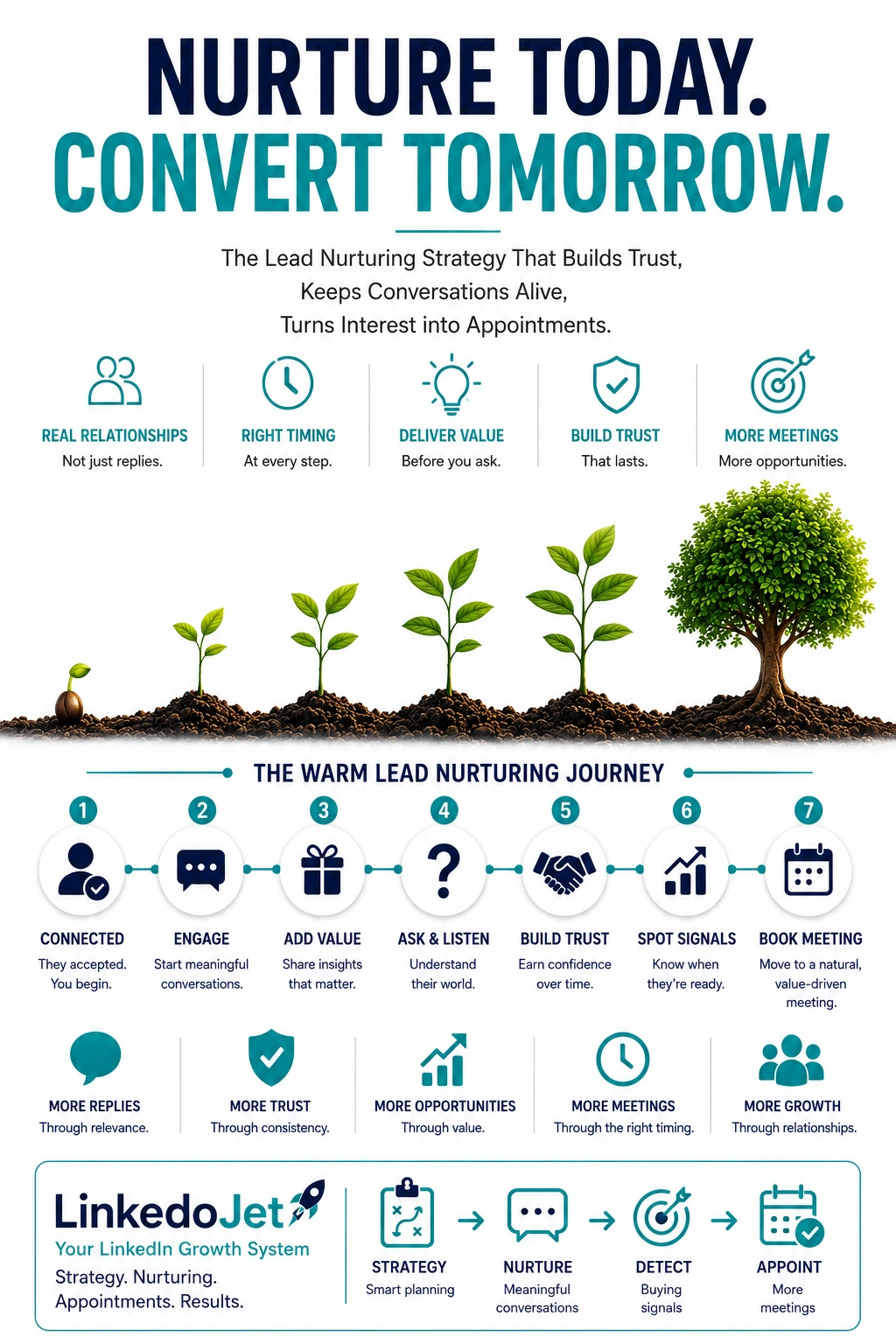
This playbook is about staying present without being noise: short, pharma-specific touches that earn small replies, surface timing and constraints, and earn the right to ask for a calibration call.
Warmth isn’t one thing: a simple temperature model that stops you from pushing too early
Most firms treat every warm signal the same and aim straight for an intake. That’s where trust gets damaged. A profile view is not the same as “we’re struggling to hire GMP validation.”
Use three temperature bands. Simple enough to run. Specific enough to change your messaging.
| Temperature | What you’ll see on LinkedIn | What they’re protecting | Your next message must achieve |
|---|---|---|---|
| Light warmth | Connection accepted, profile view, occasional post like, follows your page | Time and attention (and avoiding vendor drama) | Earn a tiny reply with a relevant micro-observation; tag role family + site reality |
| Conversational warmth | Short replies; “send info”; “not hiring right now”; mentions future quarter; asks what you cover | Process risk (creating a trail), procurement optics, bandwidth | Keep the thread alive with one calibration question; tag timing and constraints without pushing a call |
| Active need | Mentions urgency, failed search, inspection readiness, shift gaps, attrition, time-to-fill pain, “can’t find GMP validation/QA/QC” | Hiring outcome and credibility internally | Narrow scope fast; propose a short calibration call as the quickest way to stop waste |
Notice what’s missing: “send deck.” In pharma, a deck often reads as “here comes more work for me.”
Cadence that respects their world: re-enter, earn a reply, then go quiet
Pharma stakeholders don’t ignore you because they’re rude. They ignore you because responding often creates work: vendor governance, “can you add them to the PSL?”, internal follow-ups, procurement emails, or a hiring manager asking for candidate lists before a req exists.
A respectful cadence is not “less follow-up.” It’s better timing and lower friction.
Use three lanes (and don’t jump lanes)
- Lane A: Light warmth (no replies yet). 1 message after acceptance, then wait. If no reply, re-enter with a single market note tied to their function/site. Then stop. Two touches over 14–21 days is plenty.
- Lane B: Conversational warmth (they replied once). Respond within 24 hours. Ask one calibration question that helps you tag timing and constraints. If they go quiet, wait 7–10 days before re-entering with a practical insight (not a nudge).
- Lane C: Active need. Don’t “nurture.” Contain the scope and move to a calibration call. If they can’t meet, offer a written 3-bullet calibration summary they can correct asynchronously.
When to go quiet on purpose
- They mention audit/inspection readiness or remediation work.
- They say PSL-only and you haven’t been invited into the process.
- They’ve seen two follow-ups and haven’t engaged at all.
Silence isn’t failure if you leave a clean door to restart later. The mistake is continuing to “check in” until you become the reason they avoid LinkedIn.
One more nuance: if they’re in a 24/7 manufacturing environment, their “workday” often isn’t your workday. A short message that’s easy to answer on a break beats a long paragraph they’ll “get back to later.”
Message examples that earn small replies (without sounding like a template)
These aren’t scripts. They’re conversation starters that work because they reduce risk and show you understand GMP hiring realities.
- First warm follow-up after connection acceptance (micro-insight, not a pitch)
“Thanks for connecting — I work with a few GMP sites and keep a close eye on availability. Lately I’m seeing QA/QC candidates in [region] getting picky about shift patterns and on-site days more than comp. Are you seeing the same friction at your site(s), or is it a different bottleneck?”
- Follow-up after “not hiring right now” / “send info” (keep thread alive, tag timing)
“Makes sense — appreciate the straight answer. When things do pick up for you, which function usually spikes first: QA/QC, Validation (CSV vs equipment), or Manufacturing support? I’m just trying to keep my notes honest so I don’t surface noise.”
- Educational nurture (domain competence, one practical lesson)
“Quick thing I’ve learned the hard way: ‘Validation’ screens totally differently depending on CSV vs equipment. The best CSV folks can look ‘light’ on GMP shop-floor exposure, and the best equipment validation people can look ‘light’ on documentation systems — but both can be excellent if you calibrate expectations early. Do you tend to separate those skill sets in-house, or try to hire hybrids?”
- Insight-based follow-up (reduces risk)
“I’m noticing notice periods stretching again for senior QA leads — not because they’re in love with their employer, but because handovers are getting stricter around batch release and deviation backlog. If you ever have to move fast, do you prefer contractors to bridge, or do you push for perm and accept a longer runway?”
- Proof-based nurture (credible, process-focused)
“We recently helped a GMP site that kept getting ‘good CVs’ but poor shortlists for a QA/QC supervisor role. The fix wasn’t more sourcing — it was a 20-minute calibration on shift expectations, documentation depth (GDP habits), and what ‘hands-on’ actually meant in their environment. After that, we only sent 4 profiles, and the hiring manager stopped rejecting on basic fit. Is your team more often stuck on skills, or on those non-negotiables like shifts and on-site?”
- Soft question to reopen after silence (easy out, still useful)
“No rush on this — I’m updating my Q3 notes. If you had a hiring spike, is it more likely to be contractor coverage (shift gaps/tech transfer support) or perm hiring for QA/Validation? Either answer helps me avoid pestering you at the wrong time.”
- Buying-signal response (contain scope + propose calibration call)
“That’s helpful context — if the search is stalling and inspection readiness is in the mix, I’d rather tighten scope than throw more CVs at you. Two quick questions: (1) what’s truly non-negotiable — GMP documentation depth, specific systems, or shift pattern? (2) where did the last shortlist fail — technical screen, culture, or comp/notice period? If you’re open, I can do a 15–20 minute calibration call and send back a one-page ‘what good looks like’ summary you can share internally.”
- Soft meeting request (15–20 minutes, no assumption of live req)
“Would a short calibration chat be useful? 15–20 minutes to map what ‘good’ looks like for your typical QA/Validation hires and where searches usually break (shifts, on-site, documentation expectations). No need for a live requisition. I’m free Tue 11:30 or Thu 15:00 — if neither works, tell me what does, or just say ‘not a priority’ and I’ll leave it.”
- Dormant lead revival (respectful trigger, no guilt)
“Saw the new postings around [function] and the site update — congrats on the momentum. When teams expand quickly, I usually see either shift coverage pinch-points or a scramble for documentation-heavy profiles (QA/RA). Is any of that showing up for you, or are the hires more steady-state?”
- Final polite close-loop (protects relationship + clean restart)
“I’m going to stop nudging for now — last thing I want is to add noise. If you hit a QA/Validation spike, a search stalls, or you need contractor coverage fast, message me here and I’ll respond with a short calibration checklist before we talk. Either way, appreciate the connection.”
Buying signals vs pause signals: what to do when urgency appears (and when to stop pushing)
In this niche, “warm” can mean polite networking. It can also mean “we’re about to get crushed.” Your job is to tell which is which without forcing them into a meeting they can’t justify.
Buying signals that justify a calibration call
- They mention a failed search or “we can’t find people” (especially GMP validation, QA/QC leadership, RA specialists, MSAT, tech transfer).
- They reference inspection readiness, remediation, batch release pressure, deviation backlog, or a timeline tied to a program milestone.
- They ask where candidates are coming from, what comp is doing, or what notice periods look like.
- They talk about shift coverage, on-site mandates, or location constraints (the silent killers of candidate pools).
- They complain about irrelevant CVs or vendors not understanding documentation expectations.
Pause signals (don’t force it)
- “We’re in a vendor freeze.”
- “Everything goes through the procurement portal.”
- Repeated non-response after you offered easy outs and useful context.
- They only ask you for candidate sourcing without any hiring-side ownership (often a sign you’re being used as a free database).
If procurement is mentioned, don’t debate. Ask one calm question that shows you respect governance:
“Understood. When a niche search is failing, what’s the cleanest way for a specialist supplier to be considered — TA intro first, or procurement-first?”
That single line keeps you professional. It also tells you whether you’re speaking to someone with real influence or someone trying to avoid creating a trail.
Mistakes that kill trust fast (and why pharma stakeholders go quiet)
If you’ve ever felt a relationship cooling in real time, it’s usually because one of these happened.
- The “checking in” trap. “Just circling back” signals you have nothing useful. In pharma, that reads as noise and risk.
- Generic capability decks. They don’t want to forward a deck internally. That’s vendor-management work.
- Fluffy compliments. “Loved your profile” doesn’t land with a TA leader who’s triaging 30 reqs and an audit response.
- Consecutive nudges. Two follow-ups in three days is how you get muted.
- “Any hiring coming up?” with no context. It forces them to do forecasting for you, and it ignores stop-start cycles tied to inspections, tech transfer, and headcount approvals.
- Pretending you have candidates before calibrating constraints. The moment you say “we have great people” and then miss on shifts/on-site/GMP documentation, you’re filed as unsafe.
- CV-dumping when they finally reply. You waited weeks for a response and then punish them with eight attachments and no alignment. That’s how you become the agency they “can’t deal with right now.”
The better pattern is boring and effective: earn a small reply, tag timing, ask one calibration question, then go quiet until you have something relevant.
FAQ
What should I say after a pharma TA leader accepts my connection but doesn’t reply?
Assume acceptance is permission to stay lightly in their orbit, not an invitation to pitch. Send one message with a micro-observation tied to their world (shift patterns, on-site mandates, notice periods, or a specific function like QA/QC or CSV), then ask a single easy-to-answer question. If they don’t reply, wait 10–14 days and re-enter once with another useful note. Then stop.
How do I follow up when they say “not hiring right now” or “send info” without pushing a call?
Acknowledge it and ask a timing/tagging question that makes your future messages more relevant: which function spikes first, whether they build a bench ahead of tech transfer, or whether they tend to use contractors to bridge. Avoid decks. Offer one short, specific artifact only if it helps (e.g., a one-page calibration checklist for GMP roles), and keep it optional.
How often should I nurture warm LinkedIn leads in pharma without becoming noise?
For light warmth, think 2 touches over 2–3 weeks, then a longer gap. For conversational warmth, reply quickly and then space touches 7–14 days apart unless they re-engage. In pharma, the right cadence is defined by their bandwidth and governance, not your BD target. Your goal is to be easy to work with, not persistent.
How do I handle “we’re PSL-only” or “procurement controls vendors” without burning the relationship?
Don’t argue, don’t posture, don’t send a deck. Ask how exceptions happen when a niche search fails: TA intro first or procurement-first. Then run a low-friction nurture path: occasional market insights and calibration questions that build credibility until timing changes. Your win condition is being the “safe” specialist supplier when their usual list isn’t delivering.
What are real buying signals in pharma staffing conversations (vs curiosity or networking)?
Buying signals sound like operational pain: failed searches, inspection readiness pressure, shift coverage gaps, attrition spikes, or “we can’t find GMP validation.” They also ask market questions (comp, notice periods, candidate sources) and share constraints. Curiosity is likes, profile views, and vague “good to connect.” Treat curiosity as permission to nurture lightly, not a reason to force a meeting.
If you want this to run without you babysitting it, this is what we set up
This isn’t a generic “strategy chat.” It’s a working session to put your warm-lead follow-up on rails — and a delivery model that keeps it running week after week.
On the session, we’ll look at how warm signals are currently showing up in your world (connection accepts, post engagement, profile views, short replies like “send info,” procurement mentions) and where the threads are dying. Then we’ll map a simple temperature-and-intent routing system so your team stops treating every warm contact like an immediate intake.
After onboarding, LinkedoJet operationally provides:
- ICP and targeting setup for pharma hiring-side decision makers (TA leads, HRBPs, hiring managers, and when relevant, procurement-adjacent stakeholders) by function, site type, and role families (QA/QC, Validation/CSV, RA, MSAT, tech transfer, manufacturing support).
- Sales Navigator / LinkedIn prospect list building with clear inclusion/exclusion rules (PSL-heavy orgs, specific geographies, on-site environments, shift-driven sites, CDMO/CRO nuances).
- AI-assisted personalization that stays professional: it’s used to adapt messages to the prospect’s context (site, function, likely constraints), not to write cheesy compliments.
- LinkedIn outreach execution with temperature-based cadences, so light warmth gets light touches and active need gets a fast path to calibration.
- Lead reply handling and nurturing so “not hiring,” “send info,” “PSL-only,” and “maybe later” don’t become dead ends — they become tracked paths with the right next question.
- Warm lead tracking that captures intent cues (engagement patterns, urgency language, procurement mentions, timing hints) so you don’t rely on memory or scattered inbox threads.
- Appointment generation support focused on calibration calls and intake alignment, not random meetings. When buying signals show up, we guide the transition to a short, precise next step.
- Campaign visibility through dashboards so you can see what’s being sent, what’s getting replies, which temperature bands are moving, and where conversations stall.
- Ongoing campaign refinement based on real reply data (not opinions): which micro-insights get responses, which constraints trigger meetings, and where trust is being lost.
Why this is different from ordinary LinkedIn automation tools: tools send messages. They don’t build your targeting system, they don’t handle replies with judgment, they don’t track intent, and they don’t help you convert warm engagement into calibrated appointments without burning long-cycle relationships. LinkedoJet is the managed outbound engine behind the consistency.
If you’re serious about turning warm pharma TA conversations into booked calibration calls — without nagging or CV-dumping — book a time below. You’ll leave with a clear nurture path and, if we’re a fit, a team that runs it for you.
Next step: install the system that keeps relationships warm until timing flips
When this works, you stop “checking in.” You run a calm, trackable nurture motion that earns small replies, surfaces constraints, and asks for calibration calls only when the moment is real.
From identifying the right decision-makers to starting meaningful conversations and turning them into qualified appointments... LinkedoJet manages the entire outbound engine for your business.