
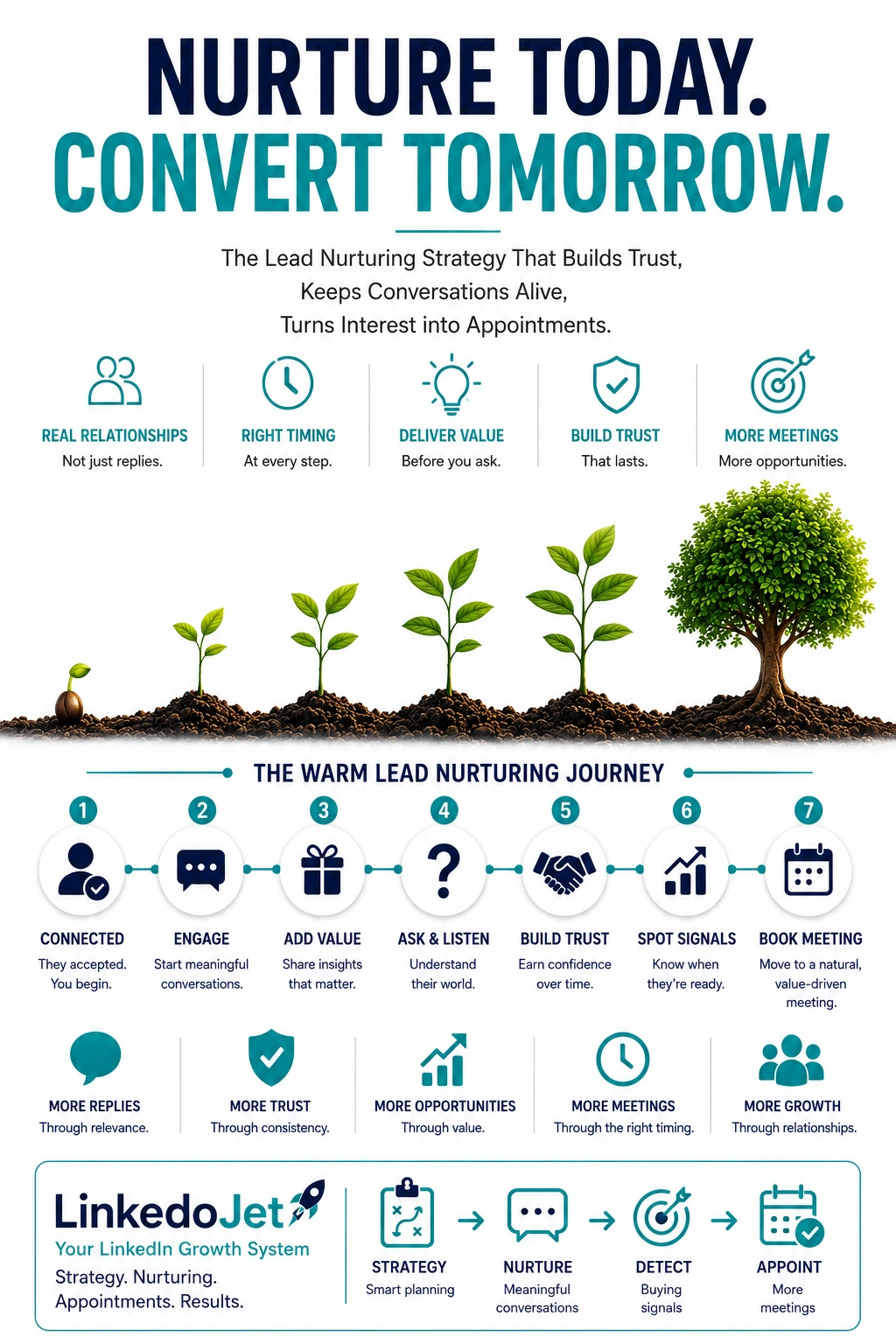
What “warm” really means in packaging—and why those threads die after “send info”
In packaging, “warm” rarely sounds warm.
It looks like: they accept your connection because you’re clearly a converter/manufacturer… they like a post about lead times or PCR… they view your profile after you mention flexible film, cartons, labels, corrugate, molded fiber… or they reply with the classic: “Send info.”
And then the thread dies.
Not because they weren’t interested. Because you accidentally helped them do the one thing procurement is paid to do: collect options without committing. A deck gives them cover. A generic capabilities PDF lets them say, “We have alternates.” It doesn’t move the project.
Packaging decisions don’t stall for lack of touches. They stall in the gap between curiosity and internal readiness: artwork isn’t approved, line trials aren’t scheduled, the pack-out changed, the brand team is arguing about claims, quality wants certifications, and procurement is quietly building a file for the next supplier review.
When your follow-up is “checking in,” you aren’t progressing the deal—you’re lowering your credibility. You start to feel like the brochure vendor who only shows up to ask for an RFQ.
The commercial cost shows up everywhere: reps wasting cycles, longer sales timelines, more pricing-only threads where you get compared on pennies, and fewer spec-driven conversations where you can win on performance, reliability, and risk reduction.
A daily temperature model: Curious → Evaluating → Active
Most teams treat every warm contact the same. That’s how you end up pushing a meeting when they’re still collecting suppliers—or sending a deck when they’re actually one constraint away from a sample plan.
Run a simple temperature model. Every warm lead gets a label, a next step, and a “why now.”
| Temperature | What you’re seeing on LinkedIn | What’s probably true inside their org | Your goal (micro-commitment) |
|---|---|---|---|
| Curious | Connects, likes a lead-time/sustainability post, views profile, asks a light question (“Do you do compostable?”) | No active project, or they’re building a supplier bench for launches/annual reviews | One low-friction answer + a single sorting question (category/format/timing) |
| Evaluating | “Send info,” “We’re looking at options,” mentions a product line, asks about MOQ/print method/certifications | They have a problem but specs aren’t clean yet; engineering/quality not aligned; procurement wants coverage | Clarify project type + capture 2–3 constraints so you can propose a spec call or checklist |
| Active | Mentions timing/volumes, asks about samples, lead times, testing, change-control, or introduces a colleague | Internal work is happening; they’re trying to reduce risk and avoid rework | 15-min spec/constraints call → sample plan → stakeholder map → clean path to RFQ |
Messages that earn the next micro-commitment (packaging-specific examples)
Your follow-up should do one of three things: reduce uncertainty, prevent rework, or earn a small commitment. Not all three at once.
After connection acceptance (context-forward, low friction)
Message: “Appreciate the connection, [Name]. Quick one—are you mostly focused on flexible, cartons, or corrugate right now? We’re seeing a lot of teams rechecking lead times and second-source options ahead of launches.”
Why it works: It lets them answer in five seconds, and it tells them you understand what’s actually happening (coverage + timing).
After “send info” (avoid the deck-to-silence trap)
Message: “Happy to send a quick overview. Before I do—are you looking at this for a new SKU launch, a cost-down on an existing pack, or a backup supplier? I’ll send the most relevant examples.”
Micro-commitment: choose a lane. Now you can respond with relevance instead of dumping materials.
Educational nurture (make internal alignment easier)
Message: “If you’re comparing suppliers, the three inputs that usually save the most back-and-forth are: annual volume range, barrier/shelf-life target, and where it runs (VFFS/HFFS/flow wrap). Want me to send a one-page spec checklist your team can use internally?”
Insight follow-up (current packaging reality, no drama)
Message: “We’ve noticed teams getting burned when ‘recyclable’ claims get ahead of what the structure can actually do for barrier/seal integrity. If sustainability is in scope, I can share how we frame tradeoffs so you don’t end up with a pack that looks good on paper but fails in transit.”
Proof-based nurture (operational, measurable)
Message: “We recently helped a brand reduce scuffing and improve line efficiency by adjusting film structure and seal layer—kept graphics consistent and avoided a full redesign. If you tell me what product category you’re in, I can share the before/after in a way that’s relevant.”
Buying signal response (turn intent into a clean next step)
Message: “If you’re looking to validate this before [month], the fastest route is usually a 15-minute spec/constraints call, then we align on a sample plan and what ‘pass’ looks like for your line. Who besides you needs to weigh in—procurement, packaging engineering, quality?”
Soft reopen (no ‘bumping this’)
Message: “Quick check—did your team end up getting the spec inputs together, or did the project get pushed? Either way is fine; I can point you to the simplest path when it comes back up.”
Polite close-loop (protect relationship, keep the door open)
Message: “I don’t want to keep poking you if timing isn’t right. If packaging sourcing comes back on your radar—second source, cost-down, or a launch—reply with ‘revisit’ and I’ll pick it up from there. Otherwise I’ll close the loop for now.”
What to share between touches so you don’t become “the brochure vendor”
Packaging buyers don’t ghost because they hate you. They ghost because continuing the thread creates work: more emails, more internal questions, more risk.
So give them assets that reduce work and prevent surprises—short, specific, and tied to the bottlenecks that actually slow down packaging decisions.
- Lead-time reality (in one paragraph): what you can and can’t do right now, what drives variability (substrate availability, print slots, approvals), and what’s required to hold a window.
- Sampling timeline: “If we have X by Friday (structure target, dimensions, run method), we can do Y by next week (lab sample / press check / transit test plan).”
- Quote-clean checklist: annual volume range, pack-out, dimensions, barrier targets, distribution conditions, print method, and any required certifications (food contact, BRC/IoP, FSC).
- Risk notes procurement can forward: what causes delays in quoting and why “ballpark pricing” becomes a trap later.
- Comparison beyond unit price: scrap, downtime, seal integrity, color variation, damage rates, on-time delivery, change-control discipline.
Notice what’s missing: long decks, generic capability lists, and “we’re a full-service provider” language. None of that helps engineering, quality, or procurement make the next internal move.
Role-based nurturing: procurement vs engineering/R&D vs sustainability/brand
“Send info” means something different depending on who said it. Treating every role the same is how you get irrelevant replies—or none at all.
Procurement (coverage, leverage, and risk control)
They’re often building a file: alternates, lead times, certifications, “can they quote,” “can they ship.” They may also be collecting pricing to apply pressure to an incumbent.
- What they need next: a clean path to quote without a 20-email chain.
- Good follow-up question: “Is this for a re-bid, a second source for continuity, or a new launch?”
- Offer that lands: “I can send a one-page intake that gets you a defendable quote and avoids backtracking later.”
Packaging engineering / R&D (performance, machinability, trials)
They don’t care that you can print. They care whether the structure will run, seal, survive distribution, and not create a quality escape.
- What they need next: constraints and acceptance criteria (“pass/fail”) before samples.
- Good follow-up question: “What’s the run environment—VFFS/HFFS/flow wrap, and what’s the current failure mode (seal, scuffing, curl, pinholing)?”
- Offer that lands: “15 minutes to map current structure + constraints, then a simple sample plan with what ‘good’ looks like on your line.”
Sustainability / brand (claims, tradeoffs, approvals)
They’re navigating scrutiny: PCR content, recyclability claims, labeling, and what happens when the ‘better’ structure breaks shelf life or seal integrity.
- What they need next: tradeoffs explained in plain language, with guardrails.
- Good follow-up question: “Is the priority claim-driven (recyclable/PCR) or performance-driven (barrier/shelf life) for this SKU?”
- Offer that lands: “I’ll share a short tradeoff framework so you don’t get stuck with a structure that passes the claim conversation but fails in transit.”
Role-based nurturing is how you stay relevant while the deal is quiet. It also pulls stakeholders into the thread naturally—without forcing a meeting too early.
Cadence, buying signals, and when to pause (so you don’t lose credibility)
The easiest way to ruin a warm packaging lead is to follow up frequently with nothing new.
Cadence should match temperature and internal friction.
- Curious: every 10–21 days. Short insights, a single sorting question, or a relevant “heads up” (lead time shifts, claim scrutiny, common pitfalls). Keep it light.
- Evaluating: every 5–10 days. One clarifying question at a time. Share quote-clean inputs and offer a spec checklist.
- Active: every 2–5 days until the next step is booked (spec call / sample plan). Be crisp, confirm stakeholders, document constraints.
Packaging buying signals worth acting on
- Timing language: “launch window,” “before peak season,” “contract renewal,” “supplier review.”
- Constraints: MOQ, lead times, print method (digital/flexo/gravure), tooling/plates/cylinders.
- Risk markers: “issues with current supplier,” scuffing, seal failures, transit damage, color consistency.
- Validation requests: sample timelines, testing, certifications (food contact, BRC/IoP, FSC).
- Stakeholders: “Looping in quality/engineering/procurement.”
Pricing traps (and how to sidestep them)
If they ask for pricing with zero specs, you’re being invited into a comparison you can’t win—and you’ll hate the thread later.
Response: “I can give a directional range, but I don’t want to send a number that gets misused internally and forces a re-quote. If you can share just two things—volume range and current structure (or thickness/basis weight)—I can be much more accurate. If you don’t have that yet, I can send the one-page intake and you can forward it to whoever owns specs.”
When to pause
If they repeatedly refuse to share any context and only ask for pricing, pause politely. Staying in the thread teaches them you’ll do free estimating forever.
Close-loop: “Totally understand if you’re just collecting options right now. I’ll step back so I’m not adding noise. If a second source or cost-down becomes active, reply ‘revisit’ and I’ll pick it up fast with the right inputs.”
Frequently asked questions
What counts as a “warm” LinkedIn lead for a packaging manufacturer or converter?
Someone showing light intent without being spec-ready: connection acceptance tied to your category, profile views after you mention a material/format, engagement on lead time or sustainability posts, a quick capability question (MOQ, print, food contact), or a reply like “send info.” Warm means you have a reason to follow up—just not permission to push an RFQ yet.
What should I say after a prospect replies “send info” so it doesn’t turn into silence?
Send a tight offer plus one sorting question. Example: “Happy to send a quick overview. Before I do—are you looking at this for a new SKU launch, a cost-down, or a backup supplier? I’ll send the most relevant examples.” That one question changes your next message from generic to specific.
How do I respond when a packaging lead asks for pricing but won’t share specs yet?
Protect yourself from the ballpark trap. Ask for the minimum constraints that make a quote defendable (volume range + current structure or thickness/basis weight). If they don’t have it, offer a one-page intake they can forward to engineering/quality. Make it clear you’re avoiding rework, not dodging pricing.
What follow-up cadence works for packaging sales when procurement and engineering are involved?
Slower than most reps want, but tighter when signals appear. Curious: 10–21 days. Evaluating: 5–10 days with one question at a time. Active: 2–5 days until the next step is scheduled (spec call → sample plan). The rule: every touch brings a new input, a new risk reducer, or a clear micro-commitment.
How do I revive a dormant LinkedIn conversation tied to supplier reviews, peak season, or sustainability deadlines?
Re-enter with a reason that fits their calendar. Example: “Circling back because a few teams are doing mid-year supplier reviews right now—if you still want a backup option, I can share what we’d need to quote cleanly and avoid a long email chain. Worth revisiting, or should I check back later in the year?” Make it easy to say “later” without awkwardness.
If you want warm LinkedIn interest to turn into spec calls and RFQs, we’ll run the system with you
This isn’t a “let’s chat” call. It’s the fastest way to see what LinkedoJet would execute end-to-end for your packaging team—and what you’ll have running after onboarding.
What LinkedoJet operationally provides: we build your ICP and targeting rules, create Sales Navigator-ready prospect lists (by role, category, format, and buying triggers), write the outreach and follow-up workflows, and run execution on LinkedIn with AI-assisted personalization that stays grounded in packaging reality (lead times, samples, constraints, claims, trials).
How targeting and list building works: we don’t spray “operations leaders” and hope. We assemble lists around your real buying committee—procurement, packaging engineering/R&D, quality, brand/sustainability—and filter by the accounts you actually want (brands, co-packers, contract manufacturers) plus signals that matter (launch timing, second-source behavior, supplier issues, certifications).
How warm-lead follow-up is handled: when someone engages, replies, or asks for info, we track the thread context and temperature (Curious/Evaluating/Active). Then we choose the next “useful nudge” that earns a micro-commitment: spec checklist, constraint question, stakeholder intro, sample plan, or a 15-minute spec/constraints call.
AI-assisted personalization (without sounding like a template): we use AI to tailor the message to the person’s role and likely job-to-be-done (cost-down, second source, new launch, lead time reliability, print consistency, damage reduction). A human operator reviews what goes out so it reads like a credible supplier, not automation.
Lead nurturing and follow-up workflows: we run multi-touch sequences that bring something new each time—quote-clean inputs, sampling timelines, tradeoff notes on sustainability claims, and short proof points tied to performance (scrap, downtime, seal integrity, transit damage). No “just checking in” loops.
Tracking warm leads and appointments: you get visibility into who’s warm, what was last discussed, which stakeholders are involved, and what the next step is. When a conversation turns real, we support appointment generation so your team is showing up to qualified meetings—not chasing vague interest.
Why this is different from ordinary LinkedIn automation tools: tools send messages. LinkedoJet runs the outbound engine: targeting, list building, personalized outreach, reply handling, warm-lead nurturing, tracking, and ongoing refinement based on what’s actually converting into spec discussions and meetings.
Next step: stop losing warm threads between “send info” and a real packaging step
If you’re tired of ghosted LinkedIn conversations and pricing-only dead ends, the fix isn’t more persistence. It’s a follow-up system that progresses specs, samples, stakeholders, and timelines—without creating extra work for the buyer.
From identifying the right decision-makers to starting meaningful conversations and turning them into qualified appointments... LinkedoJet manages the entire outbound engine for your business.