
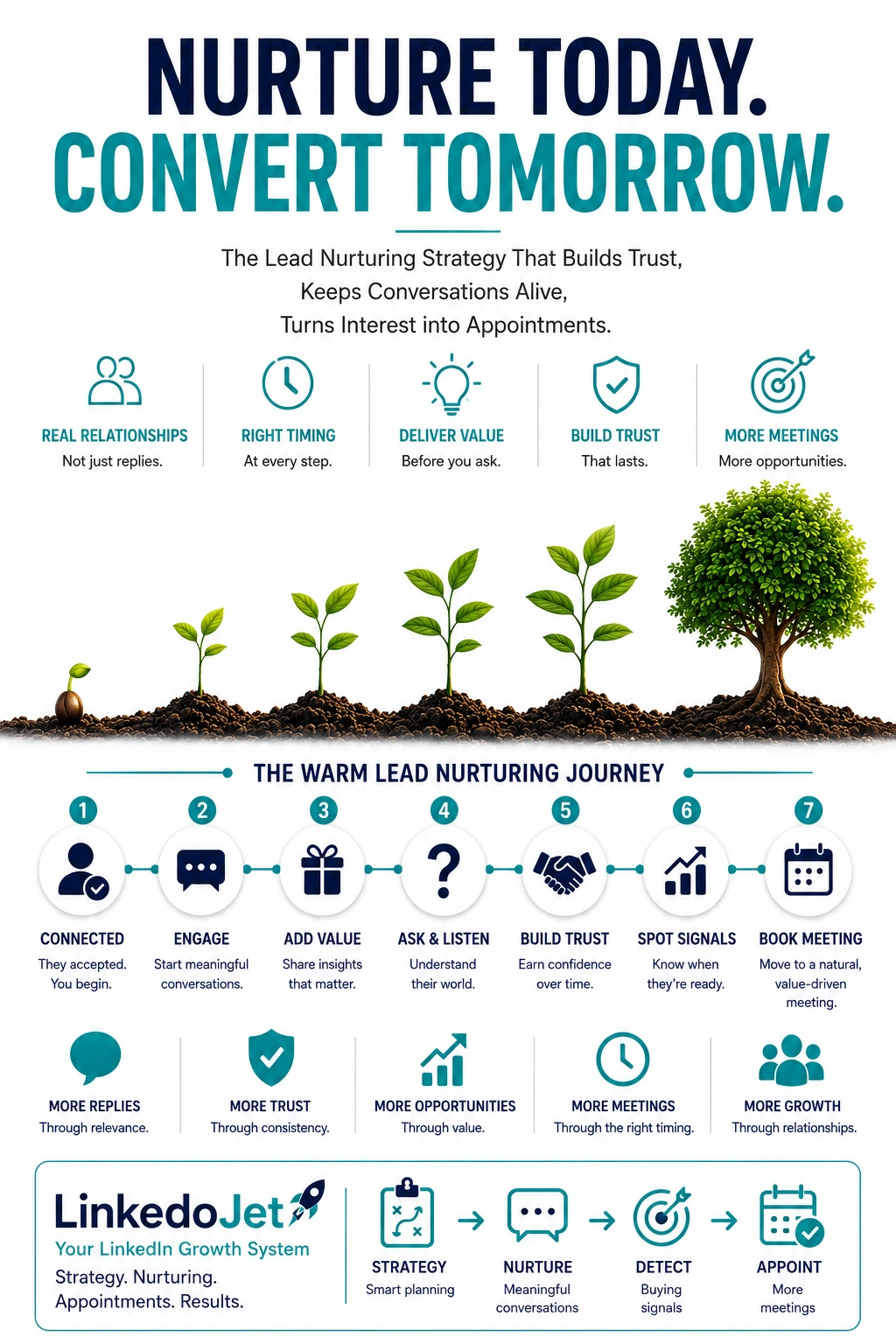
The uncomfortable middle of origination: they engaged once… and then went quiet
Not cold. Not in motion. Just quiet enough that every follow-up feels risky.
They already said yes once.
A connection acceptance. A quick “thanks.” A like on a post about sector multiples. A profile view right after you commented on their news. Maybe they asked a light question (“What are you seeing in buyer appetite lately?”) and then disappeared.
Now you’re in the part of origination nobody trains juniors for and partners don’t have time to run manually.
If you push, you look like you’re trying to start a mandate in a LinkedIn chat. Founders hate that. PE partners and strategics mute that. Referral sources remember that.
If you back off, the thread decays. The next banker who shows up with calm relevance becomes the “safe” call when timing shifts. And you only find out months later—when the owner says, “We’re already talking to someone.”
The real cost isn’t one missed intro call. It’s continuity.
- You lose the narrative of what mattered to them (succession vs liquidity vs de-risking).
- You miss the subtle timing changes (a recap conversation, a board push, fatigue, a partner buyout).
- You end up spending partner time re-opening the same threads with the same awkwardness.
This is where mandates are quietly won and lost: in the 6–18 month middle, where discretion matters more than clever messaging.
Lead temperature in deal terms (not funnel stages)
The follow-up that works is the one that matches what they’re protecting.
Most warm LinkedIn leads don’t go quiet because they rejected you. They go quiet because engaging too much creates a trail. Or because they’re not ready to let the idea become real.
So stop labeling people “warm” or “cold.” Track them in deal language that reflects intent and confidentiality sensitivity.
| Temperature (M&A terms) | What it looks like on LinkedIn | What to send next (discreet) |
|---|---|---|
| Curious-but-private | Accepts connection, light reply, likes a post, profile views; avoids specifics | One clean observation + a low-stakes question they can answer without “starting something” |
| Light planning mode | Asks about timing, valuation drivers, “what buyers care about,” mentions a peer deal | Offer a short note on a single driver (QoE, WC, concentration, management reporting) and ask permission to send it |
| Preparation mode | Mentions succession, partner buyout, recap curiosity, unsolicited inbound, advisor introductions | Confirm discretion. Ask 1–2 founder-safe questions about priorities and constraints; propose a no-deck sanity-check call |
| Window opening | References fatigue, board/shareholder alignment, competitor sale, buyer outreach, refinancing pressure, “maybe next year” with specifics | Move to a short confidential call with a clear agenda and an explicit “no pressure to run a process” frame |
When you track temperature this way, follow-up stops being emotional (“Should I nudge?”) and becomes operational (“What’s the next touch that fits their stage?”).
A week-by-week nurture rhythm that respects confidentiality
You’re not chasing. You’re staying present like a credible market contact.
The mistake is treating warm nurture like a short campaign. M&A timing is lumpy. Your cadence should be calm and predictable—light enough to avoid pressure, consistent enough to avoid being forgotten.
Here’s a rhythm that works for founder-led sell-side sourcing, buy-side relationships, and referral partners without sounding like you’re pushing anything.
Weeks 1–2: Acknowledge and set tone
- 1 short follow-up after acceptance (context + low-stakes question).
- If they reply, respond fast and narrow: one useful angle, not a deck.
Weeks 3–6: Alternating touches (observation → question)
- Market observation they can agree/disagree with (buyer selectivity, financing friction, earnout structure shifts, add-on appetite).
- Founder-safe question that doesn’t force intent (“Is working capital volatility showing up more in buyer questions for you lately?”).
Months 2–6: Light check-ins tied to real triggers
- Quarter-end performance or budgeting season.
- Competitor transaction chatter in their niche.
- Recap activity / lender behavior.
- Leadership changes (succession risk signals).
One touch every 3–5 weeks is usually enough. More frequent only when they’re actively engaging.
Months 6–18: Keep the relationship warm without “process language”
- Rotate 3 content types: buyer lens (what gets scrutinized first), owner lens (value leakage), timing lens (what makes a window open/close).
- Occasional permission-based “should I stop nudging?” message that preserves dignity and keeps the door open.
This works because it respects the real constraint: they don’t want to be handled, and they don’t want to leave evidence they’re shopping the business.
Message examples that don’t sound like you’re starting a mandate over LinkedIn
Short. Specific. Easy to ignore without damage.
1) First warm follow-up after connection acceptance
“Thanks for connecting, [Name]. I work mostly with owner-led [industry] businesses in the lower mid-market. Quick one—when you think about optionality over the next 12–24 months, is it more about growth capital, de-risking, or just staying informed?”
2) Follow-up after they reply (human, narrow, permission-based)
“Appreciate that. One thing we’re seeing in [industry] right now is buyers getting unusually sensitive to [single driver: customer concentration / WC swings / reporting cadence]. If it’s useful, I can send a 5-bullet note on what they’re pressing on—want it?”
3) Educational nurture (owner lens, no pitch)
“One owner-side pattern we keep seeing: value leakage isn’t ‘no buyers,’ it’s messy metrics—especially when monthly reporting doesn’t tie cleanly to cash and working capital. Are you seeing more buyer questions on WC normalization lately?”
4) Insight-based follow-up (market signal M&A people actually discuss)
“Quick market read: add-on appetite is still there, but financing terms are pushing more structure (earnouts / seller notes) in the mid-market. Curious—are you seeing strategics behave differently than PE in your space right now?”
5) Proof-based nurture (anonymized, confidentiality-safe)
“We recently worked with an owner in the $[range] revenue band. The big improvement wasn’t ‘more buyers’—it was cleaning up customer concentration story + tightening monthly reporting so diligence didn’t drag. If you ever want a quiet second opinion on what buyers would press on first, happy to share how we frame it.”
6) Soft question to reopen a quiet thread (timing, with an easy out)
“Quick check, [Name]—are you thinking mostly about growth and staying put this year, or is succession starting to come onto the radar? Totally fine if it’s ‘neither’—I just don’t want to be noise.”
7) Buying-signal response (confidential call frame, no pressure)
“Got it. If you’re curious about valuation/timing without kicking anything off, we can keep it very discreet—15 minutes, no deck. Agenda would just be: what matters to you, what ‘good’ looks like, and what preparation would change outcomes if you ever chose to explore. No pressure to run anything.”
8) Soft meeting request (sanity-check, two options)
“Would a quick sanity-check call help—15 minutes to pressure-test timing, or 30 if you want to talk buyer-fit and what prep would look like? Either way, we can keep it completely off the record.”
9) Dormant lead revival (trigger-based, easy out)
“Saw the [competitor/adjacent] transaction news and it made me think of your niche. Not implying anything on your side—just curious if you’re hearing more inbound lately, or if it’s business as usual. If now’s not a good time, no need to reply.”
10) Final polite close-loop (preserve dignity)
“I’m going to stop nudging so I’m not cluttering your inbox. If you ever want a confidential second set of eyes on timing or buyer-fit, just reply ‘timing’ and I’ll send a couple options for a quick call.”
Notice what’s missing: valuation bait, “process” language, and long messages. You’re signaling competence without trying to pull them into a transaction.
Silence isn’t rejection. It’s often self-protection.
And your follow-up approach can either reduce risk—or amplify it.
Warm M&A leads go quiet for boring reasons and high-stakes reasons.
- Workload: they’re running the business, closing the quarter, dealing with a key hire, handling a customer renewal.
- Fear of “starting something”: one reply can feel like the first domino.
- Shareholder complexity: partners disagree; family dynamics; board pressure; timing isn’t aligned.
- Confidentiality: they don’t want messages that could be screenshot, forwarded, or seen by a colleague.
- Channel fatigue: their LinkedIn inbox is full of bankers and brokers using the same cadence.
- They’re already talking to someone adjacent: CPA, attorney, lender, PE contact—and they don’t want overlap.
What makes it worse (and more common):
- Pushing valuation too early.
- Using “process” language (“run a process,” “take to market,” “CIM”) before they’ve earned the right to engage.
- Sending long messages that feel like a pitch deck in text form.
- Acting entitled to a reply (“just circling back” energy).
- Dropping generic market reports with no clear relevance to their world.
- Going silent for months and resurfacing with sudden urgency.
The fix isn’t “more follow-ups.” It’s lower-friction follow-ups with a clear reason to exist. You want them thinking: “This person understands discretion. They’re not trying to trap me in a sales conversation.”
Routing and tracking: capture signals and prompt the next best touch
If nurture lives in partner memory, it dies in partner calendar.
The operational gap inside most boutique advisory firms is simple: warm origination sits in scattered LinkedIn threads, personal notes, and half-remembered context.
So the firm can’t answer basic questions:
- Which owners are curious-but-private vs quietly preparing?
- Who engaged recently but didn’t reply?
- Which PE partners are active in add-ons vs paused?
- Which referral sources need a light touch before the next introduction season?
A workable system tracks signals and turns them into next steps without making you feel like you’re spamming people.
| Signal | What it often means in M&A | Next best touch |
|---|---|---|
| Profile view after your message | Curiosity; they’re checking if you’re “safe” and credible | One short market observation + a permission-based offer to send a brief note |
| Likes/comments on sector posts | They want to stay informed without showing intent | Ask a founder-safe question tied to that exact topic |
| Reply includes “maybe next year” / “not ready” | Timing exists, but risk tolerance is low | Confirm you’ll keep it light; schedule a 4–6 week check-in with a trigger-based angle |
| Questions about valuation drivers / diligence length | Preparation mode starting | Offer a discreet 15-minute no-deck call; keep agenda tight and private |
| Mentions recap / partner buyout / unsolicited inbound | Window opening or internal decision forming | Move to a confidential call and define next steps without “process pressure” |
This is how you keep a bench of live relationships—without relying on heroic partner memory.
Frequently asked questions
How soon should an M&A advisor follow up after a LinkedIn connection accepts?
Within 24–72 hours, while the context is still fresh. Keep it to one short line of why you connected (sector + owner-led focus) and one low-stakes question they can answer without implying they’re “in market.” If they don’t respond, don’t chase the next day—wait a week and send a single relevant observation.
What’s a reasonable LinkedIn follow-up cadence for founder-led sell-side mandate sourcing?
For most owner-led relationships: one touch in week 1, one in week 2–3, then every 3–5 weeks unless they’re actively engaging. Increase frequency only when they’re replying or asking timing/valuation questions. The goal is calm consistency, not inbox dominance.
How do I move from LinkedIn chat to an intro call without sounding pushy or process-driven?
Wait for a signal (timing curiosity, valuation drivers, partner buyout, unsolicited inbound, “maybe next year” with detail). Then offer a confidential, no-deck call with a clear agenda and an explicit line that there’s no pressure to run anything. Two time options (15 vs 30) helps it feel like a sanity-check, not a sales call.
What are the clearest buying signals on LinkedIn that a founder may be quietly preparing to sell?
Questions about diligence timelines, what buyers scrutinize first, how to keep employees from finding out, how valuation changes with preparation, recap curiosity, succession mentions, or partner/shareholder alignment issues. Also watch for “soft intent” signals: repeated profile views after market posts, thoughtful replies that include constraints, and references to competitor transactions.
How do I revive a LinkedIn conversation with a business owner who went quiet—without looking needy?
Re-enter with a trigger they’d care about (competitor sale, financing conditions, buyer selectivity, sector multiple chatter) and give them an easy out. One message, short, and explicitly non-demanding: “No need to reply if now isn’t a good time.” If there’s still no response, send a respectful close-loop note and stop nudging.
If you want this to run quietly in the background, we’ll build the system and operate it with you
LinkedoJet is built for firms that need discreet, consistent origination—without turning partners into full-time follow-up managers.
On a demo session, we’ll show you how LinkedoJet supports warm LinkedIn lead nurturing for sell-side mandate sourcing, buy-side relationship building, and referral partner development—without spammy automation.
Operationally, here’s what we provide:
- ICP and targeting setup: we help define your best-fit founder profiles, PE partner types, strategic buyer roles, and referral sources—then translate that into precise filters.
- Sales Navigator / LinkedIn prospect list building: we build and maintain segmented lists (owners, corporate development, PE deal team, intermediaries) so nurture isn’t one giant bucket.
- AI-assisted personalization: we generate short, discreet message variants that sound like a corporate finance professional—context-driven, not “mail-merge energy.” You approve the tone and guardrails.
- Outreach execution: connection + conversation workflows are run consistently, with a cadence designed for 6–18 month timing cycles.
- Lead reply handling and nurturing: replies are triaged by intent (curious vs planning vs preparing vs window opening) so the next touch matches the stage and confidentiality sensitivity.
- Warm lead tracking: we track engagement signals, thread status, and next-step prompts so nothing lives only in partner memory.
- Appointment generation support: when timing shifts, we help move the conversation into a short, confidential intro call with a clean agenda—no pressure language.
- Campaign visibility: dashboards show what’s working (accept rates, reply rates, warm lead volume, booked intros) and where conversations stall.
- Ongoing refinement: we adjust targeting, messaging, and cadence based on real replies and what your market is signaling.
What happens after onboarding: you’ll have live prospect lists, approved message tracks for each relationship type, and a running nurture cadence that stays present without pushing a process. You’ll also have visibility into who’s warming up, who went quiet, and who’s showing real intent.
Why this is different from ordinary LinkedIn automation tools: most tools send sequences. LinkedoJet runs an operating system—targeting, conversation flows, intent-based routing, follow-up prompts, and appointment support—so your firm shows up like a calm, consistent relationship-builder.
If that’s the gap you’re feeling, book a time. We’ll walk you through what we’d implement for your firm and what you’ll have running in the first few weeks.
Next step: put warm nurture on rails—without losing the human feel
You get consistent targeting, discreet outreach, and a nurture cadence that keeps you top-of-mind until timing becomes real.
From identifying the right decision-makers to starting meaningful conversations and turning them into qualified appointments... LinkedoJet manages the entire outbound engine for your business.