
Why export buyers go quiet after “send pricing” (and how you get cut from the quote set without knowing it)
If your threads die right after you send a catalog or a number, assume you just created work and risk for procurement.
You’re seeing traction: connection accepts, a few replies, the occasional “send details/pricing.”
Then it goes silent.
That silence isn’t neutral. In export sales, it’s often the moment you get compared — and quietly de-scoped. Not because your product is wrong. Because you felt like supplier risk.
Procurement and category managers will run wide searches, collect options, and stress-test responsiveness before they ever expose a real RFQ. LinkedIn is where they can do that without starting a formal process. Your first follow-up tells them whether you’re the kind of supplier who makes their job easier… or the one who creates a mess the moment details matter.
Here’s what typically happens after “send pricing”:
- They’re building a quote set and want to see if you understand the application, not just the SKU name.
- They’re waiting on internal spec confirmation (engineering, QC, compliance), and they’re checking who can stay useful without chasing.
- They’re setting a target price and collecting “anchoring” numbers — especially if you send a full price list with no context.
- They’ve been burned by late shipments or quality drift, so they’re scanning for operational competence: lead time logic, packaging discipline, claim handling, export docs.
When you respond with brochure behavior — a huge catalog, an unscoped quote, or a push for “a quick call” — you raise friction. You’re asking them to do the hard part (translate their messy internal need into your format) while taking on the risk of getting it wrong.
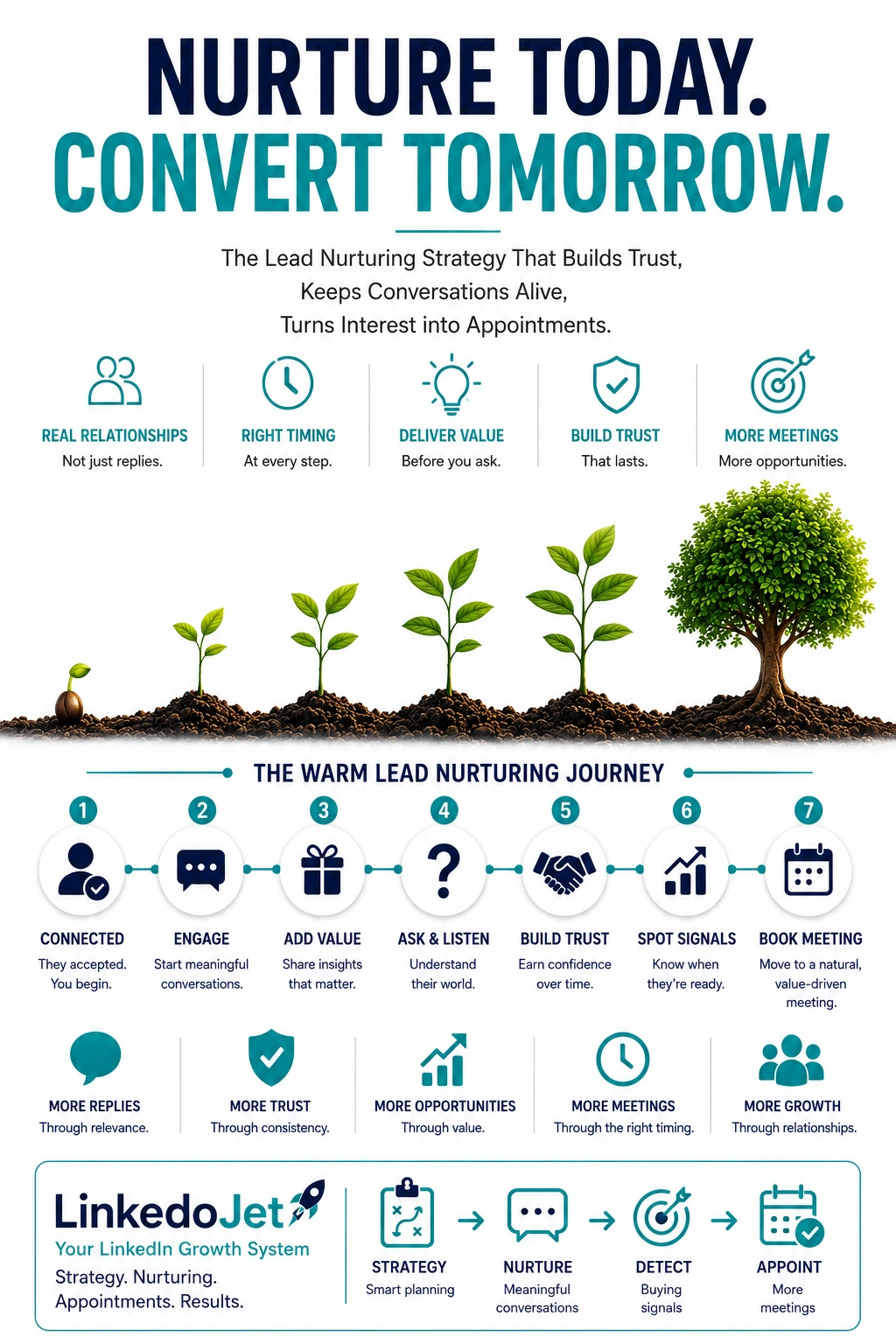
Warm lead nurturing in export isn’t “more follow-ups.” It’s controlled de-risking. Small proof, small questions, and the next step that feels safe to share internally.
Warm-lead classification for exporters: importer, distributor, OEM buyer, procurement quote-set builder, trading company price-fisher
Treating every warm reply the same is how you over-push the serious buyers and under-lead the ones who could turn into RFQs.
Most export teams run two buckets: “hot” (book a call) and “cold” (follow up later). That’s not how buying happens across borders.
Warm leads are usually in a sourcing stage. Different roles create different kinds of silence — and they respond to different types of follow-up.
| Warm lead type | What they’re really doing | What useful follow-up looks like | Red flag behavior |
|---|---|---|---|
| Importer exploring a new category | Testing supplier options and internal appetite | Send a tight capability snapshot + ask for destination market + compliance needs | Vague “send info” with no product focus |
| Distributor mapping suppliers for a region | Building a line card; checking consistency and packaging/labels | MOQ bands + lead time window + packaging options + how you handle claims | Only wants lowest price list; avoids any volume discussion |
| OEM buyer validating alternates | Risk-reduction: second source, spec match, PPAP/FAI-style thinking | Ask application/spec + tolerances + approval steps; offer a sample path | Wants quote without spec; won’t confirm revision or standard |
| Procurement building a quote set | Collecting comparable quotes; checking who’s “easy” and credible | Clarify spec, volume band, Incoterms, destination; give a quote framework | Repeated requests for price lists; no commitment to a spec |
| Trading company / price-fisher | Shopping numbers; reselling quotes; low context | Gate with minimum info required; keep replies short and conditional | Refuses basic questions; pushes for full list + fastest lead time claims |
The goal isn’t to be suspicious. It’s to protect your time while still looking like a reliable operator. Serious buyers respect suppliers who can ask two clarifying questions and explain why — because that’s how you avoid bad first orders.
The 4-week conversation arc: from first reply to RFQ clarity
You’re not trying to “close on LinkedIn.” You’re trying to make the next step low-effort and high-clarity while they evaluate.
Export deals rarely move in a straight line. Procurement, engineering, and sometimes finance align in the background. Your job is to stay relevant without adding pressure.
Here’s a 4-week arc that matches how international buyers actually buy — and prevents the common stall after “send pricing.”
Week 1: Confirm relevance with two fast questions
- Confirm application/spec direction (enough to avoid meaningless pricing).
- Confirm destination market (compliance and docs change the whole job).
- Confirm volume band (MOQ and lead time assumptions live here).
Week 2: Give operational proof in small pieces
- Lead time windows (normal vs peak season) and what drives variation.
- QC process: pre-shipment inspection, first-article approvals, traceability if relevant.
- Packaging/labeling options (case pack, palletization, private label realities).
Week 3: Reduce buyer workload with a “ready-to-forward” summary
- One-page capability + product family fit.
- MOQ bands by product family (not a 40-page list).
- Incoterms you can support + typical payment terms options.
Week 4: Move to RFQ readiness (without forcing it)
When they’ve shown real signals (samples, certs, capacity-by-month, packaging constraints, target price), suggest a short alignment call framed around avoiding quote mistakes:
- Spec / revision / standards
- Volume bands and ramp assumptions
- Destination compliance + documentation
- Lead time window + shipment timing
- Incoterms + payment terms
That’s not “sales.” That’s preventing rework. Procurement understands that.
Message snippets you can copy: follow-ups that reduce buyer workload
Short, specific, low-drama. Each message earns the next step instead of begging for it.
First warm follow-up after connection acceptance
Message: “Thanks for connecting — I saw you’re covering [market/region] and working with [category]. Quick one so I don’t send the wrong info: are you mainly sourcing for (A) distribution/resale, or (B) OEM/own production? Either is fine — it just changes the way we quote MOQ and packaging.”
After they reply “send details / pricing”
Message: “Happy to. To avoid a meaningless quote: what’s the application/spec (or standard), and a rough volume band (e.g., 1–5k / 5–20k / 20k+ per order)? Also, which destination market (EU/US/MEA/LATAM)? MOQ, compliance, and lead time assumptions change a lot by those three.”
Educational nurturing message (operator insight, not a brochure)
Message: “One thing that slows first orders more than price: packaging assumptions. MOQ often ties to carton/case pack and labeling, not just production. If you tell me your preferred case pack + whether you need bilingual labels, I can keep the quote and sample aligned from day one.”
Insight-based follow-up tied to real procurement friction
Message: “Quick heads-up — we’re seeing lead time variance tighten/loosen depending on [raw material / component] availability and peak season booking. Is your team aiming for shipment in a specific month this quarter, or is timing still flexible while specs get confirmed?”
Proof-based nurturing (operational, not fluffy)
Message: “For context on how we usually start with distributors: first order is often a small MOQ trial with tight packaging specs. Once the first shipment lands clean, we move to a rolling forecast with a 6-week production window and pre-shipment inspection checkpoints. If you share your target market + expected monthly demand range, I can suggest a low-risk start.”
Soft question to reopen a quiet thread (procurement-friendly)
Message: “No rush on my side — should I assume this is paused until (A) specs are confirmed internally, or (B) you’re waiting on a buying window? If it helps for internal sharing, I can send a one-page summary with MOQ bands + lead time window + compliance notes for [destination].”
Dormant lead revival message (with a real reason)
Message: “Circling back with something concrete: we’ve opened additional capacity for [product family] and our lead time window improved by ~[range] weeks for July/Aug runs. If your team is planning Q3 shipments, I can hold a provisional slot once we confirm spec + packaging.”
Final polite close-loop message (reputation-safe)
Message: “I’ll close the loop here so I’m not cluttering your inbox. If you want it, I can share a quick ‘sample + first order’ checklist (MOQ logic, typical lead time windows, docs by destination). If timing is simply later, tell me a month to circle back and I will.”
Buying-signal handling: what to say when they ask for samples, capacity-by-month, certs, private label, HS/export docs, or target price
These questions are the RFQ forming. Answer directly, then make the next step easy.
Warm lead nurturing becomes simple when you treat certain questions as stage signals. Below are responses that keep momentum without sounding pushy.
When they ask: “Can you send samples?”
Response: “Yes. To make the sample meaningful: which spec/application are you validating, and what’s the destination market? If you’re aiming for a specific ship month, a quick 12-minute alignment call helps us confirm spec/packaging so the sample and quote match your reality.”
When they ask: “What’s your capacity by month?”
Response: “We can share a realistic capacity window once we know the product family + packaging. If you give me your expected monthly range and target ship window, I’ll come back with a capacity band and a production schedule assumption (normal vs peak).”
When they ask: “Do you have ISO/CE/FDA/REACH/ROHS?”
Response: “We can provide the relevant certificates and test reports for the exact product/version. Tell me the market (EU/US/etc.) and whether you need documented traceability for audits. I’ll send the correct pack — not a generic folder.”
When they ask: “Can you do private label / custom packaging?”
Response: “Usually yes, within constraints. The key questions are artwork ownership, label language, and case pack because that’s what drives MOQ and lead time. If you share a reference pack or target format, I’ll confirm MOQ bands and the approval steps.”
When they ask: “HS code / export docs / origin / compliance docs?”
Response: “We handle standard export documentation (commercial invoice, packing list, COO where required) and can confirm HS code guidance for the product family. Tell me the destination and Incoterm you prefer so I send the doc set that matches your customs process.”
When they share a target price
Response: “Got it. Before I react to the number, I want to make sure we’re comparing the same thing: spec/revision, packaging, Incoterm, and volume band. If we’re aligned there, I can tell you quickly whether that target is workable — and what trade-offs would move it (MOQ, lead time window, or packaging).”
Soft meeting request (framed as quote accuracy)
Message: “If you’re moving toward a quote set, a short call avoids back-and-forth. Agenda is simple: spec + volume band + destination requirements + lead time window + Incoterms/terms. I’m free Tue 10:00 or Wed 16:00 your time — which works?”
Warm-lead mistakes that kill export deals: brochure behavior, blind quoting, needy check-ins, and meeting asks before trust
Most “lost” export deals weren’t lost on price. They were lost on process and perceived risk.
If you want to feel the leak in your forecast, watch what happens after you send early info. Bad nurturing teaches the buyer you’ll be painful later.
- Sending a full price list without context. You turn yourself into a commodity and invite cherry-picking. Serious buyers want a quote that matches their reality, not 200 SKUs.
- Blind quoting. Quoting without destination market, Incoterm, packaging assumptions, and volume band is a future dispute disguised as “responsiveness.”
- Generic personalization. “Saw your profile” reads like spam. Mention their market, category, or channel — something that proves you understand the job they’re doing.
- Needy check-ins. “Any updates?” forces them to do work (explain internal status) with no payoff. Give an easy out and a useful re-entry.
- Overpromising lead times or terms to keep the thread alive. The moment procurement pressure-tests delivery reliability, you lose trust.
- Pushing a meeting before you’ve reduced risk. Calls are earned when the buyer sees you’ll save time and prevent mistakes.
- Ignoring multi-stakeholder reality. Many buyers are collecting options for someone else. Your job is to create a message they can forward internally without embarrassment.
Export nurturing works when each touch does one of two things: reduces buyer workload, or reduces buyer risk. If it does neither, it’s noise — and you get parked in a folder.
Questions export teams ask when they’re serious about converting warm LinkedIn interest
What’s a realistic LinkedIn follow-up cadence for manufacturing export deals without sounding needy?
Think in “useful touches,” not reminders. A common pattern is 4–6 touches over 3–4 weeks: (1) qualify lightly, (2) send a tight capability snapshot, (3) one operational insight tied to lead times/packaging/compliance, (4) proof point, (5) a procurement-friendly reopen, (6) close-loop. If you don’t have new clarity or new proof, don’t message just to message.
How do I reply to “send your price list” on LinkedIn without wasting time on a meaningless quote?
Gate it politely with two essentials: destination market and volume band, plus one spec/application detail. Offer MOQ bands and a quote framework instead of a full list. If they won’t answer basic questions, treat it as price-fishing and keep your response conditional.
How can I qualify an international buyer on LinkedIn without pushing for a call?
Ask questions that feel like quote-accuracy questions, not interrogation: destination market, application/spec, and volume band. Then give a small piece of operational proof (lead time window, QC checkpoint, packaging constraint) that shows you’re a safe supplier to bring internally.
What are the strongest buying signals in LinkedIn messages for exporters (and what signals mean “pause”)?
Strong signals: samples, capacity-by-month, compliance certs, private label/packaging constraints, HS/export docs, Incoterms, payment terms, target price with context, or introducing another stakeholder. Pause signals: repeated price list requests with no spec, refusal to share destination/volume, vague “send info” across multiple categories, or clear statements they’re under contract until a later window.
What should I include in a LinkedIn follow-up after sending a product catalog to a buyer?
Don’t resend the catalog. Send a short “navigation” message: which 2–3 pages/SKUs are likely relevant, the MOQ band and lead time window for those, and one question that prevents wrong assumptions (destination market or packaging). Offer a one-page internal summary they can forward.
If you want warm LinkedIn conversations to turn into RFQs and booked calls, you need a desk process — not more messages
LinkedoJet runs your LinkedIn outbound and warm-lead follow-up like an export sales desk: intent classification, next-step logic, reply handling, and appointment generation support.
LinkedoJet is not a browser bot that sends connection requests and leaves you with a messy inbox.
We set up the targeting system, build the prospect lists in Sales Navigator, and run outreach that sounds like a competent export operator — then we manage the warm conversation layer that most teams drop.
Operationally, here’s what you get after onboarding:
- ICP and targeting setup for your export motion (importers, distributors, OEM buyers, procurement, category managers) including geography, industry, and buying role filters that match how you sell.
- Sales Navigator / LinkedIn prospect list building so outreach goes to the right stakeholders (not just generic titles).
- AI-assisted personalization that’s grounded in buyer context (market, category, channel) — not “saw your profile.” Messages are reviewed and tuned to your voice and compliance needs.
- LinkedIn outreach execution with controlled volume and sequencing that protects your brand while creating steady conversations.
- Lead reply handling and nurturing using stage-based follow-up: catalog/pricing requests, sample requests, compliance checks, packaging questions, Incoterms/terms, and RFQ signals.
- Warm lead tracking so you can see who’s early, who’s evaluating, and who’s showing RFQ readiness — with clear next actions.
- Appointment generation support that frames calls the right way: “let’s get the quote right and prevent back-and-forth,” with agendas tied to spec, volume bands, destination requirements, lead time windows, and terms.
- Campaign visibility through dashboards so you’re not guessing: connection acceptance, reply rates, warm lead stages, and booked meetings.
- Ongoing campaign refinement based on what buyers actually ask for (samples, capacity, certs, private label) and where threads stall.
How targeting and list building works: we start with your strongest export wedges (product family + target market + buyer type), then build segmented lists (e.g., EU distributors in category X, US OEM sourcing managers for application Y). Each segment gets messaging and follow-up logic that matches their buying process.
How AI-assisted personalization is used: we use AI to draft variations quickly, but the goal is restraint: one relevant line that proves you understand their world, then a low-effort question. It stays practical — MOQ bands, lead time windows, destination market realities — not marketing language.
How nurturing and follow-up workflows operate: when a buyer asks for pricing, we don’t dump a list. We gate with two essentials, send small proof in pieces, and keep the thread moving toward RFQ clarity. When they go quiet, we reopen with procurement-friendly nudges tied to real export triggers (lead time shifts, compliance docs, packaging updates, capacity windows).
How warm leads and appointments are tracked: every warm conversation is tagged by intent and stage, so you know which leads are building a quote set versus price-fishing. When RFQ signals appear (samples, capacity-by-month, certs, target price with context, additional stakeholders), we shift to meeting readiness and help get the call booked.
Why LinkedoJet is different from ordinary LinkedIn automation tools: tools send. We manage. The difference is the warm layer — classification, reply handling, next-step decisions, and appointment support — so your export pipeline becomes a controlled flow instead of a monthly scramble.
Next step: turn warm replies into RFQ-ready clarity (without chasing)
You’ll leave with a clear follow-up system: who you target, what you send next based on buyer signals, how you track warm lead stages, and how calls get booked when timing is real. From identifying the right decision-makers to starting meaningful conversations and turning them into qualified appointments... LinkedoJet manages the entire outbound engine for your business.