
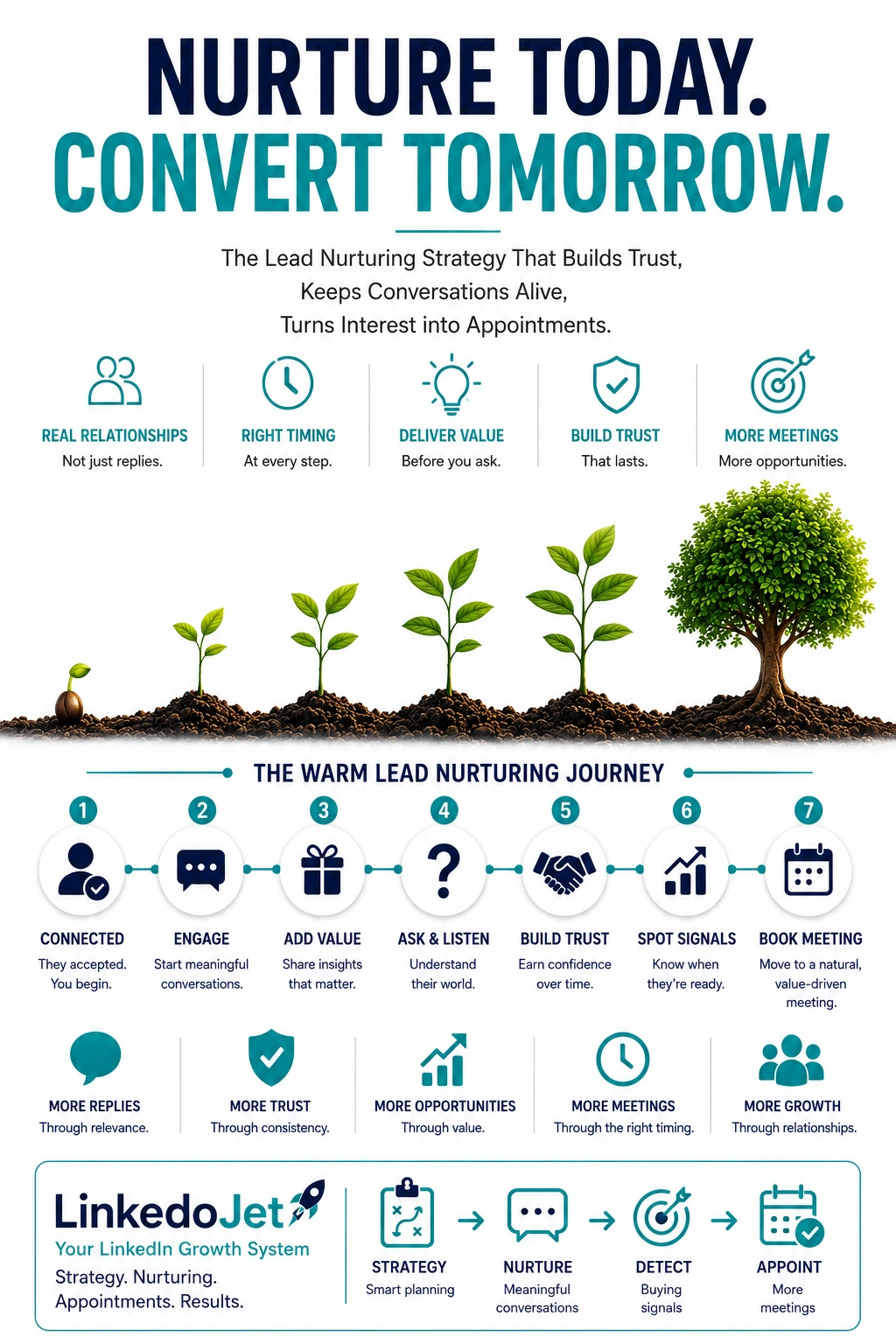
Why warm LinkedIn signals stall in logistics
You already earned a response. The part that hurts is watching it fade right before the moment it would have mattered.
You get the signals: a shipper-side ops leader accepts your connection after you post about on-time performance; a transportation manager replies once after you mention appointment compliance; procurement views your profile right after a visibility thread.
Then… nothing.
In logistics, that silence usually isn’t rejection. It’s timing, risk, and gates. Ops is firefighting. Procurement is protecting process. And the incumbent provider is “good enough” until a service miss becomes an escalation, a DC hits capacity, a new lane launch breaks the plan, or a renewal window forces a review.
The hidden cost isn’t a missed reply. It’s being forgettable when the fire drill hits.
Because when the inevitable trigger shows up—claims spike, detention disputes pile up, chargebacks start hitting, exception noise overwhelms the team—buyers don’t search their inbox for “friendly vendor.” They answer the person who felt operationally credible before urgency existed.
Most warm follow-up dies for one simple reason: it sounds like you’re trying to get to lanes/volumes and a meeting in week one. That’s how you get parked. And once you’re parked, every “checking in” message trains them to ignore you.
A lead-temperature model that matches how logistics buying really happens
Stop treating polite interest like intent. Start treating it like recall you earn.
If your reps don’t share a simple temperature model, you get two failure modes: over-pursuit (vendor fatigue) or under-nurture (missed trigger windows). In freight, 3PL, warehouse solutions, and supply chain tech, that’s the difference between “they went quiet” and “we got the working session during bid prep.”
| Temperature | What it looks like (logistics cues) | What to do next | What to avoid |
|---|---|---|---|
| Warm | Connection accepted; liked a post about service KPIs; profile view after a visibility/claims/detention topic; one-line reply like “makes sense” | Confirm context with one easy question. One insight touch within 5–7 days. | Asking for lanes/volumes, incumbent bashing, “Can we hop on a quick call?” |
| Hot | Mentions a bid, provider review, service failure, new DC, new customer launch; asks “what are you seeing?”; “we’re getting hit with detention/chargebacks” | Clarify scope/timeline/stakeholders. Offer a short working session with a clear output. | Pitching a deck, rate talk without lane context, generic “we can help” claims |
| Cooling | Polite replies with no operational detail; “we’re good for now”; “handled internally”; delays between responses | Mirror their language, offer one small comparison point, then give them an easy off-ramp. | More pings, longer messages, “any thoughts?” loops |
| Dormant | No response after two context-based nudges; seen-but-ignored; engagement stops | Pause. Re-enter later with a timely trigger hook and a one-word reply prompt. | Chasing, guilt, “just bumping this” |
Notice what’s missing: “interested” as a standalone concept. In this niche, interest without a trigger is just a person being polite while they’re trying to keep freight moving.
Cadence over weeks (not days): stay relevant without vendor fatigue
Your goal is “easy to reply to” until timing turns.
Logistics buyers don’t reward persistence. They reward relevance delivered with restraint. The fastest way to get muted is to treat a warm signal like a 72-hour close.
Here’s a cadence that respects how shipper conversations actually move—especially when ops and procurement aren’t aligned yet.
Week 1: context, not conversion
- Touch 1 (within 24–48 hours of the warm signal): a short message that confirms their world (shipper ops vs procurement vs transportation) and asks one easy question.
- Touch 2 (5–7 days later): one operational observation tied to their segment (FTL/LTL, parcel, cross-border, warehousing, visibility), plus a low-friction question.
Weeks 2–3: one useful idea at a time
- 1 touch per week, max. Keep it under 70–90 words.
- Rotate between operations KPIs (on-time, claims, dwell), process (appointment compliance, accessorial dispute handling), and planning (peak prep, network changes).
- Ask questions that help you classify temperature (“renewal window this half?” beats “want to chat?”).
Week 4+: trigger-based nudges only
- If there’s no trigger and no engagement, switch to monthly touches or pause.
- If they show a trigger, move to a short working session offer with a clear outcome (benchmark, provider review checklist, stakeholder map).
This cadence keeps you present without becoming the vendor that makes them regret accepting a connection.
Conversation progression that earns trust: context → operational relevance → trigger readiness
The meeting isn’t the next step. Earning recall is.
A good logistics nurture thread feels like a peer-to-peer operational exchange. Not a slow-motion pitch.
1) Context: where complexity actually sits
Early on, you’re not qualifying budget. You’re learning where pain would show up first.
- Is this owned by transportation/ops (service, dwell, exceptions) or procurement (process, compliance, savings narrative)?
- Are they fighting warehouse constraints (dock scheduling, labor, yard flow) or carrier performance (OTIF, claims, missed pickups)?
- Are they locked into a contract, or in a rolling review culture?
2) Operational relevance: small insights that fit their day
“Here’s what we’re seeing” works when it’s specific: detention disputes, appointment compliance drift, claims leading indicators, visibility exception overload, accessorial surprises tied to bad master data.
One insight. One question. Then stop.
3) Trigger readiness: align with the real gates
Most deals don’t die because your solution is weak. They die because you asked for the wrong next step before procurement and ops could justify the switching risk.
When a trigger appears, your job is to make the next step safe:
- Clarify timeline (“is this a this-month fire drill or a Q3 bid?”).
- Clarify owner (“ops driving, or procurement initiating?”).
- Clarify success (“reduce exceptions, improve OTP, lower expedites, fewer chargebacks?”).
Only then does a discovery call feel like a working session instead of a vendor meeting.
Short message examples that sound like a logistics operator (not a lane-chaser)
Each one is designed to learn something, not “keep the thread alive.”
1) First warm follow-up after connection acceptance (context-first, no pitch)
When to use: they accepted, liked a post, or viewed your profile.
What it’s trying to learn: what they’re judged on—service, cost-to-serve, accessorial control, or visibility.
Message:
Appreciate the connect. Quick one—on your side, is the pressure mostly service (OTP/claims), cost-to-serve (accessorial surprises), visibility noise, or warehouse flow (appointments/dwell)?
No need for lanes/volumes—just trying to understand what “a bad week” looks like for you.
2) Follow-up after a prospect replies “we handle that internally” or “we’re good for now”
When to use: they responded, but shut the door.
What it’s trying to learn: whether there’s a latent risk signal you can be remembered for.
Message:
Totally fair—and a lot of teams keep it in-house until something breaks.
One thing I’m seeing: the early warning sign usually isn’t cost, it’s appointment compliance drift (then dwell climbs, then detention disputes explode).
If you want, I can send a 6-point checklist ops teams use to spot it early—worth it, or not relevant on your network?
3) Educational nurturing message (useful operational takeaway)
When to use: Week 2/3 touch; no trigger yet.
What it’s trying to learn: which operational metric they care about and whether they’re feeling pain.
Message:
Quick pattern we’re seeing with shipper teams trying to cut detention disputes: the wins come less from “better carriers” and more from tightening arrival/appointment evidence (gate timestamps + exception codes that procurement will accept).
Are detention/chargebacks even a headline issue for you this quarter, or is it more service/claims?
4) Insight-based follow-up (timing and triggers)
When to use: you suspect a calendar event, but you don’t know.
What it’s trying to learn: whether a bid/renewal/network change is on their radar.
Message:
Sanity-check: are you anywhere near a renewal/bid window or a network change (new DC, new customer launch, mode shift) this quarter?
If not, I’ll stay out of your hair—just trying to catch the timing where a benchmark is actually useful.
5) Case-study / proof-based nurturing (credible, constraint-aware)
When to use: they’ve engaged lightly; you want to build operational credibility.
What it’s trying to learn: whether their pain matches a known failure mode.
Message:
One mini example (not magic, just what worked): a shipper team was getting hit with chargebacks tied to missed delivery windows.
They didn’t rip/replace providers. They tightened appointment discipline on the top problem facilities, cleaned up exception categorization, and set a weekly ops/procurement review so savings didn’t come at the cost of service.
Do missed appointments/chargebacks show up for you, or is your pain more claims + exception overload?
6) Soft question to reopen the conversation (when they go quiet)
When to use: Cooling or early Dormant.
What it’s trying to learn: which bucket they’re in, with minimal friction.
Message:
Quick one-word reply is fine—what’s the nearest “trigger” on your side?
1) renewal window 2) service issues 3) new lanes 4) visibility 5) warehouse capacity 6) nothing urgent
7) Buying-signal response (they mention a bid/review/problem)
When to use: they say “we’re re-bidding,” “evaluating 3PLs,” “service is slipping,” “we need better visibility.”
What it’s trying to learn: scope, timeline, stakeholders, and success definition.
Message:
Got it—thanks for sharing that. To make this useful and not sales-y, three quick clarifiers:
1) Is the driver service, cost-to-serve, or exception control?
2) Who owns the decision day-to-day—ops/transportation, or procurement?
3) What’s the timing (this month fire drill vs a structured bid window)?
If you’re open, we can do a 20-minute working session to map scope and the questions procurement will ask so you don’t lose time later.
8) Soft meeting request (natural transition)
When to use: they’re warm and responsive, but not overtly buying.
What it’s trying to learn: whether they want synchronous help or prefer async.
Message:
Two options—your call:
A) 15 minutes and I’ll share what we’re seeing across shipper teams on the specific KPI you mentioned (and the common failure modes), or
B) I stay async and send one more relevant benchmark/checklist.
Which is easier right now?
9) Dormant lead revival (weeks later, new relevance)
When to use: Dormant, but you have a new timely hook.
What it’s trying to learn: whether the old context is now active.
Message:
Circling back on a real ops trend: a lot of teams are seeing “visibility fatigue”—too many exceptions, not enough action, and ops stops trusting the alerts.
Last time we spoke you mentioned visibility/service was a focus. Is that still a priority, or did the fire move somewhere else?
10) Final polite close-loop (protects brand, keeps door open)
When to use: you’ve nudged twice with context; still nothing.
What it’s trying to learn: whether to pause without burning trust.
Message:
I’m going to stop nudging so I’m not adding noise.
If a bid window opens or a service issue hits and you want something specific, reply with one word—BENCHMARK or CHECKLIST—and I’ll send a tight set of questions teams use for provider reviews (ops + procurement).
Mistakes that kill warm logistics conversations (and what to do instead)
Most follow-up fails because it ignores switching risk and the buyer’s reality.
1) Asking for lanes/volumes too early
Why it fails: you’re asking them to do work and expose information before there’s a reason to switch.
Do this instead: earn context with low-friction questions (which KPI is breaking, where the bottleneck is, what the next calendar event is).
2) Pushing a meeting before a trigger exists
Why it fails: ops leaders hear “another vendor meeting.” Procurement hears “process risk.”
Do this instead: offer a working session only when timing is real, and state the output (benchmark, stakeholder alignment, provider review checklist).
3) Rate talk without context
Why it fails: it signals you’re chasing freight, not solving operational fallout. It also attracts the wrong kind of buyer.
Do this instead: talk in operational terms first: OTP, dwell, claims, exceptions, accessorial disputes, appointment compliance.
4) Fluffy personalization
Why it fails: “noticed your profile” reads like spam—especially in freight, where inboxes are full of it.
Do this instead: personalize to the operational world: their mode, network shape, likely constraints, and typical trigger events.
5) Sharing irrelevant content
Why it fails: generic sales posts don’t help someone dealing with a missed pickup that just escalated to a customer.
Do this instead: send one practical observation: reducing detention disputes, tightening appointment discipline, claims leading indicators, visibility noise reduction.
6) Ignoring procurement realities and switching risk
Why it fails: changing carriers/3PLs/TMS workflows has blast radius: SOP changes, exceptions, claims handling, warehouse impacts.
Do this instead: acknowledge the disruption and frame next steps as de-risking: small scope, clear measurement, stakeholder clarity.
How LinkedoJet runs warm follow-up end-to-end (so reps don’t wing it)
Warm signals only turn into meetings when someone owns the system—not just the inbox.
LinkedoJet isn’t “a LinkedIn automation tool.” It’s the operating system for outbound when your market has long cycles, real switching risk, and short trigger windows.
What we set up after onboarding:
- ICP and targeting setup: we define who matters in logistics deals (ops vs transportation vs procurement vs supply chain systems) and the segments you actually want (shipper profiles, 3PL types, warehouse operators, supply chain tech buyers).
- Sales Navigator / LinkedIn prospect list building: we build and maintain clean lists tied to your buying committees, not vanity titles.
- AI-assisted personalization: not fluffy intros—tight opening context that matches their operational world (service KPIs, dwell, claims, accessorial control, visibility).
- Outreach execution: connection + message sequencing run consistently, with cadence rules that prevent vendor fatigue.
- Lead reply handling and nurturing: we support your team with next-best responses and nurture logic based on temperature (Warm/Hot/Cooling/Dormant), so a “good for now” doesn’t turn into a dead end.
- Warm lead tracking: we track signals and thread status so your team knows who’s heating up, who’s cooling, and who needs a trigger-based re-entry.
- Appointment generation support: when intent is real (bid/review/service failure/network change), we help move the conversation to a working session without forcing a premature demo.
- Campaign visibility: dashboards that show what’s being sent, what’s getting replies, and where conversations stall—so you can fix the system, not blame reps.
- Ongoing refinement: targeting, messaging, and cadence get tuned based on reply patterns in your niche (freight, 3PL, warehousing, supply chain tech).
The practical outcome: fewer “activity-heavy” weeks and more conversations that stay alive until the trigger hits—then convert cleanly into qualified discovery.
FAQ
What counts as a “warm” LinkedIn signal in logistics sales (and what doesn’t)?
Warm means they did something that suggests recognition or curiosity: accepted the connection, replied once (even briefly), liked/commented on a post about service KPIs, detention, claims, visibility, or they viewed your profile after a relevant message. Not warm: random follows from overseas dispatchers, generic “thanks for connecting,” or engagement that never repeats and has no operational context.
How do I follow up without asking for lanes, volumes, or a call too early?
Ask for context that’s easy to answer and tied to their day: service vs cost-to-serve vs visibility vs warehouse flow. Then send one operational observation per week for a couple weeks. Your next step isn’t “a call.” It’s earning recall. Only introduce a working session when they mention a trigger (bid, renewal, review, service failure, new lanes, network change).
What cadence works for enterprise shipper conversations with renewals and bid calendars?
Think weeks, not days. Week 1: one context question + one operational insight touch. Weeks 2–3: one touch per week. Week 4+: monthly or pause unless there’s a trigger. Enterprise buyers will tolerate fewer messages if each one is specific (appointments/dwell, claims, exception noise, chargebacks) and gives them an easy way to respond.
How do you revive a dead LinkedIn conversation with a shipper or 3PL prospect without sounding pushy?
Don’t “bump.” Re-enter with a timely operational hook (visibility fatigue, appointment compliance drift, detention disputes, claims leading indicators) and connect it to what they previously hinted at. End with a one-word or multiple-choice reply. If they still don’t respond, close the loop politely and leave a keyword they can use when timing changes.
What are the clearest buying signals in freight/3PL/warehouse sales conversations on LinkedIn?
Direct signals: “We’re re-bidding,” “we’re reviewing providers,” “service is slipping,” “we’re adding lanes,” “new DC,” “renewal is coming up,” “we need better visibility,” “detention/chargebacks are killing us,” “send me what you’ve seen work.” Indirect signals: they ask operational questions, they reference timelines, or they introduce procurement/ops stakeholders into the thread.
If you want this to run consistently, we’ll build and operate it with you
Not theory. A working warm-lead follow-up engine for logistics sales—temperature rules, messages, nurturing, and appointment handoff when timing is real.
When you book a LinkedoJet session, we’ll look at your current LinkedIn motion through a logistics lens: who you’re targeting (ops vs procurement vs transportation), what your warm signals actually mean, and where threads are dying before a bid window or service event makes them actionable.
What LinkedoJet operationally provides (not just software): we set up your ICP and targeting, build Sales Navigator prospect lists, write and run outreach workflows, and use AI-assisted personalization to keep messages specific to how shippers and 3PL buyers talk (service KPIs, detention, appointment compliance, claims, exception noise, chargebacks).
After onboarding, here’s what you receive:
- A defined temperature model (Warm/Hot/Cooling/Dormant) with cadence rules and trigger-based next steps.
- Prospect list building tied to buying committees—so you’re not “marketing to titles,” you’re reaching the people who feel the operational pain and the people who control process.
- Message libraries and follow-up sequences that stay credible in long cycles (no lane-chasing, no forced meetings).
- Lead nurturing and follow-up workflows that keep conversations alive until timing turns—plus guidance on how to respond when prospects say “good for now.”
- Warm lead and appointment tracking so you know what’s heating up, what’s cooling, and what moved to a working session—without losing the thread in a rep’s inbox.
- Campaign visibility through dashboards, and ongoing refinement based on real reply patterns in freight/3PL/warehousing/supply chain tech.
How targeting and list building works: we start with your ICP (shipper segments, network characteristics, modes, typical triggers), then build segmented Sales Navigator lists by function (ops/transportation/procurement/systems) and by likely trigger windows (renewals, bids, network changes). That’s what makes follow-up feel timed instead of spammy.
How AI-assisted personalization is used: to generate operator-grade openers and follow-ups that reflect the prospect’s world—without pretending we know their lane data. It’s a support layer for relevance, not a gimmick.
How nurturing and reply handling works: we help your team keep replies moving with short, credibility-first responses and next-best questions. When a buying signal appears, we guide the transition to a working session and support appointment generation so meetings happen when intent is real.
Why LinkedoJet is different from ordinary LinkedIn automation tools: automation sends messages. LinkedoJet runs the full system—targeting, execution, warm-signal tracking, nurturing logic, reply handling support, and the handoff into qualified appointments—so your pipeline doesn’t depend on who “remembers to follow up” that week.
Next step: get a follow-up system your team can actually run
You don’t need more LinkedIn activity. You need a warm-lead engine that stays credible until timing turns—and then converts.
From identifying the right decision-makers to starting meaningful conversations and turning them into qualified appointments... LinkedoJet manages the entire outbound engine for your business.