
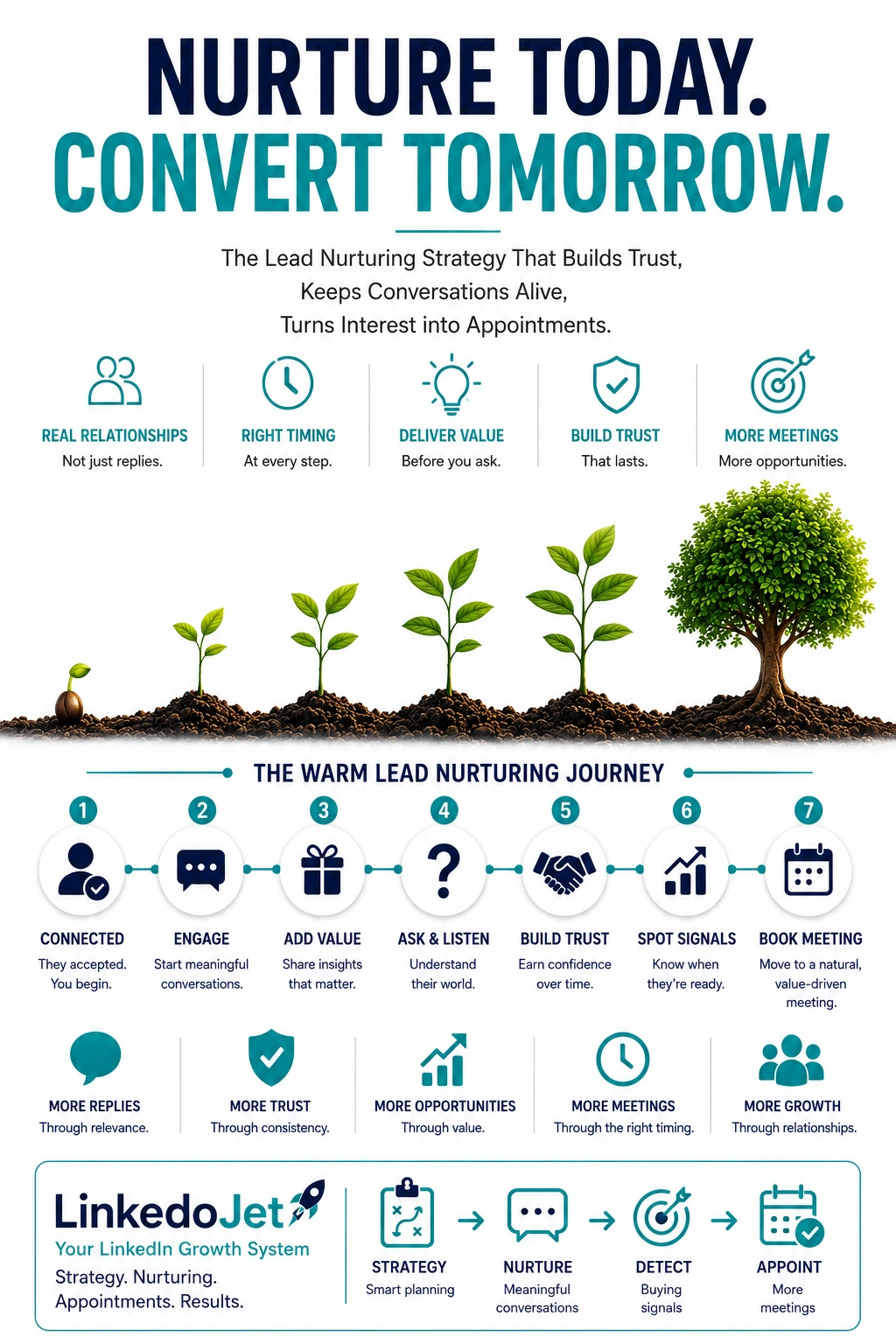
Why warm ISO leads go quiet (and the real cost of letting threads die in your inbox)
Warm ISO leads rarely die because your first message was wrong. They stall because the buyer’s internal engine stalls.
You know the feeling: a Quality Manager reacts to a post about audit readiness, connects, asks a quick question about timelines… and then the thread goes cold. Not because they’re “not interested.” Because they’re juggling day-to-day operations while a compliance trigger sits half-defined in the background.
ISO work is bought in bursts. A customer questionnaire lands. A tender asks for certification evidence. A surveillance audit date gets penciled in. Leadership asks, “Are we actually in control?” Then momentum disappears as soon as the fire shifts.
When those warm threads die, your pipeline doesn’t just shrink. It gets lumpy. You start backfilling with cold outreach, hoping referrals show up, or waiting for the next last-minute “we need ISO in 6 weeks” rescue. That’s not a sales problem. That’s an operating problem.
The hidden reason people go quiet in this niche is almost never a classic objection. It’s scoping ambiguity and internal embarrassment:
- No clear owner: the QMS/ISMS “belongs to everyone,” so it belongs to no one.
- They can’t define scope boundaries: sites, functions, products, supplier footprint—too many unknowns.
- They’re waiting on external decisions: certification body selection, procurement process, tender clarifications.
- They got spooked by template-dumping: a consultant made it feel like a paperwork project, not operational control.
- They fear being judged: internal audits are weak, corrective actions don’t close, evidence is scattered.
If your follow-up looks like generic sales follow-up, you become one more task in an already overloaded week. If your follow-up feels like calm triage, you become the “safe pair of hands” they come back to when the trigger hits.
Lead temperature for ISO work: Curious → Triggered → Active → Mobilizing
Treat nurturing like implementation triage: small steps that reduce uncertainty, timed to compliance reality.
| Temperature | What they’re really deciding | What you do next on LinkedIn |
|---|---|---|
| Curious | “Is this relevant to us?” / “Is ISO going to become a problem?” | Ask one scoping-intent question. Offer a tiny, practical prompt (not a call). |
| Triggered | “What’s driving this and by when?” (customer requirement, audit, tender, security review) | Confirm the driver. Ask for the one date that changes everything. Give a realistic expectation about effort. |
| Active | “What will this take?” (scope, timeline, resourcing, cost ranges) | Reduce ambiguity: 2–3 questions that determine plan + price. Share a simple timeline frame. |
| Mobilizing | “We’re doing it.” (stakeholders named, certification body in motion, dates, internal ownership) | Move to a short scoping working session. Make it about risk reduction and avoiding late rework. |
Most consultants treat every warm reply as “Active.” That’s how you end up pushing for a call when the buyer can’t even answer “what’s in scope?” without feeling exposed.
Message examples that sound like an ISO scoping partner (not a template)
Short, situational, and grounded in how audits and certification actually work.
1) First follow-up after connection acceptance (small next step, not “book a call”)
After they liked/commented on an audit readiness post:
“Thanks for connecting — saw your note on audit readiness. Quick sense-check: are you aiming for certification this year, or is this more ‘get the system under control’ before you commit to dates?”
After a Quality Manager profile visit / quiet connect:
“Appreciate the connect. When ISO 9001 comes up internally, the first thing that decides speed (and cost) is scope definition. If it helps, I can send the 5 scoping fields we use before we talk numbers.”
After an ISO 27001 post interaction:
“Good to connect. For 27001, teams usually get stuck on ownership (risk/asset inventory/supplier risk) more than on writing policies. Are you already tracking evidence anywhere, or is it still spread across tools?”
2) Follow-up after they reply (keep it consultative, surface urgency)
“That makes sense. When you say ‘we need 9001,’ is it driven by a customer requirement/tender, or more internal ops cleanup? If there’s a date attached (audit window, bid deadline), that changes the plan fast.”
“If you already have procedures but internal audits are weak, timelines look very different than greenfield. Do you have an internal audit rhythm today, even if it’s informal?”
3) Educational nurture (a short lesson they can reuse internally)
“One thing I see a lot: teams ‘document’ a QMS but don’t build the operating cadence. Auditors rarely get stuck on whether you have a policy — they probe whether corrective actions close, process owners actually own measures, and management review drives decisions. If you want, tell me which part feels heaviest: internal audits, CAPA, or management review.”
“If you’re combining 9001 with 14001/45001, the mistake is rebuilding everything twice. You can keep one core operating system (context, leadership, planning, support, performance evaluation, improvement) and add only what’s truly standard-specific. The time-saver is scope clarity, not ‘more templates.’”
4) Insight-based follow-up (sounds like current work)
ISO 27001:
“This week I watched a team lose two weeks because ‘risk assessment’ had no real owner. Everyone agreed it mattered, nobody owned the decisions. Once ownership was clear, the asset inventory and supplier risk work stopped being theoretical and started producing evidence. Is ownership clear on your side, or still a committee?”
ISO 9001:
“The quiet killer in 9001 is corrective actions that never really close — you fix the symptom, not the cause, so the same issues resurface before the audit. If you’ve had repeat findings (even informal), that’s a signal to tighten CAPA before anything else.”
5) Proof-based nurture (anonymized, specific, responsible)
“An example that might map to you: we came into a team with scattered procedures, no internal audit rhythm, and unclear scope across two sites. We ran a tight scoping pass, then built a simple evidence cadence (internal audits + management review inputs) instead of ‘writing more.’ They went into audit with minimal nonconformities and avoided the late-stage scramble of chasing records in week 11.”
6) Reopeners (easy reply even when they’re busy)
“Quick one — still on your radar, or did the customer/tender timeline move?”
“Are you trying to get certified for a specific customer, or is this mainly about cleaning up operations? Either is fine — it just changes the plan.”
7) Dormant lead revival (timing-triggered, no guilt)
“Quick check-in — teams usually resurface this when a questionnaire lands or an audit date gets confirmed. Has anything changed on your side? If you’re in 27001 mode, I can send a one-page prompt on risk/asset ownership and evidence collection that auditors tend to push on.”
8) Final close-loop (professional, compliance-contextual)
“No worries if this has paused. If an audit date gets set or a customer asks for certification evidence, message me ‘scope’ and I’ll send the scoping prompts we use to size the work quickly.”
Buying signals, negative signals, and what to do in each moment
Your follow-up should change when the signal changes. Otherwise you look careless.
Signals that mean “move toward scoping”
- Dates: “audit in October,” “surveillance is coming up,” “tender closes Friday,” “this quarter.”
- External pressure: customer mandate, contract clause, security review loop, procurement asking for evidence.
- Control pain: “we can’t find evidence,” “internal audits aren’t happening,” “CAPAs don’t stick.”
- Stakeholders named: IT/security lead involved (27001), Ops/process owners (9001), HSE lead (14001/45001).
- Certification body talk: comparing CBs, asking about Stage 1/Stage 2 sequencing.
What to do right then (example response when an audit date or tender appears)
“Got it — if you’re aiming for [month], the fastest way to avoid rework is to lock scope and maturity quickly. Two questions that decide the plan: (1) how many sites/functions are in scope, and (2) do you already have an internal audit + management review cadence, even if it’s messy? If you want, we can do a short scoping working session and you’ll leave with a realistic timeline and the first set of actions.”
Negative signals (where you slow down or qualify harder)
- “Just send templates.” Often code for “we want to do this without changing anything.”
- No driver, no date, no owner. They’re browsing, not buying.
- Pricing-first, scope-absent. They want certainty before they’ve earned it internally.
- Vendor-shopping behavior: broad questions, no context, pushing for a quote via DM.
How to handle pricing-before-scope without sounding evasive
“I can give ranges, but they only become honest once three things are clear: scope boundaries, site count, and current maturity (do you have working internal audits / evidence today?). If you tell me those in two lines, I’ll point you to the likely band and what typically drives it up or down.”
Cadence and lanes: pace follow-ups around audit/procurement reality + route by standard
A good cadence feels like calm continuity, not persistence.
The best ISO follow-up cadence is rarely “every X days.” It’s paced to their trigger and their readiness. Your goal is to stay relevant with low-effort prompts they can answer between meetings.
A simple cadence that works in practice
- Day 1–2 after their last reply: one clarifying question + one grounded expectation.
- Day 5–7: a micro-lesson tied to their standard (9001 vs 27001 vs 14001/45001).
- Day 12–18: a proof note (anonymized) or a “two-lane” question (certification vs control).
- Then: one reopener every 3–4 weeks, timed to likely triggers (tenders, surveillance cycles, customer questionnaires).
Route the thread into the right lane (or you’ll say the wrong useful thing)
- ISO 9001 lane: process ownership, internal audit rhythm, CAPA closure, management review inputs, multi-site scope clarity.
- ISO 27001 lane: risk ownership, asset inventory reality, supplier risk, evidence collection, “policy vs practice” gaps in security operations.
- ISO 14001/45001 lane: operational controls, legal/other requirements registers, incident/near-miss learning loops, competence/training evidence.
- Support type lane: implementation vs internal audit support vs remediation after a rough surveillance.
When you route correctly, your follow-ups don’t feel like follow-ups. They feel like you’re paying attention.
A soft meeting request that doesn’t spook them: turn clarity into a 20‑minute scoping working session
Position the call as a risk-reduction working session, not a pitch.
In compliance work, people avoid calls when they expect judgment, homework, or a sales script. Your meeting ask should sound like relief: quick clarity, fewer unknowns, no grand commitment.
When to ask
- They mention a date (audit, tender, “this quarter”).
- They name a driver (customer requirement, surveillance, security review loop).
- They show scope confusion (“not sure what’s in/out,” “multiple sites,” “we also want 14001 later”).
Soft ask scripts (pick one that matches the moment)
Certification date present:
“If you’re aiming for certification by [month], a 20-minute scoping chat will tell you whether this is a light tidy-up or a proper implementation project. Want to sanity-check scope and timeline?”
They’re early and cautious:
“Happy to keep this async if that’s easier. If you want a quicker path to clarity, we can do a short scoping working session — you’ll leave with the 3–4 decisions that make the rest straightforward.”
Procurement / tender pressure:
“With tenders, the risk is overpromising and then paying for it later. If you share the deadline and the scope boundary (what’s actually being certified), we can do a short working session and get you a realistic plan you can take to procurement.”
Notice what’s missing: pressure. You’re offering a practical next step that reduces risk and gives them something they can use internally.
How LinkedoJet operationalizes warm-lead nurturing for ISO consultants
Not “more automation.” A managed outbound system that keeps warm ISO intent alive until the timing is real.
Most LinkedIn tools can send messages. That’s not the hard part in ISO. The hard part is staying specific over weeks, tracking readiness, and showing up at the exact moment the tender/audit/customer demand makes action unavoidable.
LinkedoJet is built to run that engine with you, end-to-end:
- ICP + targeting setup: define who actually drives scope decisions (Quality/Ops/Compliance/IT/Security, plus founders in smaller firms) and what triggers create urgency (surveillance, tenders, customer mandates).
- Sales Navigator prospect list building: we build and maintain segmented lists by standard and persona (9001 vs 27001 vs 14001/45001; Quality vs Security vs Ops), so your nurture stays relevant.
- AI-assisted personalization: used to reflect what they engaged with (audit readiness post, ISO 27001 comment, profile visit) and to keep messages human—without turning you into a full-time copywriter.
- Outreach execution: connection + initial context-setting handled consistently, with message logic that matches ISO buying behavior.
- Reply handling + nurturing: warm replies are routed into temperature stages (Curious/Triggered/Active/Mobilizing) with ISO-native prompts that surface driver/date/scope without pushing too early.
- Warm lead tracking: we track intent signals (replies, engagement, profile behavior) and maintain visibility so warm threads don’t die quietly.
- Follow-up workflows: paced around procurement and audit timing, including dormant revival and clean close-loop messages that protect trust.
- Appointment generation support: when the signal turns real, we help convert it into a booked scoping working session, not a vague “chat.”
- Campaign dashboards + refinement: you can see what’s working by standard/persona, and we adjust targeting, prompts, and cadence based on outcomes—not guesses.
The outcome is simple: fewer stalled conversations, more ISO-native momentum, and scoping calls that happen when the buyer is ready to make decisions—because the thread stayed credible while their internal situation caught up.
FAQ
What’s a good LinkedIn follow-up cadence for ISO consulting without becoming a pest?
Anchor cadence to readiness, not a calendar. After a reply, follow up in 1–2 days with one clarifying question. Then 5–7 days later share a micro-lesson tied to their standard. After that, widen the spacing (every 3–4 weeks) unless a trigger appears (audit date, tender deadline, customer mandate). The goal is to remain useful without creating work for them.
How do I revive a dead LinkedIn conversation with a Quality Manager before an audit or tender?
Use a trigger-based reopener that gives them an easy out: “Quick one — teams usually resurface this when the audit date gets confirmed or a tender asks for evidence. Has anything moved on your side?” Then offer one small, relevant asset (scoping prompts, common audit bottlenecks) rather than “checking in.”
What buying signals matter most for ISO 9001 vs ISO 27001 leads on LinkedIn?
For ISO 9001, watch for signals around internal audits, CAPA not closing, multi-site scope questions, and management review pressure—plus any explicit audit/tender dates. For ISO 27001, pay attention to ownership (risk/asset inventory), supplier risk, evidence collection pain, recurring security questionnaires, and mentions of leadership/procurement deadlines.
How do I handle prospects who ask for pricing before scope is defined?
Offer ranges with conditions. Ask for the three inputs that actually drive cost: scope boundary, site count, and current maturity (do they have working internal audits/evidence today?). If they won’t share any scoping facts, pause—price shopping without context tends to create low-quality projects and scope fights later.
What should I send as “value” if they don’t want a call yet (without dumping templates)?
Send micro-clarity, not documents. A one-paragraph explanation of what auditors test beyond policies, a simple timeline frame (“greenfield vs tidy-up”), a scoping prompt list, or a short note on common bottlenecks (internal audit cadence, management review inputs, risk ownership). The goal is to help them make one internal decision, not hand them a binder.
See how we keep warm ISO threads alive—and turn the right ones into scoping calls
This isn’t a generic “strategy call.” It’s a working session to show you the operating system we run, and what you’ll receive after onboarding.
If you already have warm LinkedIn conversations that keep stalling, we’ll show you how to run nurturing like implementation triage: calm, specific, and timed to compliance triggers.
On the session, we’ll do three concrete things:
- Map your targeting and lanes: who you’re targeting (Quality/Ops/Security/Compliance/founders), which standards you sell most (9001/27001/14001/45001), and which support type (implementation vs internal audit support vs remediation).
- Build your warm-lead follow-up logic: the exact prompts and temperature routing (Curious → Triggered → Active → Mobilizing), including reopeners and close-loop messages that protect trust.
- Define what “appointment-ready” means: the scoping fields that must be surfaced before a call makes sense (driver/date, scope boundaries, site count, maturity/ownership) so calls don’t turn into vague chats.
After onboarding, LinkedoJet operationally provides: ICP and targeting setup, Sales Navigator prospect list building, AI-assisted personalization, LinkedIn outreach execution, reply handling and lead nurturing, warm lead tracking, and appointment generation support—backed by dashboards so you can see what’s happening without living in DMs.
Targeting and list building aren’t guesswork. We build segmented lists by persona and standard (e.g., Quality Managers for 9001 vs Security leaders for 27001) and keep them fresh. Personalization is AI-assisted, but controlled: it reflects what the prospect actually engaged with, and it stays in an ISO-native tone—no hype, no “growth” talk, no template dumping.
Follow-up workflows run on signals. When someone replies, engages, or shows intent, they’re routed into the right nurturing lane with prompts that surface scope and timing without pushing too early. Warm leads and booked meetings are tracked so nothing quietly dies in your inbox. And we keep refining what’s working as the market shifts.
Why this is different from ordinary LinkedIn automation tools: tools send sequences. LinkedoJet runs the system—targeting, messaging, routing, follow-up logic, reply handling, nurturing, tracking, and appointment support—so warm intent turns into scoping conversations at the right moment.
Next step: make warm interest predictable
If your team can win ISO work, you don’t need more noise. You need a system that keeps credibility high until the trigger becomes action.
From identifying the right decision-makers to starting meaningful conversations and turning them into qualified appointments... LinkedoJet manages the entire outbound engine for your business.