
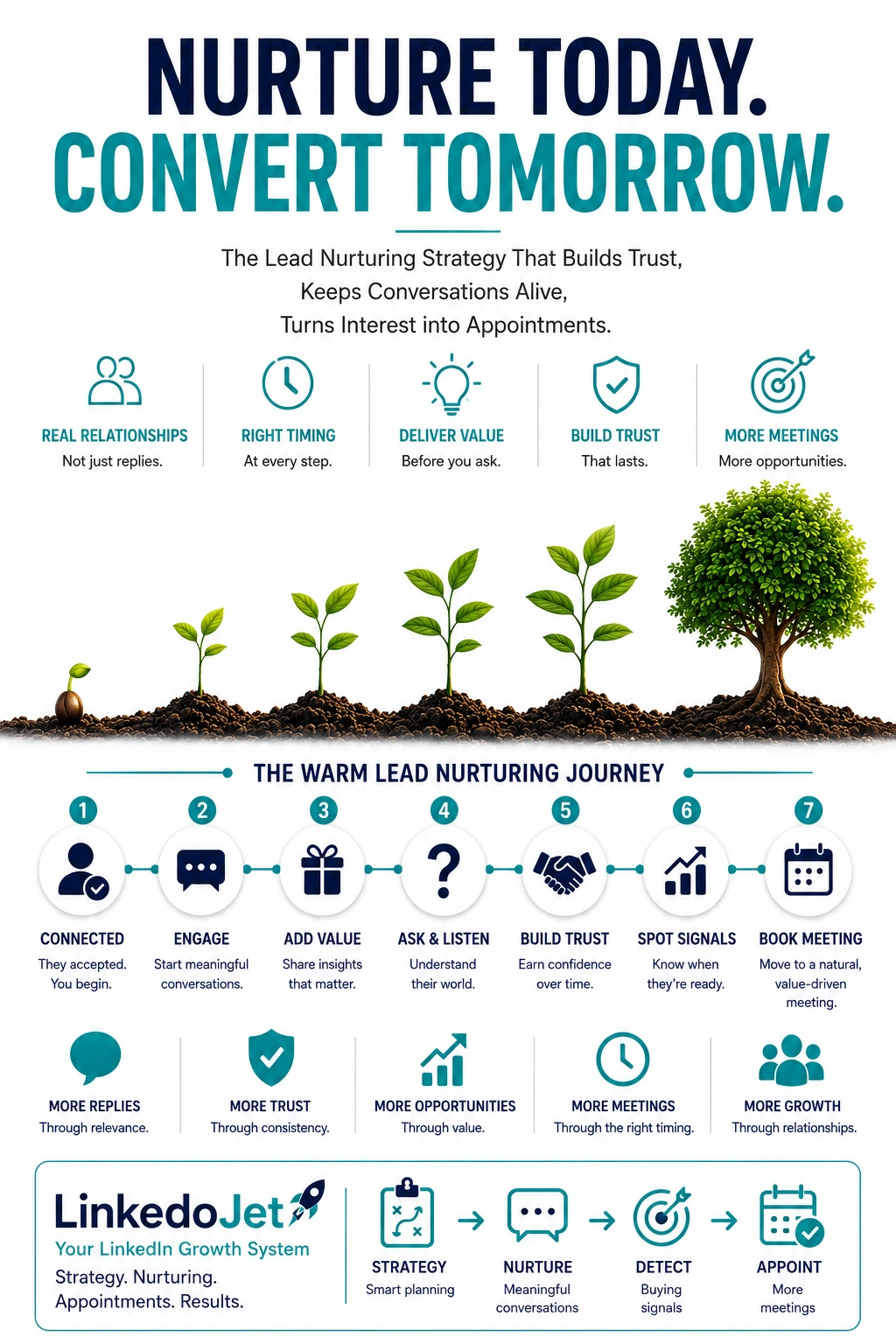
Why warm LinkedIn signals stall in IR (and where the retainer gets lost)
You’re not being ignored. You’re being postponed—by calendar, politics, and risk.
A CFO accepts your connection the week after earnings. A Head of IR likes your note about Q&A drift. Someone replies “interesting” to a comment you left on a strategic update.
And then… nothing.
Not because the work isn’t needed. Because issuer-side buyers rarely have permission to “talk vendors” on your timeline. Their calendar is built around quarter prep, board materials, quiet periods, roadshow travel, and internal comms alignment. Their downside isn’t missing a clever idea. It’s being seen as shopping advisors, or creating internal questions they don’t have energy to answer.
This is where IR pipeline quietly bleeds out: in the weeks after the first warm signal, when your firm has earned attention but hasn’t earned a safe next step.
Most teams react the same way:
- They push for a call right after connection acceptance (too early, too sales-coded).
- They send a long DM that reads like a pitch deck (too heavy, too risky to engage with).
- They go silent until the next earnings cycle (too late; the thread loses continuity).
The result is a familiar kind of frustration: “meeting almost-ready” relationships sitting in limbo while you keep relying on referrals and timing luck for retainers, earnings support, investor targeting refreshes, and investor day work.
What “warm” means in issuer-side IR buying: signals, politics, and safe engagement
Warm isn’t interest in hiring. It’s permission to keep talking.
In IR, warm signals are often tiny because the buyer is cautious. A CFO might be curious about how peers are handling guidance language, but not willing to create a “vendor conversation” in writing. A Head of IR might be feeling pressure about targeting discipline, but can’t look dissatisfied with an incumbent.
So warmth shows up as low-risk engagement:
- A profile view from finance leadership after you comment on an 8-K or earnings post.
- A like on a post about recurring analyst questions in their sector.
- A short reply: “fair point,” “interesting,” “will keep in mind.”
- A connection acceptance shortly after quarter results, a strategic update, a listing/uplisting, or a leadership change.
- A question that sounds casual but isn’t: “How are others structuring investor day messaging?”
What most IR firms miss is the political layer. A lot of issuer-side buyers can’t openly explore alternatives while they have an incumbent advisor, a bank relationship in motion, or an internal narrative alignment issue. They need a way to engage that doesn’t trigger procurement vibes.
Your follow-up has to feel like the work: short, grounded in public signals, and designed to keep a safe dialogue open until a catalyst makes an intro call logical.
Temperature bands for IR leads: how to classify intent and choose the next move
Silence isn’t a copy problem. It’s a misread of intent and timing.
You don’t need more touches. You need better classification so the next move matches what the signal actually means.
| Band | Typical warm signals | What’s likely happening | Next move that fits IR |
|---|---|---|---|
| Light | Profile view, post like, connection acceptance | Curiosity without permission to engage | 1 short observation tied to a public moment; no meeting ask |
| Awake | One-line reply (“interesting”), small back-and-forth | They’ll talk if it stays low-friction | Ask one practical question + offer a benchmark or framing |
| Engaged | They ask how others handle targeting/Q&A/investor day; mention bandwidth | They have a problem but are managing politics | Offer a 2-option path: written note now or 15-min working session later |
| Catalyst | New CFO/Head of IR, coverage drop, volatility, activist noise, listing, board pressure | Window opens; urgency rises | Direct but respectful call request with a tight agenda |
| Pause | “We have an incumbent,” “quiet period,” “reach out after X date” | Engagement is risky right now | Confirm pause, set a reminder, keep one light public touch only |
This is the core system move: different temperatures get different follow-ups. If you treat a profile view like a buying signal, you look desperate. If you treat a catalyst like a casual nurture, you miss the window.
Cadence that respects earnings rhythms: reflection windows, dead zones, and catalyst spikes
IR is seasonal. Your follow-up has to be, too.
Issuer-side responsiveness isn’t random. It clusters.
There’s a short period after earnings where reflection is possible. There are weeks where quarter-close pressure makes any vendor-ish message feel like noise. And there are sudden spikes—coverage changes, stock moves, leadership transitions—where a 15-minute working session is suddenly reasonable.
A practical cadence that doesn’t get you muted:
- Post-earnings reflection window: 3–10 days after the call, one concise note tied to a public detail (Q&A theme, guidance phrasing, repeat analyst concern).
- Mid-quarter: one “market pattern” touch (what questions are showing up across the sector, where narrative drift tends to start).
- Pre-earnings build: avoid pushing. Offer a single angle that reduces work (Q&A prep framing, messaging consistency check, targeting hygiene).
- Dead zones: quiet periods, board prep weeks, travel-heavy roadshows—only respond if they engage first; otherwise park it.
- Catalyst spikes: when they mention a real trigger, move to a clear, bounded call request.
The point is not frequency. It’s permission. Each touch should feel like you’re helping them think, not asking them to do something.
What to share to hold CFO/Head of IR attention (without sounding like you’re pitching)
If your “value add” could apply to any issuer, it won’t land.
Issuer-side buyers respond to specificity they can sanity-check against public facts. They don’t need a whitepaper. They need a steady-handed note that shows you’re paying attention, and that you understand the difference between messaging, targeting, and calendar reality.
Content angles that keep dialogue alive in IR:
- One-paragraph pattern recognition: “Across your sector, the Q&A tends to concentrate on X and Y; teams that answer it cleanly usually do Z in their prepared remarks.”
- Narrative drift warning: “I noticed the language around margin/returns shifted slightly vs last quarter—small changes like that often create a new thread in the next Q&A.”
- Investor targeting hygiene: “When coverage tightens or turnover rises, targeting lists get stale fast; the fix is less about new names and more about cleaning the thesis tags and ownership style.”
- “Here’s what the market is rewarding” note: framed as observed behavior—multiple compression, durability questions, capital allocation scrutiny—without pretending you have inside info.
- Micro-story (confidential): “We’ve seen teams reduce repeat misunderstandings by tightening three slides and aligning spokesperson language across CFO/CEO/IR.” Process over promises.
None of this asks for a meeting. It earns the right to ask later—when the thread is already advisory.
Message examples: 10 IR-native follow-ups tied to real warm triggers and catalysts
Short, specific, and written the way a senior advisor would actually message.
After connection acceptance (post-earnings):
Thanks for connecting. I caught your quarter update—one thing I’m seeing across this part of the market is Q&A drifting toward [theme] even when the prepared remarks are strong. If helpful, I can send a quick 5-line benchmark on how peers are framing it. No need to jump on a call.After a one-line reply (“interesting”):
Glad it resonated. Quick question—where are you seeing the most investor friction right now: guidance clarity, margin narrative, growth durability, or capital allocation? The answer usually changes what’s worth fixing between quarters.Educational nurture (4–6 lines, Q&A prep):
One small thing that helps earnings Q&A: pre-write 3 “bridge sentences” that bring answers back to the same proof points each quarter. It reduces narrative drift and stops you from answering different versions of the same concern. Curious if you’re seeing repeat questions cluster around one topic recently?Insight-based follow-up (volatility / sector re-rate):
Markets feel jumpier in your sector right now—multiple compression tends to turn “good quarter” into “prove durability.” When that happens, the teams that hold up best usually tighten how they talk about [driver] and what they won’t do on capital allocation. Are you getting more of those questions yet?Discreet proof-based nurture (process, not brag):
We’ve supported issuers in a similar situation by doing a quick messaging consistency pass: prepared remarks → deck → FAQ → spokesperson language. The win isn’t flashier language; it’s fewer recurring misunderstandings and better quality investor conversations. If that’s relevant, I’m happy to walk you through the approach.Soft reopen when the thread cools (timing-aware):
Quick check—are you in the middle of quarter prep / board materials right now? If so, I’ll park this and follow up after the cycle. If not, I can send one short note on a common investor targeting mistake I’m seeing this quarter.Buying-signal response (catalyst mentioned):
That’s a meaningful catalyst. When coverage drops / a new CFO comes in / an investor day gets pulled forward, the first question is usually whether the issue is messaging, targeting, or simply calendar bandwidth. What’s the main pressure point for you right now? If you want, we can do 15 minutes to compare notes and map timing.Soft meeting request (earned, with agenda):
We’ve traded a couple notes now—would it be useful to do a short working session (15–20 min) on (1) where the narrative is getting friction, (2) what catalysts matter over the next 90 days, and (3) how you’re approaching targeting and outreach? If it’s not the right moment, no problem—happy to keep it in writing.Dormant lead revival (new public trigger):
Saw your recent update / stock move / guidance change. One pattern I’ve seen is that when the headline shifts, the buy-side immediately tests “what changed” in Q&A even if fundamentals didn’t. If helpful, I can share a short way to frame that conversation without over-explaining.Final polite close-loop (preserve goodwill):
I’ll close the loop for now so I’m not creating noise. If it’s useful after this earnings cycle / post investor day, I’m happy to share a couple observations on messaging and targeting based on what’s public. Either way, wishing you a smooth run into the next quarter.
FAQ
How often should an IR firm follow up on LinkedIn without looking pushy?
Aim for fewer touches, each with a reason. For “Light” warmth (views/likes), one follow-up in the post-earnings reflection window and one mid-quarter touch is usually enough. If they reply, you can tighten the cycle—but keep messages short and avoid repeated meeting asks. In dead zones (quiet period, board prep, roadshow travel), pause unless they engage first.
What are credible “buying signals” for IR services on LinkedIn (and what are negative signals)?
Credible signals include: asking how other issuers handle Q&A prep, investor targeting, investor day structure, perception work; mentioning bandwidth constraints; hinting at dissatisfaction (“not getting traction”); referencing catalysts (new CFO/Head of IR, coverage drop, volatility, activism). Negative signals: explicit “we have an incumbent and aren’t evaluating,” clear quiet-period boundaries, or a specific “reach out after X date.” Treat negatives as a pause-and-reminder, not an objection to overcome.
What should you send after a CFO or Head of IR views your profile or likes an earnings Q&A post?
Send one grounded observation tied to something public (a recurring analyst theme, a small wording shift, a sector pattern) and offer a low-friction next step: “I can share a quick benchmark” or “I can send a 5-line note.” Don’t ask for a meeting on that first follow-up. Your goal is to create a safe reply path.
How do you nurture prospects during quarter close, quiet periods, or roadshow travel windows?
Make it easy to say “not now.” Acknowledge the timing, offer to park it, and provide an optional written takeaway they can read in 30 seconds. If you keep touching during those windows with sales-coded messages, you train them to ignore you. Respecting the calendar is part of credibility in IR.
How do you ask for an intro call in IR when they may have an incumbent advisor?
Frame the call as a bounded working session, not a vendor evaluation. Be explicit about the agenda (narrative friction, upcoming catalysts, targeting approach, where bandwidth is tight) and give an easy out. Often the safest step is “compare notes” rather than “let’s talk about switching.”
If you want this run as a system, not a hope-based nurture
LinkedoJet helps IR firms turn light LinkedIn signals into ongoing advisory dialogue—then converts the right moments into booked intro calls.
This isn’t a generic “strategy call.” If we’re a fit, LinkedoJet becomes the operating layer behind your LinkedIn outbound and warm follow-up—built for high-trust services where timing and tone decide everything.
What we set up and manage for you:
- ICP and targeting setup: issuer-side decision-makers (CFO, Head of IR, CEO, board-adjacent profiles) mapped by listing status, sector, market cap bands, catalyst context, and likely buying triggers.
- Sales Navigator / LinkedIn prospect list building: clean lists you can sanity-check, with segmentation that matches how IR work is bought (earnings support, investor targeting refresh, investor day prep, “steady hands” counsel under pressure).
- AI-assisted personalization: short, credible openers tied to public signals—earnings moments, guidance language shifts, strategic updates, coverage changes—so messages read like an advisor note, not a template.
- LinkedIn outreach execution: connection + follow-up workflows run consistently, with cadence that respects earnings rhythms and dead zones.
- Lead reply handling and nurturing: we help manage threads so “interesting” becomes an actual exchange, without forcing a meeting ask too early.
- Warm lead tracking: temperature bands based on real signals (views vs likes vs questions vs catalysts) so next actions are disciplined, not reactive.
- Appointment generation support: when a catalyst window opens, we move to an earned, bounded intro call request framed as a working session.
- Campaign visibility through dashboards: see what’s being sent, what’s working, where leads sit by temperature, and which segments are producing engaged conversations.
- Ongoing campaign refinement: we tighten targeting, angles, and sequences as we learn what issuer-side buyers respond to in your niche.
What happens after onboarding: you get a live targeting system, approved message angles, and an outreach + follow-up engine that keeps continuity across quarters. We keep it moving week to week—so warm signals don’t die in the quiet weeks.
What you receive: segmented prospect lists, message libraries tailored to IR triggers, managed outreach execution, tracked warm leads, and booked intro calls when intent and timing line up—plus clear reporting you can review without digging through DMs.
Why this is different from ordinary LinkedIn automation tools: tools send sequences. We run the full intent-and-timing system—classification, cadence, reply handling, and appointment conversion—so your outreach stays credible in a category where issuer-side buyers are guarded.
Next step: make warm signals predictable revenue, not a recurring frustration
If your team can win the work once you’re in the room, the constraint is getting to the room at the right moment—with the right tone.
LinkedoJet gives you the targeting system, outreach workflows, AI-assisted personalization, and reply-handling discipline to keep issuer-side conversations alive across quarters—then helps convert catalyst windows into qualified intro calls.
From identifying the right decision-makers to starting meaningful conversations and turning them into qualified appointments... LinkedoJet manages the entire outbound engine for your business.