
You earned the warm thread. Then it quietly dies.
In HRMS/HCM, the hardest part isn’t getting attention. It’s staying relevant long enough for timing, risk, and internal alignment to catch up.
You get the connection acceptance after the webinar. An HR Director replies, “Not looking right now—send something.” An HRIS Manager views your profile the week after an event. A People Ops lead comments on your onboarding post. It feels like motion.
Then your SDR drops a “quick bump” a few days later and the thread goes cold. Not because the buyer hated you. Because their week got eaten by open enrollment prep, payroll exceptions, a compliance fire drill, or quarter-end reporting. HR doesn’t go quiet in a straight line. It goes quiet because the job is reactive.
The expensive part is what happens next: your team either over-pursues (and becomes more vendor noise) or backs off completely (and loses the account to the one vendor that stayed useful without being needy). In HR tech, missing the window isn’t a small miss. Once they move into “we’ll look next cycle,” you may not get another clean shot until renewal season—or until a new VP People arrives and resets the stack.
There’s also the hidden forecast tax. Activity looks healthy—connections, replies, “send info”—but meetings stay thin. SDRs spend hours chasing ghosts. Managers coach on copy. None of it fixes the actual problem: you’re treating a committee sale with implementation risk like a short sequence problem.
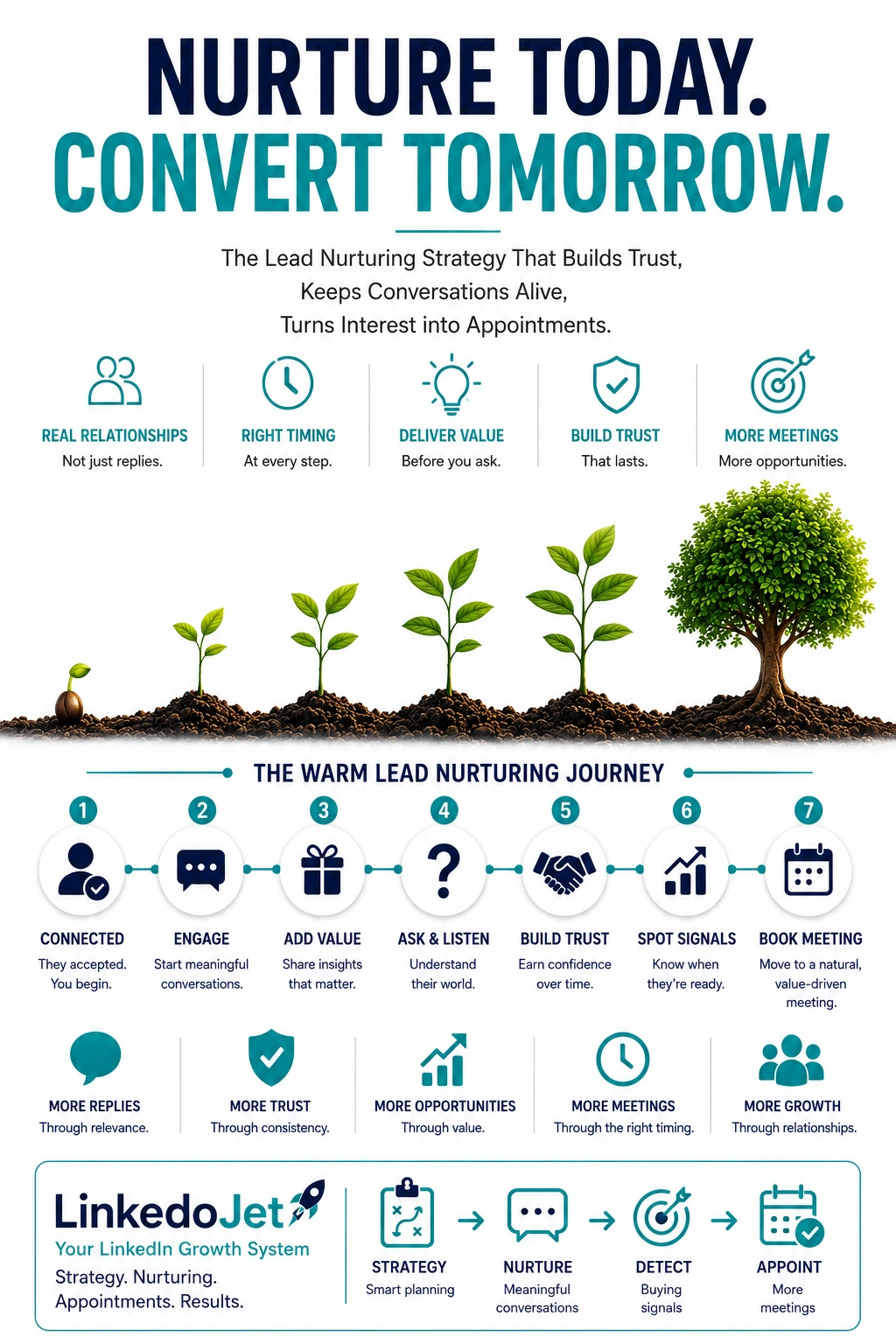
Progression beats persistence: a five-part conversation that can run for weeks
The goal is controlled progression: reduce perceived risk, match their stage, and earn the right to ask for time.
Warm follow-up in HRMS works when you stop trying to “get the demo” and start guiding the thread through a few predictable stages. Each stage has a different buyer fear.
- Acknowledgement + context (they’re busy, they connected for a reason). Make it easy to reply.
- Problem framing (show you understand operational pain). Skip HR buzzwords; talk about payroll accuracy, reporting trust, manager adoption, and manual handoffs.
- Operational proof (implementation reality, not marketing). Share what tends to break: permissions sprawl, field governance, workflow exceptions, multi-entity mess.
- Stakeholder mapping (committee awareness). Bring HRIS/Payroll/IT/Security/Finance into the frame without forcing a “committee meeting.”
- Meeting transition (short scoping, not a demo). Frame it as confirming complexity and next steps, not “seeing the platform.”
Notice what’s missing: “checking in.” HR operators can smell that from a mile away. It signals you don’t have a point of view, so you’re outsourcing the next move to them.
When you run this as progression, the thread can breathe. You stay present during their bad weeks. You add clarity when they’re ready to think. And when they finally ask about integrations, migration, or timeline, you’re not starting over.
Warm doesn’t mean ready. Here’s lead temperature that matches HRMS buying behavior.
Treat intent like a signal stack: language + engagement + operational context. Then choose the next move.
In HR tech, “warm” is often just polite curiosity. If you treat it like evaluation, you push too hard and get parked. If you treat it like nothing, you disappear.
| Signal you see in LinkedIn | What it usually means in HRMS | Best next move |
|---|---|---|
| Connection accepted after webinar; no reply | Light awareness; zero urgency | One helpful question tied to their world (reporting, onboarding, payroll accuracy). Then pause. |
| Profile view + liked/commented on HRIS/onboarding content | They’re paying attention, but still in problem recognition | Send a practical observation (a common failure mode) + a one-line question. |
| “Not looking right now—send something” | They’re avoiding meetings and vendor management | Send a short artifact + ask what timing trigger would make it relevant (renewal, audit, headcount change). |
| Mentions payroll corrections, manual onboarding, reporting mistrust, manager non-compliance | Real pain, probably internal frustration | Narrow with two scoped questions; offer a 15-minute scoping call if they want to compare approaches. |
| Asks about integrations (ATS, benefits, accounting), migration, security review, timeline | Evaluation behavior is starting | Answer directly; propose a short scoping call to map complexity and stakeholders. |
| “We just implemented X” / hiring freeze / explicit do-not-contact | Negative signal | Stop or set a long pause; leave one clean door-open message. |
The point isn’t to score leads like a spreadsheet. It’s to stop guessing. HRMS cycles are long; your follow-up should be responsive to what they’re actually doing—not what your sequence says is due.
Messages you can copy that don’t burn trust
Short. Specific. Low-pressure. Built for HR operators who are trying to avoid extra meetings and implementation headaches.
1) First follow-up after connection acceptance
Message:Thanks for connecting — enjoyed the webinar discussion on onboarding + HRIS reporting. Quick question: what’s getting the most attention on your side right now — reporting confidence, onboarding throughput, manager task completion, or payroll accuracy?
2) When they reply: “not looking right now—send something”
Message:Totally fair — HR weeks can get swallowed whole. I’ll send a one-pager on what tends to break in HRIS/payroll changes (permissions + field sprawl, workflow exceptions, and manager adoption). Before I do: when this becomes relevant again, is it usually tied to renewal timing, a compliance/audit push, or a headcount/location change?
3) Educational nurture (practical insight HR teams recognize)
Message:One pattern I keep seeing: teams go live with clean workflows, then 90 days later exceptions pile up and managers quietly stop completing tasks. It’s rarely the tool — it’s governance (who can create fields, who owns approvals, what gets audited). How do you keep workflow + permissions from getting messy over time?
4) Insight-based follow-up (signals you understand HRMS reality)
Message:Multi-state payroll and multiple entities tend to surface process gaps fast — especially when HR and Finance define “source of truth” differently. Is your biggest pain today accuracy (corrections), speed (cycle time), or reporting (trust in headcount/comp data)?
5) Proof-based nurture without the forced meeting
Message:We’ve seen teams reduce payroll corrections and cut manual onboarding handoffs by tightening data capture + approvals upstream (before it hits payroll). I can share a one-page summary of the approach if it’s useful — want me to send it here?
6) Soft re-opener for a quiet thread (with an easy out)
Message:Quick one — saw you’re hiring for HR Ops/Payroll. That role usually shows up when process debt is starting to hurt. If systems work isn’t on the table right now, no stress. If it is: what’s the first thing you’d fix — time tracking disputes, onboarding bottlenecks, or reporting gaps?
7) Buying-signal response (implementation/integrations/migration/security/pricing)
Message:Good question. Timeline usually depends on data cleanup + integration scope (ATS/benefits/accounting/SSO) and whether you’re dealing with multiple entities/states. Rather than jumping into a demo, want to do 15 minutes to confirm complexity and I’ll tell you what teams commonly underestimate in migration + security review?
8) Soft meeting request that fits HR tech
Message:If it’s helpful, we can keep this lightweight: 15 minutes to map your current setup, what’s breaking (accuracy, adoption, reporting), and who else typically needs a say (HRIS, Payroll, IT/security, Finance). If it’s not realistic this quarter, we’ll call it and I’ll stop pushing.
9) Dormant lead revival (cycle-aware)
Message:Assuming priorities shifted — open enrollment / year-end reporting tends to wipe out any “new system” bandwidth. Are HRIS/payroll changes back on the table for you in the next 60–90 days? If yes, I can send a migration readiness checklist teams use internally (data, integrations, stakeholder approvals).
10) Final close-loop (protect your reputation)
Message:I don’t want to become background noise. I’m going to close the loop and stop reaching out after this. If you’d ever like the checklist or an evaluation scorecard for HRIS/payroll options, tell me where to send it and I’ll share it.
Cadence design that respects HR cycles (and keeps you present)
Your timing is part of your credibility. If you follow up like you don’t understand their calendar, you won’t get the meeting even if they like you.
HR teams don’t experience time evenly. There are weeks where a thoughtful message gets read and answered. There are weeks where anything that smells like a sales sequence gets archived out of self-defense.
Instead of “Day 2 / Day 5 / Day 9,” use a cycle-aware rhythm with clear intent for each touch. The goal is to earn replies without demanding them.
- Weeks 1–2 (post-signal): one context anchor + one low-effort question. If no reply, stop chasing.
- Weeks 3–5: one operational insight that helps them think (governance, workflow exceptions, reporting trust). No meeting ask.
- Weeks 6–8: one stakeholder-aware nudge (“when Finance/IT gets involved, what do they usually care about?”). This quietly qualifies the deal without turning it into an interrogation.
- Trigger-based touches: renewal windows, new HR/Payroll leadership, hiring spikes, acquisitions, new locations, policy/compliance changes, performance review season.
- Meeting ask only on evaluation signals: integrations, migration, timeline, security, pricing bands, “we’re reviewing options.”
Practical example: if you’re selling into mid-market HR, the two weeks around open enrollment are not where you win hearts with “circling back.” That’s where you send something that reduces risk and requires zero meeting time. Then you come back when the air clears.
The mistakes that irritate HR buyers (and quietly kill good deals)
Most of these aren’t “bad tactics.” They’re signals that you don’t understand the risk HR is carrying.
- Pushing “book a demo” after one positive reply. HR heard “more vendor work” and protected their calendar.
- Talking like HR buzzwords are pain. “Engagement” and “employee experience” don’t beat “payroll corrections,” “audit anxiety,” and “reporting I can defend to Finance.”
- Ignoring the committee until late. If IT/security and Finance appear at the end, your deal gets delayed or dies in procurement purgatory.
- Pretending implementation is easy. HRMS buyers aren’t afraid of software. They’re afraid of migration, data integrity, adoption, and employee comms blowback.
- Over-following up during predictable bad windows. Open enrollment, year-end, quarter-end reporting, comp cycle, compliance spikes.
- Treating silence like an objection to overcome. Sometimes silence means “wrong move.” Switch to a resource, a scoping question, or a respectful pause.
If you want more discovery calls, your follow-up has to feel like it reduces risk and decision fatigue. HR operators will engage when you make the path clearer—not when you ask them to do more work.
FAQ
How do I follow up with an HR Director on LinkedIn after they connect without sounding like every other vendor?
Anchor to the reason you’re connected (event, post topic, mutual context), then ask one low-effort question tied to real HR operations: reporting confidence, onboarding throughput, manager adoption, or payroll accuracy. Keep it short. No meeting ask. Your goal is to learn what bucket they’re in, not to “advance the deal” on message one.
What should I say when an HR lead replies “not looking right now—send something”?
Acknowledge bandwidth, send a single useful artifact (one-pager, checklist, scorecard), and ask what timing trigger would make it relevant later (renewal, audit/compliance push, headcount/location change, new HR/Payroll leader). That turns a stall into a future re-entry point without forcing a call.
What are HRMS-specific buying signals that indicate it’s time to propose a short scoping call?
Language around implementation reality is the tell: data migration, integrations (ATS/benefits/accounting/SSO), security review, timeline, pricing bands, multi-entity/multi-state complexity, reporting gaps they can’t defend, manager self-service friction, or payroll corrections becoming frequent. When you hear that, propose 15 minutes to confirm complexity and map stakeholders—don’t jump straight to a full demo.
How long should a LinkedIn nurture run for HR tech deals—days or weeks?
Weeks. HRMS decisions often sit in problem recognition while internal priorities and stakeholder alignment catch up. A good nurture mixes light touches with genuinely useful observations and waits for evaluation signals before asking for a meeting. The win isn’t “more touches.” It’s being the vendor that stayed relevant when timing finally opened up.
How do I keep HRIS, Payroll, IT/security, and Finance in mind when the conversation starts with one HR contact?
Bring the committee into the conversation gently: ask who typically weighs in when systems change, what tends to block progress (security review, data cleanup, Finance approval), and what integrations matter. Offer to help them think through the internal path. That earns trust because it shows you understand this isn’t an “HR-only” decision.
If you want this run as a system (not “hope and follow-ups”), book a LinkedoJet demo session
We build the targeting, run the outreach, handle warm replies, and manage nurture until it converts into qualified HRMS discovery calls—without turning your brand into another vendor nuisance.
LinkedoJet isn’t a LinkedIn automation tool you hand to an SDR and wish for the best. We operate the outbound engine with you.
What we set up and manage:
- ICP and targeting setup: define the right HRMS buying committees (HR Director/People Ops, HRIS, Payroll, Finance, COO, and when relevant IT/security) and build segmentation by company size, complexity (multi-entity/multi-state), and likely trigger windows.
- Sales Navigator prospect list building: clean, role-accurate lists with the right seniority and adjacent stakeholders—so warm threads don’t die because you only talked to HR and ignored Payroll/Finance.
- AI-assisted personalization: messaging that stays grounded in HR operations reality (reporting trust, exceptions, adoption, compliance risk) while still sounding like a human—no fake familiarity, no “just checking in.”
- Outreach execution: connection + message workflows that match HR cycles and avoid the “demo push” pattern that burns trust.
- Lead reply handling and nurturing: we categorize replies (curious vs. busy vs. polite-no vs. evaluation) and run stage-based follow-up over weeks with resource drops, scoping questions, and respectful pauses.
- Warm lead tracking: we track signals like profile views, comments, reply language, and evaluation questions (integrations, migration, security, timeline) so the next move is chosen, not guessed.
- Appointment generation support: when buying signals appear, we transition the thread into a short scoping call framed around complexity, stakeholders, and readiness—not a premature platform tour.
- Campaign visibility: dashboards that show what’s happening (reply mix, warm lead movement, meetings set) and what’s being refined each week.
- Ongoing refinement: we adjust targeting, angles, and follow-up paths as we learn which HRMS pains are actually converting in your segment.
What happens after onboarding: within days, you have live targeting segments, built prospect lists, message paths for warm follow-up, and a working nurture cadence tied to HR calendar realities. Then we run it—daily—so your team isn’t stuck chasing silent threads.
What you receive: qualified conversations, warmed stakeholders, meeting-ready accounts, and a clear view of where each thread sits (problem recognition vs. evaluation) so your forecast reflects reality.
Why this is different: ordinary tools send messages. LinkedoJet runs the operating system: targeting + personalization + execution + reply handling + nurture + tracking + appointment support.
Next step: stop losing warm HR interest to timing
If you already have threads, you don’t need more “touches.” You need a system that turns light intent into well-timed scoping calls—without irritating the very operators you’re trying to sell.
From identifying the right decision-makers to starting meaningful conversations and turning them into qualified appointments... LinkedoJet manages the entire outbound engine for your business.