
The silence isn’t ghosting. It’s a risk review you can’t see.
This is for the moment they accepted, replied once, liked your interoperability/RCM post, viewed your profile after a webinar… then disappeared.
You earned attention in a healthcare inbox. That part is hard. What’s brutal is watching that attention evaporate while your pipeline looks “busy” and your forecast stays thin.
Most warm LinkedIn threads don’t die because the buyer isn’t curious. They die because the buyer can’t safely progress you internally yet.
Behind the silence is usually something boring and real:
- An EHR upgrade or optimization cycle that just stole every spare hour (and every available analyst).
- Security/compliance backlog where “we’ll take a first look” becomes “maybe next month.”
- Implementation bandwidth that makes any new vendor feel like a threat, not an opportunity.
- Stakeholder drift: the CMIO is interested, but RCM owns the outcome; IT owns access; finance owns approval.
- Vendor fatigue: they regret replying once because it usually turns into three demo pushes and a deck dump.
The cost isn’t just a missed meeting. It’s the dead space where intent cools off and your team starts a new thread instead of advancing the one that was already warm.
And in healthcare, that’s not neutral. This market remembers.
How a warm conversation should mature over weeks (without forcing a demo)
In healthcare SaaS, your follow-up isn’t a cadence problem. It’s a conversation maturity problem.
If your next message feels like “so… want to hop on a call?” you’re asking them to create internal work before you’ve reduced internal risk.
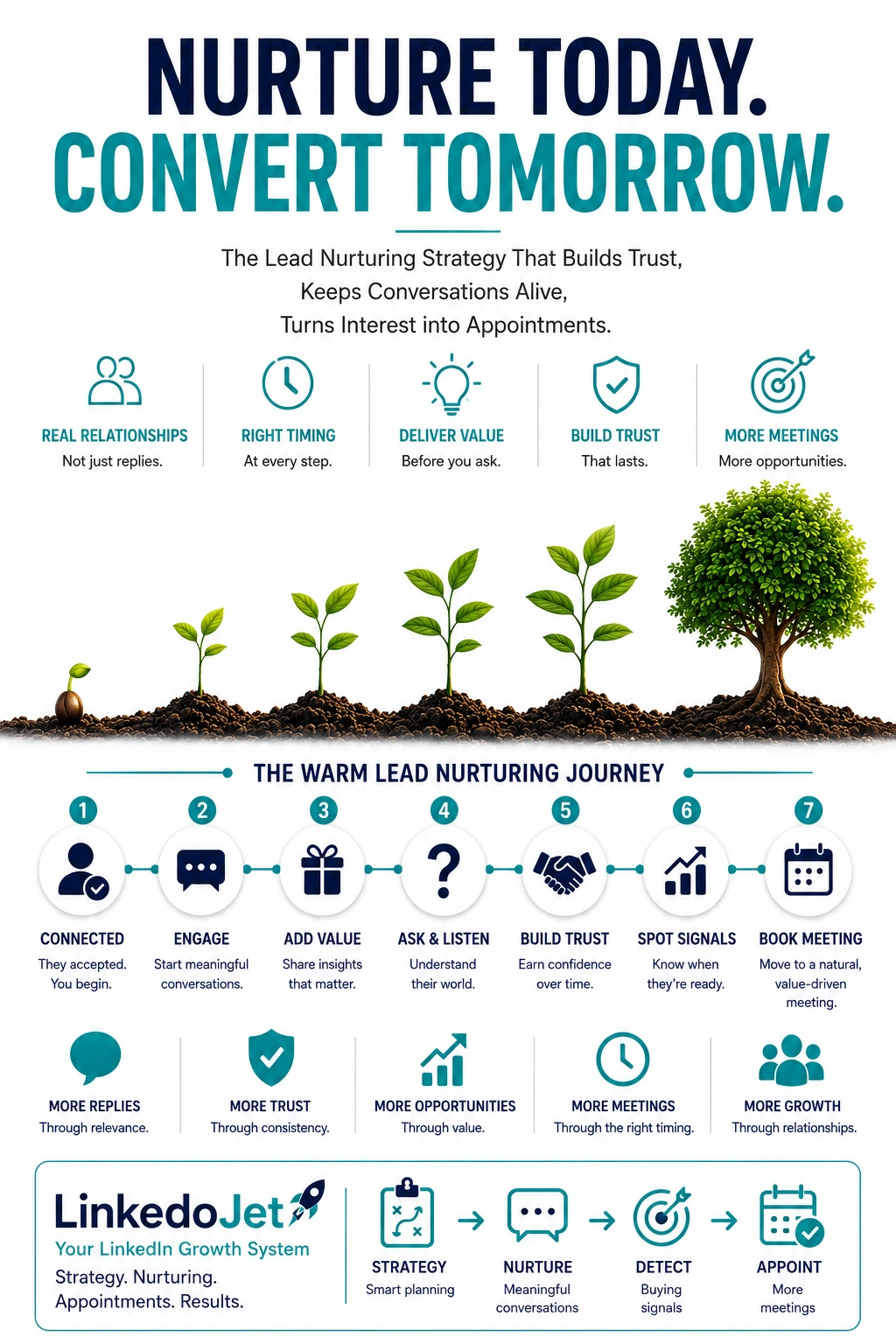
A better progression looks like this:
- Confirm context without pitching. Establish what kind of org they’re in (IDN vs community hospital vs specialty group vs MSO vs payer-adjacent) and what’s on fire this quarter (throughput, denials, prior auth, documentation burden, scheduling leakage, interoperability).
- Offer role-specific insight. One tight observation a CMIO cares about is different from what a VP Revenue Cycle or security leader cares about.
- Send risk-proof in small pieces. Not a deck. A checklist, a short implementation reality, a security artifact, or an adoption lesson.
- Ask a small question. The goal is a reply that reveals timing, ownership, and the next stakeholder—not an interrogation.
- Watch for buying signals. Integration approach, BAAs, questionnaires, “who owns this internally,” “timeline,” “what does rollout look like.”
- Suggest a short call only when there’s a reason. A “sanity check,” “compare notes,” or “see if it’s even worth pulling others in.”
The point is to stay relevant while their evaluation stays quiet. You’re making it easy for them to keep you warm without committing to a meeting they might not be ready to defend internally.
Healthcare-specific lead temperature: classify intent by stakeholder cues
“Warm” isn’t one bucket. A CMIO liking your clinical burden post and an IT director viewing your profile after a mutual connection are both warm, but the next touch should be completely different.
Use temperature plus stakeholder type. Here’s a practical way to do it without overthinking.
| Stakeholder cue | What it usually means | What to send next | What to avoid |
|---|---|---|---|
| Clinical (CMIO/CNIO/clinical ops): reacts to workflow, clinician time, adoption posts | They’re feeling burden and politics. They’ll protect clinicians from disruption. | A short adoption/rollout lesson, workflow mapping question, “what breaks implementations” insight. | ROI claims before you understand workflow ownership; “can we demo?” |
| Revenue cycle (VP RCM/denials/prior auth): asks about denials, cash, payer rules, workqueues | They care about measurable operational impact and change management across teams. | One benchmark, a “how teams handle exceptions” note, a small scoping question about where leakage happens. | Generic “we improve revenue”; content not tied to their operating model (central vs distributed teams). |
| IT/Security: profile view after engagement; asks about Epic/Cerner/Meditech, FHIR/HL7, hosting, SOC 2, BAA | They’re a gate. Curiosity doesn’t equal sponsorship. | Offer the exact artifact: security summary, integration overview, implementation approach; ask one scoping question. | Dumping a deck; pretending integration is easy; “just a quick call.” |
| Finance/Procurement: “send info,” “what’s pricing,” “are you on contract” | They’re often collecting vendors and reducing risk, not choosing value. | Pricing band context + what drives it; deployment model; reference process; stakeholder mapping question. | Over-selling; trying to turn procurement into the champion. |
Then tag the thread with a simple label your team can act on: Role (Clinical/RCM/IT-Sec/Finance) + Temperature (Acknowledged / Curious / Evaluating / Coordinating).
The win is consistency. When an SDR or AE comes back two weeks later, they should know why this person was warm and what risk they were trying to reduce.
Message examples that sound like a healthcare SaaS operator wrote them
These assume the person is already warm (connection accepted, profile view, light reply, post engagement). Keep them short. Make the next step safe.
First warm follow-up after connection acceptance
Message:
“Appreciate the connect. Quick question so I don’t send you the wrong kind of noise—are you more focused this quarter on (A) clinical workflow/adoption, (B) RCM pressure like denials/prior auth, or (C) IT/security constraints around data + integration? Different teams in the same system usually live in different worlds.”
Follow-up after a light reply (“Thanks” / “Interesting”)
Message:
“Makes sense. When I see this come up with your role, the sticking point is usually who actually owns first change—a clinical leader, an ops owner, or IT. In your org, does this sit closer to clinical ops or revenue cycle day-to-day?”
Educational nurturing message (small artifact)
Message:
“One thing that’s saved time for teams lately: a 1-page ‘security first look’ checklist (hosting, data flows, BAA, questionnaire lead time). Happy to paste it here if helpful—do you typically run initial vendor screening through security early, or only once there’s a clinical/RCM sponsor?”
Insight-based follow-up tied to a healthcare trigger
Message:
“Seeing a pattern during EHR optimization cycles: anything that adds clicks gets paused, even if it helps downstream metrics. The teams that still move forward frame it as removing steps, not adding tooling. Are you in an optimization window right now, or is the bigger constraint staffing/bandwidth?”
Case-story / proof-based nurturing message (no fake numbers)
Message:
“Quick story from a similar setting: they had a strong clinical sponsor, but the rollout almost died because integration ownership wasn’t clear (interface team vs app team), and training got treated like an afterthought. What changed was agreeing on a tiny pilot with explicit ownership + a ‘what would make you stop’ list. If you’re ever evaluating something like this, I can share the pilot structure that kept IT and clinical aligned.”
Soft question to reopen after they went quiet
Message:
“Totally understand priorities move in healthcare. Simple check: is this (A) on your plate right now, or (B) usually something IT/security wants first look at before anyone else spends time? Either answer helps me route this correctly.”
Buying-signal response (integration / BAA / security questionnaire)
Message:
“Yes—we can share our security summary + the ‘data flow / integration’ overview (what touches PHI, what’s optional, and what’s needed for Epic/Cerner/Meditech environments). Before I send it, quick scoping question: are you mostly evaluating read-only data access, write-back, or both? That changes what matters in the first review.”
Soft meeting request only after a reason exists
Message:
“If it’s useful, we can do a 15-min sanity check to compare notes on your workflow + what typically slows security/implementation. No deck—just see if this is even worth pulling others in. I’m open Tue 11–1 ET or Thu 3–5 ET. If not timely, also fine.”
Dormant lead revival (30–90 days)
Message:
“Reaching back out because I keep seeing the same pitfall: teams get excited, then stall when the first security questionnaire shows up and nobody owns it. If you’re still anywhere near this, I can send a short ‘who owns what’ breakdown (clinical/RCM/IT/security/procurement) that prevents the stall. Want it?”
Final polite close-loop message (protect the brand)
Message:
“I’m going to stop nudging so I don’t become background noise. If this comes back up later, I’m happy to share the security/implementation checklist or compare notes on how others are handling it. Either way, appreciate the connect.”
Buying signals in healthcare LinkedIn threads (and how to respond without dumping a deck)
Healthcare buyers rarely say “let’s book a demo” in a LinkedIn chat. They signal readiness by trying to reduce uncertainty.
Here are the signals that actually matter, and the operator response that keeps momentum without overwhelming them.
- “How does this work with Epic/Cerner/Meditech?”
They’re asking if you understand constraints (data access, build effort, ownership). Respond with an integration overview + one clarifying question about read/write and workflow location. - “Do you sign a BAA?”
They’re checking if engaging you creates compliance headaches. Offer a simple “yes” plus your security summary and who on your side handles security review. - “We have to do a security questionnaire.”
They’re warning you about timeline and friction. Ask what format they use (SIG Lite, internal, vendor portal) and offer to send the artifacts that answer 80% fast (SOC 2, pen test summary, hosting, data flow). - “What does implementation look like?”
They’re trying to picture disruption. Share the realistic version: governance, training, owner roles, what breaks, and what you do to prevent it. - “Who else uses this in orgs like ours?”
They want peer safety. Don’t spray logos. Offer a role-based reference path (e.g., “I can connect you with someone who owned the workflow / the security review / the rollout”). - Stakeholder mapping language: “Our CIO will want…”, “RCM owns…”, “Compliance needs…”
They’re telling you a committee exists. Your next move is to help them route the conversation: “Would it help if I sent a 1-paragraph summary you can forward to IT/security?”
The goal is not to “answer everything.” The goal is to give them a clean, forwardable piece of proof that makes internal progression easier.
Why warm leads go silent in healthcare SaaS (and what to stop doing this week)
Warm healthcare leads go quiet for reasons that won’t show up in your CRM notes.
- Implementation bandwidth disappeared. The same director who engaged last week just got assigned an EHR project or a staffing gap.
- Security got louder. A small incident or a new directive makes “new vendors” a political risk.
- Budget timing shifted. Reforecasting quietly pauses anything that can be framed as optional.
- Ownership is unclear. They can’t answer your question without starting an internal debate, so they don’t answer.
- They’re doing silent due diligence. They’re asking peers, reading your content, and checking whether you feel credible in their world.
Now the part you can control: the mistakes that kill momentum.
- Following up every 48 hours. In healthcare, that reads as “vendor who doesn’t understand my reality.”
- Asking for a meeting before context is clear. You’re asking them to take reputational risk too early.
- Generic personalization. “Saw you’re a CMIO” isn’t personalization. It’s a label.
- Sending content that isn’t tied to their environment. A community hospital and a multi-site specialty group don’t have the same constraints.
- Talking to clinicians like generic B2B buyers. Clinical leaders filter through adoption, burden, and patient safety—always.
- Ignoring IT/security until late. The prospect chooses silence over opening a compliance can of worms.
- Pushing ROI before the workflow is understood. In healthcare, “ROI” without operational credibility feels like risk.
If you want one simple change this week: stop “checking in.” Start sending one forwardable thing per touch—an insight, a constraint, a checklist, a question that helps them route you internally.
How LinkedoJet runs warm follow-up as a system (not a scramble)
Most teams don’t lose warm LinkedIn leads because they’re lazy. They lose them because context lives in someone’s head, follow-up is random, and the buyer’s committee motion isn’t respected.
LinkedoJet is built to operationalize what you just read—end to end.
- ICP + targeting setup: we help you define the right slices (providers, health systems, specialty groups, MSOs, payers/RCM orgs) and the roles that actually form the committee (clinical sponsor, operational owner, IT/security gatekeepers, finance/procurement).
- Sales Navigator / LinkedIn list building: we build and maintain prospect lists by segment, role, and priority—so you’re not mixing CMIO language with security language in the same batch.
- AI-assisted personalization: we generate role-aware personalization that references real healthcare realities (workflow, adoption, integration ownership, security review lead times) without sounding like template spam.
- Outreach execution: we run the connection + message workflows inside agreed guardrails, so activity is consistent and on-brand.
- Lead reply handling + nurturing: we help triage replies by intent (acknowledged vs curious vs evaluating), and we prompt the next best message based on stakeholder type and what they actually did.
- Warm lead tracking: we track who engaged, what they engaged with, and where the thread sits—so warm conversations don’t get buried under “new outreach.”
- Appointment generation support: when a reason exists (signal + context), we move the thread into a soft meeting ask that fits healthcare reality: short, specific, low-pressure.
- Campaign visibility + refinement: dashboards show what’s working by segment and role, and we adjust messaging, targeting, and timing as patterns emerge (for example, when IT/security engagement lags clinical engagement).
The difference from ordinary LinkedIn automation tools is simple: automation sends messages. LinkedoJet runs the operating system—targeting, sequencing, personalization, reply intent, nurturing logic, and appointment support—so warm interest turns into scheduled conversations without burning trust.
FAQ
How do I follow up with hospital decision makers on LinkedIn without sounding like another vendor?
Make the next touch safe. Reference their environment (type of org + likely constraints), offer one small useful observation, and ask an A/B question that helps route the conversation (clinical vs RCM vs IT/security). Avoid “checking in” and avoid asking for time before you’ve reduced perceived risk.
What’s a realistic LinkedIn follow-up cadence for healthcare SaaS when security and implementation bandwidth are the blockers?
Think in weeks, not days. A common rhythm is a light touch 3–7 days after engagement, then spaced touches every 7–14 days, with longer gaps when they’ve acknowledged but not shown evaluation signals. The content matters more than the timer: send forwardable proof (security summary, implementation reality, adoption lesson) rather than repeated pings.
How do I nurture multiple stakeholders (CMIO, VP Revenue Cycle, CIO/security) in parallel without creating internal confusion?
Keep each thread role-specific and consistent: same problem frame, different proof. Clinical gets adoption/workflow reality, RCM gets operational outcomes and exception handling, IT/security gets data flow + artifacts. When you sense committee formation, offer a 1-paragraph forwardable summary so the champion doesn’t have to translate your product into internal language.
What are the strongest buying signals in LinkedIn conversations for healthcare SaaS (integration, BAA, security, timelines, stakeholders)?
Signals look like risk-reduction questions: integration approach (HL7/FHIR, write-back vs read-only), BAA/security documentation, questionnaire process, implementation timeline/ownership, and stakeholder mapping (“our CIO will want…”, “RCM owns…”). Those are your cues to shift from insight to artifacts and scoping questions.
How do I move a warm LinkedIn chat to a discovery call without asking for a demo too early?
Earn a reason. Confirm context, share one role-specific insight, reduce one risk, and ask a small question that surfaces timing and ownership. Then propose a short “sanity check” call with a narrow purpose (e.g., validate workflow + identify what would block security/implementation). Keep it explicitly okay to say no.
If you want this run as a system, not a hero effort
We’ll show you exactly how we manage warm LinkedIn follow-up for healthcare buying committees—by stakeholder, by temperature, and with the right proof at the right time.
On the session, we’ll look at your current LinkedIn motion (what counts as “warm,” where threads stall, and which stakeholders you’re actually engaging). Then we’ll walk you through how LinkedoJet would run it operationally for your team.
What LinkedoJet provides (delivery, not theory):
- ICP + targeting setup tailored to healthcare committees (clinical sponsor vs operational owner vs IT/security gates vs finance/procurement).
- Sales Navigator prospect list building so you can run separate threads for CMIO/CNIO, RCM leadership, IT/security, and operations—without mixing language.
- AI-assisted personalization that references real constraints (EHR reality, adoption friction, data access, security review lead times) while keeping messages short and human.
- LinkedIn outreach execution with compliance-aware pacing that respects healthcare stop-start timelines.
- Lead reply handling + nurturing where replies and engagement are tagged by intent and stakeholder type, and the next touch is prompted based on what the prospect did—not a generic sequence timer.
- Warm lead tracking
- Appointment generation support
- Dashboards + ongoing refinement
After onboarding, you receive a working outbound engine: targeted lists, role-based messaging and nurture sequences, AI-assisted personalization prompts, reply-intent handling, and a clear appointment-setting workflow your team can run consistently.
This is not ordinary LinkedIn automation. The goal isn’t sending more messages—it’s keeping warm healthcare interest warm, reducing perceived risk, and turning the right threads into qualified conversations.
Next step: turn warm engagement into scheduled conversations (without burning trust)
If you’re seeing connection accepts, profile views, light replies, and post engagement—but it’s not converting—this is fixable. The answer is a stakeholder-aware nurture system with real proof, clean tracking, and a disciplined move to a call only when the buyer has a reason.
From identifying the right decision-makers to starting meaningful conversations and turning them into qualified appointments... LinkedoJet manages the entire outbound engine for your business.