
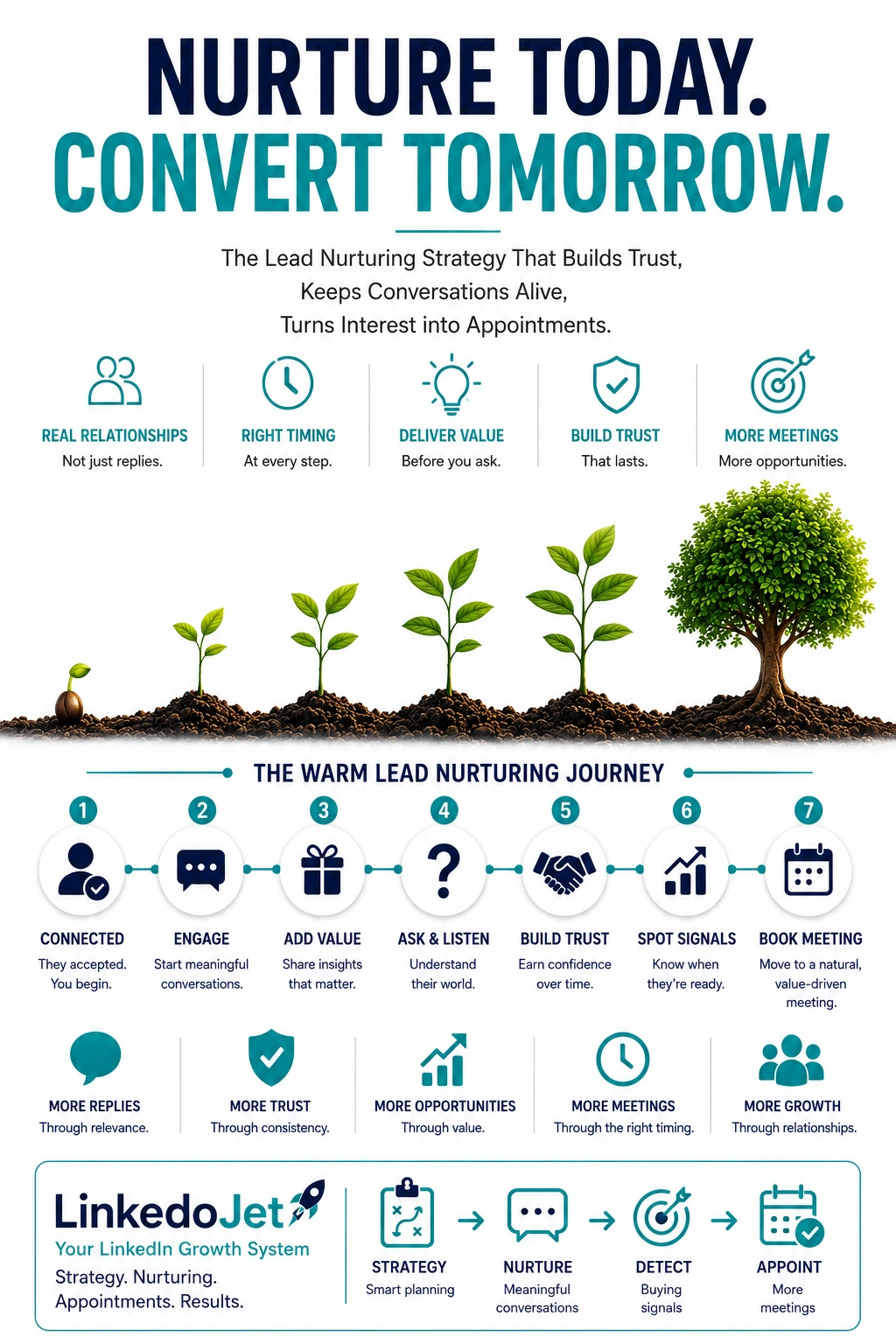
The stall after the first signal (and why it keeps costing you meetings)
They accepted your connection. Maybe they even replied once. Then: nothing. Not a “no” — just the thread slowly dying while you keep “checking in.”
If you sell corporate fitness or wellness into HR/Total Rewards, you know this specific flavor of frustration.
An HR Director views your profile after you post about low participation. A Benefits Manager likes a note on return-to-office and wellbeing. A Workplace Experience lead replies with something like “we’re looking at wellness this year” and then disappears for six weeks.
Your team does what they’re supposed to do: follow up, stay polite, send the brochure, bump the thread. But each message feels like it adds work to their day. And HR is already drowning in open enrollment prep, employee relations issues, vendor noise, and internal approvals.
The uncomfortable part: warm LinkedIn conversations don’t die because there’s no interest. They die because the buyer’s internal sequence is longer than your follow-up patience.
Wellness decisions are tied to triggers — renewal windows, open enrollment planning, utilization pressure, leadership asking for reporting, a shift to hybrid, a new HQ opening, a culture initiative with a deadline. If you’re not present (and relevant) when that trigger becomes real, you’re not in the shortlist. And once Procurement is involved, you’re competing against whoever already has a seat at the table.
That’s why your pipeline can look “active” while meetings don’t materialize. You’re mistaking movement (likes, replies, “send info”) for control of the calendar.
A simple lead-temperature model that matches how HR actually buys
Stop treating every warm signal like it deserves the same follow-up. HR doesn’t respond to volume — they respond to timing + low-friction relevance.
You don’t need a complex scoring model. You need three temperatures and a “next move” for each.
| Temperature | What it looks like in corporate wellness | What you do next (without chasing) |
|---|---|---|
| Light warm | Connection accepted after a benefits/utilization post; profile view; a like/comment from an HRBP; follows your page. | One contextual note + one small question. Then a slow nurture rhythm (insights tied to adoption, comms, reporting). No meeting ask yet. |
| Medium warm | Replies with a constraint (“hybrid workforce,” “multiple sites,” “shift workers”); asks how programs work; mentions “we’re exploring options.” | Clarify one operational detail, then offer a low-effort asset (one-page rollout outline, sample comms calendar, reporting examples). Softly qualify timing (renewal month / OE planning). |
| High warm | Mentions renewal timing, dissatisfaction with current vendor, budget cycle, low participation, or “send info”; asks about pricing model or reporting; asks if you work with similar employee mixes. | Tighten the thread: propose a short scoping call framed as a working session (fit + rollout constraints), with two specific time options. |
The point of the model isn’t to sound scientific. It’s to keep your team from making the same mistake: treating a profile view like a buying signal, and treating a buying signal like a request for a full demo.
In this category, the fastest way to lose a warm HR lead is to make the next step feel like a commitment.
Cadence that respects HR calendars (and tells you when to pause vs. press)
You’re not just following up. You’re trying to stay credibly present until their internal window opens.
HR cycles aren’t mysterious. They’re just rarely mapped into your outreach.
- Open enrollment planning: bandwidth collapses. They’ll ignore anything that looks like a new project unless it clearly reduces work or supports benefits communications.
- Renewal windows: decisions suddenly move fast — but only for vendors already in motion.
- Vendor review season: they’re gathering inputs from Total Rewards, Finance, Workplace Experience, and sometimes Legal/IT if there’s an app or data component.
- RTO changes / site expansions: wellness becomes an “experience” and attendance problem, not a perk.
Here’s a cadence that works because it matches how HR processes vendors:
- Light warm: 1 follow-up within 2–4 business days, then 1 touch every 10–14 days for 6–8 weeks. If no engagement, shift to monthly.
- Medium warm: 1–2 touches in the next 7–10 days (asset + small question), then every 2 weeks. If they answer timing (renewal/OE), anchor your next touch to that date.
- High warm: same-week response, then 2 attempts over 7 days to land a scoping call. If you don’t get it, don’t “bump” forever — park it with a clear re-open point tied to their cycle (e.g., “60–90 days pre-renewal”).
Most teams never pause. They just slow down and keep nudging.
A clean pause is different. It preserves credibility and gives the buyer an easy way back in when the trigger hits.
10 LinkedIn message snippets you can actually send to HR/Benefits
These are written for the messy middle: after the first positive signal, before the buyer is ready to commit to a meeting.
First warm follow-up after connection acceptance
“Thanks for connecting, [Name]. Quick context: I saw you’ve been posting about engagement / RTO. When wellness comes up internally, is the main tension participation (people don’t use it) or rollout bandwidth (comms/admin load)? Either answer helps me share the right examples.”
Follow-up after a prospect replies
“That makes sense — hybrid changes everything. Before I send anything, can I sanity-check one thing: are you supporting mostly corporate staff, or do you also have shift/frontline teams across locations? If helpful, I can share a one-page rollout outline + a sample monthly engagement calendar we’ve seen HR teams actually stick with.”
Educational nurturing message
“One pattern we keep seeing: participation drops after week 3 if managers aren’t prompted in a lightweight way. Are you currently doing any manager-facing nudges, or is it mainly employee comms? (A) manager-only nudges (B) employee-only comms”
Insight-based follow-up tied to HR timing
“Quick timing question — when do you typically review wellness vendors? Is it closer to open enrollment planning, or closer to renewal? I’m asking because the best rollout plans look different depending on whether comms bandwidth is already allocated.”
Case-study / proof-based nurture (operational, not hype)
“Small example from a mid-market employer: they weren’t getting traction because sign-up felt ‘one more portal.’ We simplified enrollment, added location-based sessions for the on-site groups, and ran a 6-week comms cadence HR could approve in one pass. Launch was under 3 weeks; reporting was monthly with participation by segment. If you tell me your employee mix + how you communicate benefits today, I can tell you if those same levers would matter.”
Soft question to reopen the conversation
“No rush on this — I know wellness slips down the list fast. Is this something you’re thinking about this quarter, or is it more of a pre-renewal / open enrollment planning topic for you?”
Buying-signal response (renewal/vendor issues/utilization pressure)
“Got it — if renewal is coming up and participation is under scrutiny, the fastest path is a quick fit + rollout constraints session. 15–20 minutes to confirm employee segments, comms bandwidth, and what leadership expects in reporting. If it’s useful, I can share a simple ‘adoption plan’ outline you can reuse internally. Are you open to Tue 11:00 or Wed 2:30?”
Soft meeting request framed as a working session (not a demo)
“If you’re open to it, I’d suggest a short scoping call rather than a demo. We’ll map your employee mix (remote/on-site/shift), what you can realistically run in comms, and what ‘success’ needs to look like for Total Rewards/Finance. Then I’ll tell you what typically drives adoption in similar rollouts — and what tends to flop.”
Dormant lead revival (timely trigger + small asset)
“Hey [Name] — circling back because benefits planning season usually changes priorities. Last time we spoke you mentioned participation being uneven across groups. I can send a sample 30-day relaunch comms calendar (lightweight, HR-friendly) if that’s helpful. Is wellness on your plate now, or should I reconnect 60–90 days before renewal?”
Final polite close-loop
“I don’t want to keep tapping you on this if timing isn’t right. If wellness isn’t a focus this cycle, I’m happy to pause and reconnect closer to your next renewal / OE planning window. Would it be okay if I reach back out around [month]?”
Why HR prospects go silent (and the nurture touch that matches the real reason)
Silence is often a gate you haven’t acknowledged — not a rejection you need to overcome.
When HR goes quiet in corporate wellness, it’s rarely because they “lost interest in wellness.” It’s because something in their world became heavier, riskier, or more urgent.
| Why they go quiet | What they’re protecting | A better nurture touch |
|---|---|---|
| Procurement / vendor intake gating | Avoiding a process they can’t finish yet | Ask timing: “When does vendor review usually open?” Offer a one-page summary they can forward internally without creating a project. |
| Comms bandwidth is tapped | Not adding “another thing to communicate” | Send a sample comms cadence they can approve once (monthly themes, manager nudges, on-site vs remote variants). |
| Legal/privacy review anxiety (apps/data) | Reducing compliance and employee trust risk | Offer a plain-English data boundary note: what data you do/don’t collect, reporting level, and how opt-in works. |
| Utilization pressure / Finance scrutiny | Not funding a program that won’t get used | Share how you measure participation by segment and what you do when adoption drops (relaunch plan, manager prompts, on-site activation). |
| Stakeholder alignment (Total Rewards, Workplace Experience, CFO) | Avoiding internal debate without evidence | Ask who else cares about success criteria. Offer a short “stakeholder prep” checklist: reporting expectations, rollout effort, pricing model questions. |
| Competing initiatives (RTO, engagement survey, ER issues) | Protecting focus | Send a “park + re-open” message tied to a real window: “I’ll reconnect 60–90 days pre-renewal unless you tell me otherwise.” |
Notice what’s missing: repeated “just checking in.”
The best nurture touch makes re-engagement feel safe. Low effort. No immediate meeting trap.
Mistakes that kill warm HR conversations (and what to do instead)
In this category, sounding “normal” is the fastest path to getting ignored.
- Mistake: Pouncing with a demo the moment you get a reply.
Instead: Offer an asset that helps them do internal work (rollout outline, comms calendar, reporting snapshot) and qualify timing. - Mistake: Generic claims (“we improve employee wellness”).
Instead: Talk in HR’s operational language: comms bandwidth, adoption mechanics, manager reinforcement, reporting expectations, privacy boundaries, employee segments. - Mistake: Ignoring renewal and open enrollment planning cycles.
Instead: Ask directly when wellness gets reviewed and anchor follow-ups to that window. Park threads with permission. - Mistake: Over-indexing on perks and outcomes while skipping implementation reality.
Instead: Make rollout feel doable: what the first 30 days looks like, who owns comms, how sign-up works, what reporting arrives monthly. - Mistake: Treating “we already have a vendor” as a dead end.
Instead: Ask what’s working vs. not (participation? admin load? reporting?). Then position a low-risk option: pilot a segment, run a relaunch, or support a specific location.
HR buyers aren’t allergic to vendors. They’re allergic to risk and extra work.
Your nurturing has one job: stay relevant without creating homework — until the decision window opens, then move fast.
FAQ
What counts as a warm signal on LinkedIn for HR, Benefits, and Workplace Experience buyers?
In this niche, warm signals are usually subtle: a connection acceptance after a post about utilization or burnout, a profile view soon after you comment on a benefits thread, a like from a Total Rewards leader, or a short reply that mentions constraints (hybrid, multiple locations, shift workers).
High-warm signals look different: renewal timing, dissatisfaction with the current vendor, questions about reporting or pricing model, or “send info” tied to an active initiative like open enrollment planning or an RTO change.
What follow-up cadence works for Benefits Managers without creating vendor fatigue?
Benefits and HR teams get punished for engaging with vendors too early — it creates inbox load and internal expectations. A good cadence is slower than most sales teams want.
For light warmth: one contextual follow-up, then every 10–14 days for a short run, then monthly. For medium warmth: two touches inside 7–10 days (asset + small question), then every two weeks. For high warmth: same-week response and a short push to a scoping call, then park it with a clear re-open point if timing isn’t there.
How do I handle “we already have a wellness vendor” without sounding desperate or pushy?
Don’t argue. Get specific.
A calm response is: “Makes sense — most teams do. What’s working well, and what are you still getting heat for: participation, admin/comms load, or reporting for leadership?” If they answer, you can offer a relevant asset (relaunch comms cadence, manager nudges, reporting structure) without positioning a rip-and-replace.
What should I send instead of a demo after an HR lead replies once and then disappears?
Send something that reduces internal effort: a one-page rollout outline, a sample monthly engagement calendar, a plain-English note on data/privacy boundaries, or an example reporting snapshot (participation by segment, trend over time).
End with a low-friction question they can answer quickly — ideally timing-based (renewal month / OE planning) or constraint-based (employee mix, locations, shift workers).
How do you revive inactive LinkedIn conversations right before renewal or open enrollment planning?
Bring a trigger, not a “bump.” Reference the last thread, name the calendar moment (“OE planning season” / “renewal window”), and offer a small, optional asset that fits the moment (relaunch comms plan, utilization benchmark questions, manager prompt examples).
Give them an easy out: “Is this on your plate now, or should I reconnect 60–90 days pre-renewal?” That protects the relationship and often gets a clean answer.
If you want this run as a system (not a scramble), LinkedoJet can manage it end-to-end
You’re not hiring “a tool.” You’re putting warm-signal nurturing, timing, and meeting conversion on rails — with visibility your team can trust.
LinkedoJet is built for the exact gap this page described: the period after the first positive signal, when HR interest is real but the buying window isn’t open yet.
Operationally, we set up and run the outbound engine for you:
- ICP + targeting setup: we define the roles and filters that matter in corporate wellness (HR Director, People Ops, Total Rewards/Benefits, Workplace Experience, and the Finance partner who cares about per-employee cost and utilization).
- Sales Navigator prospect list building: we build and maintain prospect lists by segment (industry, headcount, multi-site vs. single location, likely hybrid mix indicators), so your team isn’t guessing who to message next.
- AI-assisted personalization: we personalize messages based on context that actually lands with HR (rollout effort, comms cadence, adoption mechanics, reporting expectations) — not generic “saw your profile” fluff.
- LinkedIn outreach execution: we run connection + follow-up sequences that match lead temperature and avoid the demo-pounce pattern that triggers vendor fatigue.
- Reply handling + lead nurturing: when prospects respond, we help manage the thread: clarifying constraints, sending the right low-effort assets, and timing follow-ups around renewal/open enrollment/vendor review windows.
- Warm lead tracking + appointment support: warm signals (engagement, replies, timing mentions) are tracked so the right leads get the right next step. When the trigger appears, we support the move into a short scoping call that feels like a working session.
- Campaign visibility: you get dashboards that show what’s happening (who is warming up, what’s stalling, which messages drive replies, and where meetings are coming from).
- Ongoing refinement: we adjust targeting, messaging, and cadence based on what HR stakeholders are actually responding to — and what’s producing booked intro calls.
What happens after onboarding: we stand up your targeting + lists, build the initial messaging library (by temperature and by HR calendar moments), launch outreach, and then manage nurture and conversion week-to-week. You’re not stuck chasing “check-ins” or wondering which warm conversations died quietly.
What you receive: a live prospecting system, active LinkedIn conversations with HR/Benefits stakeholders, organized warm lead tracking, and support converting buying signals into booked intro calls — without turning your team into full-time follow-up machines.
Why this is different from ordinary LinkedIn automation tools: tools send sequences. They don’t think about HR cycles, stakeholder gating, rollout risk, or how to re-engage without forcing a demo. LinkedoJet is the operating layer: targeting, personalization, execution, nurturing, tracking, and appointment generation support — with real accountability for outcomes.
Next step: turn warm HR interest into booked intro calls with a repeatable nurture system
If your team keeps losing the thread after the first signal, the fix isn’t “more follow-ups.” It’s a temperature-based cadence tied to HR calendars, with messages that reduce rollout risk and make re-engagement easy.
From identifying the right decision-makers to starting meaningful conversations and turning them into qualified appointments... LinkedoJet manages the entire outbound engine for your business.